
Business as usual won’t do
Forget what you heard about green. It’s not expensive, it’s not a fad, and it’s not just for tree huggers (although I do love my trees). Green is a mindset and an ethical basis, a scientific understanding and a spiritual perspective that is required to move into the future sanely.
Let’s backtrack for a second and reframe the urgency of the problems at hand. Fifteen thousand years ago, Connecticut was covered in over a mile of ice. The worldwide average temperature difference between the last age and today was approximately three degrees. Three degrees is the lower end of the temperature increases projected for the end of this century. The difference between the last ice age and now is less than the difference between now and 2100. The business-as-usual model, where we continue to dump more carbon dioxide into the atmosphere every year, means that the climate of Connecticut will resemble the climate of modern-day South Carolina by 2090. We’re talking avocadoes at the local farmers’ market, palm trees in our backyards, and alligators in Miller’s Pond. Forget sledding on Foss; we will be far more likely to have hurricanes than blizzards.
I bring this up because it is vital to remember that what the mainstream scientific consensus is telling us is that our old ways of doing things are rapidly moving us into a radically different world. How well we navigate the vast challenges inherent in such change will be largely determined by our adaptability, our foresight, and our willingness to accept and address the coming reality. Once we recognize just how unusual business as usual is, the question becomes not should we change, but how the f@#* do we change if we want to sustain human civilization on our planet.
Which brings us to the question … does Wesleyan have the money to go green? But before we answer this, let’s ask another question: what if Wesleyan doesn’t have the money to be green? If we assume that Wesleyan doesn’t have the money be any greener, then we are assuming that many other institutions lack the funds to go green as well: a disturbing assumption given Wesleyan’s considerable wealth. Thus to conclude that Wesleyan is too poor to clean up its act is to conclude that our species is doomed to the scariest, most dramatic planetary changes ever witnessed by any civilization. Which brings us back to the question of how do we get our sh@# together: right here, right now.
At the end of the day, how green we are is all about the energy on campus. No, not the coal and nuclear energies that power our lights now, or the wind and solar energies that ought to, but the human energy. We need to foster enthusiasm and movement. We need to turn our apathy into action.
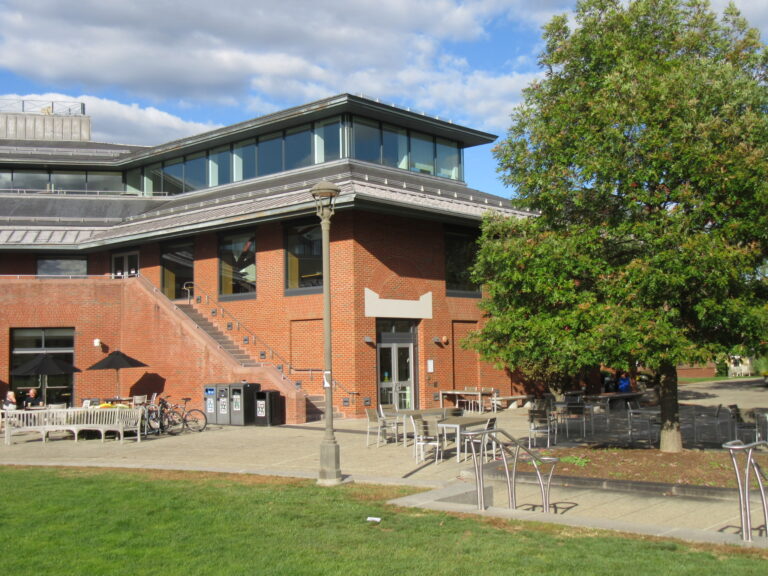
The opportunities for action from both students and the administration are endless. How about having students plant a garden on the scraggly grass outside Usdan that allows us to demonstrate what sustainable food production looks like? How about we start painting murals that reflect the urgency of the times? How about turning off our lights? How about planting wildflower meadows instead of heavily mowed and fertilized lawns? How about using the sun to dry our clothing? How about a walk instead of a TV show? How about we dust off the chalk and reclaim our voices? How about another Environmental Studies professor for the chronically over-enrolled Introduction to Environmental Studies class? How about a 10-year plan that cuts deeper than new buildings and a fatter endowment? How about a food plan that allows students to seek alternatives to industrial agriculture? How about a new wave of student radicalism? How about fruit trees on campus … lots of fruit trees?
Liberal arts education is in the midst of its greatest test. Can we stand up and take ownership for the world we are creating, or will we sit back and wallow in our own affluence? As a very wealthy institution, comprised of many highly educated individuals, if we don’t start to move purposefully to confront climate change and our sickening over-consumption, who will? If no one does, what will the consequences be? So let’s talk, and think, and move before it’s too late.

Leave a Reply