
NYT editor speaks at Crowell
In the “Making Democracy Work” keynote address on Saturday, New York Times Assistant Managing Editor Richard Berke deflected questions on the newspaper’s handling of the wiretapping issue and talked about his personal experiences interviewing politicians.
“It is not an understatement to call our government ’pressphobic,’” said Berke.
Berke accused the current administration of being more distrustful of the press, and more limiting of the press and of democracy since the Nixon administration. He cited the New York Times’ difficulty in gathering information on FEMA contracts after Hurricane Katrina, as well as the administration’s request to the press that they not report on the National Security Association’s wiretapping.
When students pressed Berke on the decision to withhold the wiretapping story for a year, he said that he could not go into detail on the decision-making process. He did say that the Times wants to protect the safety and act in the best interest of the American people.
While Berke noted the relative freedom and independence of American journalism, he was quick to point out the exceptions.
“This is not to say that we don’t have problems in the U.S. of squelching the press,” he said, and noted that American political figures are not above trying to keep information from the press, or spin the press to their side of an issue.
To highlight this, Berke shared personal stories of covering presidential campaigns. He said New York Senator Hillary Clinton is notorious for hassling reporters day and night. Her staff calls reporters shortly after their articles are published to aggressively question them about the tone, content and organization of the articles.
“I have to tell my reporters, ’I’m your editor, not them,’” he said.
Berke said that Senator Barack Obama’s (D-Ill.) campaign is no less frustrating to deal with—Obama and his close staff actively avoid probes by the press. But the New York Times staff is undeterred.
“We see our job as exposing as much as we can,” Berke said.
Berke also emphasized the power of the New York Times in the global push for democracy.
He highlighted several very recent examples of the limited press in foreign countries, pointing to Times writers’ experiences reporting from Zimbabwe. According to Berke, reporter Barry Bearak was recently jailed in Zimbabwe for “committing journalism.”
Berke also expressed concern with the growing role of Internet news sources. He acknowledged many benefits, noting the technological advanced employed by the New York Times website and the increased access to news. But he said that he was worried that many Internet news sources and blogs weren’t doing original research.
“You have to have information to base your blogging on,” he said. “That leaves it to organizations like us to say what’s right.”
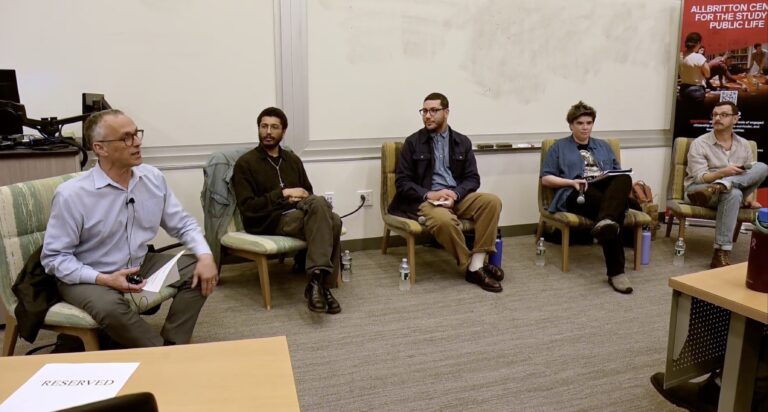
The talk was part of a conference titled “Making Democracy Work,” organized by the Roosevelt Institution, The New York Times Readership Program, Campus Progress and the Student Budgetary Committee. Other events included a panel discussion with University faculty and smaller, discussion-based workshops.
“We wanted to raise awareness about what democracy means and how it functions and fails in America,” said Elana Baurer ’09, co-chair of the conference.
Leave a Reply