
VDay protest makes love, not war
For most, Valentine’s Day is a holiday dedicated to intimacy, obligatory purchases and wearing red in the name of love. Yet for Ashley Casale ’11 and thirteen other students, this holiday meant protesting the military’s recruiting practices and the Iraq War, also in the name of love.
The protest, organized by Casale, is part of a nationwide effort planned by Women for Peace called “Don’t enlist, stay and kiss.” According to Casale, Valentine’s Day was chosen to highlight the importance and power of love over war.
“Many organizers of this event intend to make out at recruiting centers around the country,” Casale said. “We aren’t specifically planning to do that, but if some people make out, that’s great. We’re going to march down to the recruitment office singing peace songs, spreading love and blocking the entrance of the recruitment center in order to discourage people from enlisting.”
The protesters convened at around 4:30 p.m. at the Usdan University Center and constructed signs from cardboard and chalk, proclaiming slogans such as “Make Love, Not War” and “Shut down the Recruiting Center.”
Students also made Valentines out of construction paper intended for the recruiters. One made by Adam Jacobs ’10, who wore a t-shirt that stated “Kiss Me,” read, “Dearest Human, I love your flesh, your muscles, your heart, your beauty, your shine, your glitter, your love. Love on, human.”
The cards, according to Alex Pfeifer-Rosenblum ’10, are part of a technique to use the idea of love to express political and personal discontent.
“Protesting out of love is the most powerful way,” Pfeifer-Rosenblum said. “It brings the message to a whole new powerful level, transcending anger. Anger and hate is war, and that’s the energy we’re against.”
Pfeifer-Rosenblum and Casale came armed with guitars, which they used to accompany the protesters as they sang peace songs while marching. This was seen by Pfeifer-Rosenblum as a way to unify the group through music and further express what he described as energy and joy.
Casale, a proud pacifist, hopes that this protest will bring attention to what she sees as predatory practices by military recruitment officers. Casale believes that officers take advantage of underprivileged youth by luring them to enlist with the promise of military scholarship and travel. She hopes to duplicate in Middletown what has happened in Berkeley, Calif., where protesters have successfully lobbied the city council to pass a resolution proclaiming military recruitment officers unwelcome.
A student from Middlesex Community College, Liz Gionfrido, also joined the group. Gionfrido met Casale on a Jan. 28 bus trip to Washington, D.C. for an anti-war protest. Gionfrido explained that, in a way, she feels obligated to protest the recruitment center’s methods due to an example set by her parents in the 1960s.
“Someone has to do it,” Gionfrido said. “Our parents protested what they saw wrong in Vietnam. It’s up to us to prove to them that we are aware that we want to make the world better, and it will be better, we just have to act. They’re taking advantage of our generation. It’s our future.”
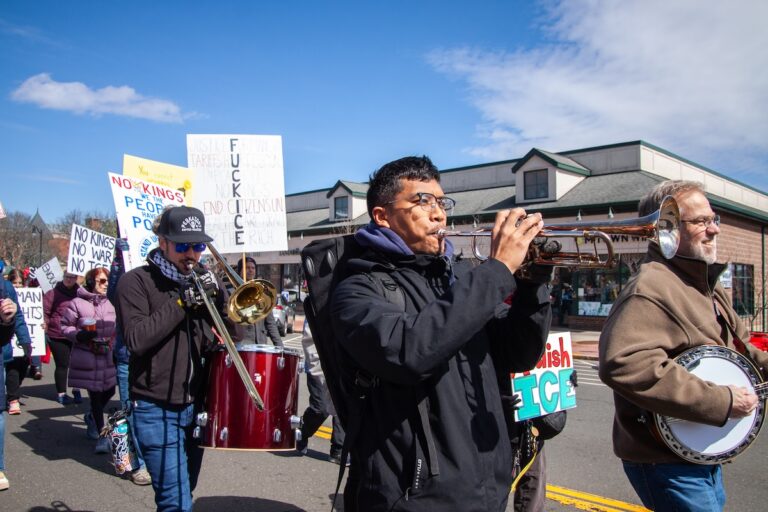
At around 5 p.m., the protesters left Usdan and began marching toward Main Street along Williams Street. Holding signs, dancing and strumming their guitars, the protesters proudly sang “This Little Light of Mine” and Dispatch’s “The General.” The first response they received was from three girls in Traverse Square. At their first glance of the protesters, the girls instantly broke out into hysterical laughter, pointing and shouting “kumbaya” toward the students. The protesters took the mockery in stride, shouting back, “Join us, you’ve got a great laugh.”
As the protesters continued their musical march onto Main Street, they received several encouraging thumbs up and honks from a duo of Volvos, as well as countless confused and amused expressions from nearby pedestrians.
The protesters reached the recruitment offices located in Metro Square, where the owner of the shopping center had prohibited the group from entering due to disruptions from previous protests. The group marched into the entryway of the recruitment office, decked out with posters and American flags, and blocked the entrance. They immediately began belting out a second round of “This Little Light of Mine” in the tight fluorescent-lit space, drawing out several surprised buzz-cut men in military uniforms.
The protesters gave the officers their Valentines, wishing them “a happy and peaceful Valentines.” One of the officers asked the group several times to leave, to which the protesters responded by bursting into John Lennon’s “Imagine.”
One of the recruitment officers soon went outside and stood waiting at the curb. When asked to comment on the situation, the officer responded simply.
“We’ve got our position, you’ve got yours,” he said.
For about another 20 minutes the protesters continued singing such songs as The Foundations’ “Build Me Up Buttercup” and “Joy to the World,” interspersing improvised lyrics that referenced the Middletown recruiting office.
The Middletown Police soon showed up, responding to a complaint from recruiters of the obstructed entrance. They entered the office and asked the protesters to leave.
“You’re not the kind of people we want to arrest,” said the policeman.
Under threat of arrest, the protesters left the office.
Sergeant Materuro stated that the protesters were peaceful and that he had no serious complaints, though Materuro did express disagreement with the method of expression.
“I don’t have a problem with their argument,” Materuro said. “They should really bring their issues up with state politicians. The recruitment officers are just doing their jobs. I understand that they have a right to peacefully assemble, but not when it obstructs traffic.”
The protesters, meanwhile, expressed general satisfaction with their efforts.
“A unanimous great job!” Jacobs shouted.
Laura Heath ’11, however, wished that the protest had been more active.
“I wish people had been going in,” she said. “That way we could have talked them out of enlisting. That would have been great.”

Leave a Reply