
Late newspaper editor’s passion for photography celebrated
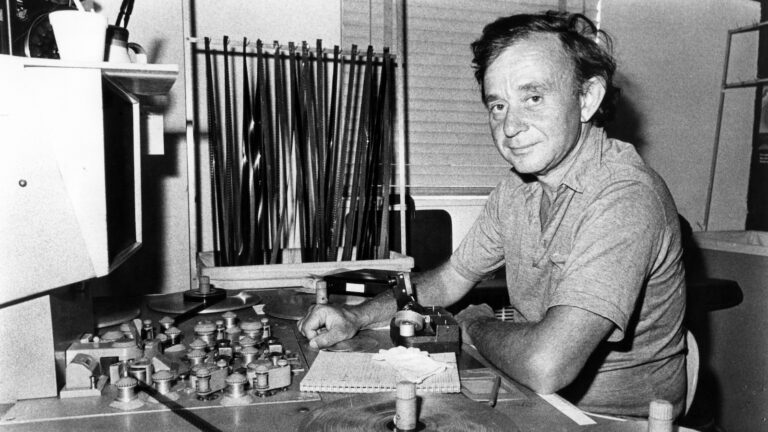
Last Friday, in a well-attended yet intimate exhibition opening, Wesleyan professors and Middletown residents gathered at the Davison Art Center to celebrate the life and photography collection of late Middletown Press Editor Russell “Derry” D’Oench. Curator Clare Rogan arranged the collection of photographs, which D’Oench donated gradually to the Davison Art Center, into several thematically linked groups.
The work of the so-called f/64 group, which was particularly important to D’Oench, comprised one set of photographs. An elite group of photographers formed in 1932 and espousing a common philosophy, works from the f/64 group included photographs by Ansel Adams, Edward Weston, and Imogen Cunningham, among others. Cunningham’s circa 1920 print, “Leaf Pattern,” clearly accomplished the group’s goal of rejecting the romanticism of their predecessors in favor of focusing with scientific clarity on their subjects. In this photograph, several leaves fill the frame, clearly emphasizing the shape and play of light on these individual objects, as opposed to making a more ideological commentary about nature in general.
D’Oench also acquired photographs from Farm Security Administration photographers Walker Evans, Dorothea Lange, and Arthur Rosenstein. These photographs include iconic American images, such as Lange’s 1936 “Migrant Mother, Nipomo, California,” which shows the dirt-streaked, troubled face of a depression-era migrant worker, as her two children bury their faces in her shoulders.
Rogan also chose to group nearly all the landscape and other nature shots together. Several photographs by Edward Henry Weston emphasize the natural shapes in front of the photographer, rather than the grandeur of the landscape. “Surf, Bodega,” Weston’s 1937 print, focuses on sand and rock patterns, without examining the wider landscape.
In contrast, D’Oench’s collection of Ansel Adams’ nature photography contains sweeping images of sky, mountains, and open fields. The presence of Adams’ beautiful “Mount Williamson, Sierra Nevada, from Manzanar, California,” from 1944, provided a notable highlight. In this shot, piles of boulders comprise the foreground, as a majestic mountain illuminated by a shaft of sun rises in the background.
Ellen G. D’Oench, Curator Emerita and widow of the collector, and Andrew Szegedy-Maszak, Chair of the Classical Studies Department, photography collector, and long-time friend of the D’Oench family, spoke to guests briefly about D’Oench’s habits as a collector and about collecting in general.
Mrs. D’Oench, who stated that she is not a collector herself, showed a great deal of respect for her husband’s passion.
“He had a very discerning eye,” Mrs. D’Oench said. “He knew what he loved, and of course it was photo journalism.”
Szegedy-Maszak spoke about his own experiences as a collector and about his relationship with D’Oench. In particular, he emphasized the passion that collectors like D’Oench and himself feel in finding, purchasing, and sharing prints.
“Once you have it, you can’t let it go,” Szegedy-Maszak said.
Both Mrs. D’Oench and Szegedy-Maszak emphasized the apparent disparity between D’Oench’s love for photojournalism and his prescience in considering photography as a form of art long before it was commonly accepted as such.
The diversity of the collection demonstrates both of these points. In addition to the photographs of Depression-era migrant workers and New York City street children, D’Oench included in his collection such photographers as Dadaist Man Ray. In his so-called rayographs, Ray placed objects directly on photo sensitive paper, exposed them, and then photographed these pieces of paper, yielding abstract light shapes on a black background.
Other notable images from the collection include Byron Rollins’ famous 1948 shot of President Truman holding up a newspaper with the headline “Dewey Defeats Truman,” and Weegee’s 1943 shot, then featured in “Life” magazine, depicting dramatic class differences in America through a shot of two socialites walking past a homeless woman.
Lauren Valentino ’10, one of the few Wesleyan students to attend the exhibition opening, commented on the iconic nature of many of the photos.
“I will say I was surprised at the fact that we have such famous images here on our campus,” Valentino said. “The one of Truman holding up the newspaper…That’s an image that was in my history book when I was in high school.”
The exhibition will be on view at the Davison Art Center until May 27.


Leave a Reply