
“Town-gown” panel addresses development
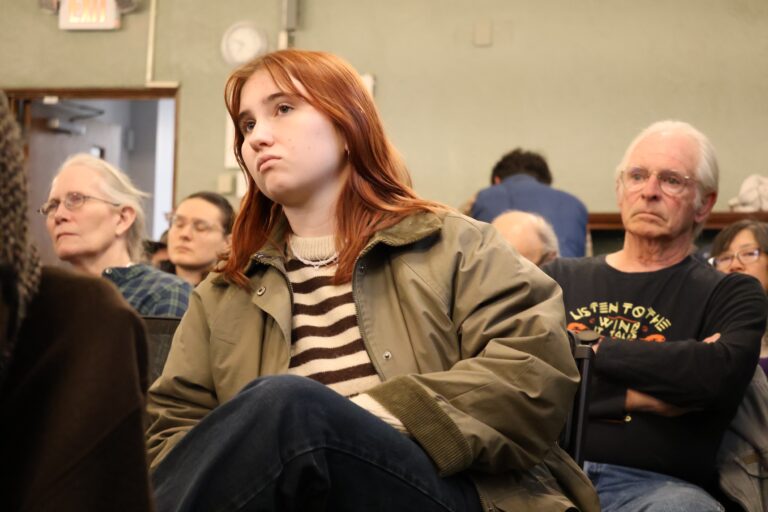
Students and Middletown citizens gathered in PAC 002 last Friday to discuss issues that both have struggled with for years. The meeting centered on topics of concern in Middletown neighborhoods, especially North End’s cycle of poverty and violence, the redevelopment of Main Street’s public transportation, and traffic congestion problems, which could lead to a tunnel built beneath the Connecticut River.
The eight panelists represented a broad coalition of local organizations, all with a vested interest in Middletown development, including architects, representatives from the Common Council, the Middletown Redevelopment Agency, the Nehemiah Housing Association, the North End Action Team (NEAT), and the Village District.
The meeting was part of the Center for Community Partnership’s First Friday series, uniting students and Middletown citizens on the first Friday of each month to discuss “town-gown” collaborations. To initiate the meeting, each of the eight panelists described their vision for Middletown.
“For me, it’s all about creating a place where people want to live,” said Professor of History Vijay Pinch.
Lee Osborne, an architect who served as chairman of the Zoning Committee for eight years, said that one of the reasons he likes Middletown is because it has “texture.”
“Our school system is one of the reasons my wife and I moved here,” Osborne said. “We wanted our children to grow up in a real world.”
However, a number of the panelists were hesitant to attribute too much to Middletown.
“Like Bill [Warner, another panelist], I don’t feel we should be pounding our chests about how great downtown is and get overconfident about it,” said Gerry Daley of the Middletown Redevelopment Agency and the Common Council.
Mark Maselli of the Village District echoed Daley’s sentiment.
“I’ve been thinking long and hard about Middletown, and I’ve come to the conclusion that we are too often doing things that are not Middletown scale,” he said. “We are taking initiatives that are done in Hartford or New Haven and we’re bringing them here to town.”
A large part of the dialogue was devoted specifically to problems in the North End.
“We have, in the North End, a census track that is extremely poor,” Osborne said.
NEAT was formed in 1997 to foster collaboration between citizens, city officials, and students while confronting the drug dealing, violence, and poverty that were prevalent in the North End. Lydia Brewster, a member of NEAT, felt that the organization was successful in putting the North End agenda on the city’s table.
To deal with housing shortages and other struggles with poverty in the North End, some suggested affordable housing units. Village District resident Jennifer Alexander ’88 vehemently opposed this idea.
“Anywhere else but the North End,” Alexander said. “I would like to see not one more affordable unit built in the North End. Why? Because it doesn’t work. Economic monoculture does not work.”
Panelists agreed that communication in general is necessary.
“To be successful, we have to have a social dialogue,” Maselli said. “And so my view is, we either have an engaged population, one that there is discourse in and at all levels [or we don’t}. If I have a vision, it is the recapturing of our newspapers.”
Alexander and Brewster agreed that one issue that makes resolution more difficult is the effort to improve diversity in Middletown schools by redistributing students who live near each other.
“Do you know how hard it is to organize a community when a simple thing like the neighborhood school isn’t even in one area?” Alexander asked.
During a question and answer session, one member of the audience asked if there were any plans to tunnel the highway so that Middletown could be more connected to the river. The Department of Transportation had been pushed to build a tunnel, but money has remained an issue.
Questions also touched on transportation, from the difficulty of finding public transportation to parking lot development on Main Street.
“We have too many vehicles on the road today,” Daley said.
The panelists rejected the idea of surface parking lots in downtown Middletown and said that the main obstacle to public transportation is the high volume of passengers.
“I think that a livable, walkable downtown in America is like a diamond,” Alexander said.
Pinch closed on a positive note, expressing pride in his neighborhood.
“I love living in Middletown,” Pinch said. “If you don’t get involved in your community, you’re just passing through.”
Leave a Reply