
Awareness month features Arab American lecture
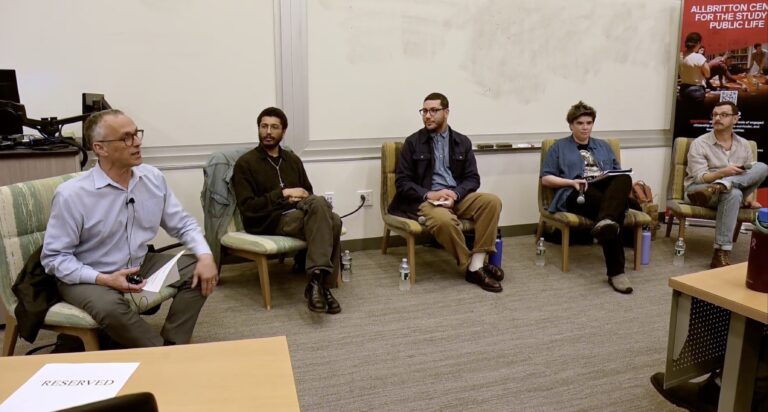
The Arab and Middle Eastern Students (AMES) Association organized a lecture on Tuesday by Helen Hatab Samhan, the executive director of the Arab American Institute Foundation. The lecture was part of April Awareness Month, which focuses on Asian/Asian American, Arab/Arab American, Pacific Islander, and Queer awareness.
Samhan spoke about understanding the Arab American and Muslim experience post-9/11. Her presentation traced the history of Arab immigration to the United States, beginning with the first immigration wave of mostly Christian Arabs, from what used to be Greater Syria, between 1880 to 1920.
According to Samhan, although 95 percent of Arabs are Muslims, being Arab does not in essence mean being Muslim because it is not a religious identity. She explained that being Arab was largely a cultural, linguistic and geographical identity.
“Unlike other groups, Arab immigrants to the United States, who are now into their fifth generation, are not concentrated in particular areas,” Samhan said. “There is no ‘Arabtown’ like there is Chinatown in the United States.
She pointed out confusing racial classification in the United States for people from North Africa and of Middle Eastern descent, who are all classified as white by the Office of Management and Budget.
”Many American-born, especially Christian Arabs identify with European ‘white ethnics,’“ Samhan said. ”Recent generations of Arab Americans, however, have begun to identify more with people of color.“
Samhan also talked about the negative connotations Arabs have dealt with, for example the perception of Arabs as servile. She pointed to the 1942 movie ”Casablanca,“ which gave Humphrey Bogart’s American character Rick most prominence while portraying the Arab locals as waiters or store vendors wearing fezes and serving food in the background.
”It’s [“Casablanca”] set in a Middle Eastern country, but you wouldn’t know it to look at it,“ Samhan said.
According to Samhan, movies such as ”Road to Morocco,“ display similar cultural biases about Arabs.
Her presentation was followed by a 15-minute film, ”In My Own Skin,“ which was made four months after 9/11 to chronicle the experiences of four Arab American women who lived through the event.
”It’s really important for people to know who they’re living with; they think we’re all harems and terrorists,“ said one of the film’s featured women, who also said she believes that this is the time for educating people about Arabs and correcting negative stereotypes.
The question-and-answer following the movie touched on issues such as the voting patterns of Arab Americans and the different experiences of Arab immigrants in Europe versus the United States.
”[I was] somewhat disturbed by the nonchalance of people here towards issues relating to the Arab world,“ said Halim Farouk Rizk ’08.
Rizk founded AMES this year to fill the space left by Salaam, the previous student group devoted to Arab issues.
”When I got to this campus after transferring from a small college in the South, I assumed that there would be a nice-sized Arab population here, as Wesleyan usually promotes itself unofficially as the ‘diversity university,’“ Rizk said. ”I was shocked not to have found that community I was looking for.“
AMES’s mission includes ”[providing] a forum of discussion for issues relating to Arab and Middle Eastern students at Wesleyan, and it strives to bring speakers, lecturers, and performers to campus to academically and artistically share facets of Arab and Middle Eastern life, especially during April Awareness Month.“
Rizk has organized a number of other events for April Awareness Month, the next one being held this Saturday about Helem, the first gay rights organization in the Arab World.
April Awareness Month kicked off with a convocation event at Malcolm X House and the 2006 NUJLS conference on Jewish identities and alternative sexualities. Other upcoming events in celebration of April Awareness Month include the Asian/Asian American cultural show Mabuhay, the burlesque political comedy and after-party ”Dirty Phoenix and the Asses of Evil,“ and a discussion led by Sociology professor Jonathan Cutler on safe queer spaces at Wesleyan. A complete list of events is available on the April Calendar at http://www.wesleyan.edu/queer/aprilcalendar.htt.
Leave a Reply