
Superintendent comes to campus
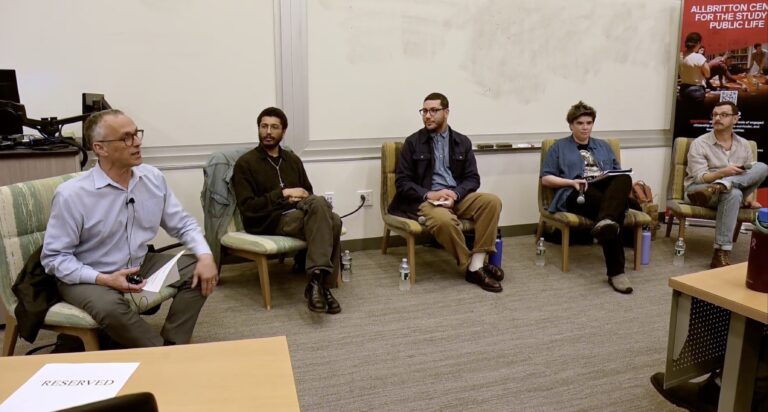
The Center for Community Partnerships welcomed Dr. Michael Frechette, superintendent of Middletown public schools, to campus Friday as part of its “First Friday” series. Frechette discussed the status of the district and expressed hope that Wesleyan can play a role in the district’s rehabilitation, although with few specifics.
Frechette came to Middletown this school year from Norwich, where he was superintendent for eight years. Since his arrival, he has authored an “entry plan” on the current status of the district and its future. Frechette has used the plan to better understand Middletown’s school system and community.
“When I first got here, I wanted to know: what’s going on in Middletown?” he said. “I wanted to find out the strengths, the weaknesses, the demographics, and the test scores.”
In meeting hundreds of locals during his first few months on the job, Frechette detected an overwhelmingly negative perception of Middletown High School and Woodrow Wilson Middle School.
“There is a negative perception of the two schools, and I don’t think that’s warranted,” he said. “They’re not drug and gun infested.”
Frechette told a story of the first time he went to the school and found the door locked.
“You had to ring a bell to get in,” he said. “That’s like calling a school and getting a voicemail. So, I got rid of the locked door…all of these things just raise the anxiety. Perception is reality, good, bad, or indifferent.”
In his observation of district demographics, Frechette said he was alarmed by the amount of segregation that takes place under the guise of “tracking,” or separating students based on ability level. He said that Advanced Placement classes are mostly comprised of white students, while the majority of students in “regular” College Bound classes are minorities.
“Students in the low ability level classes stay at that level for their whole career,” he said.
Multiple parents of students in the district were critical of Frechette’s assertion that tracking was wrong, and argued that placing more advanced students in the same classrooms with struggling students would help no one.
Later, Frechette touched on the efforts made by the University to help Middletown students. He commended the University’s involvement in the Green Street Arts Center, and noted that cultural resources, such as the Zilkha Gallery, are invaluable in broadening educational offerings.
Cathy Crimmins Lechowicz, director of community service and volunteerism, mentioned that some Wesleyan programs that take place outside of the schools, like those at Green Street Arts Center and Traverse Square, suffer from a disconnect with the school district.
“Not knowing what skills [the students] need to work on is a problem,” she said.
Crimmins Lechowicz said that many kids arrive at the after school programs and claim to not have homework. She said that there had been many discussions of setting up an online Blackboard system for the Middletown district, but nothing has ever become of it.
Frechette said he was unaware of the technology, and questioned the effectiveness of having students do homework right after school.
“After a day of school, they have to burn off steam before doing homework,” he said. “When I get back from work I need to relax.”
Still, he acknowledged the benefits of University involvement.
“The Wesleyan tutors we have are just out of sight,” he said. “Having the University’s presence at the school really adds an air of professionalism to the building…the public school system can’t do it alone—any help we can get from the University is great.”
Many in attendance reiterated that the school district often missed good opportunities to use the University’s educational resources and bring students to lectures, or have local teachers reenter the intellectual community.
Assistant Dean and Interim Director of the Graduate Liberal Studies Program Karen L. Anderson spoke about those opportunities, such as the University’s Greater Middletown Area Teachers Scholarship (GMATS). The program offers a 50 percent tuition discount to full-time contracted teachers, librarians, and administrators who work in schools in the Greater Middletown area, though few have made use of the chance.
Visiting Assistant Professor of English Elizabeth Bobrick, a former member of the Middletown School Board, offered an answer to these criticisms, pointing out that many Middletown residents have an “intense suspicion” of Wesleyan, which can hamper efforts to connect the two.
“The perception is that people who teach at Wesleyan have different values than Middletown residents,” she said. “’You Wesleyan people’ is a term I heard many, many times while on the school board.”
Yael Tarshish ’09 said she thought the discussion underscored the level of disconnect between Middletown and the University.
“More meetings such as the First Friday events seem like they might promote some sort of dialog,” she said. “From this past meeting I gathered that communication just seems to be off, and that is probably the most important ingredient in fostering any sort of relationship.”
Leora Abelson ’07 agreed that future conversation is needed to cover the larger issue of Wesleyan’s relationship with Middletown, rather than just how the University could help Middletown’s schools.
“I thought [Assistant Professor of Psychology Regina] Langhout was right on when she said that instead of saying ‘here is what we have for you, come take our help,’ we should be asking ‘what do you need?” Abelson said. “We should be asking Middletown how we can be of service to them.”
Leave a Reply