
Lecturer leads discussion on education amendment
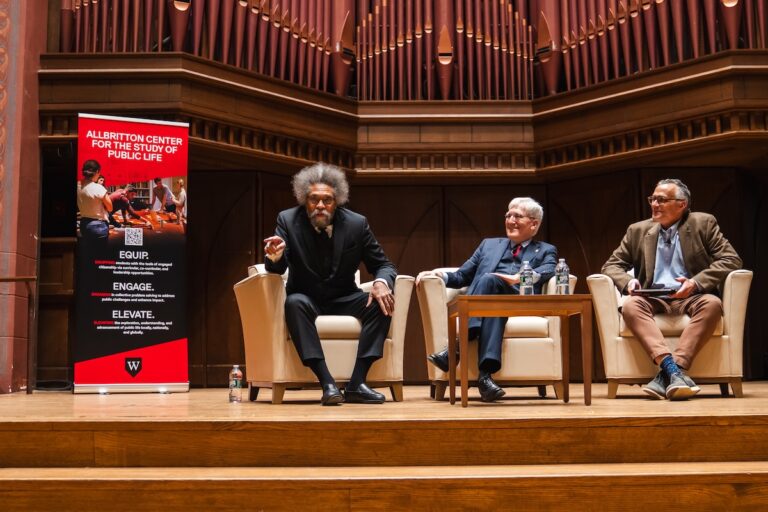
Dr. Robert Moses spoke to an energetic crowd in Crowell Concert Hall last Thursday, delivering the 2005 Center for African American Studies (CAAS) Distinguished Lecture, “Civil Rights and an Education Amendment to the U.S. Constitution.”
“Every child is entitled to a federal right that no state can disallow,” Moses said.
Moses proposed that the government and citizens develop an education amendment to the Constitution to ensure that every child receives an education. He continued to explain that poor funding is the most common characteristic of a poor education; therefore, the country is in dire need of a single, reliable federal source. Moses said that the government is not the only source from which we need to demand attention.
“Until our students understand the importance of demanding what is rightfully theirs, national funding is not going to completely solve the problem,” he said. “We are now trying to raise the question of a constitutional amendment to recognize all children in our country as children of our country.”
Moses invited members of the audience to discuss their opinions of this proposition in an open discussion. The topics of discussion ranged from how to measure a quality versus equitable education, to the benefits of funding, to the usefulness of the SATs. Some students pointed to capitalism as driving the disparity in levels of education. Much of the lecture revolved around the discussion component.
“I was proud of the students, and I think the questions they raised pointed out the good, the bad, and the ugly of Mr. Moses’s proposal,” said Professor of African-American Studies Ann duCille.
The unusual format of the lecture did not appeal to many of the students, however. Long before it had ended, a significant portion of the audience left the auditorium.
“I left early because I came expecting to hear one man provide his insight into a topic that he had been dealing with for a long time,” said Phu Nguyen ’09. “Instead, there were just lots of random questions and opinions without any credibility to back them up.”
Professor duCille agreed.
“The event was different from what I expected,” she said. “I liked the fact that Dr. Moses moved away from the more traditional lecture format in which the speaker talks at the audience from a prepared text. Still, I wish that he had offered more details about what a Constitutional amendment guaranteeing ‘quality education’ for all would look like and said more about where the movement for such an amendment stands now and who is involved in it.”
Moses drew on his experience as a prominent figure during the United States’ civil rights movement in order to reach his audience. During that time he was the Field Secretary for the Student Nonviolent Coordinating Committee (SNCC), and was Director of SNCC’s Mississippi Project, an urgent call to action for students to challenge and overcome white racism in the state of Mississippi. He was also active in the Freedom Riders and organized two ventures to end political disenfranchisement of Southern blacks: the Freedom Summer project and the Mississippi Freedom Democratic Party. Moses also worked for the Ministry of Education in Tanzania before returning to Jackson, Miss., his current residence, to teach math at Lanier High School.
At Lanier, Moses founded the Algebra Project, with the main goal of helping students in inner city and rural areas achieve the mathematic skills needed to succeed in the job market.
“The flow of the universe right now is with math,” Moses said. “Higher order thinking and problem solving skills are absolutely critical in a world where computer technology organizes our mental thoughts.”
Moses went on to explain that, despite the need to push students toward developing these skills, the quality of the education system in our country today is not sufficient enough to do this. He feels certain that the neglect of the education system, particularly in terms of the lack of mathematical preparation, is ultimately causing our nation to suffer.
“There is a connection between learning and making money that many students are just not grasping,” Moses said. “We are trying to show them that there are three ‘mathematical hoops’ that they need to jump through: the one at the state level, where they take standardized tests such as the ACT, the one at the university level which entails passing a placement test, and the final one beyond the university level, where math is no longer a barrier to a career choice.”
Moses was brought to campus by the CAAS. The Center sponsors numerous academic and cultural events every year, including a fall lecture series, a distinguished speaker in the spring, poetry readings and artistic events.
Leave a Reply