
Student group defines candidates’ stances
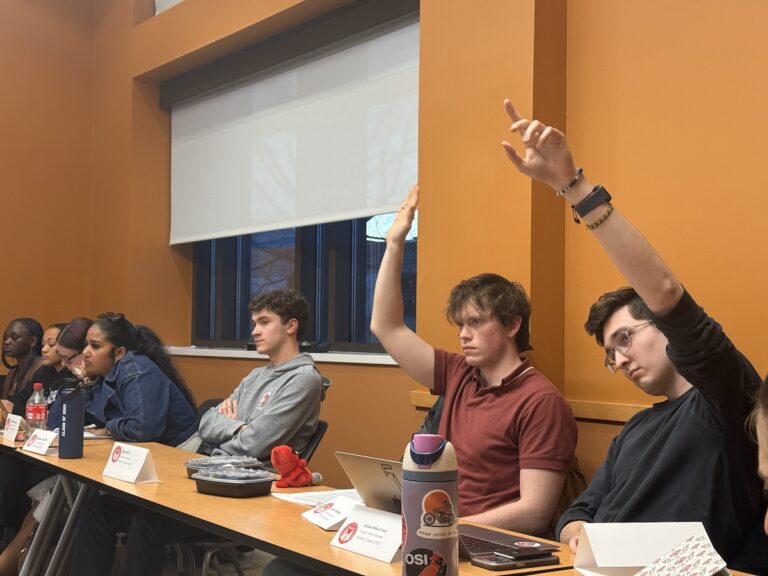
This week the group Students for Access to Health Care (SAHC) is passing out voting guides containing brief summaries of the presidential candidates’ policy proposals.
Club member Beth Newell ’04 said that her group plans to hand out the packet at the Campus Center, MoCon, Summerfields, Russell Library, Middletown’s public library and possibly local supermarkets.
SAHC sent an e-mail to all the non-partisan activist groups on campus inviting them to submit a page summarizing the policy differences of the candidates.
Environmental Organizers Network, the Wesleyan Civil Liberties Organization, Students for a Sensible Drug Policy, Students for a Free Palestine, Students Advocating for Reproductive Choice and SAHC submitted policy statements that are included in the packet.
Also included was a statement on education reform by Lena Eson ’04, who is currently attending the Urban Education Semester in New York, and an account of immigration policy by the Wesleyan ESL program. According to Newell, Eson and WesESL were invited because they are familiar with issues that aren’t otherwise represented on campus.
“It was hard because there are issues that there aren’t activists groups for on campus,” Newell said.
SAHC generally focuses on education and health care advocacy issues. Newell said that the group first decided to offer their health care policy expertise to the campus in a flyer, but as they explored the potential of the concept its scope expanded.
“We were talking in our group about handing out some information on the candidates’ different health proposals,” Newell said. “A lot of the differences are really nitty-gritty that people probably won’t necessarily understand or care about. We figured that people probably shouldn’t just care about health so someone suggested that we should have different groups submit.”
According to Newell, while personality and political experience are important, policy is often underplayed in the media and political discourse.
“We wanted to highlight something that doesn’t get as talked about as much,” she said.
The packet discusses the remaining Democratic contenders, Rep. Dennis Kucinich, Rev. Al Sharpton, Senator John Kerry and Senator John Edwards as well as President Bush.
Highlighting the differences between Edwards and Kerry, who are generally regarded as the leading contenders for the Democratic nomination, was one of SAHC’s motives for creating a voter guide on health care, according to Newell.
“Now [with] Edwards and Kerry, one’s charismatic and one has experience and we wanted to look at some of the details of their policies which don’t get discussed as often,” she said.
“There’s a big difference between Edward’s health plan which covers far fewer people and is a lot less expensive that Kerry’s,” Newell said. “A lot of people say we want to give health coverage to the uninsured but don’t really get into the numbers, so we wanted to highlight some specific differences.”
SAHC provided an overview of the situation of the 44.6 million uninsured in the United States. The health care page said that Edward’s plan builds on the employer-based system and would offer tax-credits to “buy-in” to Medicaid, would cost $432 instead of $592 and would cover 21.7 million. Kerry’s would allow a buy-in to the Federal Employees Health Benefit Package, the insurance offered to federal employees and cover all catastrophic care. In contrast, Nader, Kucinich and Sharpton all advocate a universal, national single payer system, expected to cost several trillion.
Much of the information in the packet comes from the websites of the various candidates’ websites and online voter guides prepared by advocacy organizations sympathetic to the campus groups’ missions. Some issue pages offered personal commentary, others like the ACLU compiled charts indicating the dispositions of the candidates on a variety of subjects.




Leave a Reply