
Women’s Studies symposium examines transnational feminism
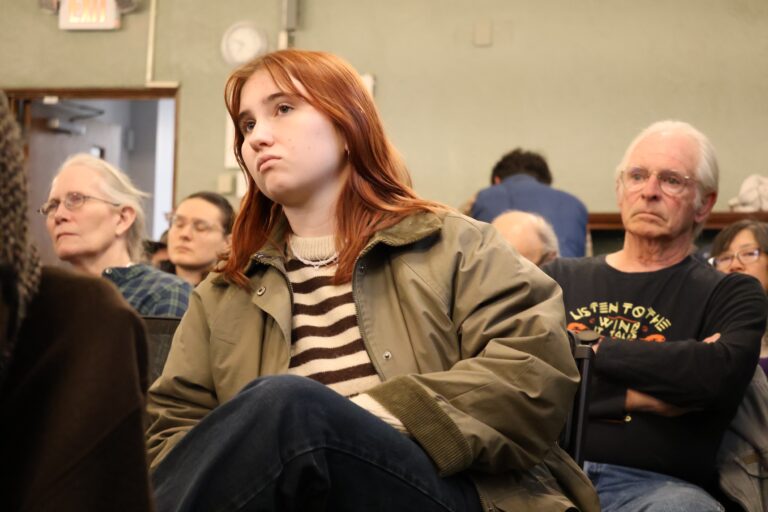
About one hundred students crammed into a narrow room in Russell House last Wednesday afternoon to hear two speakers lecture on transnational feminism for the annual Women’s Studies symposium.
Inderpal Grewal, director and professor of Women’s Studies at the University of California at Irvine, gave a lecture entitled, “American Nationalism in a Transnational Frame: Race and Gender after 9/11.” Jasbir Kaur Puar, assistant professor of Women’s and Gender Studies at Rutgers University, followed with a lecture on “Transnational Sexuality and the War on Terrorism.”
“As soon as we knew that we wanted to do transnational feminism, we knew exactly who to invite,” said Gertrude Hughes, professor and chair of the Women’s Studies program during her introduction.
Grewal said that her experiences after Sept. 11, 2001 made her want to relate issues of transnationalism, globalization, external perception of the United States, and gender issues.
“This is a talk that came about after looking at all the flags erupting in my neighborhood in the Bay area where I lived then after 9/11 and thinking about the kinds of bodies that were covered by the flag,” Grewal said.
Grewal discussed the nature of nationalism after the September 11 attacks. She said that American nationalism is spread around the world, and that America is perceived as both an imperial nation and a liberal democracy.
Grewal criticized America’s consumer culture and the role of the media, which she said purveyed nationalism to both the American people and the rest of the world. She also criticized the reaction against people of Middle Eastern descent.
Grewal used examples including a full-page advertisement that read, “Right now we are all Americans,” a Boondocks cartoon, and an Associated Press article about an arrest of a Middle Eastern man who had a knife on a train. She said the examples show the impact of American nationalism on race. She also criticized advertisements that linked patriotism with the purchase of the advertised product.
“It has now become real in a very globalized consumer culture possible for people all over the world to think about a kind of consumer citizenship in relationship to being American, or living the American dream, or thinking about America,” she said.
After Grewal’s lecture, Puar spoke from the queer perspective about the war on terrorism.
“At that time I wondered if there was such thing as a queer response [to September 11],” Puar said.
She introduced her speech as dealing with queer organizing and a queer approach to the war on terrorism.
Puar criticized queer activists for their silence during the first Gulf War. She said that one person had called the silence a “queer black hole.”
She said there were posters in midtown Manhattan only days after the attacks showing Osama bin Laden being anally penetrated by the Empire State Building that suggested there was an equation between terrorists and homosexuals.
“What can be seen as a deployment of heteronormative patriotism is, on the one hand, the quarantining of the terrorist through equating them with the bodies and the practices of queered others and on the other hand the incorporation of aspects of queer subjectivity into a body of the normalized nation,” she said.
She also said that images of America were linked with heterosexual masculinity while terrorists were considered homosexual. She said bin Laden is portrayed as a “fag.”
Puar criticized those who linked terrorism to sexual deviance, and she concluded by discussing an episode of a South Park cartoon.
“Always ridiculing the contradictions of contemporary liberalism, the show’s satirical storylines regularly produce social and political commentaries about contemporary race, gender, and class politics through its focus on that which is uncomfortable, unstated, or avoided,” Puar said of the television show.
Puar said that in one episode, a child character confuses a queer character with being Middle Eastern. She said this reflects her point that Middle Easterners are being seen as terrorists and terrorists are being portrayed as homosexual.
The symposium lasted about two hours. Students asked several questions after the lectures, including one concerning queer visibility. The lectures were preceded by a dessert reception and followed by a question-and-answer session.
“I thought that they were both very well-spoken and you can tell they are both very well educated,” said Erin Wisman ’06. “Sometimes I got lost in their jargon.”

Leave a Reply