Tag: Main

  • Murphy v. N.C.A.A Turns Eight Years Old: How Sports Betting Frayed and Severed the Fan-Athlete Relationship

    Murphy v. N.C.A.A Turns Eight Years Old: How Sports Betting Frayed and Severed the Fan-Athlete Relationship

    c/o Erin Martin/Elon News Network

    This past summer, I spent every day waiting for the train at the Secaucus Junction station in Secaucus, N.J. It’s not the most nuanced place on Earth, but after getting used to being there every day, I became fascinated with all of the different advertisements near the tracks.

    In particular, right by where I got on the train every afternoon to head home, there was a massive display of Jamie Foxx holding up a phone with the BetMGM app open, with the words “Score Without Leaving Your Seat.”

    I’d then get on the train, realizing that the advertisement’s only purpose was pushing people to use the commute time they were already spending on their phones to try to hit it big on their way home from work.

    The next thing I knew, I was getting ready to get off the train, only to see FanDuel, “America’s #1 Sportsbook,” as the doors opened at my stop. It felt inescapable: Everywhere I turned, there was a sportsbook encouraging me to bet on the next game.

    That’s the reality of being a sports fan today. You can’t be a fan, let alone a consumer of media, without catching a FanDuel, DraftKings, or local sportsbook advertisement on your phone, television, or out in public. Considering that professional sports leaned heavily against betting no more than 15 years ago, the perspective has certainly changed for the industry titans. 

    In 2018, the Supreme Court ruled in Murphy v. N.C.A.A. that the federal ban on sports betting operations was unconstitutional, leaving it to the states to decide whether or not to legalize the activity. Since then, 38 states have signed it into law, with California and Texas as notable exceptions. Sports betting went from being taboo to being widely accepted by major sports industries, as leagues and states have found ways to profit from sportsbooks’ operations. 

    Even before Murphy was passed, FanDuel and DraftKings—the two companies with the largest shares of the betting industry—were already finding ways for people to earn money off their sports knowledge. They both started as Daily Fantasy Sports companies, which combined fantasy sports with immediate action and large cash rewards.

    In 2015, both companies became two of the largest spenders on American advertising, and while they raked in massive profits early on, they were subject to controversy. Frequent questions of “how is this not gambling?” flooded their operations, but Murphy relieved most of the tension, and FanDuel and DraftKings immediately went to work creating their sportsbooks and getting a jump on the new industry. 

    Today, sports betting is everywhere. According to the Pew Research Center, 1 in every 10 adults says they have placed an online sports bet in the last year. Likewise, 63%—up 7% from 2022—of adults say they’ve heard or read about sports betting being legal. The mass exposure of sports betting to Americans has impacted both the engaged and unengaged sports fans. A Boston Celtics fan would normally not care about a 10:30 p.m. hockey game between the Los Angeles Kings and Anaheim Ducks, but placing a bet on the game gets them more invested, raking in more money for the league and the sportsbooks. 

    While straight-up picks on who will win a game are still very popular, prop bets have really taken off. Prop bets allow a bettor to attach a wager to a specific outcome within the game, often having to do with a particular player. For example, you can bet LeBron James will get over or under 5.5 assists in his next game. These have the potential to be the most divisive for potential bettors, as they can cause the most turmoil between the relationship of fans and players. 

    The irrational sports bettor may go to a basketball game and heckle at a player to hit another three so his parlay can hit, and if he doesn’t, the bettor can curse the player out in his DMs after the game. This happens far too often between players and fans, and its twofold impact on athletes and sports fanatics has harmed both sides. 

    In an Athletic poll of 133 baseball players during last year’s MLB season, 78% said legalized sports betting changed how fans treated players. Many who were anonymously quoted cited instances where their family or their lives had been threatened by fans via social media. World Series Champion Lance McCullers Jr. and three-time All-Star Liam Hendriks had high-profile incidents with these types of threats, increasing the platform for players and coaches to speak out against the unacceptable behavior of bettors. 

    Others are worried that younger players will be manipulated by bettors to perform to a certain standard rather than the team’s standards, putting the athletes in hot water. In the last six months alone, we’ve seen Cleveland Guardians pitchers Luis Ortiz and Emmanuel Clase marred by betting controversies, Miami Heat basketball guard Terry Rozier and Portland Trail Blazers coach Chauncey Billups arrested due to a mob-related underground betting scheme, and most recently, 39 college basketball players busted for involvement in point shaving for a gambling ring. We can no longer worry about the possibility of young athletes being impacted by crazed bettors: It’s happening in front of our eyes.

    From the fans’ perspective, sports betting has turned fanatics into addicts at the drop of a hat. New fans are turning towards sports betting as a way to be engaged with the game, as fans 18–29 years old are more likely to place a bet than any other age group. Unlike sports gambling of the past, where you would have to physically go to a casino or a sportsbook to place a bet, the accessibility of sports betting has also contributed to its rise in popularity, and fans are quick to use this opportunity to cash in on their sports knowledge. FanDuel frequently advertises how easy it is to place a bet, “with just a few clicks.” In conjunction with this, in-game betting has been flagged as a concern by the National Council on Problem Gambling for speeding up the process of turning a bettor into an addict. 

    Ultimately, what sports betting has done to the sports industry has changed the way we view the average sports fan. It’s not necessarily that the average sports fan bets, but the perception—based on the countless commercials and endless exposure—is that to really engage as a sports fan, betting should play a part. As I wrote about in an opinion piece about prediction markets last December, it’s not enough to know about sports anymore: You have to put your money where your mouth is. 

    As the Murphy decision turns eight years old this upcoming May, we now understand the impact this decision has on sports as a whole. Not only do we now accept sports betting ads as part of the norm, as live odds are announced by broadcasters from partnering sportsbooks, but we also see how it influences the relationship between athletes and young adult fans.

    In the aforementioned Athletic poll, one player was vehement in his position against sports betting: “It needs to be abolished,” the player said. “It’s brought more fans to the games the wrong way.”

    While it can be an entertaining and easy way to bring more fans to games both in-person and watching on TV, it should not sever the relationship between players and fans as it has recently. The industry should listen to its athletes and reflect on how it can better protect the integrity and interactions around the games we love. 

    Max Forstein can be reached at mforstein@wesleyan.edu

  • Middletown Throws Out “Save As You Throw” Waste Reduction Program After Two Years

    Middletown Throws Out “Save As You Throw” Waste Reduction Program After Two Years

    c/o Spencer Landers

    The City of Middletown’s termination of its trash reduction program will affect how hundreds of students dispose of their trash across more than 80 University residences. Announced by the city last fall, “Save As You Throw” (SAYT) was discontinued Jan. 1. 

    After a successful pilot program, SAYT first began in November 2023, promoting food scrap collection and reducing household waste through unit-based pricing.

    How did SAYT work?

    Residents in the Middletown Sanitation District who put their trash cans out on their curbs for pickup were required to use official color-coded City trash bags. Those who failed to do so received multiple warnings, after which their trash would remain uncollected until they used the bags, and residents unable or unwilling to use them would be able to pay a $30 fee to the Public Works office for each special waste pickup, according to Middletown Recycling & Sustainability Coordinator Lisa Liesener.

    Orange bags were designated for regular household trash, while food scraps went into green bags. Green bags were brought to Quantum Biopower in Southington, Conn., to be converted into energy and compost. The purchase of these bags by Middletown residents was expected to offset a reduction in the municipal trash removal fee, treating trash collection more like a water or electricity bill. 

    The University provided students with the bags, footing an annual total cost of around $10,000 which was offset by the lower trash bills instituted as part of SAYT. Still, only some buildings on campus were part of the program. 

    “The entire campus is within the City Sanitation District, but not all buildings are included in the count given that many are serviced by community dumpsters,” Associate Director of Facilities Management Jeffrey Sweet wrote in an email to The Argus. “The dumpsters were not part of the program, so we were only paying for the 86 buildings.”

    Did the program make a difference?

    SAYT, which was supported by a grant from the Connecticut Department of Energy and Environmental Protection (DEEP) to Middletown and 13 other municipalities, was indeed helping to reduce trash output and ease up load on disposal infrastructure, according to city officials.

    The city website said that after program implementation, the average Middletown Sanitation District resident threw out about half as much trash as the average state resident, helping ease the state’s dwindling waste disposal capacity, while also reducing the average trash bill by around $100 a year. 

    However, the benefits purported by the City were actually more modest than claimed and the program was running into financial difficulties, including rising upkeep costs and a prospective increase in fees to residents, according to minutes from the Middletown Public Works & Facilities Commission. The Middletown Common Council eventually voted to end DEEP assistance and scrap SAYT last October. 

    Sweet noted that the impact of the initiative in Middletown was unclear.

    “The program never got a good foothold in the Sanitation District as there have been management changes within the City and the auditing process never became effective,” Sweet wrote. “For this reason we never received any official report on the effectiveness of the program.”

    Similar unit-based pricing waste initiatives, often known as “pay-as-you-throw,” have been more successful in other Northeast towns, according to DEEP. Benefits included decreased waste, lower disposal costs, CO2 emissions reductions, and higher recycling rates.  

    “I’m disappointed that the City is terminating this program, as pay-as-you-throw programs have proven successful in many other cities and towns around the world,” Sustainability Director Jennifer Kleindienst, who also serves on the Middletown Sanitation Commission, wrote in an email to The Argus. Nonetheless, as a member of the commission, Kleindienst added that she reluctantly voted to approve the termination due to its financial problems. 

    What’s the new policy?

    Along with the termination of SAYT, the city enacted some changes to waste collection. Recycling is now collected every week, instead of every other week. Dumpster and cart rates were raised, and a smaller cart size was added as an option for residents. As opposed to the existing 90- or 65-gallon trash containers, the new 35-gallon carts are cheaper and are intended to encourage waste reduction. 

    “I am glad, at least, that with the termination of [SAYT] the City introduced smaller cart sizes for City residents that generate smaller amounts of waste,” Kleindienst wrote.

    University students using curbside trash collection will now be able to use any trash bags they want. However, the University will no longer provide them, so students will be responsible for obtaining the bags themselves. Recycling disposal, which must be loose and without a bag, remains the same. 

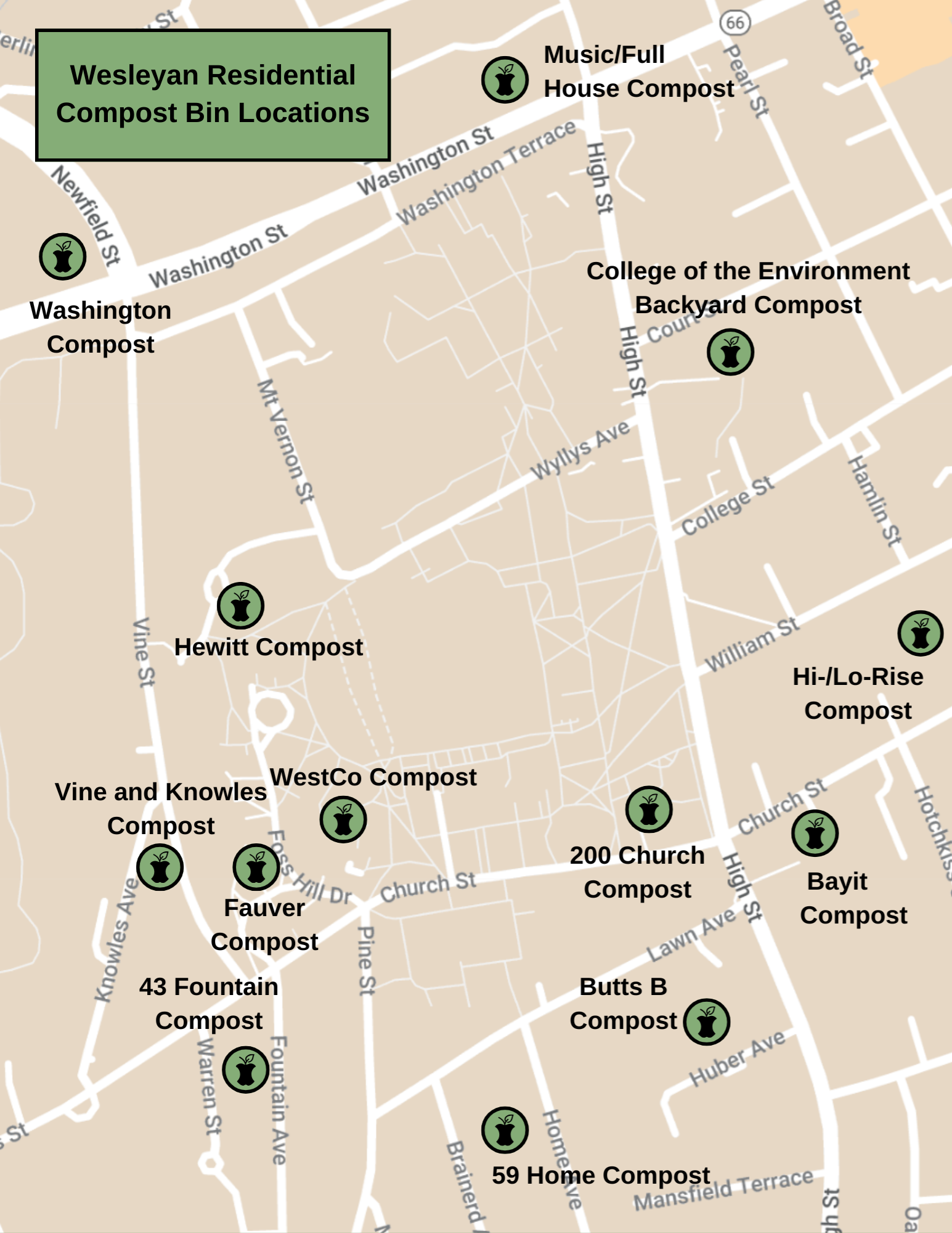
    The University continues to offer composting for all student residences, with 14 outdoor composting bins located around campus. However, Kleindienst expressed a desire for composting to return on a citywide scale. 

     “I hope that the City will find a way in the near future to bring back curbside composting options for residents,” Kleindienst wrote. 

    Correction: A previous version of this article stated that the $30 fee for each special trash pickup was a mandatory fine for noncompliance with the SAYT program.

    Spencer Landers can be reached at sklanders@wesleyan.edu.

  • Ski and Snowboarding Club Competes Across Slopes Despite Funding Cuts

    Ski and Snowboarding Club Competes Across Slopes Despite Funding Cuts

    c/o Wesleyan Ski and Snowboard Team Instagram

    Among the many sledders enticed by the aftermath of Winter Storm Fern were members of one prominent student group taking on the snowy slopes of Foss Hill. The University’s Ski and Snowboard Team brought this same spirit to a competition in Gore Mountain, N.Y. on Saturday, Jan. 31.

    “Things like the first snow on Foss Hill or just sledding are big parts of Wesleyan campus life,” club captain Miles Urban ’27 said. “We build those jumps out there for everyone to use.”

    The Ski and Snowboard Team has been around for almost 25 years, and provides anyone interested in skiing and snowboarding the chance to compete in races across the East Coast. 

    The club captains have varying levels of experience on the slopes. While Ava Symons ’26 is a certified ski instructor, Paley Adelson-Grodberg ’26 first learned how to ski through in the club. 

    “On the morning of my first race, I was worried I didn’t belong as a new skier,” Adelson-Grodberg wrote in a message to The Argus. “We watched videos, inspected the course, and members assured me that even if I was disqualified it would be okay.” 

    Adelson-Grodberg quickly gained confidence with the support of the club. She skied behind the club’s more experienced members, and would eventually go on to be given awards for “sending it” on difficult runs.

    “We went to [local hill] Powder Ridge the other day, which is like 15 minutes from campus, and [Adelson-Grodberg] hit a massive jump,” Tristan Larsson ’26 said.

    Urban credited the team’s strong campus presence for inspiring him to reenter the sport.

    “I think the ski team here really reignited my love for skiing,” Urban said. “I just kind of witnessed the vibrant community that the ski team carried on campus and I joined in.”

    While beginner skiers and snowboarders are welcome to race, there is a framework to competitively ski as well. The team competes in the United States Collegiate Ski & Snowboard Association (USCSA) in the McBrine Division. This provides opportunities for students to competitively ski and snowboard at the national level. Just two years ago, the team sent one skier, Eli Seaver ’24, to nationals. In fact, Seaver was the first skier in the McBrine Division to qualify for nationals as an individual.

    “With a little bit of school funding and some of our own fundraising, we spent enough money together to go to Sugarloaf [Mountain],” Larsson said. “It was a group of four or five of us, but [Seaver] was the only one who got us qualified.” 

    This semester, the season was cut from five races to two due to new University regulations surrounding the Student Activity Fee. The reduction in races puts qualifying for nationals out of the question. 

    “To get [to nationals], you do have to compete in all four or five races to get the points necessary,” Symons said. “So this semester, no matter how well someone does, we won’t be able to qualify because we just [won’t] have points as an individual or team.” 

    Each student pays a $390 Student Activities Fee along with their tuition. Skiing is expensive, so the ski team receives a big proportion of the Student Activities Fee. While each student spends an equal amount of money on student activities, club members in the past got to ski different amounts.

    “And they just were saying that’s unfair, and while that does make sense, it prevents us from having anybody who races twice,” Symons said.

    This season, the University paid for two trips with 20 people each, the rule being that each is a completely different group of people. In some ways, the scope of who gets to ski is widened, and in other ways, competitive ski racing has become less accessible to students. 

    The club is pivoting from these cuts to the race season with more local activities, meeting up to ski down Foss Hill and Powder Ridge.

    “We will always be out there on Foss, with all this snow,” Urban said. “We will have people sledding or skiing, and [Adelson-Grodberg] is doing jumps off of [Powder Ridge]. That, I think, shows that everyone really, really wants to ski. This team will find every means possible to give people [that] opportunity.”

    According to the Ski and Snowboard Team, the ability to compete in races with any level of experience is part of the magic of the team. On Friday, Feb. 6, they’re heading up to Magic Mountain,Vt. for their second and last race of the season. 

    “Some teams are all in speed suits and raced all of high school,” Urban said. “We are these kids who have skied [only] a handful of times about to go down [the slope]. We’re throwing snowballs, we’re out there, we’re loud. We set the tone out there.”

    Larsson echoed the sentiment.

    “[That] is another reason it is a shame that we can’t [compete] in all the races,” Larsson said. “They’re probably so bored.”

    Claire Farina can be reached at cfarina@wesleyan.edu

  • Letter From the Editors: Reading the News, Holding Our Gaze

    It’s the 1980s in Iran; a young Marjane Satrapi has more than one moment where she considers turning an eye to the changing world around her—or so we learn in her autobiographical graphic novel “Persepolis.” From the Iran-Iraq War to the execution of her activist uncle, she learns important national and personal news from the state newspaper and radio, coming of age in the aftermath of the 1979 Iranian Revolution.

    Overwhelmed and desensitized, she is frustrated with state media and yet must rely on it: newspapers tallied up death counts daily, violence was only a turn of frequency modulation away. 

    A ways away, in Middletown, Conn., we have independent news sources aplenty, yet our own relationship with media consumption is not too different from Satrapi’s. As our fall semester wound down, Brown University’s students experienced a deadly mass shooting, soon followed by the Bondi Beach massacre in Australia. While we prepared for our first week of the spring semester, Iran’s government imposed a mass internet blackout as the death count of protestors remained terrifyingly obscure.

    Closer to home, federal law enforcement escalated an immigration crackdown, killing civilians including but not limited to Renée Good and Alex Pretti, inciting nationwide counter-protests. Journalists, too, face assault by federal agents as they try to convey the gravity of these situations. Violence has become the norm here as well.

    It is difficult to find it in ourselves to turn to the news in these times. But at The Wesleyan Argus, our reporters, editors, copy editors, and layout team are aware that we are continuing a mission of student journalism in a time of crisis; we are aware of the crossroads that forces us to either turn an eye or tune in.

    As state media sources wane in their fidelity to publicize accurate information and neglect due diligence, local news’ role of keeping readers informed has become that much more important. Simultaneously, our role as media consumers has also become much more important.

    We’ve found that there are still ways to consume news productively and hopefully, whether that’s by taking breaks, allotting a particular time of day to catch up on news, broadening one’s information sources, or prioritizing news feeds over social media’s sensationalized algorithms.

    Thanks to our predecessors, Executive Editors Miles Pinsof-Berlowitz ’27 and Thomas Lyons ’26, we are proud to continue this mission with 55 members on our masthead this semester, our largest masthead in recent memory.

    We plan to expand our coverage of Middletown goings-on, science and research on campus, as well as international student perspectives, at a time of federal immigration crackdown. We’re moving ahead full steam, with our newly revived sex column, “SafeWords” that debuted last semester, expanding our Puzzles team, and bolstering how we get our coverage out to you with our social media and weekly newsletter.

    As we bid farewell to our Comics section, whose work you can now view in our Digital Archives, we gather more perspectives for you with Letters on Pragmatic Hope, an essay series begun in the fall that seeks out a broad range of Wesleyan faculty, staff, and administrators to answer how students can act with purpose and efficacy amid an increasingly authoritarian environment. 

    We’re also revamping our website! (Again. This time, with more promise, zeal, and a more navigable interface, we’re told.) More on this sooner than you think.

    All things considered, in a time when news consumption can daze, confuse, and overwhelm, we’re humbled to be working with a staff of mostly unpaid 20-something-year-old volunteers. They help us see every production that there’s value in being astonished by the world around you and telling about it, no matter how disarraying it may first seem. There’s always a way to find it within us to tell an important story. There’s always a way to find it within us to listen, and grapple with it. We feel a little bit that way when we read Satrapi’s recount of her relationship with the media.

    As we begin this spring semester, we urge you to engage with the news, not just dwell on it. Submit a tip about an upcoming protest to our reporting team. Write an article for our Opinion section. Make a contribution to The Argus to ensure that our reporting continues. Send us a letter; we promise to be good listeners. Be astonished, be frustrated. Take breaks. Rail at God if you must. Ask questions. Keep reading. Keep reading. Keep reading.

    Resist the urge to turn an eye, we know we will. 

    Always yours,

    Janhavi Munde ’27 & Peyton De Winter ’27

    Editors-in-Chief

  • Thank You to the Women in my Life

    Returning home for Winter Break and physically separating myself from campus before returning for Winter Session, I, like many others, spent a good chunk of my time reflecting on the Fall semester.

    Out of the many trials (and some tribulations) that I faced, there were still countless bright spots that made me almost (emphasis on almost) nostalgic for the first four months of school. And when I think about those bright spots, many of them are filled with my friends, new and old, whom I was able to spend my time with.

    To get even more specific, I think about the women who have impacted my life in numerous ways, some of whom may not even know that they have. This isn’t to say that I don’t value my non-woman friends—I truly do. But I want to highlight my belief that there’s something special about female friendship that I don’t think can be captured in any of the other relationships I have in my life. 

    Maybe it’s that their girlhoods sound so akin to mine, or maybe it’s the shared experiences of living under patriarchy, but I feel very strongly that there’s something deep that binds me to the women in my life. And I wouldn’t even go as far as to say that all of these women are necessarily my bestest friends—there are many that I didn’t even begin to befriend until last semester, but I value them all the same.

    There’s the one girl who gave me advice back in October that, at the time, I stubbornly refused to listen to. In hindsight, I’m touched by her gesture. Even though she didn’t know me very well at the time, she still tried to look out for me. Another girl that I didn’t know until last semester has quickly become one of my most trusted friends, who offered me some of the best guidance for getting through a wretched situation. I still find her words incredibly valuable. And that’s not to mention the girls with whom I have deepened my existing friendships. From conversing over a tin of sardines and a bag of crackers to day trips to New Haven, I look back fondly on my many moments of happiness that are attached to my friends. 

    And it’s not just at school where I find these connections. There’s my childhood friend, someone whom I view as an older sister, who invited me to spend the night at her new apartment in Chicago over break. We reminisced about our youthful escapades in between playing board games on her bed which we would later share that night, sleepover style. She told me the next morning that I snored. I told her that she did as well (it was the truth). Neither of us minded. Then there’s my high school friend group that still meets together every break to catch up and share at least one meal together. After spending time with them, I rarely leave without thinking that I’ve never laughed harder. There’s my friend who gifted me yet another novel—her favorite—with her annotations written in the margins. And then there’s my friend whom I talked with for three hours and didn’t notice until I realized that the sun was setting outside her window. 

    At the end of the day, I can’t really pinpoint what it is about female friendship that makes it so beautiful. There are too many factors, too many moments that come to mind. In short, thank you to the women in my life. You all mean the world to me.

    Julia Podgorski is a member of the class of 2028 and can be reached at jpodgorski@wesleyan.edu.

  • 2026 PGA Tour Preview: Who Will Conquer Golf’s Premier Events?

    2026 PGA Tour Preview: Who Will Conquer Golf’s Premier Events?

    c/o Denis Poroy-Imagn Images

    Golf is a game of unpredictability, with luck dictating so much week-to-week. Narratives are often lies we tell ourselves to make sense of randomness. For example, take a look at my prediction for The American Express last week:

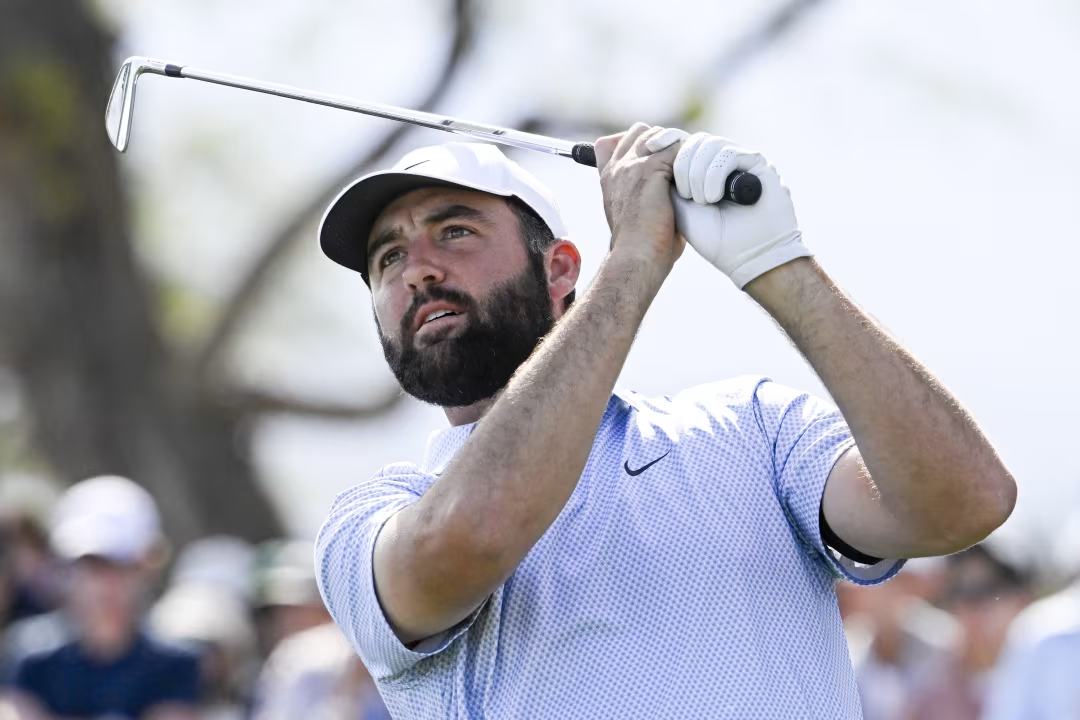
    “The PGA Tour season is an eight-month hunt, and the apex predators don’t waste energy chasing early prey. They treat the opening months as a stalking period: sharpening tools, conserving energy, waiting for spring when the majors begin.” This was my justification for picking Haotong Li. Scottie Scheffler—the best player in the world—went on to win by four shots. So much for apex predators conserving energy.

    Making golf predictions is a fool’s errand, but I’m doing it anyway. What follows are my picks for every 2026 PGA Tour tournament that matters.

    Farmers Insurance Open at Torrey Pines: Jake Knapp

    Torrey Pines is a bomber’s paradise and a strategically mundane golf course. The fairways are narrow, the holes are long and straight with no curvature, and the rough is uniformly thick. The course will be soft, reducing it to a simple formula: blast it off the tee, fire at flags, and make 15-footers. It’s more of a paint-by-number than a blank canvas. It’s not my kind of golf, but it is Jake Knapps, who has thrived on these courses in the past.

    Waste Management Open at TPC Scottsdale: Jordan Spieth

    TPC Scottsdale is an excellent golf course and perhaps the most underrated on tour. It has treated Jordan Spieth well over the years. He’s finished tied for sixth or better in four of the last five seasons. Spieth underwent wrist surgery this offseason to finally address a nagging injury that plagued him for the better part of a decade. While expecting a return to his mid-2010s form (or even close to it) would be foolish, I do expect more consistent ball-striking in 2026 and a win.

    Pebble Beach Pro Am: Tommy Fleetwood

    It’s somewhat unfortunate that the highest-rated course on tour is playing in its worst condition. In February, the Monterey Peninsula sits at the tail end of the rainy season, so Pebble plays like target golf, losing much of the strategy baked into its original design. I won’t complain too much. Watching those dramatic Pebble Beach views while curled up in 20-degree weather is a very nice escape.

    This was Rory McIlroy’s first win in his 2025 campaign. I expect this year’s winner to also take a win at this historic venue and run with it. Only Scheffler enters the year playing better golf than Tommy Fleetwood. There’s not much to say about Fleetwood; he’s world-class in every facet of the game. He got the monkey off his back in August, capturing his first PGA Tour win at the Tour Championship, and success seems inevitable for him in 2026.

    Genesis Invitational at Riviera: Jason Day

    Due to the Los Angeles wildfires last year, the Genesis was forced to skip Riviera (its home since 1999) and relocate to Torrey Pines. Fortunately, we’re back at George Thomas’ masterpiece, which is consistently my favorite non-major tournament of the year.

    You’re going to miss greens at Riviera. Scrambling is at a premium, and many past winners boast some of the best short games in the world. The tournament has been friendly to Australians, with Adam Scott capturing two titles here and Aaron Baddeley, one of the greatest short-game players, winning in 2011. Jason Day is also an Australian who can chip with the best of them.

    Cognizant Classic at PGA National: Daniel Berger

    PGA National used to be one of the sternest tests on tour, with only three players reaching double digits under par from 2013 to 2022. As technology has continued spiraling out of control, it’s been massacred the past three years, with Knapp even shooting a 59 last year. Daniel Berger has seemingly fully recovered from the brutal back injury that derailed his 2023 and 2024 seasons. He’s well-rounded and feels due to get back in the winner’s circle.

    Arnold Palmer Invitational at Bay Hill: Lucas Glover

    If Bay Hill plays anything like it did last year, the top of the leaderboard will be littered with short, accurate players. That sounds like a Lucas Glover tournament to me…and we’ll be in the South.

    The Players at TPC Sawgrass: Scottie Scheffler

    Scheffler has been crowned the best since Tiger. The level he is playing at now, however, is much, much closer to Tiger than fans want to admit. Per Data Golf, Scheffler is 1.45 strokes better per round than the second-best player on tour (Fleetwood). That translates to almost six shots a tournament. To put it another way, Scheffler is like if Fleetwood started every tournament at six under par. Woods’ peak was better than this (and longer as of now), but Scheffler is also playing against deeper fields and in an era where technology makes it tougher to separate.

    He won his first start of the 2026 season, and honestly, if we make it to The Players without another Scheffler win, it will be the talk of the week. Regardless, the Texan has always thrived at Sawgrass, and I expect him to grab his third Players title in four years.

    c/o Christopher McEniry

    Valspar Championship at Innisbrook: Viktor Hovland

    Innisbrook has a thing for back-to-back champions. Paul Casey won in 2018 and 2019, and Sam Burns followed suit with consecutive victories. I’d be lying if I said I had any clue what version of Viktor Hovland we will see. That unpredictability might define his career. But Hovland is a world-class talent. There will be valleys, but when he finds a feel—which seems inevitable at some point each season—wins will follow.

    Texas Children’s Houston Open at Memorial Park: Scottie Scheffler

    Scheffler’s had two straight runners-up here…I don’t think we’ll see a third.

    Valero Texas Open at TPC San Antonio: Davis Thompson

    I predicted Davis Thompson would win three times last year. I’ll settle for one win in 2026.

    The Masters at Augusta National: Tommy Fleetwood

    Fleetwood’s history at Augusta National isn’t anything to write home about. While he hasn’t missed a cut since his debut, he has only one top-10 finish. Still, it’s a great fit for him on paper as it favors a right-to-left ball flight and requires an elite short game, and as I alluded to with my Pebble Beach prediction, I expect the Englishman to finally capture a major.

    RBC Heritage at Harbour Town: Matt Kuchar

    Harbour Town rewards precision over power, making it one of the tour’s most unique venues. Few have exploited it better than Matt Kuchar, who has one win and six other top-10s. He’s quietly playing solid golf (78th in Data Golf rankings) and will tee it up as a past champion. It’s been years since we’ve seen a grizzled veteran steal a tournament, but Stewart Cink proved it’s possible a few years ago at Harbour Town, capturing the title at 47. Kuchar is the same age now. If the stars align anywhere for a late-career win, it’s on this narrow, tree-lined layout.

    Truist Championship at Quail Hollow: Rasmus Neergaard-Petersen

    The Truist has historically been contested at Quail Hollow, though last year’s PGA Championship forced a temporary move to Philadelphia Cricket Club, where Sepp Straka claimed the title. We’re back at Quail Hollow now, and I’ve been waiting for the right spot to slot in Rasmus Neergaard-Petersen. I am buying all of the stock available in the 26-year-old Dane. He absolutely lashes at the golf ball, possessing one of the most violent swings I have ever seen. He hits it straight, too. RNP secured his PGA Tour card this past fall and followed it up with a win at the historic Royal Melbourne Golf Club. Since this is a signature event, he’ll likely need to qualify through the Aon Swings. If he gets in, though, Quail Hollow’s demand for ball striking is tailor-made for his game.

    PGA Championship at Aronimink: Cameron Young

    This will be our first look at Aronimink Golf Club since the 2020 Women’s PGA Championship, where Sei Young Kim won with a ball-striking masterclass in the final round. If the course avoids heavy rain in the lead-up, controlling the ball will again be paramount. Aronimink is expected to stretch beyond 7,300 yards despite being a par-70, 300 yards longer than when the BMW Championship was contested here in 2018. Keegan Bradley edged Justin Rose in a playoff at 20-under that week, with Xander Schauffele, McIlroy, and Fleetwood all cracking the top 10. Length rose to the top of the leaderboard, and if the greens firm up, expect that advantage to matter again.

    Cameron Young is built for stages like this. He has six major top-10s and was Team USA’s best player at the Ryder Cup. A major victory in 2026 would elevate him to the top tier of the game.

    CJ Cup at TPC Craig Ranch: Johnny Keefer

    Read this great article on Keefer. He’s going to be a stud.

    Charles Schwab Challenge at Colonial: Harry Hall

    Another place where it’s important to have good hands. Hall was quietly one of the most consistent guys last season, finishing the year with 12 top 10s in 13 starts.

    The Memorial Tournament at Muirfield Village: Rasmus Neergaard-Petersen

    Scheffler will be going for a three-peat at Jack’s Place. The only reason he won those two years is that RNP wasn’t in the field. I am doubling down on the Dane to have a breakout 2026 season. Lad os gå!!

    RBC Canadian Open at TPC Toronto: Rory McIlroy

    McIlroy is a National Open killer. He’s captured the U.S., British, Scottish, Irish, Australian, Hong Kong, and Canadian Open (2x). I expect him to add a third Canadian Open at a third different course, as the Tour will be at TPC Toronto for a second straight year.

    U.S. Open at Shinnecock: Rory McIlroy

    Save St. Andrews, Shinnecock Hills is widely considered the best course that hosts professional golf tournaments. The last U.S. Open here saw Brooks Koepka win at over par, fending off Fleetwood’s final-round 63. The story of that week was Zach Johnson declaring the USGA had “lost the golf course,” a sentiment many of his peers echoed. One can only hope we see the world’s best in such a state of disarray, but that seems unlikely with how far gone technology is. Still, I am more excited for Shinnecock than any Major Championship since St. Andrews in 2022. Scheffler will be going for the career Grand Slam, and while I think he will contend, McIlroy will ride the momentum and grab his sixth major.  

    Travelers Championship at TPC River Highlands: Ludvig Åberg

    Åberg feels good for a win a year for the foreseeable future. His driver, while still lethal, wasn’t a superpower last year. Along with cleaning up his wedges, regaining this prowess will be key to his 2026 success.

    John Deere Classic at TPC Deere Run: Steven Fisk

    This is always my favorite tournament to pick because I can basically throw any name out there. The average ranking of winners over the past eight years is 138. The current 138 is Steven Fisk. Let’s go with it!

    Genesis Scottish Open at Renaissance Club: Rasmus Højgaard

    You need to hit the ball far at the Renaissance Club. Rasmus Højgaard does just that and is slowly becoming one of the world’s premier putters.

    Open Championship at Royal Birkdale: Robert MacIntyre

    Birkdale is often labelled the fairest test in the Open rota. Each hole is defined by towering dunes that act like American trees, creating distinct corridors. The fairways are narrow, the second shots demand precision, and the greens, while approachable, punish misses with nasty trouble. Playing on the Irish Sea, it is rare to get a benign day at Southport. The architecture isn’t spectacular (comparatively), and it isn’t particularly funky, but it will identify the best golfer that week, and players will have to hit creative shots.

    Augusta hasn’t treated Robert MacIntyre well, but he has had success in the other three majors, highlighted by a solo second at the U.S. Open last year and three top 10s in the Open Championship. Bob Mac emerged as one of the tour’s best putters. His wedge game lags, but his long iron play is world-class, and that’s what Birkdale rewards. It’s been 27 years since a Scot won a major, but that drought ends here.

    As far as I am concerned, the season ends after the Open Championship. The “Midwest swing” leaves much to be desired, and the Tour still has a long way to go until I am captivated by the Playoffs. But in the pursuit of completeness, while recognizing I am already at 2,100 words, I will list out my predictions for the final six tournaments.

    3M Open: Sam Ryder

    Rocket Classic: Max Greyserman

    Wyndham Championship: Justin Lower 

    FedEx St. Jude Championship: Patrick Reed

    BMW Championship: Patrick Cantlay

    TOUR Championship: Cameron Young

    Sam Weitzman-Kurker can be reached at sweitzmankur@wesleyan.edu.

  • Middletown Residents Gather For Vigil Honoring Alex Pretti at the Church of the Holy Trinity

    Middletown Residents Gather For Vigil Honoring Alex Pretti at the Church of the Holy Trinity

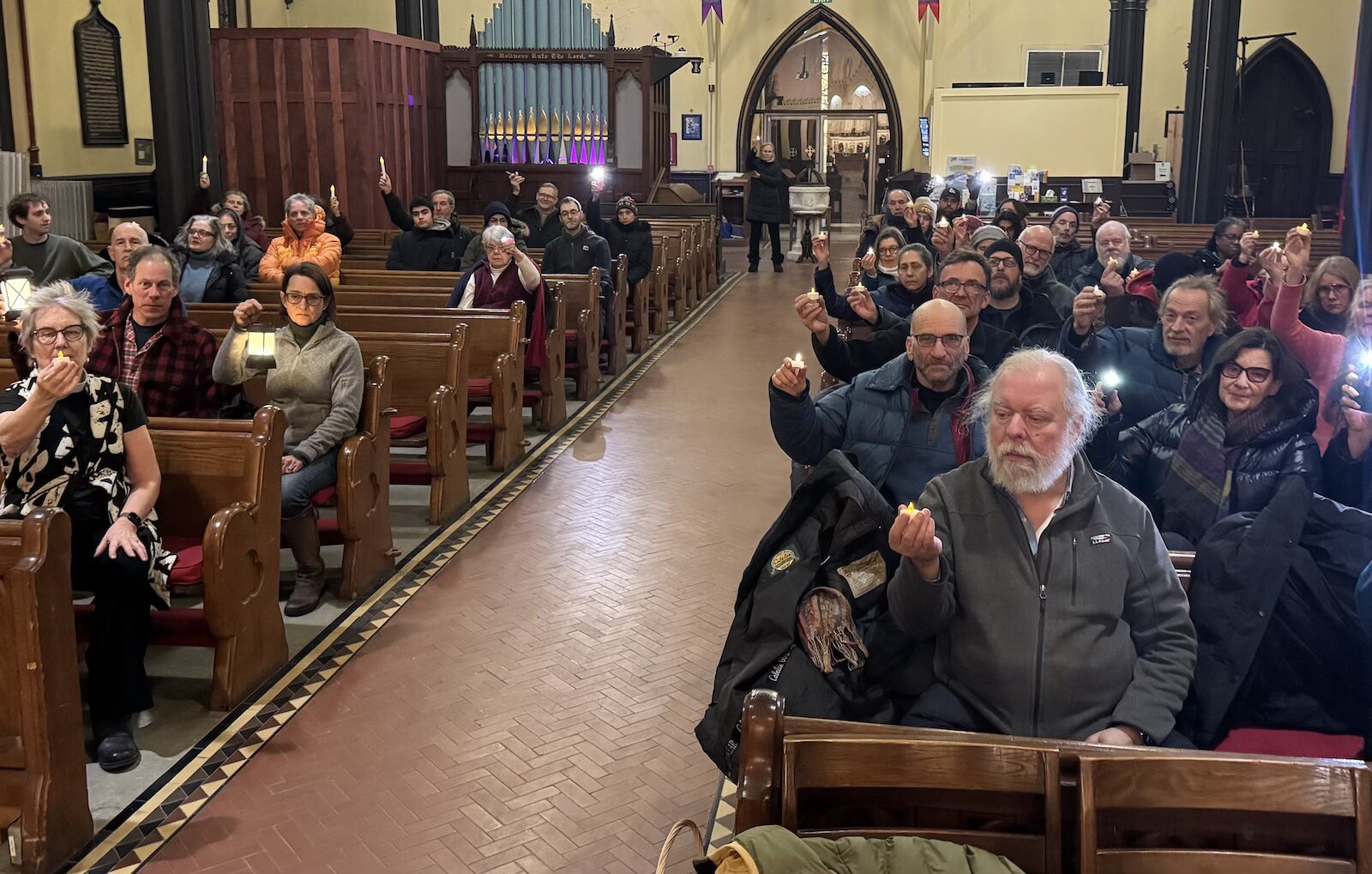
    Vigil attendees hold up LED candles. c/o Rev. Mary Barnett

    Middletown residents gathered at the Church of the Holy Trinity on Saturday night to honor Minnesota resident Alex Pretti, shot by federal law enforcement agents in Minneapolis.

    The vigil, organized the same day, took place at the church’s Main St. address at 8 p.m. on Saturday, Jan. 24. The event drew a crowd of about 50, including a handful of current and former University faculty members. Pretti, a U.S. citizen and registered intensive care nurse at Minneapolis VA Health Care System, was filmed approaching federal agents with a phone. Contradicting DHS officials’ statements, Pretti was not wielding a gun at the agents, though one was on his person and he was licensed to carry.

    His killing is among the recent casualties of federal law enforcement’s crackdown on immigration, resulting in escalated altercations between Minnesota residents, protestors, and federal agents. The federal crackdown and counter-protests in Minneapolis and St. Paul have incited anti-ICE protests in solidarity with Minnesota across the nation, including in New Haven. The federal agents involved in Pretti’s killing have been placed on administrative leave.

    Ed McKeon, a longtime Middletown resident and activist, was the primary organizer of the vigil. McKeon first heard that candlelight vigils were planned in Minnesota and were being held nationwide in solidarity from a message posted by Heather Cox Richardson, a historian at Boston College.

    “I was appalled at what happened,” McKeon said. “I was shocked. I was horrified. I was almost speechless.”

    Deeply involved with local issues, McKeon has previously served as a member of the Middletown Common Council and the Middletown Board of Education. 18 months ago, McKeon founded Middlesex County’s chapter of Indivisible, a progressive advocacy group, leading the group’s weekly demonstrations, fundraising, and demonstrative events ever since.

    He called Rev. Mary Barnett, the pastor of the Church of the Holy Trinity, to ask if the event could be held at the church. “I don’t know why it is I got there,” McKeon said. “Mostly it was probably because, in terms of ‘somebody’s got to do it,’ and I raise my hand, and in all the cases, it’s not just me.”

    Despite living 45 minutes away from Middletown, Barnett agreed to open her doors and return to the church. “I was sitting at home and consuming news in various ways, and really feeling very distraught over this murder of this young man,” Barnett said. “Just feeling grief. Like, wow, how did we get here? And what am I called to do?” 

    Barnett wants the church to feel welcoming to all, but stressed the importance of taking a moral stand. At the event, she called for clarity and unity. “My prayer is that everyone in this country will take time in the days ahead, for however long it takes, to begin to see how we’re breaking this country and human beings apart like twigs,” she said. 

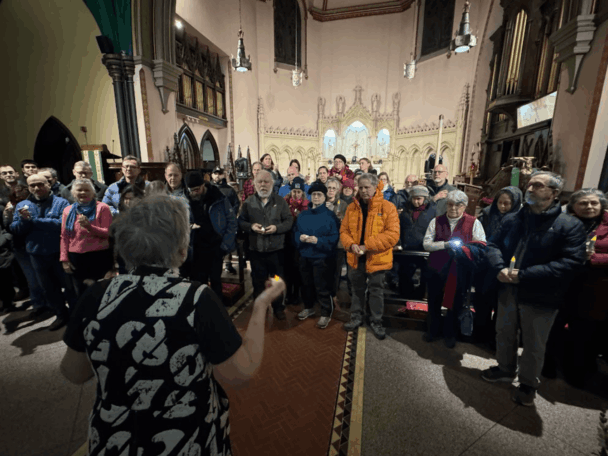
    Rev. Barnett speaks to the crowd. c/o Ed McKeon

    Attendees listening in the pews brought LED candles to the church. Those who didn’t have candles flicked on their phone flashlights, raising them as Barnett spoke.  

    Among attendees was Steve Machuga, former Director of Administrative Services for the University’s Information Technology Services. Machuga described feeling anger at the brutality of Pretti’s murder. 

    “There’s just no excuse for that level of oppressiveness and lack of concern for human beings,” Machuga said. “And you know, they’re federal agents. They should be concerned about U.S. citizens, too. It offends my sense of what I think America is.” 

    To close the vigil, McKeon’s sons took a guitar to the front of the church and performed Buffalo Springfield’s “For What It’s Worth,” a protest song written about the 1966 Sunset Strip curfew riots, where youth clashed with police over stringent regulations.

    “There’s a man with a gun over there / A-telling me I got to beware,” attendees sang. “Everybody look what’s going down.”

    Aarushi Bahadur can be reached at abahadur@wesleyan.edu.

  • Arts Roundup Part 1: CFA, Spike Tape, and SHADES to Present Budding Theater Productions for Spring ’26

    Arts Roundup Part 1: CFA, Spike Tape, and SHADES to Present Budding Theater Productions for Spring ’26

    c/o Wesleyan University

    Though the campus is now covered with fresh, white snow, before long the snow will melt and give way to spring’s gentle rain. By then, the University will be geared up for a season of thrilling spring shows. The Argus presents a comprehensive list of theater productions going up in the 2026 spring semester! Mark your calendars and reserve your tickets as soon as they are available, as seats are highly sought after. For updates, follow the Spike Tape, Center for the Arts (CFA), and SHADES Instagram pages. 

    This Friday, Jan. 30, and Saturday, Jan. 31, Spike Tape will be putting on a festival of one-day plays, starting Friday at 7 p.m. In these 24 hours, students will write, produce, and act in original plays. 

    The next performances arrive at the end of February. “The Easily Lovable and Endlessly Persistent,” a senior thesis for the theater major written by Sage Saling ’26, goes up in the Romance Language Building’s Highwaymen Common Room on Thursday, Feb. 26 at 7 p.m. and Saturday, Feb. 28 at 3 p.m. Performed as a staged reading, the play uses material from interviews with non–male identifying artists to explore the themes that shape women’s roles. This highly provocative work both questions and challenges gendered expectations to emerge with a more dynamic understanding of female characters. 

    SHADES, Wesleyan’s theater collective for students of color on campus, will be putting on four different productions this spring. The first is “Horse Girls,” written by Jenny Rachel Weiner and directed by Celeste McKenzie ’26. The dark comedy follows the story of twelve-year-old Ashleigh, who learns that her family’s stables will be sold and her horses butchered for meat. It’s “a play about pre-teens: their obsessions, their insecurities and their desperate need to find a place in the world,” as the description from Concord Theatricals reads. See “Horse Girls” in the Patricelli ’92 Theater on Friday, Feb. 27 and Saturday, Feb. 28. 

    March begins with a staging of the Senior Capstone Theater production “Escape Room” in Theater Studio 001, on Monday, March 2 at 7 p.m., 8 p.m., and 9 p.m. Created by Wennan (Avivi) Li ’26 and Liang Liang ’26, the immersive production merges theater, games, and art, while incorporating audience involvement through its multimedia approach to performance art.

    “[T]his interdisciplinary capstone invites the audience to explore absence and presence, choice, and illusion within a world shaped by puzzles, light, shadow, and silence,” the capstone’s description from the CFA website reads. “Inside a black-box space, participants become both players and storytellers, uncovering fragments of a forgotten campus ritual.”

    After a relaxing two weeks of spring break, Spike Tape will kick off the second half of the semester with staged readings of student-written plays and musicals on Friday, March 27 and Saturday, March 28, as well as Friday, April 3 and Saturday, April 4. Over two weekends, original thought and creativity will come to the stage at a to-be-determined location. During the weekend of April 3 and 4, make sure you also catch the SHADES production of “Fuddy Meers” written by David Lindsay-Abaire and directed by Jerry Persaud Jr. ’26. The dark comedy follows the life of a woman named Claire, whose amnesia causes her to forget each day. Suddenly, her life takes an unexpected turn when she’s abducted by a limping man. A surreal and darkly hysterical journey ensues, filled with bizarre characters, including a stoner teen and a ventriloquist.

    The rest of April is jam-packed with five theater productions. First up, Spike Tape presents “The Ninth Hour: The Beowulf Story” on Friday, April 10 and Saturday, April 11 in WestCo Cafe. This rock opera musical, full of folk-pop and rock-noir ballads, was originally created by Kate Douglas and Shayfer James and will be directed by Ezekiel Allman ’27. For all the English lovers out there, this production takes a uniquely creative approach to the beloved epic poem “Beowulf.” 

    The following weekend, two more productions will take place. Spike Tape will continue its creative adaptations of literary classics with its ’80s glam rock musical production of William Shakespeare’s “Richard III” on Friday, April 17 and Saturday, April 18 in WestCo Cafe. Directed by Sophie Brusini ’26, this adaptation will follow Richard III on a journey full of threat, danger, lies, and schemes as he seeks to secure the throne of England. On Saturday, April 18 at 7 p.m., Lola Cortez ’26 will present a musical adaptation of the manga “Banana Fish” in the Patricelli ’92 Theater. 

    On Tuesday, April 21 in the Ring Family Performing Arts Hall, SHADES will present “Tears of Gold.” Performed as a staged reading, this original play was written and directed by Senica Slaton ’26. 

    “After the passing of her grandmother, a young woman is trapped in the only thing she has left of her grandmother: a fairytale story she told her every night before bed,” a description from the SHADES Instagram reads.

    Spike Tape closes out April in a musical bang with a production of “The 25th Annual Putnam Spelling Bee” on Friday, April 24 and Saturday, April 25 in WestCo Cafe. This story, directed by Sasha Nelson ’28, follows six middle school–aged students’ journeys during a spelling bee championship. Comedic yet deeply touching, this musical will rely on audience participation.

    As the semester comes to an end, May begins with the Theater Department’s staging of “The Crucible,” authored by Arthur Miller. This production is directed by Visiting Professor of Theater Alex Keegan and will take place in the CFA on Thursday, April 30 at 7 p.m. and Saturday, May 2 at 1 p.m.

    “[A] timely parable that exposes the devastating consequences of mass hysteria and the erosion of justice…Arthur Miller’s investigation of groupthink, betrayal, and morality offers a searing critique of McCarthyism, serving as a stark and urgent warning for our times,” a description from the CFA website reads.

    Spike Tape’s last show of the semester, “Sunday in the Park with George” by James Lapine, will take place Friday, May 1 and Saturday, May 2 in the Patricelli ’92 Theater. With music by Stephen Sondheim, this musical follows a fictionalized account of the real-life pointillist painter Georges Seurat as he struggles to balance his quest to create a masterpiece and his relationship with his mistress. After his mistress, Dot, becomes pregnant and moves away to America, the story takes a turn and follows the journey of Georges Seurat’s great-grandson and his struggles with his own artistic practices. 

    The final theater performance of the Spring 2026 semester comes from the students in “Adaptations for Performance Theater” (THEA221). This class, taught by Professor of Theater Ronald Jenkins, will showcase performances of adapted texts on Tuesday, May 5 at 4 p.m. in the Ring Family Performing Arts Hall. 

    SHADES’ “Does it Matter What We Dream?” is an original theatrical concert experience created by Ting Tsai ’27. This multimedia performance will contain live music performances, a music video screening, dance choreography, theatrical pieces, and interactive elements that explore themes of desire, love, and imagination. Dates will be announced during the semester. 

    Amelia Haas can be reached at ahaas01@wesleyan.edu.

  • A Middletown City Block at the Bottom of America’s Safety Net

    On the horizon of Middletown, Conn.’s notoriously wide Main Street, the peeling Colonial Revival edifice of the Arriwani Hotel rises like a tomb. Five stories tall and nearly as wide, it dominates the city block between Liberty Street and Grand Street in a mass of granite, brick, and concrete. Upstairs, most of the blinds are drawn, though a few whitewashed walls peek through. At street level, however, the scene shifts, and the floor-to-ceiling lobby windows are filled with inviting light. 

    In a scene typical of late March in Middletown’s North End, a handful of people linger nearby, drifting between parked cars, sitting on the curb, sometimes smoking or rifling through brown paper bags. Passersby avoid eye contact and walk a little faster. Behind them, yellow “NO LOITERING” signs are pasted inside the lobby windows, facing out. More often than not, a Middletown Police Department vehicle is parked across the street.

    The Arriwani Hotel is not a hotel, and it hasn’t been for more than 30 years. In 1994, the top four floors of the building were converted into Liberty Commons, a 40-unit supportive housing complex for adults with a history of homelessness, severe mental illness, and chronic addiction. A year later, in 1995, the refurbished lobby became home to the Buttonwood Tree Performing Arts Center, a nonprofit, volunteer-run community space and music venue. Although stacked together, these two institutions, their patrons, and their visions for the city could not be more different. The Buttonwood’s laudable mission—to “uplift, inspire, educate, and enrich lives through artistic and cultural programming”—struggles under the weight of reality for Middletown’s most vulnerable.

    Around 6 p.m., the front door of the Arriwani swings open, and a short white woman named Terri Lachance backs herself outside, dragging a sidewalk sign with “Live Folk Music Tonight: $15” written in colorful chalk. She wears a “Fun-O-Meter” button on her shirt, with a little arrow cranked all the way into the hazardous red zone. There aren’t many spur-of-the-moment concertgoers strolling this side of town, but Lachance adjusts her sign to face the street anyway, as though an audience might materialize through sheer force of will. 

    Lachance’s newly minted status as program director of the Buttonwood Tree is indicative of the administrative reshuffling that has plagued the place since its founder, Susan Allison, died in 2018. Weekly Buttonwood events––open mic nights, comedy shows, magic acts, jazz, folk, reggae, R&B––are facilitated entirely by volunteers. Lachance describes the Buttonwood as a magical “island of misfit toys,” where “every person that comes in brings whatever they can bring.” After the latest executive director, Anne-Marie Cannata McEwen, resigned in 2023, nobody gets paid. But, Lachance adds, this uncompensated, ad hoc operation is more representative of the Buttonwood’s original collaborative community vision anyhow. Lachance spent three years in the Peace Corps after college, so she knows a little something about giving back. 

    Despite their physical proximity, Buttonwood Tree patrons and Liberty Commons residents rarely interact with one another. Liberty Commons residents idle on the curb; Buttonwood Tree patrons park their cars, gather their coats, and make a beeline to the warm light inside. The conflict is deceptively simple: The Buttonwood is advertised as an all-inclusive space, but it depends on ticket sales and private donations to survive, and Liberty Commons residents typically can’t afford to pay. Cannata McEwen’s resignation in 2023 came following a series of workplace and personal upheavals, partly because the neighborhood had worn her down.

    “It was really difficult to blend the two worlds,” she said. “They’re just people stuck in a different, difficult situation, and you have to have mercy. But it’s intimidating for a lot of people. It made it difficult for us to get audience members. It was just challenging to run a business with them there.”

    That’s not to say Cannata McEwen didn’t try. Her tenure as executive director included a series of attempts to bring the people outside and inside the Buttonwood’s giant windows together. She tried to entice people to come volunteer, tried to get Liberty Commons residents to watch the shows, and at one point even tried to organize a livestream upstairs. She ran into roadblocks and resistance at every turn. North End and Liberty Commons volunteers were unreliable, even disruptive, and the Buttonwood regulars didn’t exactly want them around.

    “Talk to them? You mean the street people?” one Buttonwood concert attendee said, shifting uncomfortably. Then a pause: “What am I going to do, ask to split a spliff?” 

    Liberty Commons was the first housing project completed by the Connecticut Supportive Housing Demonstration Program, a 1993 pilot initiative between the state government and a national anti-homelessness intermediary, the Corporation for Supportive Housing, in order to relieve overcrowding in homeless shelters across the state. Since its inception, Liberty Commons has been overseen by St. Vincent de Paul Middletown, a local Catholic nonprofit that simultaneously runs the St. Vincent de Paul soup kitchen directly next door. Per the Corporation for Supportive Housing model, Liberty Commons operates under a housing-first standard, meaning that access to housing is not contingent on tenants maintaining sobriety, securing employment, complying with treatment plans, or meeting other conditions of “self-sufficiency.” Maryellen Shuckrow, the Executive Director of St. Vincent de Paul Middletown, regularly uses the word “triage” to describe the work that her organization does—supporting the most vulnerable first.

    After securing the sidewalk sign on Main Street, Lachance smiles and waves to Larami Vereen, a 49-year-old Black man waiting on the curb. He nods in greeting, then ducks under the door frame to follow her inside. Around here, Vereen is known by his stage name, “El Vee,” a play on his initials. He has deep roots in Middletown––he was a high school basketball star, he grew up two blocks from the Arriwani, and his father lives upstairs in Liberty Commons. These days, Vereen has become a regular presence and motivating force at the Buttonwood. His intermediary role is something of an anomaly; he alone moves seamlessly between the worlds inside and outside the Arriwani’s lobby windows. 

    “If I didn’t have the Buttonwood Tree, I would have been in the streets without anything positive to anchor me from what I was going through at the time,” Vereen said. “This place literally saved my life. Really saved me from madness, from imploding.”

    To hear anyone else tell it, Vereen saved the Buttonwood Tree, not the other way around. At the very least, he reopened the connection between the community center and the city block it calls home. With help from the Buttonwood Board of Directors, he launched a weekly “Artist Development Night” to produce recordings for emerging local hip hop artists and offer them advice.

    “He has a gift for music, and he does an amazing job,” Lachance said. “Especially when it comes to people from the North End, I think they trust him. He grew up with them. If I went in there and said, ‘I’m gonna start recording rap,’ and I’m like, a white person from the suburbs, there’s no way. It’s not my genre, you know, it’s not my right.”

    “Growing up around here, you can do three things,” Vereen’s friend, Yawasaph Robinson explained, counting on his fingers. “You play sports, you make music, or you sell drugs.”

    As a teenager, Vereen occupied himself with basketball, marijuana, and hip hop, and over the years, music won out. He regularly attended the annual Wesleyan University Spring Fling concert just up the street. Smoking at the top of Foss Hill, away from the crowd, he fantasized about one day playing on a stage that big. Today, on Bandcamp.com, Vereen’s many album covers spill down the screen, dating back to the early 2010s. In the last few months, he’s been reaching out to local artists, inviting them onto his records and into the Buttonwood.

    As Lachance bustles around, setting up folding chairs, Vereen helps himself to leftovers from the refrigerator behind the front desk. The place is cheerfully cluttered: There are paper snowflakes taped to the windows, piles of CDs on a shelf, and an advertisement for Reiki healing hung on the wall. A few audience members trickle in for the show. Many of them know Lachance and the folk guitarist personally, and the lobby gradually fills with soft voices and the hiss of opening seltzer cans. White heads of hair glow under the Buttonwood’s blue and yellow lights. Nobody mentions the people outside. 

    “It’s tricky, but I don’t feel that we have a responsibility to them,” Cannata McEwen said, referring to the residents of Liberty Commons and the patrons of St. Vincent de Paul’s soup kitchen. After fifteen years in various roles at the Buttonwood, she wondered aloud if the whole effort wasn’t a losing battle. “I would appreciate it if they would respect the building and the environment better and, frankly, even themselves better. So they wouldn’t just lay around the sidewalk, drunk, or just sitting there, not even drunk but just sitting there, you know? It’s disrespectful to the business that’s going on, and they just don’t seem to get that. The problem is mental health, really.”

    When Vereen was about eight years old, he lived with his family in his aunt’s third-floor apartment on Green Street. Waking up early for school one day, he noticed ten fingers gripping the balcony railing outside. Vereen ran to get his mother, to tell her that his father was hanging from the bannister and foaming at the mouth. As the story goes, someone slipped his father some kind of high-potency drug that addled his brain and sent him crawling over the balcony, but Vereen knows his dad had started using before then, to stay close to Vereen’s mom. It was the only way to live in her world. After that, Vereen says, his father was never the same.

    “We’ll start like a regular conversation, and then it’ll turn to a one-sided conversation, and he’s talking about anything in the universe,” Vereen said. “They give him apartments, and he’d rather stay outside. He’d rather be homeless. So last time they gave him an apartment, he didn’t live in it, and they gave it up to somebody else.” This time, it seems to have stuck. Vereen’s father has been staying in Liberty Commons for nearly four years.  

    By the mid-1990s, Connecticut was preparing to shut down two of its three large psychiatric hospitals. Nationwide, the 1960s and 1970s heralded a significant shift in public funding for state hospitals and inpatient psychiatric care. Civil-rights-era activism gave rise to the deinstitutionalization movement, which advocated for the release of people with severe mental illness from psychiatric hospitals into public life. Hospitals were abusive and inhumane; developments in antipsychotic medication offered a hopeful new horizon; Medicaid could help; and increased investments in community support services would be more effective, more compassionate, and cheaper overall—the obvious solution.

    As a result, the 1980s rolled out a laundry list of adult mental health initiatives in Connecticut, including supportive housing programs, case management, vocational intervention, and a statewide network of authorities each assigned to oversee all the psychiatric patients within a certain region. Fairfield Hills Hospital closed in 1995, followed by Norwich Hospital in 1996. The burden of care fell to local municipalities, volunteers, and nonprofits. By 1997, Connecticut only had 550 state inpatient psychiatric beds left. Overflow patients who could not be placed in community programs were transferred to Middletown’s Connecticut Valley Hospital, Connecticut’s last remaining large psychiatric care facility, which rapidly found itself unprepared and overwhelmed.

    Even before Connecticut Valley Hospital became ground zero for Connecticut’s mentally ill, the people of Middletown were living in anger and fear. In the summer of 1989, less than five years before Liberty Commons opened its doors, a Connecticut Valley Patient named David Peterson wandered down from the hospital complex to Middletown’s annual Main Street Sidewalk Sale, where nine year-old Jessica Short was enjoying the day with her mother. As the pair emerged onto the crowded street from Woolworth’s General Store, Peterson attacked Jessica with a knife, stabbing her more than thirty times. He was later found not guilty of Jessica’s murder by reason of insanity, but the event looms large in Middletown’s collective memory, tempering community tolerance for the unhoused and mentally ill to this day.

    For Maryellen Shuckrow, St. Vincent de Paul’s “triage” work has boiled down to basic survival. “Our goal right now is that nobody freezes,” she said. The Middletown chapter of St. Vincent only employs a full-time staff of 23. In 2024, their food and housing triage programs reached more than 4,000 patrons; that’s more than 170 people per employee. “What’s really important is that nobody dies. We lost 22 people last year from the soup kitchen population, and that’s a lot for us. Keeping people alive, getting them housed, getting them into recovery services—those are our daily thrusts.” 

    “I agree, feeding people is necessary, but feeding our souls is also necessary, right?” Cannata McEwen said. She knows it sounds harsh, but at the end of the day, her job was to keep the Buttonwood afloat.

    “You have to embrace where it is and what it does,” Lachance added. “But there’s a balance between patrons of the Buttonwood that have money, that want to see high-end performances, and people on the streets that scare them in some way.” State psychiatric policy has concentrated and defunded recovery infrastructure, putting open-door community institutions like the Buttonwood in a desperate situation. A volunteer nonprofit, loosely organized by retirees and struggling artists, entirely dependent on donations and ticket sales––is it their job to pick up the pieces?

    While Cannata McEwen struggled to merge the two worlds, Vereen moves through them easily. During the Buttonwood’s regular Friday and Saturday night programming, he hovers in between, sometimes standing in the back of the audience, sometimes outside with the residents of Liberty Commons. If you ask locals how they know him, they shake their heads and can’t remember a time when they didn’t. 

    In the 1990s, Vereen was a local basketball legend. He led the 1994 Middletown High boys basketball team to its most significant state title in city history, and his MVP performance in the championship game forever cemented his name in the Middletown Sports Hall of Fame. With rebounds like that, his classmates said, Vereen was bound to go pro—the NCAA, no, the NBA—Middletown’s own Michael Jordan, destined for greatness. 

    “I imagine that [my leadership at the Buttonwood] is making a lot of people uncomfortable, but the board seems to be embracing it, like they know that this change is supposed to be happening,” Vereen said. “The town has really never embraced me the way they’re embracing me now. The only time the town embraced me like this was when I was playing ball.”

    Vereen never made it to the NBA. Or to college, for that matter. His MVP game was more than 30 years ago. Instead, when Vereen was 22, he was arrested for having a relationship with a minor. His family couldn’t afford a lawyer, so they relied on public defenders, and he was convicted of statutory rape. He spent two years in prison, followed by a parole violation and 20 years as a registered sex offender. After his release, Vereen worked a series of odd jobs–– dishwashing, landscaping, unloading trucks. A lot of driving, including non-emergency medical transport to the airport or the bus station. It was hard to make anything stick, as employers almost always conducted background checks. In a turn of painful irony, Vereen’s younger brother won a state title in football, played Division I in college, and had a brief stint in the NFL.

    “Everybody I knew turned against me,” Vereen said. “Even if they didn’t believe it, they were like, ‘How could you let this happen to you? You had a future.’”

    So why not leave? Move someplace new and start over? For Vereen, there is nowhere else to go. Middletown is his world, always has been, and the cycle of punishment and survival, recovery and relapse, is at least a familiar kind of purgatory. For all his efforts to build something good, Vereen, like Shuckrow, Lachance, and Cannata McEwen, remains buried in triage. To hear Cannata McEwen tell it, there’s something about the Arriwani Hotel itself that doesn’t let people go.

    “I once had a friend who could see ghosts try to move along the spirits up there,” she said. “He was able to move some along, but this is an old hotel, so there are a lot of people, and I guess a lot of spirits who still get stuck hanging out there.”

    In April 2025, Vereen finally made it to Foss Hill. His connection to the Buttonwood set him on stage in the middle of Andrus Field, playing to a mass of Wesleyan University students soaking up the sun. After performing far longer than his allotted time slot, he climbed down off the stage, grinning and covered in sweat—MVP all over again.

    But by the following evening, Vereen’s excitement had worn off. Leaning against the brick wall outside the Buttonwood Tree, he looked across Middletown’s Main Street, wide as ever, and shrugged. “So is it the city failing the people,” he asked, “or the people failing the city?”

    Sophie Jager can be reached at sophiekjager@gmail.com.

  • Prediction Market Mania: Kalshi, CNN, and the Blinking Red Light

    Prediction Market Mania: Kalshi, CNN, and the Blinking Red Light

    c/o Kalshi

    Do you want to bet on the Celtics winning this Thursday against the Bucks? How about who will be the first member of President Trump’s cabinet to leave? Or maybe how much it will snow in Chicago this month? If any of this sounds appealing to you, all of these questions are available to be gambled on through prediction markets like Kalshi, Polymarket, PredictIt, and more. Today, people are increasingly using prediction markets to put their money where their mouth is, and the political implications have been vast.

    Prediction markets show real-time opinions from bettors, whereas polling data only comes from a previous date and may not have taken into account events that could have impacted voters in the meantime. If people are expressing what they think about a political race using their own money, that can be a live tell of how the public is thinking. And the heads of prediction markets see their platforms transcending polls as the key telling factor during election season. With the widespread acceptance of political betting as having a pulse on the public, prediction market data will be featured more than polling data by the 2028 election, possibly by next year’s midterms. And the outlook for what that says about American society is the unsung issue of Kalshi and Polymarket’s get-rich-quick agenda. 

    The rise of prediction markets has its origins in 2018, when the Supreme Court allowed states to legalize sports betting in Murphy v. National Collegiate Athletic Association. Murphy overturned a 1992 federal law that banned sports betting in all but four grandfathered states. Since then, 38 states have legalized sports betting, and it is impossible to be a consumer of information online without being exposed to a FanDuel or DraftKings commercial. 

    Since its legalization, sports betting has led to a change in both sports fan ideology and American ideology, where your knowledge of sports can turn you a profit. Jonathan D. Cohen, writer of “Losing Big: America’s Reckless Bet on Sports Gambling,” called this the “gamblification” of American sports, where it’s not enough to know something about sports anymore; instead, you have to back up your knowledge by profiting off it. 

    The legalization of sports betting has had both benefits and drawbacks, but regardless of your stance, there’s a much bigger beast on the rise that has gained serious traction over the last two years: prediction markets. 

    The premise of prediction markets is simple: bet on anything. Prediction markets are usually organized around yes or no questions, and users purchase individual shares worth up to 99 cents on a certain statement’s market. This can take the place of sports betting sites—Kalshi, Polymarket, and other popular sites still get most of their revenue from their sports-related markets—or it can present betting markets for aspects of popular culture, like who will be a bridesmaid at Taylor Swift and Travis Kelce’s wedding. 

    What separates Kalshi from a FanDuel or a DraftKings is its legal standing and accessibility to its users. Despite its parallels to sports betting, these platforms are classified as markets, and bets are considered investments. Therefore, anyone 18 or older can make a bet on a prediction market, further blurring the lines between betting, investing, and gaming. 

    The political betting markets emerged as a serious player during the 2024 elections and were influential in this past year’s local elections. In 2024, when the polls predicted a dead-even split headed into Election Day, prediction markets gave Trump the advantage, and as the day progressed, the odds tipped more and more in his favor. Additionally, Kalshi and Polymarket called the election before CNN, Fox News, and MSNBC, declaring victory for the industry once it was confirmed on television.

    In a post on X, formerly known as Twitter, Kalshi chief executive Tarek Mansour wrote on election night: “Polls 0, Prediction Markets 1.”

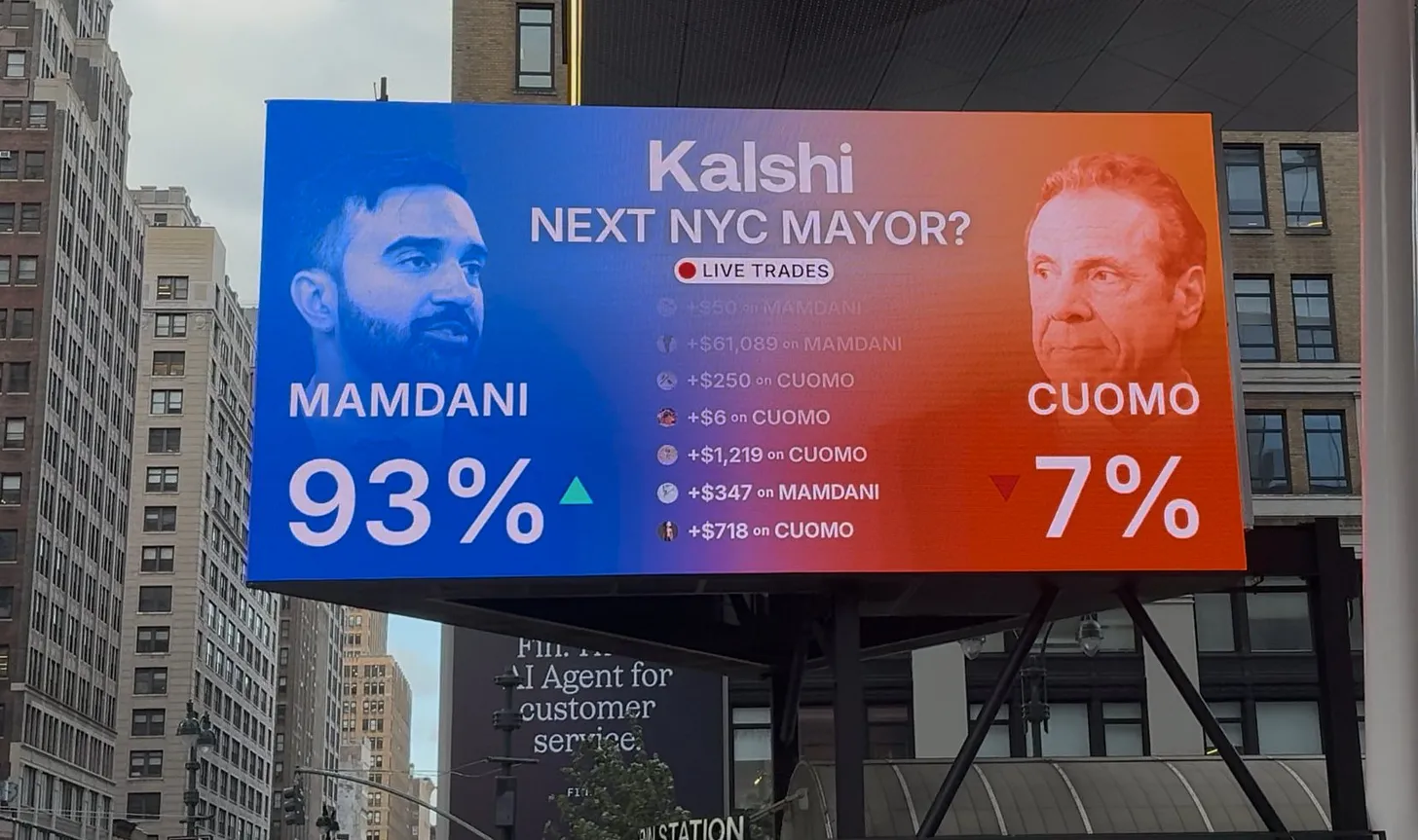
    This year, prediction markets made a name for themselves through their advertising and prevalence during local elections. They accurately predicted governor races in New Jersey and Virginia and called them before networks did. But their presence in the New York City mayoral election was most notable. A massive billboard outside of Madison Square Garden and Penn Station displayed the live odds on Kalshi between Zohran Mamdani and Andrew Cuomo. All across the city, advertisements were spotted, resulting in the state going after them for their seemingly crucial presence in the election cycle. 

    Comparisons between prediction markets and the stock market or sports betting platforms show significant value differences. In the stock market, you are investing in companies that recognize you as an investor. On prediction markets, you are not. While the stock market is not perfect, at least it has much more regulation in place. Sports betting also has regulation, as state laws cover FanDuel, DraftKings, and other betting platforms to ensure they operate above board.

    Ultimately, the nearly unregulated nature of prediction markets should raise serious red flags about their use in the public eye. At this current moment, anyone over 18 can hop on their computer or phone and access prediction markets in all 50 states. As referenced before, you can use these sites to bet on almost everything. It gives everyone access to something, without the monitoring exhibited in the stock market or the sports betting industry. 

    Furthermore, the global impact of prediction markets has already been felt. The Nobel Peace Prize Committee noticed that Venezuelan opposition leader María Corina Machado’s chances on Polymarket to win the Peace Prize spiked in an instant driven by one user’s trading patterns, causing concern for the committee when she was eventually named the recipient a few hours later. The Norwegian Nobel Committee launched an ongoing investigation into the user, speculating that this could have been a case of insider information informing one’s ability to profit. 

    If this happened with the Nobel Peace Prize, what is stopping politicians from using prediction markets to gain some monetary advantage on a political event not yet made public? President Trump’s son, Donald Jr., sits on the advisory board for both Kalshi and Polymarket, indicating a direct avenue for where this could occur. And the response from prediction market higher-ups is unclear. Kalshi co-founder Luana Lopes Lara emphasized the site’s status as compliant with government regulations: “Kalshi is a federally-regulated, fully-compliant exchange, and we have systems in place to monitor for any suspicions or unusual activity. We also have a lot of trading prohibitions in place.”

    However, if Kalshi is up to code with government regulation while the president’s son is sitting on their board, what does that suggest about the possibilities government officials can explore using these sites?

    Last week, Kalshi announced a deal with CNN, whose programming will now feature a ticker of live Kalshi odds. This demonstrates the mainstream acceptance of prediction markets and direct endorsement from major television networks, as they begin to trust  the accuracy of these markets at a greater level than polling data. 

    However, prediction markets don’t necessarily show how people plan to vote or the likelihood of an event. The price of milk won’t increase just because people think it will increase, and the Chiefs won’t win the Super Bowl just because people think they will. They show what people think will happen. Someone can vote for a Republican candidate, but they are willing to bet that the Democratic candidate will win, so they place a bet on it. That doesn’t show what they did, it shows that they think everyone else did.

    Now that CNN will begin showing these live odds, they will be broadcast to millions at home in the United States, which could lead to more people trusting betting odds to inform their voting measures than their own desires. And since there’s only more of an acceptance of these prediction markets to come, I wouldn’t be surprised if we care more about who the markets say will be our next president, let alone who will win in the 2026 midterms. 

    Ultimately, the unregulated nature of prediction markets should be a blinking red light in the face of the public, but it’s hard for anyone to take that seriously if they are only seeing green. 

    Max Forstein is a member of the Class of 2027 and can be reached at mforstein@wesleyan.edu.