Author: Yaryna Kholod

  • Reflections of a Ukrainian Student: On the Third Anniversary of the Full-Force Invasion

    Reflections of a Ukrainian Student: On the Third Anniversary of the Full-Force Invasion

    c/o Yaryna Kholod
    c/o Yaryna Kholod

    Since I set out to write this article commemorating three years since Russia attacked my country with all the troops and weapons available, I have changed my mind on what latest news deserves to be part of the introduction paragraph several times. I followed the fight of the first responders and paramedics in Kherson to save a family of four from under the rubble of their apartment building that was targeted by a Russian fighter drone. It was a joy to read the headline about 15 Ukrainian children being returned to their homeland, but it was a pain to see in the later paragraph of the article that 19,546 more children were confirmed to have been deported to Russia from the occupied territories. My phone was bombarded with news notifications of the new administration in the U.S. making countless immoral claims on the war, each of them bringing the U.S. closer to becoming a Russian ally, joining in that rank Belarus, North Korea, and Iran. 

    I have been told by otherwise incredibly kind and socially aware people that they have blocked the word “Ukraine” from their Google News recommendations because of the stress it brought them. I and other Ukrainians do not have the luxury of keeping these tragedies out of our minds. Instead, we do our best to use our grief and anger to fuel our contributions to the resistance.  

    To keep the army of the country that has a population three times that of Ukraine from advancing, it was never enough to rely on career military officers. None of our soldiers were made for war, and they could have had successful careers that they put on stop to become part of the army. Most of my favorite writers and musicians are now snipers, infantrymen, or drone operators. My acquaintance from a boot camp, which was organized by the community organization that helped me get into Wesleyan, only worked at a Wall Street firm for about a year after she graduated from NYU when she then decided to become a military paramedic. 

    Civilians have made the support of the army a part of their routine. Many of us have set a regular percentage of the monthly income we donate to the many organizations that assist those on the frontline, like Come Back Alive. The technological progress of modern warfare often makes it hard for the bureaucracy of the state to react to the new requirements of surviving an attack. Our family friend, a member of the all-women volunteer NGO, shared at Christmas dinner her newly gained knowledge that simple first-point view drones no longer cut it. Instead, we must move towards FPV drones with optical fiber because they cannot be jammed. 

    Russian unprovoked aggression forced even children to learn the differences between the explosions caused by missiles, cruise or ballistic, or fighter drones. The kids on the playground in front of my apartment building have developed a habit of screaming ferociously so that they could drown out the sounds of the air raid siren. It is hard for the adults to convince them of the need to go to a bomb shelter or explain why they could not go to school and socialize with their peers regularly until one was built next to the school building. Still, even children do their bit by helping to weave camouflage nets and prepare medical supplies. My younger sister Khrystia has become particularly fast at rolling bandages for personal first aid kits. 

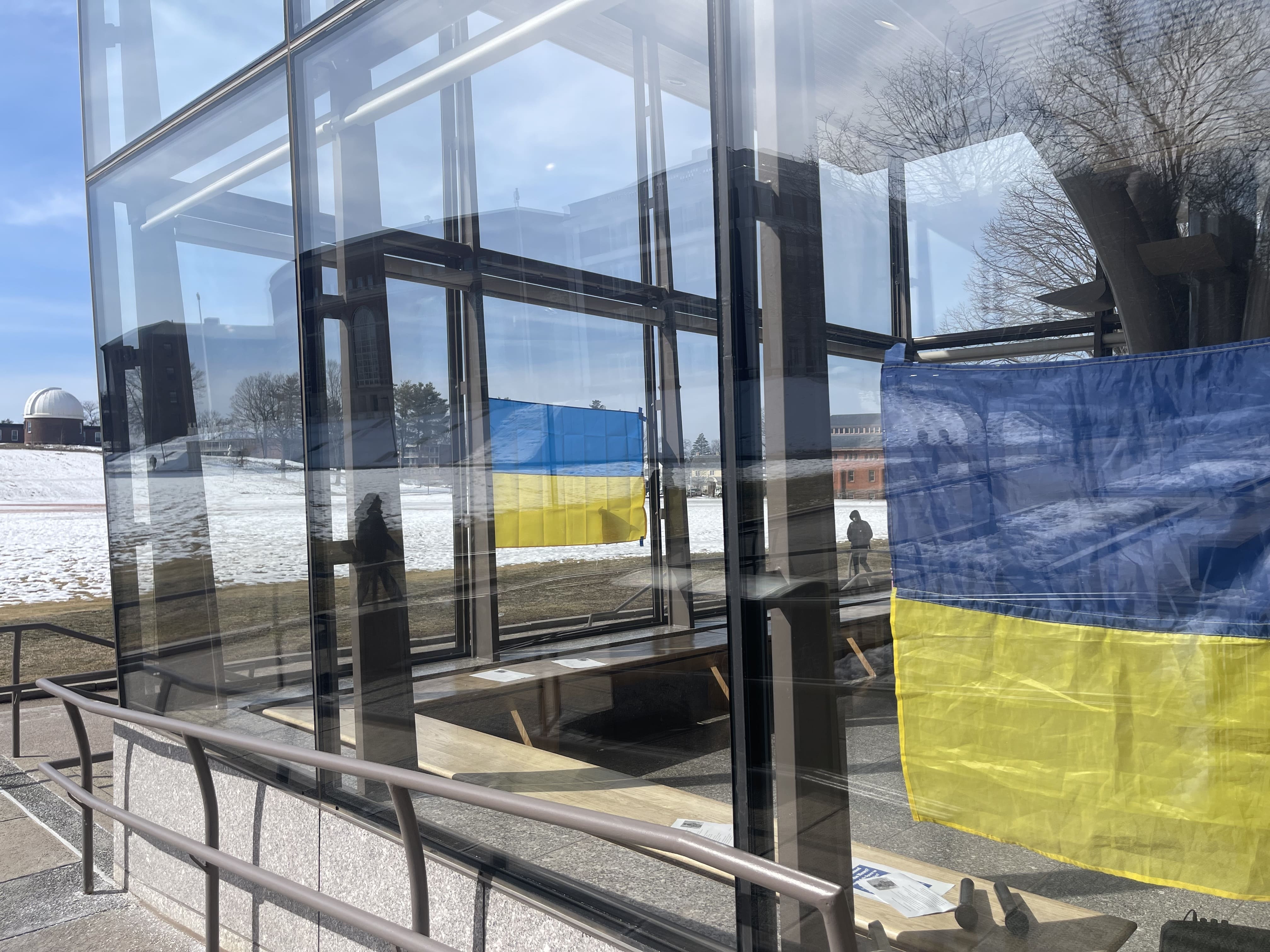
    Ukrainian cities, even those far from the frontline, carry the signs of being part of the country at war. A large part of the central square of my hometown is occupied by masts with Ukrainian flags and photos of the fallen soldiers attached to them. This scene is so vivid with details in my head that I notice every single new flagpole appearing from afar even when running to the bus at the station nearby. 

    I have recently visited the Saint George Cathedral in Lviv. It is almost three hundred years old, but still, it looks quite different now, with all of its sculptures covered up by gray bags with isolating material meant to protect them from the explosion wave if there is a bombing close to the building. What struck me even more, however, was an exhibition about the Greek Catholic priests, nuns, monks, and simple believers who were arrested by the Soviet KGB, often tortured, and sent to concentration camps in Siberia and elsewhere because the denomination was deemed too closely tied to the Ukrainian identity in the Western regions. I thought about the territories that were liberated and where numerous torture chambers were found along with civilians captured there, and the territories that are still occupied by Russia where the number of victims is still unknown. There aren’t many Catholics in the East and the South, but there are other groups targeted by the modern Russian army, like journalists, human rights activists, teachers, LGBTQ+ people, or even simply Ukrainians who insist on speaking the Ukrainian language. 

    While facing the challenges and losses, Ukrainians are still continuing to stand up to tyranny and defending our right to be Ukrainian. We will not give up on any part of our country because we know the horrors of what happens in occupation. There is a high chance that it might get even harder, but I believe that my country will get through that thanks to all the people doing routine daily work that makes up a heroic fight.

    Yaryna Kholod is a member of the class of 2028 and can be reached at ykholod@wesleyan.edu.

  • While Targeting Eastern-European Voters, Kamala Harris Recognizes That Russia Is Not Only a Ukrainian Problem

    What is happening in Ukraine concerns you too.

    That was the message that Ukraine and Ukrainians at home and abroad have been striving to communicate to the foreign public for years now. To debunk the appealing but false notion that Russia will stop at the territories that it occupied in the East and South of Ukraine, I’ve given speeches and hosted fundraisers during my three years of studying in the U.S. Still, the U.S. support of Ukrainian resistance could not be described as steadfast, as Ukraine did not receive necessary weapons for months last spring due to a deadlock in Congress. I experienced the effects of this firsthand when Russia was able to bomb the energy plant in my hometown in Ukraine while our air defense unit simply did not have enough missiles to shoot down the Russian ones. With all this in mind, Kamala Harris’ decision to position herself as a candidate who realizes the risk that Russia poses is an acknowledgment of the concerns of many, including Americans of Eastern-European heritage. 

    As was mentioned in The Argus’ coverage of the presidential debate, Donald Trump’s refusal to declare that he wants Ukraine to win has indeed signaled the lack of a tough approach against the Russian dictatorships. This stands in stark contrast to the Republican leaders of the past, whose stances allowed them to create an image as the party that stands against tyranny. With this reputation fading due to Trump and his supporters, it made a lot of sense for the Harris campaign to work to gain the votes of those who take the threat of Russia seriously. During the debate, the Vice President underscored the importance of American weapons for preserving Ukraine’s independence and democracy before stating that Putin’s ambitions do not end with Ukraine.

    “Tell the 800,000 Polish Americans right here in Pennsylvania how quickly you would give up,” Harris very pointedly remarked to Trump during the debate.

    The digital and TV ads, run by a PAC that is supportive of the Democrats, go further in courting the votes of sizable Eastern-European communities in the swing states. They position Kamala Harris as a successor to the American tradition of defending freedom. This puts her alongside both Democratic and Republican presidents, like Kennedy and Reagan—both of whom were popular among those whose ancestral lands were behind the wall Reagan told to tear down. 

    “If we stand by while an aggressor invades its neighbor with impunity, they will keep going,” she says in the videos.  

    Another ad references Ukrainian history of resisting foreign invasions and features an iconic medieval mosaic of Orans in Kyiv, which is easily recognizable to the Ukrainian diaspora. 

    It would be easy to dismiss these efforts as attempts to woo a specific demographic in the unpredictable toss-up of this year’s election. However, the Russian government has provided more than enough evidence to suggest that the general rhetoric of the above-mentioned claims is true. The last decades were marked by people and whole countries incorrectly believing that Russia would stop its belligerence—first at Georgia, then at the Crimean peninsula of Ukraine, then at the Donbas region, and now at almost one-fourth of Ukrainian territory. It is time to finally recognize that the only way to stop the ever-growing Russian aggression is for Ukraine to have enough arms to stop the advancing Russian army and liberate the occupied territories. 

    The countries that are near Russia realize this, as they know that the same outlandish and pseudo-historic claims that Russian imperialism has over Ukrainian lands could apply to them as well. They saw how the USSR occupied Lithuania, Latvia, and Estonia and installed puppet governments in even more countries. It is also hard not to notice that Russian fighter drones flying over Poland and Romania have become an awfully common occurrence.

    Eastern-European countries have responded to this threat. The Baltic states have been at the forefront of supporting Ukraine with armaments, with the Estonian prime minister saying that there is no “plan B” for the scenario of Russia succeeding in its invasion. Despite the narratives being spread in the U.S. that European countries expect the U.S. to defend them without making their own contributions, they are stepping up their defenses in Poland, for example, raising their military budget to amount to 5% of their GDP. 

    As Ukraine and other countries are determined not to let Russia continue its streak of invasions, the U.S. should strengthen its support of the Ukrainian Armed Forces as well. Prolonged deliberations over a particular kind of weapon being sent or using this assistance as a bargaining chip in inter-party debacles lead to grave consequences that undermine the sovereignty and safety of nations. Let’s hope that understanding this will guide the presidential candidates beyond the fight for votes in swing states. 


    Yaryna Kholod is a member of the class of 2028 and can be reached at ykholod@wesleyan.edu.