Author: Samuel McCarthy

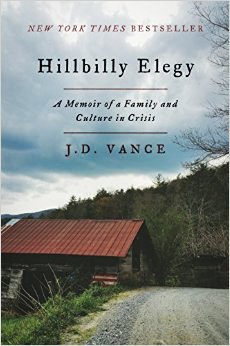
  • In Light of Election, “Hillbilly Elegy” is Relevant and Insightful

    In Light of Election, “Hillbilly Elegy” is Relevant and Insightful

    c/o amazon.com
    c/o amazon.com

    Contrary to many hopes, the 2016 election was not decided by women, immigrants, or people of color. Instead, it was the white working class’s record turnout in states such as Pennsylvania, Ohio, Michigan, Wisconsin, and Iowa that carried Donald Trump to victory. These blue-collar workers, isolated by globalization and modernization and alienated by Democratic identity politics and GOP corporatism, cast their vote for Trump in what The New York Times called a “repudiation of the establishment.”

    In the weeks since the election, blue-collar whites have achieved a near-mythical status in the eyes of the mainstream media and Democratic elite. J. D. Vance’s “Hillbilly Elegy,” published in June, is a timely examination of the white working class that trades condescension for sympathy. Vance’s memoir is the story of his own unlikely ascension from a broken home in Middletown, Ohio to a successful career as a lawyer. Along the way, Vance examines the institutions that failed him and debates the role of individual ambition versus societal influence as the cause of white American stagnancy.

    Vance is the great-grandson of Mamaw and Papaw Blanton, two legendary figures of Breathitt County, Kentucky. Shortly after World War II, Mamaw Blanton’s teenage daughter, also referred to as Mamaw, became pregnant with Vance’s aunt and fled with her boyfriend from the hills of Kentucky to the booming steel town of Middletown, Ohio. Her husband soon got a job at Armco, now AK Steel Holding, and the two began a seemingly middle class life. Mamaw and Papaw were not unique: During the years after WWII, an informal “hillbilly highway” carried thousands of Appalachian farmers from land of their Scots-Irish ancestors to industrial towns in the Midwest.

    Though raised in Ohio, Vance endured an Appalachian legacy of violence and instability. His upbringing was one of constant upheaval. His mother, struggling with drug addiction and mental illness, cycled through numerous short-lived relationships and marriages, and his biological father, a devout Evangelical Christian, remained distant. Only while living with Mamaw in his last years of high school did Vance find enough stability to envision a future beyond the confines of Middletown.

    Although Vance’s life story is captivating, buoyed by characters like the gun-toting, fiercely loyal Mamaw, “Hillbilly Elegy” is at its best when the author broadly examines the culture and society of white, post-industrial America. Vance’s portrait of Middletown is bleak, marked by economic decline, social decay, and, most of all, personal hopelessness.

    “Years of decline in the blue-collar economy manifested themselves in the material prospects of Middletown’s residents,” Vance explains. “The Great Recession, and the not-so-great recovery that followed, had hastened Middletown’s downward trajectory. But there was something almost spiritual about the cynicism of the community at large, something that went much deeper than a short-term recession.”

    Though understanding of the broader economic trends responsible for much of white America’s suffering, Vance can be sharply critical of his community. Working at a supermarket as a teenager, for example, the author is frustrated by welfare recipients wasting government money on T-bone steaks. Vance describes acquaintances who quit their well-paying jobs only to complain on Facebook about the “Obama economy.”

    Although it would be easy for Vance to fill his book with this type of finger-wagging, the author opts for a more nuanced view. Due to factors beyond their control, Vance argues, members of his community feel powerless and become content with stagnation. The author, speaking from experience, proposes that his community needs positive role models to demonstrate that their choices actually matter. Vance credits his own success to the time and effort of others. When the author describes how he avoided the fate of his peers, he is not boasting of his own ambition but celebrating the influence of Mamaw and Papaw on his life’s upward trajectory.

    “Hillbilly Elegy” occasionally feels confused in its balance of personal anecdotes and sociological observation. Vance’s young age and straightforward style can feel skimpy for a memoir, and the book would be strengthened by a more thorough investigation into the greater world of the white working class. When Vance does venture into this territory, however, his observations are acute and impactful, grounded in the events of the story.

    Although “Hillbilly Elegy” is rarely political, its portrait of the white working class helps explain their overwhelming support for Donald Trump. Throughout his campaign, Trump asked black audiences what they “had to lose” by voting for him. But this question is also suited for communities like Middletown, Ohio, where voters elected Trump not to affirm his policies but to voice their discontent. As Vance repeatedly mentions throughout the book, working-class whites are, by some studies, the only group in the country whose economic prospects are continuously declining. Rates of marriage and union membership are falling. Unemployment and drug addiction are on the rise. Trump’s portrait of America was distorted and grim: third-world infrastructure, roving gangs of inner city “thugs,” crooked politicians. While inaccurate, his hyperbolic picture of America echoed the gloomy sentiment of the white working class.

    Like many frustrated voters during the election’s aftermath, I was quick to deem all Trump supporters racist. His campaign, centered around the wall, the Muslim ban, and a law-and-order crackdown, certainly was. But, like all good books, “Hillbilly Elegy,” made me reconsider.

    Liberals, usually quick to highlight how circumstance impacts individual actions, seem to have abandoned this philosophy regarding Trump supporters. Meanwhile, moderate Republicans, champions of so-called personal responsibility, have excused their party’s horrendous mistake by pointing to governmental failures. In “Hillbilly Elegy,” Vance straddles both sides, sympathizing with his community while still holding them accountable for their own choices.

  • Vince Staples and the Meaning of a Viral Video

    Vince Staples and the Meaning of a Viral Video

    c/o spin.com
    c/o spin.com

    On Oct. 5, a video showing a woman’s angry, tearful response to the song “Norf Norf” by Vince Staples went viral. In the clip, she describes the shock of hearing such a vulgar song on the radio and tearfully rants about how such music is affecting the current generation of young people, including her four daughters. The video was quickly shared by major music publications and viewed by over one million people on YouTube.

    It’s easy to imagine that some of the woman’s criticisms of “Norf Norf” come from a malicious place. Are her opinions legitimate concerns for the innocence of her kids, or is she shaken by exposure to the plight of others that she would rather ignore? Does race play a factor in her reaction? Does being middle class cause her to push away from consuming depictions of poverty?

    The Internet was quick to laugh at the woman, and so was I. Totally perplexed, she describes the vulgarity of “Norf Norf” while pining for the completely “sanitized” pop artists of her youth like Britney Spears and Christina Aguilera.

    “Norf Norf” was the third single from Vince Staples’ studio debut, Summertime ’06. An intricate and intense double album, the project is far from the empty hedonism the woman believes it to be. Staples’ lyrics are unabashedly violent, and occasionally crude, but he never lets the listener forget that his art is a reflection of the environment that shaped him.

    “I just want to help people understand that we don’t get to pick, bro,” Staples said of his music. “We don’t get to pick where we was from. That ain’t how it works.”

    Over the past few years, Staples has proven himself to be one of the most intriguing, complex, and surprising artists in hip hop. As a musical celebrity, he is something of an enigma. His grim and unrelenting musical persona, for example, stands in stark contrast to his upbeat and witty online presence. As an artist, Staples is consistently excellent; even his earliest mixtapes show a knack for musical cohesiveness that is rare in many established musicians. Staples continues this winning streak on August’s Prima Donna (EP) in which he expands on the lyrical themes of his older work.

    Considering the thoughtfulness of his past endeavors, Staples’ reaction to the “Norf Norf Rant” is unsurprising. Staples shot back at his fans in a series of tweets, claiming that the woman “is clearly confused on the context of the song which causes her to be frightened,” and that “no person needs to be attacked for their opinion on what they see to be appropriate for their children.” His tweets made me give the clip a level of consideration that I might not have otherwise. The woman’s video is a vehicle for valuable questions about the purpose of art, the cultural barriers that divide its listeners, and the reasons why people reacted so strongly to the video in the first place.

    Like Staples, this woman is a product of her environment. Based on the clip, it is reasonable to conclude that her views are conservative-leaning and that she has lived a somewhat sheltered life. Considering this, how else would she have responded to lyrics like “folks need Porsches, hoes need abortions”?  Of course she doesn’t want her children to hear about moving drugs and running from the police. She doesn’t want to hear these things herself. Of course she would rather they don’t know what an AK-47 or a Crip is. She would rather not know herself.

    Staples likes to harp on the demographics of his audience and for good reason. A large section of Vince Staples’ following are flannel-wearing, Pitchfork-reading white people. For this demographic, bitterly attacking the “Norf Norf” woman reinforces a notion of superior cultural and artistic understanding. It is a way of patting oneself on the back for being a good, enlightened white person.

    “Who the activist and who the devil’s advocate?” Staples asks on the opener of Prima Donna (EP). I never thought about the line seriously until considering it within the context of this video. By condemning this woman, are we genuinely pushing for change in mainstream American opinion? Or are we devil’s advocates, criticizing for the sake of criticism? As Staples suggests in his lyric, the distinction isn’t always clear.

  • Isaiah Rashad Shows Growing Potential on Compelling, yet Flawed Studio Debut

    If Isaiah Rashad’s 2014 EP Cilvia Demo was notable for anything, it was the rapper’s unfiltered honesty. Lacking the technical brilliance of Top Dawg labelmate Kendrick Lamar or the pop appeal of Top Dawg-signed Schoolboy Q, Rashad offered listeners a hazy vision of hip hop, aided by stellar production and lyrics that candidly dealt with depression, childhood, and drug abuse. This sincerity helps define Rashad’s uneven, imperfect, and highly compelling debut album The Sun’s Tirade.

    Though Rashad is certainly a skilled rapper, his previous work often sounded like an attempt to catch up with his nimbler labelmates rather than carve out a voice of his own. On The Sun’s Tirade, Rashad emphasizes delivery over technicality, opting for spacious rhymes that inhabit instrumentals rather than sit on top of them. Like Kendrick, Rashad’s voice is versatile. He alternates between a mumbled Southern drawl and a goofy, melodic flow. Though he enlists guests for the more complex hooks, Rashad is able to convincingly carry a tune as he does on “Rope” and “Silkk da Shocka.”

    Rashad is as capable of poignant poetry as he is of trite misogyny and cliché. His lyrics, in fact, provide The Sun’s Tirade with its most powerful moments as well as comprise its greatest missteps. The hook of “4 da Squaw” has the rapper comparing his own problems with those of his son, quietly telling him “you ain’t nothin’ but a baby, your fear is growin’ up.” Rashad incorporates an imitation of his son’s gibberish in the same chorus. It’s touching, clever, and a brilliant showcase of the rapper’s melancholic drawl. There are equally moving moments on the record, like on “Silkk da Shocka,” where Rashad tells a lover: “I see the world from your eyes/You pulled the thorn from my side.”

    Rashad’s lyrics draw from the turbulent period in his life since the release of Cilvia Demo. Over the past two years, the Top Dawg rapper has battled depression, developed an addiction to alcohol and Xanax, had a second child, and tempted his label to drop him. Rashad’s willingness to talk so openly about these topics, particularly mental illness, is an admirable quality in a genre that still prizes masculinity and bravado over vulnerability. With that being said, Rashad often derails his own lyrics with empty misogyny, like on the hook to “Tity and Dolla” and all over the underwhelming tracks “Park” and “A lot.”

    Rashad’s occasionally lackluster lyrics are made up for by the Sept. 2 release’s uniformly excellent production. The instrumentals delicately balance electronics with live instrumentation, often to the point that they are indistinguishable. The beats draw from genres as disparate as boom bap, soul, and classic rock, but never feel pastiche; snappy drums and grinding bass keep the music grounded in the present. Most importantly, the music is a logical extension of Rashad’s lyricism. The sluggish psychedelia of “Bday” matches the rapper’s image of stumbling drunk to a brothel; the rumbling bass of album highlight “Stuck in the Mud” sounds like the sludge Rashad finds himself in. The sole outlier is “A lot,” whose robotic, Mike WiLL Made-It beat sounds utterly out of place on an album of sentimental, intricate instrumentals. Mike WiLL is the only big-name producer on the album, and it shows; most of the other beats feel curated to craft a cohesive sound.

    Featured vocalists are employed with the same choice of talent over ubiquity. The malleability of Rashad’s voice gives him great chemistry with guests, and this holds true for most of the features on The Sun’s Tirade. As he’s shown in the past, Rashad makes some of his best music with labelmate and singer SZA, who appears on the seven-minute “Stuck in the Mud.” The two disappointing features are verses from Hugh Augustine and Jay Rock on “Tity and Dolla,” thematically linked by the same weirdly off-putting chauvinism.

    The only A-list feature on the album is a verse from Kendrick Lamar on the standout “Wat’s Wrong.” Lamar bombards the listener with beautifully disturbing images of riding around in his father’s haunted Mercedes with a “three-piece chicken dinner and shotgun,” or holed up in the Trump Tower, spray-painting the walls and smoking weed. Like most of Kendrick’s work, it is a dazzling balance of technicality and poeticism, sin and godliness, wrath and justice. Although the record undoubtedly belongs to Rashad, Kendrick’s fingerprints are everywhere from Rashad’s frank discussion of suicide on “Rope,” to the cartoonish vocal inflections on “Free Lunch,” to the wailing alto sax of “Brenda.” Rashad makes no attempt to conceal the fact that his album was created in a post-To Pimp a Butterfly musical landscape.

    The Sun’s Tirade, however, is indicative of an even greater trend within hip hop. The year’s best rap albums (including releases from Kendrick, Anderson .Paak, Chance the Rapper, and his Chicago affiliate Noname) simultaneously demand more from the artist and more from the listener. Rappers are expected to be able to sing, or at least rap, exceptionally; beats incorporate layers of live instrumentation, expanding their scope to encompass genres like jazz and gospel. Although far from perfect, The Sun’s Tirade lands among these albums as a forward-thinking, inventive piece of music, suggesting that Rashad’s best music may still be ahead of him.