
Author: Kaye Dyja

  • In Honor of the 50th Anniversary of Earth Day

    To the Editors of the Argus,

    April 22nd, 2020 marks the 50th anniversary of the first Earth Day celebration.

    This tradition began when Senator Gaylord Nelson proposed a teach-in for April 22, 1970, on the topic of nature and environmentalism. According to an estimate on the EPA website, some twenty million Americans participated in peaceful public demands for attention to the environment on that day—in 1970, that was ten percent of all Americans. Media coverage reached many more. Since then, Americans and (after 1990) the world celebrate the planet, and make commitments to sustainability, environmental protection, and awareness.

    While the shelter-in-place instructions inhibit meaningful social gatherings like hikes and protests, they cannot stop all types of activity. For one, if you have the ability to go outside, do it! Go outside, be in nature, appreciate the gifts of this planet. This year, Earth Day offers us the unique opportunity to appreciate something that, until quarantine, was banal for most. You can take a few minutes to connect with your immediate environment by walking around your neighborhood (with the proper precautions of course), sitting under a tree, or listening to the sounds around you. Consider how the coronavirus pandemic has affected your neighborhood’s relationship with its environment, and your own.

    Earth Day can still be a day of action. Many of the planned Earth Day events will no longer take place due to the closure of campus; that being said, we can still support its message by engaging in activities from our places of quarantine. Here is a list of just some of the events in Connecticut and online where you can attend, listen, and actively participate:

    https://docs.google.com/document/d/14iQV0vilZUL-5noZvwOjQCDBWmzWFLU4pEQnLvV7dRw/edit.

    Action is needed at both the individual level and the University level. Though we understand that Wesleyan University has been dramatically affected by the challenges associated with the pandemic, we urge the University to uphold its commitments to sustainability efforts. Though the economic impacts of the coronavirus will necessitate financial austerity on the part of the University, this austerity must not come at the price of sustainability. Earlier this year, our class made a trip to Physical Plant’s power station. During this trip, Andrew Plotkin, Project Engineer for Physical Plant, shared with us his plan to convert Wesleyan to more efficient heat pumps, which though they still require fossil fuel power, would reduce energy demand significantly. This process would only be the first step in his multi-step program to make the university completely carbon-neutral. Mr. Plotkin was not coy about the cost, time, and labor that would be involved in this ambitious project. We are calling for his ambition to be matched by the University. Climate change is more than a financial inconvenience, it is an existential threat. If Wesleyan acts as a model for other institutions, we could effect meaningful change.

    Signed, PHYS105/ENVS235 – Radical Sustainability: Levi Baruch Miles Brooks Marissa Rose Chang Alissa Dobrinsky Harper Gambill Jon Hollister Giacomo Marenco di Moriondo Samuel McCarthy Cal Mirowitz Molly Mittelbach Maggie O’Hanlon Abi Pipkin Maggie Polk Cassidy Soloff Grayson Squires Brian Stewart Shaya Tousi Olivia Weiss Joey Young

  • State Senator Lesser and Representative Phipps Discuss State Politics

    The Wesleyan Democrats hosted a Middletown State Legislators Forum featuring Connecticut State Senator Matt Lesser and State Representative Quentin “Q” Phipps on Tuesday, Jan. 28. The two legislators discussed topics ranging from public transportation and the legalization of marijuana to bills they’re working on and their endorsements for the 2020 presidential primary.

    Lesser and Phipps began by outlining their paths into the state legislature. Lesser first got into politics when he was a student at Wesleyan after receiving a call from the Middletown Democratic Town Committee Chair asking him to run for mayor. Instead, Lesser decided to run for a seat on the Planning and Zoning Commission—against Phipps—and ended up winning. He then got a job on President Barack Obama’s first presidential campaign, which strengthened his passion for local and state politics.   

    “I saw something happening around the country,” Lesser said. “I thought things were changing in a big and meaningful way. At the time, Middletown actually had a Republican State Representative, gerrymandering in a way, so it was a really Republican district. But I thought young people were getting involved, communities of color were getting engaged—the country was changing—so I said, you know what? If nobody else wants to run, I’ll take a stab at this. I’ll run for state elected office. So I ran, and I won.” 

    Since then, Lesser has served in the Connecticut House of Representatives for ten years, until his election to the State Senate two years ago. During his time in the State Legislature, Lesser has realized the tremendous importance of state politics.   

    “What really matters in terms of people’s lives happens at the state level,” Lesser said. “I don’t know what’s going to happen in Iowa, I don’t know what’s going to happen in November, but I do know that if you want to build real lasting progressive change, it’s going to start on the state and local level.”

    Unlike Lesser, Phipps has always been in politics; his first election was in sixth grade, and he’s served in elected office ever since. Phipps is a Middletown native and currently serves as the State Representative for the 100th district. In Middletown, Phipps has served on the Planning and Zoning Commission and was unanimously elected as its Chair in 2011. He has served as City Treasurer since 2011 and was elected to the State House in 2018. 

    “I see politics and government as a source of empowerment,” Phipps said. “I think many times folks don’t think government can work because they feel disconnected from it, because they don’t know how to reach their legislators. They speak up, and no change happens…. I think when you have Democrats who believe government can and should work, the community goes in the right direction.”

    After explaining their backgrounds, Lesser and Phipps answered questions from the audience. One question tackled issues regarding tolls and mass transit in Connecticut and whether or not Lesser and Phipps were working on making transit more accessible to a wider range of constituents. 

    Lesser explained that the fight for paying for transportation in Connecticut is years old and that the state desperately needs sustainable funding mechanisms for transportation. He also emphasized the need for increased spending on mass transit, bikes, buses, and sidewalks. Phipps agreed, but also argued that Connecticut and Middletown should follow the model of Kansas City and push for free mass transit. They also discussed the need for improving the Connecticut 55 Bus (which runs between Hartford and Middletown) as well as strengthening intercity bus services. 

    Lesser and Phipps also dove into specific bills and projects that they’re working on in the legislature. As Phipps explained, he’s helped launch the Downtown and Main Street caucus, which specifically works on strengthening traditional Main Streets in towns like Meriden and Middletown. While the caucus has only held two meetings thus far, they have focused on making more affordable housing options, safer walkability, and increased transit options. Phipps has also worked on voting bills that are pushing for the expansion of early voting and access to absentee ballots.

    While Lesser has also helped with Democratic voting initiatives—such as a bill requiring college campuses to have a polling place—he’s primarily focused on health care policy. As he explained, his top priority is to cap the amount of money that people have to pay for insulin. 

    “We’re seeing people die around the country,” Lesser said. “A guy named Alex Smith in Minnesota turned 26, fell off his parents’ health care plan, and died. People have to live with insulin. If you’re a type one diabetic, you can’t go more than 24 hours without insulin or you will die. There are people in this state who are paying $2500 a month because they have high deductible health plans, just to get the insulin they need. We’re going to end that.”

    Phipps and Lesser also talked about the legalization of marijuana. Lesser alluded that the legalization seems to be in the works, but Phipps argued that he will not support a bill that does not primarily focus on the expungement and elimination of criminal records regarding marijuana. 

    “There are suggestions that we could just have [marijuana] legalized and not worry about the expungements,” Phipps said. “For those that aren’t aware, typically when you tell people of color or people that have been oppressed before that ‘Just wait you’re time is coming, don’t worry about your rights,’ that doesn’t work too well for us. I unquestionably will not support any bill that doesn’t have an equity lens, and I will not support a bill that doesn’t have the expungement come first.”

    Lesser and Phipps concluded the forum by talking about their endorsements for Senator Elizabeth Warren and asking for students’ help in their offices and on their re-election campaigns.

    Kaye Dyja can be reached at kdyja@wesleyan.edu. 

  • GOVT372 Survey Looks At Loud Side, Quiet Side Political and Romantic Divides

    This semester, GOVT372 “Political Communications in a Polarized Era” conducted a campus-wide survey to examine University students’ political perspectives, which addressed topics such as students’ positions on the Democratic primary field, knowledge of political issues, and overall partisan socialization. Fielded in mid-September, the class has been analyzing the data over the course of the semester. 

    Overall, the survey received 700 student responses, but included slightly more women and fewer students of color than the greater University population. Fifty-five percent of respondents identified as female, and 40 percent identified as male; 28 percent of respondents identified as students of color; and 15 percent were international students. Additionally, 44.7 percent of respondents identified themselves as a part of the upper-middle class, and the majority of students—33.4 and 33.3 percent, respectively—identified as from an urban or high-density suburban hometown. 

    For years, University students have joked about cultural and social differences between those who sit on the West Wing and Mink Dining Hall—Loud Side and Quiet Side, respectively—of the Usdan University Center’s dining hall. To investigate this perceived divide, the survey asked respondents “With which side of Usdan do you identify?” The class then compared these results to political perceptions and affiliations. According to the data, 48.7 percent of respondents identified as a part of the “Quiet Side,” 22.6 percent identified as a part of the “Loud Side,” 20.6 percent as identified as a part of both sides, and 8.1 percent as neither side. 

    One of the first questions on the survey asked what students saw as the most pressing issues currently facing the United States. According to the data, the majority of students are most concerned with the environment. This was followed by gun violence, and then race relations.

    Students in GOVT372 then looked at these results in comparison to “Loud Side” and “Quiet Side” respondents. According to the data, students who identified as a part of the “Quiet Side” supported Senator Elizabeth Warren most strongly, followed by Senator Bernie Sanders. While “Loud Side” respondents also primarily supported Warren, their second favorite was equally divided between former Vice President Joe Biden and Sanders. Both received 15.7 percent of the “Loud Side” respondents’ support.

    Graph1

    Figure 1. Total student response to the survey question about Democratic Party candidate preference.

    Despite these results, the data show that the student body is also concerned with the notion of electability. When asked who had the best chance of beating President Donald Trump—regardless of who students individually support—respondents most heavily supported Biden, followed by Warren and then Sanders. 

    Another section of questions that the survey looked for was partisan socialization. When asked if students had any friends on the opposing side of the political spectrum, 54.5 percent of students said no. When broken down by geography, urban students were by far the least likely to be friends with political opponents. High-density suburban, low-density suburban, and rural students, on the other hand, were more likely to be friends with people from the other side of the political spectrum.

    Picture2

    Figure 2. Distribution of partisan socialization, as moderated by students’ hometowns

    The class also compared these results to “Loud Side” and “Quiet Side” respondents. According to the data, students who identified as a part of the “Quiet Side” were the least likely to be friends with political opponents, whereas students on the “Loud Side” were the most likely.

    Picture3

    Figure 3. Answers to the question of socialization with people in another party, moderated by Usdan side preferences.

    The survey also asked if students would date someone across the political aisle. 43.7 students responded “maybe,” 30 percent responded “no,” 26.3 percent responded “yes.” When divided by “Loud Side” and “Quiet Side,” however, the results look different: While the “Quiet Side” overwhelmingly said they wouldn’t date a political opponent, those who said they preferred neither side, the “Loud Side,” and both sides all said yes or maybe.

    Picture4

    Figure 4. Responses to the question of whether students would date someone across the aisle, based on Usdan side preference.

    Remaining survey data will be distributed to the wider student population likely by the end of the semester.


    Kaye Dyja can be reached at kdyja@wesleyan.edu

  • California Students React to Wildfires at Home

    California Students React to Wildfires at Home

    c/o wsj.com
    c/o wsj.com

    Throughout the past several weeks, wildfires in both Northern and Southern California have destroyed buildings and forced thousands to evacuate from their homes. This is not the first time that California has been ravaged by wildfires; in 2018, wildfires throughout the state killed 31 people. Wesleyan students from California have been experiencing this continuing devastation from across the country. 

    The Kincade Fire, which began on Oct. 23, in Northern California’s Sonoma County, destroyed 374 structures, including 174 residential homes. As the blaze grew to about 76,000 acres, only about 45 percent was ultimately contained. In the south, the Gerry Fire struck the Los Angeles basin, forcing 10,000 structures under mandatory evacuation order. Eventually, the fire spread to over 700 acres, including parts of the the 405 Freeway, one of Los Angeles’ busiest highways. While many of the fires have now been contained, three of the fires—the Ranch Fire, the Taboose Fire and the Cow Fire—are still active. 

    Tommy Graves ’23, who is from the Pacific Palisades area, discussed the devastation unfolding near his home and what it’s like to watch such a tragedy from 3,000 miles away.

    “Wildfires are so at the mercy of the winds. There isn’t anything I can do,” Graves said. “Even if I was there, you just have to hope the winds don’t pick up in your direction. You’re just entirely at the mercy of the wild, which is very spooky. Especially being here, you feel particularly helpless because I can’t even help my family and friends pack up and move if they hypothetically had to evacuate.”

    Students shared the difficulties of learning about the fires over social media and the news, speaking to feelings of helplessness.

    “It’s just like, what can you do?” Katie Stewart Frizzell ’20, from Mandeville Canyon, said. “At a certain point, it’s weird to hear about it because you see these apocalyptic pictures online, but there’s just nothing you can do.”

    Students also face heightened anxiety due to the media’s potentially sensationalized coverage of the fires. 

    “Being far away during a time like this was very difficult, since I was receiving so much information from different outlets and it was hard to really understand how bad the damage was and how much danger my house was in,” Grace Rose ’21, from the Pacific Palisades, wrote in an email to The Argus. “No matter how much my family reassured me we were going to be fine, the news always seemed to make the situation appear more serious.”

    c/o newsweek.com
    c/o newsweek.com

    “My parents grew up in California and were born there, so they’re so used to these fires,” Katie Lord ’20, who is from the Los Angeles area, added. “They’re not too moved by it and don’t tell me many of the details about it, so when I see it on social media, I begin to freak out because I see my house on the news or how many houses around me are affected. I get way more freaked out on social media before talking to my parents.” 

    Despite the struggle of constantly seeing the devastations online, the consistency of the fires has also desensitized many students’ perceptions of them. 

    “It’s definitely becoming more normalized. Just the constant wildfires happening all over the state—like these massive destructive wildfires that are killing tons of people—are just no longer jarring to me anymore,” Graves added.

    The University has also recognized the severity of the fires by extending the Early Decision application deadline for students affected. 

    “Mindful of the toll the wildfires in California are taking on some communities, Wesleyan is extending the Early Decision deadline for students and schools from the affected areas until Friday, November 22nd,” the University Admissions & Aid website reads. “If the application fee poses a financial hardship, please request a waiver and rest assured that it will be granted.

    As these fires continue to blaze, students have raised ideas for long-term solutions for combating wildfires. 

    “In the short-term it’s really difficult because it’s so dry, windy, and hot, specifically during the fire season, that there’s not really much the government can do,” Graves said. “But obviously climate change legislation is the only long-term solution, but right now we’re just so vulnerable because there’s so much dry, burnable material across the state.”


    Kaye Dyja can be reached at kdyja@wesleyan.edu.

    Nate Schultz can be reached at nschultz@wesleyan.edu

  • USLAC Leads Protest During Homecoming Game

    USLAC Leads Protest During Homecoming Game

    Magda Kisielińska, Photo Editor
    Magda Kisielińska, Photo Editor

    Student activists representing the United Student/Labor Action Coalition (USLAC) held a protest during the Homecoming Football game on Saturday, Nov. 2, continuing to demand the hiring of five more custodial workers. The group of approximately 30 students walked around the perimeter of Andrus Field during halftime. 

    The protest is part of USLAC’s ongoing efforts that began in October 2018 demanding that the University hire five more custodial workers. While the University announced the hiring of one more worker on Sept. 3, USLAC has stuck to its demands for five more custodial workers. 

    “Over the summer they hired one more worker,” USLAC member Harry Bagenstos ’22 said. “That’s great, but our sense is that a lot of these problems still exist, and the only way they’re possibly going to solve them is if they actually complete our demands.” 

    The protest began between Judd Hall and the Public Affairs Center (PAC). Holding a large sign that read “Workers’ Rights Now,” the group of students walked back and forth between Usdan and Judd Hall. Protesters chanted different messages directed at the administration, such as “Roth’s salary stays protected, workers’ rights are not respected,” “No justice, no peace,” and “Michael Roth don’t be a jerk, workers make this campus work.” 

    The group then walked towards the Wesleyan tailgate, which consisted of many students and families attending the football game. As the group approached the tailgate, some students joined the protesters and grabbed signs. The group then stopped in front of the Wesleyan tailgate for about five minutes, continuing their cheers and chants. 

    Students and families at the Wesleyan tailgate had varied reactions to the protest. Some students commended USLAC’s protest and their ongoing commitment for five more workers.

    “The protest definitely caught my attention,” Charlie Hills ’20 said. “I think it’s great that USLAC is continuing to advocate for workers’ rights at this school, and I think collective action is always a great way to bring attention to issues like these.”

    Others, however, felt that the protest was out of place.

    “I thought it was well organized but maybe not executed at the best time when the most people were listening,” Vanessa Baker ’20 said. “The audience was huge, but no one really knew what they were protesting, unless you’re a student who had heard about it before. Most of the parents were confused.” 

    The group then walked behind the Wesleyan tailgate towards Olin Library, concluding at their starting point between Judd Hall and PAC. They ended the protest chanting, “We’ll be back!”

    After the protest, USLAC members addressed their decision to protest at the Homecoming football game.

    “We decided the best time to meet was during Homecoming weekend [because we thought] it was important to continue putting pressure on the University at a time when there is a lot of excitement over things like football and school pride,” USLAC member Leah Levin Pensler ’20 said. “We wanted to draw attention to something that the school really should be ashamed of, and it’s the working conditions on this campus and how they treat their subcontracted custodial workers.” 


    Kaye Dyja can be reached at kdyja@wesleyan.edu

  • CAPS Begins Drop-In Support Sessions, Looks to Meet Highest-Ever Student Demand
    CAPS Begins Drop-In Support Sessions, Looks to Meet Highest-Ever Student Demand

    Tanvi Punja, Staff Photographer
    Tanvi Punja, Staff Photographer

    Counseling and Psychological Services (CAPS) began clinical drop-in support sessions this semester to address high demand for their services, as well as to help students manage growing wait times between appointments. 

    To accommodate more students’ needs, clinical drop-in sessions take place Monday through Friday in the CAPS solarium from 12 p.m. to 1 p.m. A clinician is available during these sessions, and students can attend the entire hour or only drop in as needed. Students should be mindful that these sessions are not private.

    “Students who are considering attending a drop-in support group should be aware it is not group therapy in a traditional sense,” Jennifer D’Andrea, Director of Counseling and Psychological Services, said. “The clinician is available to talk through student concerns, offer problem-solving strategies, and connect students to resources both on campus and in the community. Students should also be aware it is not a one-on-one session with a clinician; they should expect to see other students there and have some comfort with accessing support in a group environment.”

    The need for more counseling services comes after a longer struggle to fill vacancies throughout the department. In September 2018, there were multiple vacancies for therapists, and the Advanced Practice Registered Nurse (APRN) had resigned. Since then, the department has been working to fill multiple vacancies and expand resources. In January 2018, CAPS hired Tamanna Rahman as the new APRN, whose arrival followed the addition of two new full-time psychotherapists, Priya Senecal, LPC, and Ginnie Taylor, Ph.D.

    “The demand for [CAPS] services has been very high for years now,” D’Andrea said. “This year the demand is higher than ever before. We began the clinical drop-in support space this semester to assist students with managing the wait to their intake appointments. We also hope it will help to bridge the gap between therapy appointments, which take place biweekly in most cases.”

    CAPS hopes that the sessions will be a helpful tool for students who are considering making a personal appointment, but don’t feel comfortable.  

    “They can stop by, see our office, and get a sense of what it is like to talk with a therapist,” D’Andrea said.

    To join a session, students only have to fill out a sign-in sheet. Students may also attend as many of the sessions as they wish.


    Kaye Dyja can be reached at kdyja@wesleyan.edu.

    Oliver Cope can be reached at ocope@wesleyan.edu.

  • It’s Time We Start Paying Attention To The Elections That Really Matter

    It’s Time We Start Paying Attention To The Elections That Really Matter

    As the Democratic presidential primary heats up, Americans are obsessing over every headline, every tweet, and every possible detail related to the 2020 presidential election. While this race is important—and should command attention—it’s not the only upcoming election with serious, long-term consequences. 

    This November, 538 state legislative seats are up for election, and another 4,798 state legislative seats are up for grabs in November 2020. Within the next two years, 14 gubernatorial seats will be decided. After losing over nearly 1,000 state seats in the Obama era, Democrats cannot achieve widespread political dominance without flipping these state legislative seats from red to blue.

    Many Americans don’t recognize the power of state legislatures. Along with controlling whether or not we have a democratic voting system, state legislatures determine funding for education, health care access, and abortion rights. They decide what the minimum wage should be, and if individuals can carry guns. And, with the addition of Associate Justice Brett Kavanaugh to the Supreme Court, states are the last line of defense to safeguard reproductive rights, environmental protections, and keep dark money out of politics. 

    In GOP-controlled states, lawmakers have passed a slew of terrifying, extremist legislation that have damaged the lives of millions of Americans. For example, in 2019 thus far, nine states have passed laws prohibiting abortion or greatly decreased access to the procedure. Laws like the “heartbeat bill” have forced individuals to travel miles away from home and put their lives at risk to obtain basic healthcare access, all thanks to Republican controlled state legislatures. 

    But that’s only the beginning. In terms of gun control, GOP-held states have done nothing to protect their constituents against violence, even in light of horrific mass shootings. After the mass shooting at Virginia Beach that took 12 innocent lives, the Virginia GOP ended a special session on gun violence prevention without voting on a single piece of legislation. Similarly, after the El Paso shooting, instead of beefing up its gun regulations, Texas’ GOP-held state legislature actually weakened its gun laws. As of Sept. 1, Texas allows individuals to transport and store guns on school grounds, permits gun storage in foster homes, and bans landlords from including “no firearms” clauses in their leases. 

    It looks even worse for voting rights. Last year, Floridians overwhelmingly passed Amendment 4, which restored access to the ballot box to over 1.4 million formerly incarcerated individuals. But instead of adhering to the will of the people, Republican Governor Ron DeSantis and GOP state lawmakers passed a modern poll tax that limits voting rights restorations by excluding those who haven’t paid fines or court fees related to their sentences. 

    Believe it or not, these are only a tiny fraction of the horrible actions and pieces of legislation taking place at the state level. 

    In Democratic states, however, things look very different. Democratic-controlled state legislatures have passed progressive, inspiring legislation like automatic voter registration, pro-choice and LGBT protections, groundbreaking climate regulations, and effective gun violence prevention legislation. After Democrats flipped Maine’s state legislature last November, the state expanded abortion access by allowing all insurance providers—plus Medicare—to cover the procedure. The same happened in New York; after electing a progressive state legislature, within the first 30 days of its first session the state expanded abortion access. 

    Democratic state legislatures have also passed sweeping gun safety legislation that has protected millions of Americans from violence. As Giffords Courage states, after the mass shooting in Sandy Hook Elementary School in 2012, Connecticut overhauled its gun laws and currently has one of the lowest gun death rates in the nation. Similarly, California has some of the most comprehensive gun violence prevention laws in the country. Since 2018, no one under 21 years old can buy rifles or shotguns, and anyone convicted of certain domestic violence charges will face a lifetime ban on gun ownership. 

    But the legislation that comes out of state houses is not the only repercussion of state elections. In 2021, state legislatures will draw new district maps that will determine state and congressional power for the next decade. The last time the stakes were this high was in 2010, when Republicans rode the Tea Party wave to victory and flipped 681 state seats from blue to red. These Republican majorities in state legislatures across the country drew gerrymandered maps that systematically disenfranchised swaths of Democratic voters, especially voters of color. 

    These intentionally unfair, discriminatory maps have led to Republican congressional victories that are grossly disproportionate to their vote share. For example, in one of the most egregious gerrymanders in the country, the North Carolina GOP barely achieved a narrow 51 percent majority of all votes cast for congressional seats, but still won 10 of the state’s 13 congressional seats. This problem is not unique to North Carolina. In 2018, Democrats in Wisconsin won a majority of the vote—54 percent—but only three of the eight congressional seats. In Ohio, Democrats won 50 percent of the vote but only 4 of the 16 congressional seats. 

    While an obvious solution to blocking gerrymandering would be through the judiciary, this route is becoming less and less feasible. In a high profile case last June, the Supreme Court narrowly ruled along party lines that federal courts do not have jurisdiction over state maps, and are thus powerless in defending against gerrymandering. 

    Nonetheless, several states have given us reason for hope regarding the future of redistricting. Eight states already have implemented independent redistricting commissions, and many Democratic state legislative candidates are running on a platform of supporting the relinquishment of power to draw maps to independent commissions made up of political outsiders. However, these commissions still face fierce opposition from Republicans. In Michigan, a 2018 measure to appoint an independent redistricting commission passed, but Republican state lawmakers have filed a baseless lawsuit arguing that excluding political actors is unconstitutional. 

    Despite the tremendous power and impact of state legislative races, they’re much less expensive than federal races. Many state legislative races cost less than one-tenth as much as congressional races. Research conducted by Future Now Fund, a Political Action Committee that works exclusively on state races, found that it often costs less to flip entire chambers of state legislatures than to win just one competitive congressional seat. In fact, Future Now Fund estimates that it would likely take only $100,000 to flip the entire Montana House of Representatives. This stands in stark contrast to congressional races, which can cost up to $20 million in the most competitive districts. 

    Luckily, there’s been some momentum as Democrats are finally realizing the importance of state legislatures. Groups like Future Now Fund, Flippable, Forward Majority, and the People PAC—all of which started after 2016—have drawn much more attention and funds to these races. Despite these gains, PACs raising money for federal races dramatically outpace these groups. 

    Yes, it’s an uphill battle. But it’s a battle worth fighting for. If we really want to save our democracy, it’s time we look to the states.


    Kaye Dyja can be reached at kdyja@wesleyan.edu. Kaye is a member of the class of 2020. 

    Charlie Hills can be reached at chills@wesleyan.edu. Charlie is a member of the class of 2020. 

    An earlier version of this article incorrectly stated the Montana legislature when the authors meant the Montana House of Representatives. 

  • President Roth Talks “Safe Enough Spaces,” Free Speech, and Political Correctness

    President Roth Talks “Safe Enough Spaces,” Free Speech, and Political Correctness

    44174553._UY1500_SS1500_
    c/o goodreads.com

    President Michael Roth ’78 spoke about his new book, “Safe Enough Spaces,” with Roxanne Coady, owner of the R.J. Julia Booksellers, at the University bookstore on Thursday, Sept. 26. While the conversation mainly focused on issues regarding free speech and political correctness on college campuses, student and faculty protesters also voiced concerns about University workers and faculty rights. 

    Coady began the talk by asking Roth about the timing of his book and why he chose to publish a work focused on safe spaces. Roth explained that he first became interested in how people conceptualize the past, whether that be through the history of philosophy, psychology, or political theory. But more specifically, while rooted in these foundations of history and memory, Roth wanted to defend liberal education in response to a plethora of critics complaining about higher education.

    “I noticed this cascade of writers and pundits rolling their eyes on the page about college today, the problems of universities, closed mindedness, political correctness—there were these critiques that just went on and on,” Roth said. “It really came together as really a way of pushing back against what I think of as the tradition of Allan Bloom to the present, of people trying to write books that would sell to middle-aged people because they complain about young people.”

    The conversation then pivoted to the exploration of issues regarding free speech on campus. Coady raised the question about the definition of free speech, asking Roth to explain which actions qualify as protected speech and which should have consequences. He first responded by outlining the history of protected speech in legal history, highlighting the decision made in Citizens United v. Federal Election Commission (2010) in which the Supreme Court granted free speech protections to corporate spending in elections. When free speech is defined as an expression, Roth said, it is generally protected by the First Amendment. 

    However, Roth ultimately argued that a free market approach to free speech isn’t sufficient, particularly in a university setting. Instead, there must be a certain kind of speech that fits moral, educational, and political judgments.

    “At colleges and universities, we are always making judgments about what kinds of speech are educational for our students,” Roth said. “We should err on the side of breadth and to open our minds to thinking and new kinds of expression that might be educative. But that doesn’t mean we have to open our minds so much that our brains fall out and we can’t make judgments.”

    In response, Coady brought up the concept of liberal snowflakes, asking Roth whether or not universities should mandate what Roth calls “affirmative action for conservatives.” Roth explained that he felt as though people often think that students are far more sensitive and fragile than they really are. In reality, he argued, students are comfortable engaging with opposing ideologies and support free speech at higher rates than older people. Roth cited originalist former Associate Supreme Court Justice Antonin Scalia’s visit to campus in 2012 as an example of student engagement in light of a controversial political figure.

    “He spent the day on campus having intense interactions with our students,” Roth said. “I thought that was a victory. Now, I didn’t mean that’s a big key for free speech because I don’t think that that’s the issue. It was a victory for education. I know some people weren’t too happy to have a conversation with Justice Scalia. Maybe Justice Scalia learned something from our students. I’m not so sure, but in any case, they actually worked together in a way where they expressed their political views and the demonstrations. They had substantive discussions about the law and politics, and I think we’re [a] better campus for it. That kind of thing happens all the time American college campuses—it just doesn’t get reported on.”

    Coady then directed the conversation to Roth’s personal experience dealing with difficult decisions regarding free speech at the University. Roth responded by explaining how he welcomed Judith Butler to campus, despite his strong personal opposition to the Boycott, Divestment, and Sanctions (BDS) movement, which promotes divestment from Israel-based organizations.

    He also discussed his own encounters with student protesters.

    “I’ve been surrounded by student protesters,” Roth said. “But I have a big mouth, and I can still talk, and I still do the talk, but it’s extremely stressful. I mean, nobody should have too much sympathy—I’m overpaid and underworked and all that. But it’s still very stressful, there are times after those events where people seem to be just getting to the edge of what’s allowed in protest.”

    Coady then segued the discussion to issues regarding political correctness. Roth argued that students aren’t fragile, but are instead constantly wrestling with serious issues. Moreover, when asked whether or not the commitment to political correctness discourages diversity of thought, Roth argued that the right wing perpetuates the illusion that progressive students are tyrannical, when in fact they just don’t share the same ideologies. 

    “It is certainly the case that on many campuses, people are afraid to speak their minds, but it’s because they’re afraid—not because there’s tyranny,” Roth said. “They don’t want to get called a name. Well, that’s just too bad. Why don’t they get more courage? The problem isn’t that people are being tyrannical in their views—the problem is that other folks are afraid of getting their ideas attacked.” 

    The conversation then turned to a question and answer session, in which students and faculty protesters voiced their grievances with Roth and his views on safe spaces.

    “President Roth, tonight you have painted a rosy picture of your administration, and you pioneering a progressive direction in the role education and a progressive take on safe spaces and free speech,” Joy Ming King ’20 said. “I’m a student, and I can tell you that the majority of students do not agree with you. One example of this is the very bookstore that we are in tonight. President Roth, your administration contracts with R.J. Julia, the company that manages this bookstore, and the workers in this very bookstore are paid as low as $12 an hour and struggle to find upward mobility. They are at risk of economic deprivation. How can you claim that our University is safe enough for members of our community who service us on the daily? Roxanne Coady, as the owner of this bookstore, do you think that this practice reflects your company’s values? Do you think that this is a safe space for your workers to live and work in?”

    “I have been a small business owner for 30 years,” Coady responded. “We have employed a number of people, and we have always paid as high over the minimum wage as the economics of the business allowed…. I do feel proud about how we treat our employees.”

    Roth added that he is very proud of the bookstore and the way management treats their employees.

    Associate Professor of Molecular Biology and Biochemistry Michael McAlear, who has filed a lawsuit against the University for defamation and breach of contract, subsequently asked Roth whether or not maintaining safe spaces also applies to faculty members, particularly in regards to protection from harassment and due process.

    “Professor McAlear has initiated a lawsuit against the University, so he has chosen to have this conversation in court,” Roth responded. “I am not going to have a conversation about the faculty blue book with Professor McAlear tonight.” 

    Students concluded the talk by asking about the safety of custodial workers on campus and an incident last year when the police were called on students protesters.

    “President Roth, I’m wondering if you feel safe at Wesleyan, and if so, why did you feel the need for your administration to call the police on students last semester protesting to make the University safer for overworked custodial workers by demanding the hiring of five more custodial workers on this campus?” Leah Pensler ’20 asked. “Do you care about the safety of our campus custodial workers, or do you only care about the safety of those who pay tuition to attend this University?”

    “It’s an important question,” Roth said. “Just to be clear, I didn’t call the police on protesters, but the administration did because those protesters were pushing staff members, or those staff members felt as though they were being pushed, and I think you can remember what the police did—”

    “That’s not true!” Pensler interjected. “Public Safety pushed student protesters.” 

    “You asked me a question, and I’m just trying to answer it to the best of my knowledge,” Roth said. “I am concerned that custodians have appropriate work assignments, and that’s why I talk to their union representatives. I don’t always think that Wesleyan students are in the best position to know what the custodians’ work is…. For many people that work at Wesleyan, they have representatives who are not studying American Studies, but who are actually working at a union.”


    Kaye Dyja can be reached at kdyja@wesleyan.edu

  • University Begins Construction of $16 Million Addition to Center for Film Studies
    University Begins Construction of $16 Million Addition to Center for Film Studies

    c/o Kaye Dyja
    c/o Kaye Dyja, News Editor

    On May 26, the University began construction on a highly anticipated addition to the Center for Film Studies. Designed by JCJ Architecture of Hartford, Conn., the facility will cost approximately $16.15 million and is expected to be completed for the Fall 2020 semester. 

    While construction officially began over the summer, the conceptualization of the addition began in 2000, when the University developed a comprehensive plan for the construction of the Center. The first constructions of the Center—known as Phase I and II—were completed in 2004 and 2007, respectively. These constructions cost $10.6 million in total, and included the creation of the Goldsmith Family Cinema and the Powell Family Cinema. 

    Since the completion of Phase II, the needs of the Film Studies program have grown steadily, largely due to the establishment of the College of Film and the Moving Image (CFILM) in 2013. To accommodate the growing number of students and faculty, the project extended into Phase III, which consists of an addition to the south and to the west of the existing Center for Film Studies.

    “This addition, both building and landscape, will not only help Film adapt to its steadily increasing enrollment, but will also act to transform the most important gateway to campus from the Washington Street approach from the north and west,” Associate Vice President for Facilities Joyce Topshe wrote in a letter to the board of trustees in February.

    c/o Kaye Dyja
    c/o Kaye Dyja, News Editor

    Specifically, the new facility will include a production studio classroom, large screening space classroom, expansion to the editing room, more classroom seminar space, office space, expansion of archive storage, non-archival storage, informal meeting and gathering spaces, locker and student storage spaces, and renovations to 301 Washington Terrace. 

    Many students and faculty are especially excited about the construction of a soundstage.

    “The coolest thing is that [the addition is] going to have a soundstage,” Director of CFILM and Chair of the Film Studies Department Scott Higgins said. “That will be a shooting space, and it will have a grid for lights, room for students to construct sets, and it will have a proper environment for studio shooting. It’s something we’ve never ever had, but our students have always wanted…. I think it’s going to make things a lot more accessible for students.” 

    The driving force for the new construction project stems from the program’s increased size. Film Studies began as a department of four professors, three staff, 58 majors, and no minors in 2004. It has since grown to a college with 16 professors, five staff, 83 majors, and 36 minors, as of January 2019. This expansion, as well as the increased demand of film facilities from students and faculty outside of the major, has created a burden on the program.

    “Since the completion of Phase II there has been a huge growth in the use of film [across campus] and consequently heavy demands for Film facilities by the campus as a whole,” Topshe’s letter reads. 

    On top of the increased demand for film facilities and utilities, Film Studies’ personnel has tripled in the past five years. This steady increase has exacerbated the need for more office space. There have also been many requests for access to archival material that cannot be met due to the current space limitations for research, and students have not had sufficient space to access and study archival materials. 

    “[Visiting professors]—I think two years ago—were using the lobby for office hours, because we didn’t have rooms for them,” Higgins said. “Now, we still have faculty sharing offices over in the archive.”

    In addition to ameliorating many issues within the program, many faculty members see the addition as the final piece in creating a quintessential liberal arts film experience that blends filmmaking, film history, and theory together.

    “I think this is the last step in creating a sustainable environment for the liberal arts approach to film that we offer,” Higgins said. “After we have this, we will have everything that we need to teach the art, history, and theory of cinema in one space, and to do so for the foreseeable future.”

    FIP Construction, which also built Fayerweather, Usdan University Center, the RJ Julia bookstore, Boger Hall, and Phase I and II of the Center for Film Studies, is responsible for the oversight of the project. Currently, there is a site contractor, about 12 concrete workers, 12 steel workers, and an electrician, but Physical Plant Director of Construction & Infrastructure Alan Rubacha anticipates the group could expand to include 60 workers. While the construction has occurred on schedule, workers anticipate difficulties when working during the school year. 

    From my perspective, it’s a relatively small site, and one of the hardest things we’ve had to do is keep the existing building operational during the course of construction,” Rubacha said. “So we’re working on exits, fire alarms, fire protection, power, water—we’ve done a bunch of relocations so that we can maintain the building in its existing function throughout the course of construction.”

    The students will also be having classes during the semester, so we’ll be building right up against that as well,” Project Manager Mike Rosalie added. “So, we’ve got to keep the site safe and noises to a minimum—which will all impact the infrastructure—while keeping the building working.” 

    Nevertheless, students are excited about the upcoming addition and are anxious to begin using its new utilities and technologies. 

    “The Film Studies building has always felt like home to me,” film major Kathryn Lopez ’21 said. “I’m so excited to see how the renovations will enhance the department and its opportunities, especially on the production side.” 


    Kaye Dyja can be reached at kdyja@wesleyan.edu

  • DyeHard Brings Custom Tie-Dye Fashion to Wesleyan

    DyeHard Brings Custom Tie-Dye Fashion to Wesleyan

    Kaye Dyja, Features Editor
    Kaye Dyja, Features Editor

    “It started as a joke, and then we took it too far,” said Elliot “Ali” Dawes ’19, Head of Sales and Distribution for DyeHard. 

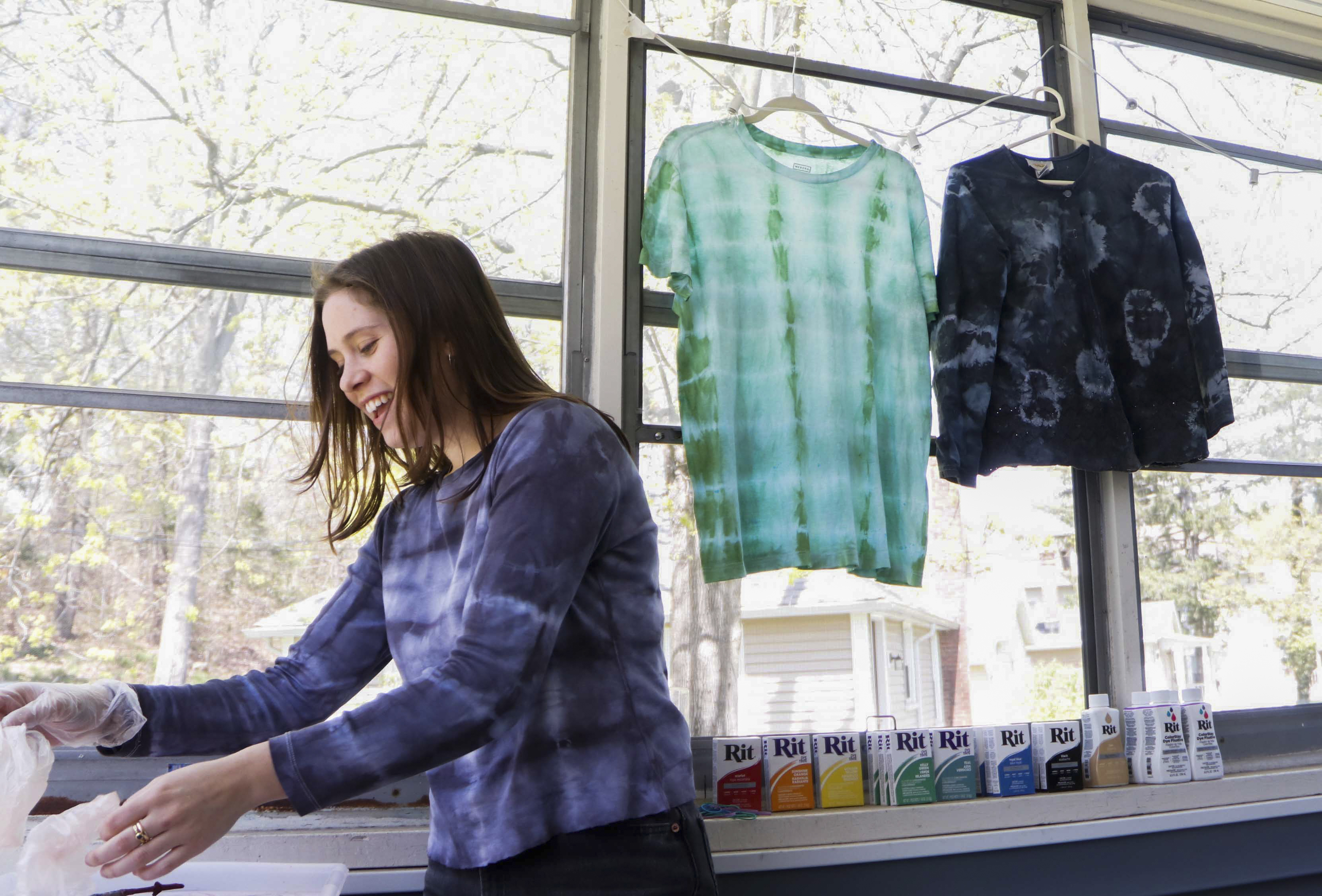
    The new frontier of tie-dye fashion, DyeHard is a trendsetting student-run company looking to disrupt Wesleyan’s fashion scene. Since their inception one week ago, DyeHard’s Instagram has already hit 103 followers, and the company has received over 25 orders. 

    Although DyeHard has enjoyed a rapid expansion, the company’s founders still acknowledge their humble beginnings.

    “I wish our origin story was more exciting,” Chief Executive Officer Isabel Keene ’19 said. “Basically, Charlotte [Klein ’19] and I went to Michael’s a couple weeks ago and purchased tie-dye. We’re both pretty crafty and were excited to experiment with this medium we were unfamiliar with. And then I made a tote bag and a shirt, and it was fun and easy. I asked around to see if people would be interested purchasing any of our products—”

    “Kind of as a joke,” Dawes interjected.

    “Yes, it started as a joke,” Keene continued. “And we got a pretty positive response. So, we decided to expand. This came at a time when Charlotte had just finished her thesis, Ali was concussed, Allegra [Lorenzotti ’19] hasn’t really been here this semester, and we were all just trying to take advantage of the good weather. It seemed like a fun activity, and we were interested in making a little profit.”

    DyeHard’s process is unique and meticulous. As Dawes describes, customers fill out a Google Form with their order, which DyeHard then moves into a spreadsheet. The team then tie-dyes the pieces—taking care to fit every tie-dye design to each customer’s personality—and arranges for delivery or pickup.

    The DyeHard team hopes to drop three cycles of orders before the end of the year. Within these three cycles, there are custom and curated orders. For a custom order, customers provide a specific piece of clothing to be tie-dyed; for curated orders, customers pick an item from DyeHard’s collection.

    “We just finished on Friday the first cycle of custom orders, and then this week at some point, we will drop our first curated collection, which is separate from custom—which is just pieces that we have fun experimenting with and that are really our creative direction,” Chief Marketing Officer Allegra Lorenzotti said. “Those will be like six to nine pieces, and those will be up for sale on the ’gram. But then we’ll have two more cycles of custom orders where people can request what pieces they want and what color preferences they want, and then we will be closed.”

    A key part of DyeHard’s business is its sustainability. Recognizing the tremendous waste produced by the fashion industry, the company only uses pre-owned pieces and usually finds their clothes at the local Goodwill or Savers.

    “Basically, we saw space in the market, [because] you have high fashion tie-dye, and then you have places like Zara that are commodifying these high-fashion tie-dyes, but they’re not sourced sustainably,” Keene said. “You have high fashion that offers very expensive tie-dyes—you don’t want to spend $200 on a tie-dye shirt. So we wanted to offer things at fast-fashion prices for consumers who care about their [carbon] footprint and where their clothes come from.”

    Kaye Dyja, Features Editor
    Kaye Dyja, Features Editor

    DyeHard also prides themselves on their sophisticated marketing campaign. Since Lorenzotti works in social media, she has taken DyeHard’s various platforms under her wing and intends on reimagining DyeHard’s digital presence.

    “The vision is going to change a little and be a little more refined in the future because I’m professional in this realm of things,” Lorenzotti said.

    Despite their streamlined tie-dying process and organized media strategy, the business has undergone substantial administrative change. Dawes, who started as a low-level tie-dye artisan, climbed the corporate ladder after Keene saw her potential.

    “I thought it was a good idea from a publicity standpoint [to show] how many opportunities there are for upward mobility within our management structure,” Keene said. “[Dawes] proved herself and also begged me for more responsibility. It made sense to delegate something to her that was very customer-facing.”

    “She proved herself quickly,” Lorenzotti added.

    “I’m really good with people,” Dawes agreed.

    Then, the team decided that Klein, who at the time was serving as Chief Financial Officer, wasn’t exactly what they were looking for in a CFO.

    “Charlotte was initially CFO,” Keene said. “It was a huge mistake. She ran out on us to go to the gym when we were trying to take company photos…. Anyways, the point of the story is that Charlotte went to Goodwill, went way way way out of budget, and that really confirmed for us that her rightful place in the company is to be siloed to production.”

    “She really does have a creative vision, though,” Dawes added. “She said that she’s very inspired by Bruce Willis.”

    “Yeah, but it just made sense for us to not get involved with her creative process and, in turn, have her not at all get involved in management decisions and our financial decisions,” Keene said.

    Additionally, DyeHard encountered some difficulties with their summer intern.

    “We did have an incident,” Keene said. “We opened the application up for an unpaid summer intern. Sonia [Frank ’19] was on the job—”

    “—this was really a lesson that it’s great to work with your friends, but you also need to be careful about setting boundaries and knowing when professionalism comes first,” Dawes interrupted.

    “Yeah, she fell asleep on the job,” Keene said.  

    “She took a four-hour nap during our custom drop and was promptly let go,” Dawes finished.

    Frank has struggled with DyeHard’s firing process, however, and wishes that DyeHard let her go in a more empathetic fashion. But Frank isn’t resentful and still respects the company.

    Kaye Dyja, Features Editor
    Kaye Dyja, Features Editor

    “I was dropped from the DyeHard team without notice,” Frank said. “I understand that there was misconduct on my part, but I feel like part of their company culture is to be transparent, and as I’m getting interviewed for this article, this is the first time I’m hearing about my firing. But honestly, I wish them well in their creative endeavors, and it was truly an honor to be a part of such a dynamic female-identifying team.”

    Frank expanded on the power of DyeHard’s female entrepreneurship and the need for more female-led fashion brands on campus.

    “I feel like there’s a monopoly on streetwear and fashion on this campus, or at least it’s mostly being created by men,” Frank said. “There’s Millinsky [Alexandre Daillance ’19], there’s Nate Antoine [’21]’s stuff, there’s Ben Schneier [’21]’s stuff, and there’s WesWorn stuff. I think it’s time for more female-identifying students to really make their mark on this campus, and DyeHard is doing that.”

    As the semester comes to a close and DyeHard’s team looks toward graduation, the group reflected on the future of their beloved company.

    “The band is not breaking up,” Lorenzotti concluded. “We’re not having a Fleetwood Mac moment.”


    Kaye Dyja can be reached at kdyja@wesleyan.edu