Wescam just came out. Give me some advice on how to attract peoplez? I never leave my room but I wanna get a lot of Wescams. đ
First, put in jlahut@wesleyan.edu to calibrate your account. You must first enter this email before you will be allowed to enter any others. Advertise in the WesAdmits Facebook groups, especially WesAdmits 2021. Just start winking. At everybody.
From: Hi Please Help Me Thanks, 2020
Help! I got a super shitty housing number đ What should I do?
Research non-traditional housing options, like living in the tunnels! Studies have shown that the asbestos is actually good for you, so youâll get a fun health boost and have a sick pad to show off to your friends. Itâll be part of your spunky image! Or, alternatively, you can live with me đ
From: asking 4 friend, 2017
What are the best places on campus to cry?
Third-floor Fisk bathroom, CFA music rooms (if you stay still long enough the motion lights will turn off and you can cry alone in the darkness you deserve), upper corners of the Stacks, my shoulder ;), thesis carrels, Olin basement bathroom, nap pods, package line, the middle of Usdan (let the world share in your despair), the roof of Bennet, into a plate of mozzarella sticks at Swings, the gallery seating at Memorial Chapel while the organist is playing, WesWell (rip up some pamphlets on safe sex while youâre at it), the COL library, the HiRise elevator (as itâs probably stuck at any given point in time), the tiny phone booths in PAC, the roof of Summies, and the shower in basement bathroom in Allbritton.Â
From: oopsies, 2018
I matched with Roth on Tinder. What should I do now?
Ok first, get a new outfit. Make it classy. Roth likes classy. Shine those shoes. Your first message to him should be ;). He will respond (;, he always does. The conversation will take care of itself from there. Suggest getting a nice dinner. Amiciâs? Esca? Or maybe youâre feeling greasy. Five Guys? You and Roth can walk wherever you decide to go. The sun will be playing softly in Rothâs wiry curls. Heâll tell a lot of dad jokes. About work. About his classes. About life. Youâll laugh, get to where youâre going for dinner. Roth will slip the waiter a twenty to get you two a good seat. He always takes care of his lover. Heâll talk about the art of Dutch woodcarving. Youâll be bored, but he has so much passion, so youâll listen anyway because he put a lot of effort into this night and you donât want to hurt his feelings. The evening will end under the stars as you and Roth lie in the dewy grass on Foss. You and Roth will part ways with a fond embrace. But remember, the REAL embrace is in your MIND!
Now that the dust has settled, itâd be redundant for me to hop aboard the think piece band wagon, skewering the political circus that was President Trump and Speaker Ryanâs catastrophic attempt to reform the pseudo-caste-system, Frankensteinâs-monster of a national health care program that plagues America. Iâd rather not contribute to the black hole of op-eds that walk that partisan line, often failing to address more worrisome, long-term questions.
Once the talk of the nation, health care reform is now treated like old news. I realize the White House exerts a great deal of influence over what journalists and their audiences consider newsworthy. Its domestic agenda (or lack thereof) and recent tumultuous actions abroad fuel the focus of American media coverage, so debates are bound to come and go. And yet, while mainstream sources like NBCâs Brian Williams might move to the swing of things, lauding revenge bombings in Syria with comparisons to Leonard Cohen songs, Iâm hesitant to dance to the commands of our ringmaster-in-chief. By no means do I intend to diminish the seriousness of the atrocities occurring in Syria, but why did all of that coverage and pressure have to go when health care reform continues to be a matter of public interest?
Itâs pertinent that the majority of Americans want reforms to our faulty system. In fact, as of January 2017, 60 percent of Americans believe that it is the governmentâs responsibility to ensure health coverage.
âThe share [of the population] saying it is the governmentâs responsibility has increased from 51 percent last year and now stands at its highest point in nearly a decade,â reads Kristen Balik of Pew Researchâs write up of the pollâs findings.
In comparison to other wealthy nations, the United States, the wealthiest in the world, currently spends far moreâaround 17 percent of GDP, almost 50 percent higher than France, who are the next highest spender at 11 percentâto provide some of the worst coverage with respect to both access and the quality of care. With an all-around governmental stalemate on the subject since the Affordable Care Act (ACA) was passed on March 23, 2010, as of 2016, 28.2 million continue to lack access to any form of coverage.
âFor those who do have private coverage, the costs of care remain a heavy, and growing, burden,â Eric Schnurer of The Atlantic wrote on the disparities in care. âThese problems tend to reinforce each other. For instance, the cost[s] of care for those lacking coverage get absorbed by those who have it. An emphasis on expensive, technologically-advanced treatments for catastrophic illnesses raises costs across the board, driving many away from obtaining less-critical care that could keep more people healthy.â
For Democrats to temporarily wipe their hands with the subject, blame Republicans, and bookmark the legislative failure of this springâs American Health Care Act (AHCA) for political points come 2018 is unacceptable. While the rejection of this bill is a huge step in the direction of the fight for universal coverage, we cannot afford to stop talking about it. Morally, fiscally, or whatever definition of affordability you prescribe to, it just doesnât make sense.
This is not to say that some legislators havenât attempted the expansion of coverage at the state level since the ACA passed seven years ago. In Colorado last November, a ballot initiative for universal health care, Amendment 69, was presented and struck down with over a 50 percent spread by an endorsement-stacked, bipartisan-led opposition for similar reasons to that of this yearâs AHCA: a lack of specifics.
âThe costs and the unknowns are the big points that the anti-ColoradoCare group Coloradans for Coloradans hit in its campaign literature,â John Ingold of the Denver Post wrote extensively during the debate over the ColoradoCare Amendment. âThe group says the amendment would give Colorado the highest income tax rates in the country and that businesses could end up leaving the state because of the payroll taxes.â
To be fair to ColoradoCare, of course income taxes would have increased. The state would provide the health coverage its citizens would otherwise be paying for. However, advocatesâ inability to concretely answer questions about the potential decrease in patient choice of providers, paranoia over economic stagnation with threats of businesses moving out of state to avoid the increase of taxes, and a lack of coverage for elective abortions buried the billâs chances.
In California, a similar debate is happening right now. Senate Bill 562 was introduced to legislators this past February. The Healthy California Act intends to eliminate both copays and insurance deductibles, providing coverage for inpatient, outpatient, emergency care, dental, vision, mental health, and nursing home care. However, with financing specifics largely unaccounted for, state-level political powerhouses like Governor Jerry Brown have refused to get behind the legislation so far. Passing this bill appears to be a uphill battle.
As with marijuana and gay marriage, the state level has often proved a barometer for the success of progressive legislation on the national debate stage in the United States. Progressive leaders at the state level must continue to push for health care reform here, as polling indicates the tide of public approval. Other countries with national health care systems, like Canada, achieved health care reforms in a similar fashion, beginning at the provincial and local level in Saskatchewan and eventually bringing the fight to the national stage.
The bottom line is that millions continue to lack access to basic health care in the United States. Life expectancies for the top 1 percent of American men remain nearly 15 years longer than the bottom 1 percent of male income earners; among women of the same income brackets, the respective disparity is a little over 10 years, according to an MIT study conducted last year. The media must continue to hold our government accountable for health care reform failures, and politicians need to begin forming a baseline definition for what health care the government ought to provide. Does our right to life begin and end in the womb or should it extend beyond that?
We can spend our days poking fun at this springâs AHCA catastrophe but we have to learn from these failures. The matter of health care reform is, quite simply, a conversation we cannot afford to allow to die.
The United States is said to have the most powerful military in the world. The nationâs combat assets are intimidating, both in technology and manpower. The weaponry at Americaâs disposal is terrifying in its intensity and scope, automated and vicious. If there was ever a nation best equipped for war in the history of the world, this is it.
But there is one asset that enables the United Statesâ military ambitions far more than the ungodly unmerciful firepower at its disposal: the American media.
This was on full display in the wake of President Donald Trumpâs tomahawk missile strike on a Syrian airbase and its munitions (one which ultimately proved so ineffective that planes from that base were flying bombing raids within hours of the American attack), whichâaccording to the governor of the Homs provinceâkilled seven civilians and injured another nine. On MSNBC, Brian Williams described footage of the strike as âbeautifulâ over and over, rhapsodizing over this unconstitutional military action as though he were John Keats and his bright star just happened to be a projectile bearing deadly explosives. He was even kind enough to quote from Leonard Cohenâs âFirst We Take Manhattanâ (âIâm guided by the beauty of our weaponsâ) with all the unhinged passion of a drunk at a party, explaining why his favorite song is so damn moving. In an interview with President Trump on Fox Business, in which the executive wrote an ode to his dessert and forgot which country he bombed while eating it, anchor Maria Bartiromo giggled as Trump explained his decision to rain death on a sovereign nation without congressional approval. On CNN, noted plagiarist Fareed Zakaria announced that Donald Trump âjust became president,â failing to explain why weâve had to put up with a megalomaniacâs executive orders since January if this is truly the case. The Interceptâs Jeremy Scahill appeared on CNN later to suggest that Zakaria might have sex with the cruise missile strike were it possible, and Iâm inclined to agree.
This is not unusual behavior, though it is especially shocking as pundits try to carve out a so-called Trump Doctrine by which to contextualize this strike, given that our Commander in Chief has shown he wouldnât be able to think five steps ahead with Google Maps in his hand. In truth, the media has long played a role in justifying American war-making, valorizing and romanticizing it. One need only look back on the newsreels of American G.I.s fighting on the Eastern and Western Fronts, propaganda spread far and wide to blind Americans to the gory, brutal, ugly nature of violent conflict, supposing a narrative of legislative and military heroism as the alternative.
The best example of this tendency would probably be the war in Iraq, which was almost unilaterally lauded, and presented as a conflict of unerring moral necessity. Most famously, Judith Miller wrote numerous stories for the New York Times, all of which were proven false, that became integral parts of the cyclical justification machine for the invasion. Up until her severance from the paper, she claimed, in the face of definitive evidence to the contrary, that she was âfucking right.â
While the media was famously critical of the Vietnam War in the wake of the Tet Offensive, that disastrous operation itself was reported as a success. It wasnât until footage of the warâs unbridled carnage and buffoonish mismanagement became overly apparent that the narrative was forced to adjust with the gravity of truth. Similarly, although the War on Terror ultimately fell under harsh media criticism, its onset saw a recitation of the jingoism that bloomed from the agony of September 11th: a refusal to suggest that the casus belli being set forth by the administration might be faulty, disingenuous, or misguided.
This is all the more frightening when one examines Donald Trump, who is famously sensitive to public opinion. One need only look at his need to push false estimates about the size of his inauguration crowd or his victory in the election to understand the lengths the man will go to to shape his narrative. With the deluge of losses heâs suffered in the past months, from the open refutation of his wiretapping claims to the public scrutiny over his potential ties to Russia, itâs not unheard of that he might seize on the praise given in response to the Syria strike and run with it, understanding that brazen military action is often painted as executive heroism in the media sphere.
Itâs likely he already has.Â
This Thursday, the United States dropped a MOABâMassive Ordinance Air Blast, colloquially called the Mother of all Bombsâin the Achin District of Afghanistanâs Nangarhar province with the aim to take out supposed ISIS tunnels in the area. The MOAB, which is being used for the first time, is the largest non-nuclear bomb in the American arsenal. It measures in at 30Â feet long and contains the equivalent of 11Â tons of TNT. Developed during the Iraq War and, up until now, employed mainly as a piece of suggestive psychological warfare, the MOAB is the pinnacle of Americaâs non-nuclear arsenal. Itâs a horrific piece of death-making machinery.Â
Though it is, as of now, unclear whether Trump himself gave the order to deploy the bomb, itâs hard not to see the strike as the logical next step in Trumpâs warcraft as egocraft. The connection between these two things has been obvious for months, since it was reported that Trump was convinced to conduct his disastrous raid in Yemen by advisors who told him that President Obama wouldnât have done it. In the wake of that failure and its explicit labeling as such, Trump was able to use his Syrian strike as a way to boost his profile as a powerful, decisive executive. The use of the MOAB is best understood as a continuation of this: an attention seeker who has found which buttons he needs to press to achieve the rise he desires.
This is petrifying. It implies that we are in the throes of an administration willing to commit violence on a global scale, sacrificing strategic objectives for 1) potential but shifty moral convictions and 2) personal praise. Itâs the logical endpoint of comparing war-making to dick measuring.
Luckily for President Trump, the American media has proven itself to be the best fluffer in the business.
âNobody has figured out how to cover [Islam] well.â
Thatâs Mark Oppenheimerâs view, anyway, as a former columnist for the New York Times and a well-known reporter on religion. He and Rosie Dawson, a longtime producer at the British Broadcasting Channel (BBC), came to the University on Thursday, April 6 to address how journalists treat religion as a subject and a beat.
Although they both work in the same field, Dawsonâs background as a British radio producer gave her a different perspective than Oppenheimer. The two presentations overlapped in their focus on our evolving perception of religionâs role and how religion is communicated.
Dawson kicked the event off by talking about the format that she uses for religion pieces.
âYou need general reporters who want to know about religion,â she said, âAnd you need academics and experts who will explain what is going on, and explain the origin, and explain the wars.â
She focused on how news stories often unintentionally give the impression that religion is relentlessly causing problems.
âIn the 1970s, the questions about whether Sikhs should be allowed to wear their turbans when theyâre on motorbikes was a really big story,â she recalled. âThese narratives are all presented as problems. And theyâre important stories to tell, but the danger is that if you only tell these stories, then all religion comes to be defined as problematic. And then we donât get to hear about the day-to-day stories, and the gentler impact that religion has in restoring the lives of those all over the world. They donât make the news agendaâwhy should they? But if you donât have those stories, then you get to see why religion is just perceived as a problem. So part of the challenge of communicating religion in the media is to find spaces where those other stories can be told and where the nuances of the contentious stories can be explored.â
Oppenheimer took a much more casual approach to his portion of the lecture, bringing up his own articles on the screen behind him and speaking off the cuff. He cracked jokes about Scientology and the âpuppy porn,â sites with pictures of dogs up for adoption, that his wife looks at. He discussed the particular challenges that he faces as a writer in a field that does not have a designated section in newspapers.
âThe way I think about that is editors donât know where to put religion,â he laughed. âSo one of the questions that I had is, âIn what section of a newspaper or magazine does religion belong?â… Iâll give you the answer ahead of time, Iâll end the suspense: nobody has a goddamn clue where it belongs.â
He later added more on this.
âThe other problem that we face is…that everyone has a different idea of what counts as religion,â Oppenheimer said. â…Religion writers, we enjoy talking about these things together. Our editors donât have good answers and donât really care. And as a field, it is still fairly youthful.â
In the Q&A after her presentation, Dawson more directly addressed rising Islamophobia in the United States and Britain. She specifically talked about the recent terrorist attack in Westminster that caused Parliament to go into lockdown.
âEveryone assumed [the attacker] was a Muslim, he actually was a Muslim, but, really, he was a criminal,â she began. âI think that there was a drawing back [on coverage of the attack] afterwards. Partly, I suppose, out of a concern that we donât slander three million peace-loving Muslims who live in our country, partly so that we donât completely panic.â
Both Dawson and Oppenheimer provided insight on the role that journalists should play as observers of religions.
âIâm not asking [editors] to think [a religion]âs a good thing or a bad thing,â Dawson remarked. âI just want them to think itâs worthy of finding out about and understanding. And a lot of people in general news and media donât have that because theyâve made up their mind about it.â
Oppenheimer echoed the sentiment.
âI want my editors to respect [religion], but I want me and my fellow writers to be irreverent about it,” Oppenheimer said. âI think one of the great failings of a lot of bad religion reporting is that itâs so respectful. Itâs like, âLook at your interesting tradition.â It should be as respectful as sports reporting or business reporting, which is that sometimes religious people are great, and sometimes religious people are jerky, and sometimes they tell the truth, and sometimes they embezzle funds. And some editors, because they donât know it, they bend over backwards to be super earnest and reverent about it, and that strikes me as a huge problem as well.â
Finally, Oppenheimer discussed the inclusion of biases in their own reporting and in general views on religion.
âFor [Catholics], denominationalism is heresy, itâs a problem to be solved, and eventually everything will be reunited under the Pope,â Oppenheimer said. âSo they donât have denominationalism. Jews donât have a concept of denominationalism. Youâre Jewish if youâre ancestrally Jewish…. But Protestants have, because of how they arose, have a tradition of schisms that gives rise to sects, denominations, whatever you want to call it. And so because we tend to order our thinking in Protestant ways, we now approach Judaism as if it has three or four denominations. Reform, conservative, Orthodox, reconstructionist… Thatâs a terrible way to think about Judaism. It just doesnât make sense, it doesnât map onto it.â
Oppenheimer concluded the discussion by talking about the fieldâs future.
âThe Trump victory actually reminded a lot of editors that there were things going on in America they didnât understand, and some of them decided that one of the things they need to understand better is religion,â Oppenheimer explained. âSo I think there is room for some optimism in the current political climate for religion writers in that our skills of talking to people about religion, asking about religion, are being, all of a sudden, valued more highly.â
The Argus Opinion section has a diversity problem. It is neither new nor unique to our section, but as editors and assistant editors, we feel it is our duty to address this issue to the best of our ability.
By its very nature, the Opinion section is political. While other sections may discuss topics that donât fit squarely into the campus framework, the Opinion section often strays furthest from on-campus coverage. As a homogenous team of editors, we are working to recognize and lessen the dominance of our lens within the section, which, as it currently stands, is a failure of the mission of our section, our paper, and our school.
If we are truly dedicated, as we say we are, to portraying Wesleyan and the world as thoroughly and honestly as possible, we cannot do so with a team that excludes such a significant number of experiential narratives. As much as we strive to publish work by writers whose opinions do not necessarily align with our own, we must recommit ourselves to making space for writers whose experiences are divergent from our own, whose stories we cannot tell without ultimately tipping into dishonesty and erasure.
The issue of diversity has been brought to The Argusâ attention before in the wake of our tone-deaf publication of an opinion piece that was improperly vetted by editors. A coalition of dedicated and passionate students from The Ankh, the WSA, and a number of other groups spent their time and energy addressing our mistakes for us, but we still have important changes to enact. The paper as a whole has made steps towards righting the institutional problems that have led to poor judgment calls in publication and coverage; however, we of the Opinion section believe it rests on the shoulders of each individual chamber of this organization to understand their role in the process that has made The Argus a predominantly white enterprise. As such, speaking solely on behalf of the Opinion section, we wish to reach out to those communities that we have failed to represent.
We understand that we are not entitled to anyoneâs voice or clemency. We cannot ask the people that have been excluded and betrayed to be the driving force behind this institutionâs rehabilitation. There is an undeniably precarious balance to be struck between attempting to integrate these voices without exploiting them or demanding their presence; we must evaluate not just the intent of our actions, but also their potentially damaging effects. We do not want to set a standard that forces the responsibility of inclusion on those historically excluded. Should our methods seem out of sync with that goal, we want to sit down and hear how we can do better.
There can be no excuses for the way in which The Argus has operated in the past. We cannot and will not rationalize our past uniformity. Doing so would be disingenuous and disrespectful to those whom we have failed, making many feel unsafe in meetings and unwelcome in the pages of our section. We are, however, committed to learning how we can do better. We want to shape the Opinion section into a more validating and inclusive arena; something worthy of representing the people in the Wesleyan community who, through the exclusion of their voices, have been told by this organization in the past that they are less important. Despite the fact that we have done little to nothing to deserve any help from the larger Wesleyan community, we are asking for your input so that we can improve. We will continue to better ourselves as best we can on our own, but that process would be insufficient without collaboration with the people and communities that we have excluded for so long. We recognize the contradiction in seeking help from those we have wronged, but we need to become more inclusive and we cannot do it on our own.
While we will always welcome pieces from all writers, we feel it is essential that our section not be a forum merely for politically and socially passionate cisgender white writers. We are perfectly comfortable with any claims that this is some politically correct maneuver on our part. If it seems as though we are privileging a subset of voices, it is because for so long our section, our paper, and our community has failed to acknowledge the power and necessity of those voices.
In addition to general opinion piecesâwe encourage interested writers to write about a wide range of topicsâwe would also love feedback: ways in which we have failed in the past; ways in which we continue to fail; and practices you believe would help The Argus evolve into a newspaper worthy of the student body it is committed to serving.
If you do not feel comfortable submitting or if you have concerns about the direction or conduct of the section, we hope you will reach out to us about anything that upsets, angers, or worries you. It is important to us that the community knows we are open to hearing any issues that anyone may have with The Argus, and that there is no problem too small to address. We will do everything we can to create a safe, open space for the voicing of concerns.
We are planning to hold an open forum, specific to the section, with details to come. We are here to listen, and we are asking for your feedback and criticism, especially regarding our conduct over the last year.
For all of us here at the Opinion section, The Argus has been a valuable community, helping us grow as writers and as people. Accordingly, we believe this community should be accessible to any student here at Wesleyan. An exclusionary Argus is a failure and an insult to what this platform can and should be. We deeply believe that our section cannot fulfill its purpose, nor do its job, if itâs a space that does anything less than serve and respect the full range of experiences that exist in our community.
We are indebted to this community. We are here to accept your criticism and rebuild ourselves into a section with not just better intent but better results. We would not be what we are without you, nor could we ever become what The Argus should and must be.
Dan Bachman can be reached at dbachman@wesleyan.edu, Michael Darer at mdarer@wesleyan.edu, Sam Prescott at sprescott01@wesleyan.edu, Connor Aberle at caberle@wesleyan.edu, and Hannah Reale at hreale@wesleyan.edu.
A certain type of thinking seems benign but is, in fact, dangerous. Having shed the yoke of this perspective, and observed how many people believe in this underlying theory, I feel it is important to speak out about this now. Itâs not a malicious or insidious thought, nor actively violent nor prejudiced, but it has played a hand in the proliferation of these problems.
I am referring to the notion that everything is up for debate, that discourse will inevitably solve all of the worldâs problems.
As an American citizen raised in American schools, I was taught about the virtues of debating anything and everything, through mock debates and through the knowledge of our history. After all, our two-party system is supposedly fueled by two opposing viewpoints coming together to learn more about each other and finding a compromise. Compromise is apparently always the proper solution when two sides go head to head. Debate, be it legal, educational, governmental, is the foundation of countless fictional and historical stories. A good argument or discussion is fun to watch and, for many, fun to take part in. This permeates every part of our culture: the concept that, if you are right, facts and arguments will always bring your opponent into the proverbial light, and if you are wrong, you will change your stance. This is a noble and naĂŻve ideal, and one that I donât intend to snuff out entirely.
Debate and discourse are wonderful things. Communicating who you are and what you believe are part of being alive. Arguments and intellectual disputes can be crucial to building your identity, and debates sharpen and define policies. I am not against debate and discourse themselves; if no one ever expressed themselves, nothing could ever be understood. However, I do not believe that the practice of debate is universally, indiscriminately applicable. It is not only untrue, it is actively harmful. Unfortunately, not everything is up for debate.
In their ideal form, discursive conversations exist to give everyone involved a voice and a platform, time to express what they know and believe, and the chance to be challenged by someone whose knowledge and beliefs are in some way opposed. Through this, everyone involved becomes empathetic towards the opposition, and ultimately, everyone is changed for the better, having compared their insight to someone elseâs. Itâs a nice idea, and it even happens sometimes! But, conceptually, this only works in a setting in which platforms are equal and everyone has something valuable to bring to the table.
As much as all of us want this to be true, it isnât. It just isnât. There are generally two categories of people involved in these debates: people who have been historically and systemically suppressed and oppressed who are more often argued about than argued with, and those whose entire discursive identity is either contrarian or violent, doing nothing but harm those who cannot speak with them on equal terms within these public systems.
For me, this idea began to crystallize almost two years ago, during The Argus controversy that still hangs over this section. My loyalty to the paper and how much it has done for me as a person, a writer, and a student, led me to take a stance I am now diametrically opposed to: that all opinions should be put into daylight, and that toxic beliefs will wither when exposed to the sun. To that end, I began to try and discuss this notion with others, but it wasnât helpful. It was silencing to the many that were hurt, and it was ranking an ideal and an ideology over the well-being of people.
Prioritizing ideology over people is one of the most blindingly stupid and parasitic qualities of modern discourse. And I supported it, with the clear-eyed, liberal belief in the power of debate. I was part of the problem, and I will do everything I can to not be part of that problem again.
This being said, what I didnât even realize at the time was something that Iâd addressed in previous opinion pieces: the ideology-over-people methodology does not wither when applied. It actually thrives. The alt-right was a fringe group until it was dragged out, until someone decided that overt white supremacy should be given a platform. If you are debating bigotry, intelligent bigotry, itâs designed to be debatable. Facts, figures, and arguments can be disputed, and the doubt sown by that dispute delegitimizes them. The most salient example is the recent travel ban, which is a vile, evil piece of legislation. During its first enactment, I saw well-meaning people use statistics and information to supposedly refute this bill, to prove it to be the overt, grossly nativist piece of legislature it is. But logic can always be re-refuted. While the lives of refugees are displaced, ruined, and lost, the debate goes on. It rages on while the voices that truly matter go unheard. It often comes from a well-meaning place, but also one of ignorance.
I am not arguing for any sort of authoritarianism, a place where debate, discourse, and dissent are put aside in favor of a single voice. Debate and discourse are crucial parts of our communication, an absolutely necessary element of being human beings. But for too many, too often, for too long, it has been thought that these sacred, unimpeachable ideals should not and could not ever be questioned. That they are the solution to every problem. And theyâre not. We cannot argue whether or not transgender people are biologically people. That is absurdly insulting and can only hurt, hurt, hurt. We cannot argue whether some religions and races are more or less violent than others. For those who cannot argue back, while our argument suspends, damages, and ends their lives, discourse and debate arenât the noble, democratic tools of an advanced society. They are a weapon with direct consequences on those who need our help the most. Itâs our job to understand, then, that some things just cannot be up for debate.
Many readers probably already know about the source of the conspiracy that vaccines are dangerous or can cause autism: Andrew Wakefieldâs study from 1998, based on only 12 patients, which was based on falsified data that suggested a link between vaccinations and autism. His medical license was subsequently stripped, but the idea has continued to stay in the spotlight for a variety of reasons.
Of course, parents must be cautious with their childrenâs health. Any research that suggests that they are putting their kids at risk is likely to make them hesitate. Itâs human nature, itâs understandable. However, another large component is the inexplicable celebrity support that the movement has had over the past two decades. Jim Carrey, for one, is extremely anti-vaccineâor, in his words, âanti-thimerosalâ (a mercury-containing compound that is in flu shots to prevent contamination). The information is out there. Everyone should know better by now.Â
We donât have to think about the consequences of actually getting the diseases that the vaccinations prevent anymore, making vaccines seem less and less necessary. Know why? The fact that the vast majority of the U.S. population has been receiving these vaccines for decades has led to widespread eradication of what they prevent. Smallpox is completely gone: We donât even give the vaccine anymore because the only known existing samples of it are kept in laboratories for various reasons. (Namely, to make an antidote in the case of an outbreak, which is certainly possible considering that, in 2014, samples of smallpox were found in a store room in Maryland that had been entirely forgotten about.)
Itâs easy to forget, but measles is dangerous. Itâs so easy to forget because weâve fixed this problem. We developed a vaccine. But, in 2014, 667 people in the United States contracted the measles. It is often likened to chicken pox and made to seem less serious than it really is. 1 in 20 children who contract the measles will also develop pneumonia, 1 in 10 will get ear infections, and 1 in 1000 will develop encephalitis, a swelling of the brain that can lead to permanent intellectual disability. As reported by the Center for Disease Control (CDC), most people that contracted it were unvaccinated; however, some had gotten the vaccine. Many point to this as a reason to not vaccinate their children, because it may not work anyway. Although I am sympathetic to parents not wanting to put their children at risk, not vaccinating kids is a selfish act.
Here are the facts: For the immunity of individuals, we need herd immunity. Herd immunity is the concept that a single unvaccinated individual can take down an entire community if they become infected. It is impossible to test that the effectiveness of a vaccine because of course we canât test the effectiveness of a vaccine. How would we? By exposing children to the disease?
Letâs answer this easy question: What usually happens when you get a vaccine? Youâre protected from the disease. Thatâs it. Actual real risks to getting vaccinated include swelling at the site of injection. In extremely rare cases, a severe allergic reaction can occur, but that is the most dramatic (and unlikely) reaction.Â
Vaccines are safe. Please know that. For your safety, for the safety of your family, and for the safety of those in your community, get vaccinated. I understand that you may not want to personally take a risk. Itâs not a risk. Do it anyway.
Now, as everything must, hereâs where it gets political.
On March 28, 2014, Donald Trump tweeted: âHealthy young child goes to doctor, gets pumped with massive shot of many vaccines, doesnât feel good and changes – AUTISM. Many such cases!â
Now, we all know that just because an idea is comes out of his mouthâor, more often, his small, Twitter-hungry fingersâit wonât necessarily be acted on. And this was three years ago. His perspective has probably switched by now, or at least heâs forgotten about the whole issue. Right?
On Jan. 10, 2017, Trump met with Robert F. Kennedy, Jr., who is outspoken in his opposition to vaccines. An NPR article on the meeting reported that Trump was considering forming a committee to research autism, which is, in his mind, apparently still linked to being vaccinated. So this is yet another bizarre example of Trump maintaining views that are entirely based in falsehood.
Unfortunately, this is a debunked theory that seems to be sticking: According to a 2015 study, nearly 1 in 10 Americans believe that there is a link between vaccines and autism, but there is no reason to give any legitimacy to this âargument.â So, if you need another reason to mistrust President Donald Trump and where he gets his information, look at his views on vaccines.
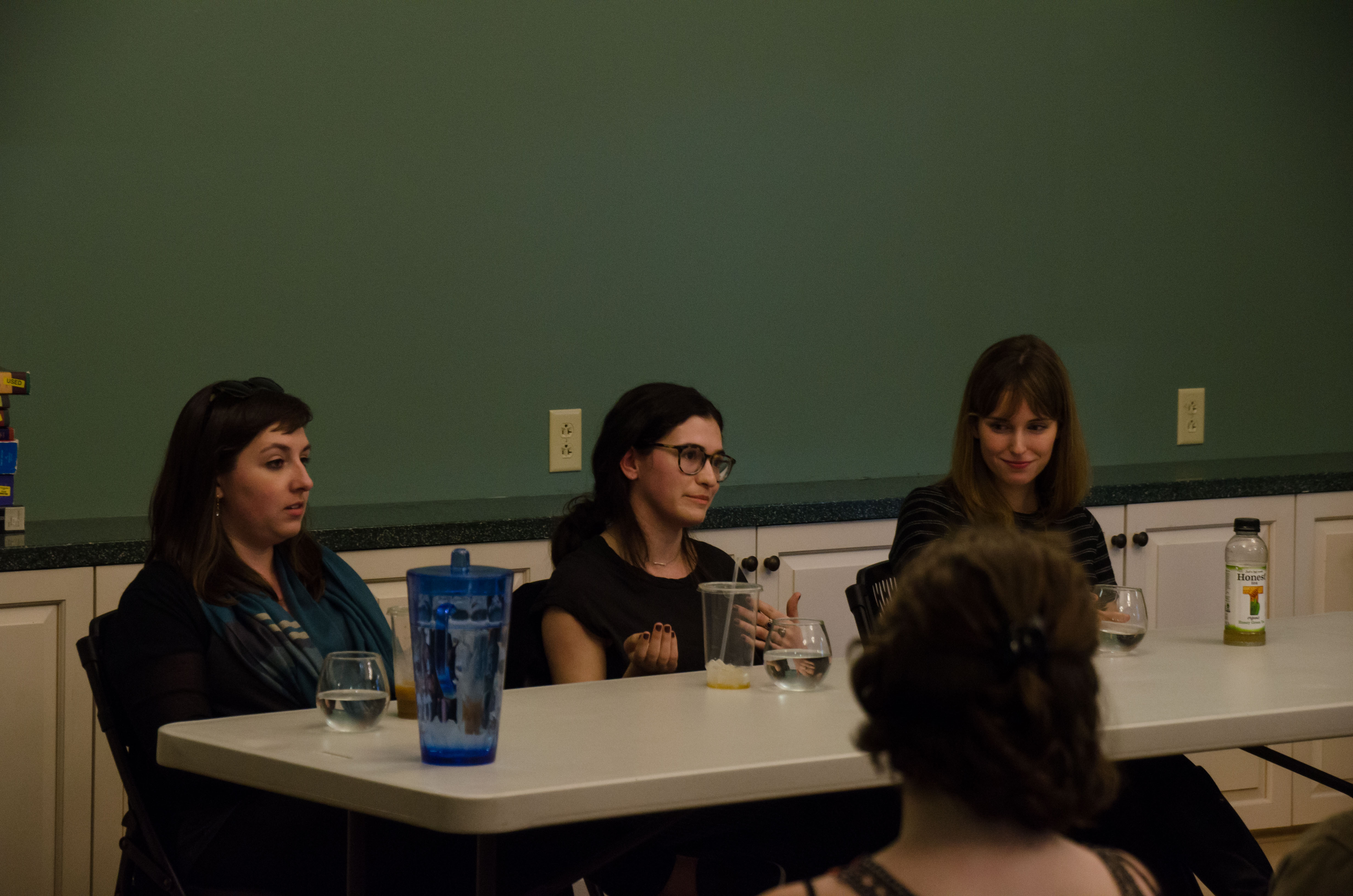
âDevil Wears Pradaâ-esque bosses and literary critiques of Western novels are only a few of the anecdotes that came out of Downey House Lounge on Friday, Feb. 24. While most of campus lounged on Foss Hill and enjoyed the unusually pleasant weather, the English department hosted a panel on careers in publishing with three University graduates: Caitlin OâShaughnessy â08, Danielle Springer â13, and Anabel Pasarow â16.
Springer is an editorial and publisherâs assistant at G.P. Putnamâs Sons (an imprint of Penguin Random House), Pasarow is an editorial assistant at the same imprint, and OâShaughnessy is the current marketing manager at Penguin Press. The alumnae addressed their experiences in the industry without sugarcoating the challenges of their careers, but reiterated how much they enjoy their work.
OâShaughnessy kicked things off by talking about her first job in the field right out of college.
âI ended up working at InStyle magazine and I was a publicity assistant,â she said. âThis was in 2008, when it was pretty much a hiring freeze across the board for all magazines. It was a really hard time to try and get into publishing, especially magazines.â
She also addressed her quick change after only nine months to try and work with books instead.
âI was an English major and I was really frustrated with how every month we would do a new issue and we never looked back at the old ones,â OâShaughnessy said. âIt felt very disposable.â
They covered a wide range of topics, from initial challenges at their lower-level positionsâOâShaughnessy mentioned that at one point she was getting coffee four times a dayâto the unexpected perks of the position.
âYouâre just surrounded by a lot of like-minded people,â said Springer. âThatâs what I really love about my job. I think what I like about editorial, specifically, is having the one-on-one contact with the author and also that thrill of finding a new submission: pulling something out and you get to be the one that goes to your boss and says, âThis is something I think that you should look at,â and then you get to see the changes draft to draft.â
After describing their current positions in detail, Springer and Pasarow gave advice to those interested in entering the field, as well as sharing what they hadnât expected about publishing. They continued to affirm their love for their positions at the organization.
âWhat I wish I had known about publishing before I started is how much of a business it is,â Springer said. âYouâre still working for a major company… and youâre still helping schedule things, youâre still looking at numbers, youâre still doing all the things at any major company. But like I said, youâre working on something that youâre really excited about, hopefully.â
Pasarow discussed one of her bosses who works primarily with celebrity memoirs, and how her work surprises her.
âItâs been not at all what I expected in a lot of ways,â she said. âI didnât expect to like working on Westerns, because thatâs not what I would reach for as a consumer…. I think itâs also a lot more administrative than I had anticipated. I had to learn to become a lot more organized.â
The panelists then answered more questions from the audience, sharing what each of them does on a typical day.
âI have a lot of meetings, which was one of the biggest surprises,â OâShaughnessy said. âA lot of emails, a lot of meetings. I have a lot of lunches, too. I like those.â
âEvery day, I read at least one submission,â Pasarow said. âWeâre the first reader, usually, of submissions that come in… Itâs cool to be an authority on that. So thatâs something I do every day. I do a lot of mailings, mail a lot of books to many people.â
When prompted, the panelists discussed how their time at the University helped them with their careers in publishing.
âFor me, it was being a writing tutor,â Springer responded. âI think that people are really attached to their work, and finding ways to help them say what they want to say and doing that in a kind way is really valuable and also you get to have your footprint on something.â
Pasarow added that she had initially contacted OâShaughnessy when she decided to enter the industry.
âThe Wesleyan connection is really strong,â Pasarow said.
OâShaughnessy compared her time at the University to her current position in marketing.
âWhen I was here, everyone was always doing something interesting and something very involved and committed to what they were doing and open to new ideas and constantly kind of thinking and creating and publishing is a similar kind of person, whoâs interested in collaborating, thinking, and creating,â she said. âEveryone has a weird hobby or something. Itâs a group of very interesting, intellectual people. The moneyâs bad, but the people are great, and Wesleyan was very much a community like that.â
Soon after, she shared her desire to stay in the industry, but to move toward the business side of publishing.
âI really like working in books, and I think thereâs a lot of room for people who have analytical skills who still understand the value of good writing and literary talent,â OâShaughnessy said. âI think we need people who are English majors, who love writing, to figure out how to restructure the industry because content is having a really hard time right now…. I feel like the media industryâs on a precipice in that, yes, we all want to read things, but we all donât want to pay for things, so we need to figure out a happy medium to kind of keep creating and keep seeing things and I want to be one of those people who stays to fix it instead of one of those people who leaves to do something else.â
She concluded her thoughts in a lighthearted manner.
âBut then again, I might have to because itâs a very hard industry to stay in for a long time,â she said.
CNNâs new documentary series âBeliever with Reza Aslanâ will be run by University graduates Liz Bronstein â89 and Ben Selkow â96, working as the executive producer and director, respectively. The show promises to use entertainment and education to provide a deep dive into various religions and their worldwide cultural influences.
Both alumni practice non-Christian religions, and have experience navigating outside mainstream American religious life, making them uniquely qualified to work on the show. Bronsteinâs mother would often bring gurus of various religions into their home and Selkow lived on a religious commune for much of his childhood.
While the focus of the third episode has not been fully clarified yet, University Professor of Religion Liza McAlister has offered input. She is an expert in Vodou and has formed tight bonds with members of the Haitian community.
â[McAlister] acted as an incredible ambassador and helped us get access to people we wouldnât have known,â said Bronstein.
The showrunners also commented on how their education prepared them for their positions within the show.
â[Bronstein]Â and I know that you go into each documentary super preparedâand the outline goes out the window the first day your feet hit the ground,â said Selkow. âWeâd watch Reza starting every time with âall right; this is what I can expect to happen,â and then there would be a great revelation and weâd watch him go through thatâand it was extraordinary.â
The original premise of the show contributed to the crew experiencing challenges that they hadnât anticipated. One or more interactions with these religious groups turned dangerous, but Selkow shared that they kept the camera rolling during these intense moments, making sure to portray the reality of these sects on screen.
âThe adage in filmmaking is that when you stop rolling, thatâs when the action gets goodâso we kept rolling,â he said. âItâs amazing to watch the scene unfold, with Reza slowly realizing that heâs in a perhaps dangerous situation and figuring out how to handle it.â
Organizations reporting on the show have commented that it could not have come at a better time. With intolerance on the rise in the United States, particularly Islamophobic sentiments, they noted that it has become especially important to embrace cultures and experiences outside of our own. Religion, in particular, is often central to social bonds in a community, and learning about its different iterations can promote acceptance of those that are considered âthe other.â
âMost episodes look at a religion thatâs under siege or at least highly misunderstood for a variety of reasons,â Selkow said.
Although âreligious documentary seriesâ may sound like the perfect backdrop to falling asleep in front of the TV, the audience will certainly be kept on its toes. With clips of the series showing interactions with cannibalistic sects and featuring quotes from Aslan like, âheâs either receiving messages from the gods or heâs batshit crazy, but thereâs no reason he canât be both,â the six episodes are sure to hold interest.
âItâs an opportunity to show religious traditions, practices, rites and rituals that may at first seem weird and foreign and exotic and unfamiliarâbecause youâre unfamiliar with the metaphors underlying those ideas,â said Aslan.
âBelieverâ premieres on Sunday, March 5 at 10 p.m.
âYou can eat whatever you want when youâre pregnant. Itâs great!â âLabor is magical.â âItâs the miracle of life.â âI canât imagine being anything but a mom.â âItâs all so worth it in the end.â
âSometimes, when a person gives birth, the vagina rips down to the anus.â
See, this little fact doesnât fit into the narrative that Iâve been fed about pregnancy and motherhood. When my 11th grade AP Biology teacher took a sheet of printer paper, formed it into a loose cylinder, and loudly ripped it in front of our class as a visual and audible metaphor for the vaginal canal during vaginal birth, I felt a quiver of fear from the everyday parenting stories that Iâve been told. Â They were suddenly facing an unanticipated challenger: truth. The foundation of my perception of being a parent was not as steady as it had been a mere 30 seconds ago.
That day, I went home, somewhat shaken-up, and told my mother about my day. She criticized him, harshly, and she was right; his demonstration was unnecessarily graphic and heâd just done it to get an entertaining reaction from his students. But that didnât change anything.
Nobody had ever been so direct with me about the difficulties of pregnancy and, by extension, parenthood before. Iâve heard stories about women who canât take care of their children, but it was always accompanied by the party line, âNot everyoneâs ready to be a mother.â That quote, in my experience, is applied to parents who are addicts or who have other severe mental disabilities (which, by the way, further stigmatizes those who have a wide range of mental health issues). There is the expectation that, without dire external factors, everyone should be able to raise a happy, healthy kid.
Earlier this month, a friend sent me an article from The Guardian that breaks down the taboo of people admitting that they regret having children. Everyone interviewed in the article emphasized that they loved their children deeply and, simultaneously, wished that they had not decided to have them. None of the interviewees went into financial difficulties or other common problems that parents face, nor did any of them have accidental pregnancies, but rather, the article centers around people without intense burdens that chose to have children. And then realized they didnât really want them.
Women that worry about âmaintaining their figureâ are mocked as vain and petty; however, there is little discussion of the real toll that carrying a child takes on the body. Postpartum depression, for instance, affects one in eight people that give birth. It is characterized by extreme self-doubt in parenting ability, other common depression symptoms, and, in some severe cases, thoughts of self-harm or harming the baby. In our historical and modern cultural perception of women, there is a clear expectation of cheerfulness, making everything even more difficult for those that face depression. Having any link between perceived âsadnessâ and motherhood serves to defeminize those that suffer from this mental illness.
It should be noted that, in cases of adoption, surrogacy, foster care, or any other imaginable forms of becoming responsible for a child, the duties and burdens of motherhood are the same. Pregnancy is only one component that has been idealized throughout my lifetime.
Here are some more simple facts that everyone seems to overlook: Children are selfish. Children cry a lot. Children wake you up while youâre sleeping to ask you stupid questions. Children pee in their beds. Children vomit on the floor. Children dictate your sleep schedule.
I like kids. Theyâre cute, theyâre entertaining, and itâs fun to watch them grow up. Logically, youâd think, these factors would indicate: âYou should be a mother.â But I now know a little bit more about the reality of motherhood, which is much more terrifying that most like to admit.
âI planned my pregnancy and thought I desperately wanted a baby,â said one of the women quoted in The Guardian article. âDesperate enough that I married the first man who was interested in having a child with me, knowing, in the back of my mind, that I was making a bad decision but thinking I was strong enough to do this.â
Her experience seems to, sadly, be shared by many other women, who accept the narrative that they have been given their entire life and then are shocked by the actuality of motherhood.
This is not to discount the experience of happy parents. Iâm just personally sick of the story of the new parents who stumble through the sleep deprivation of their childâs first years of life, happily go through ten years of their kidâs pre-pubescence (presumably enjoying the playdates, playgrounds, and juice boxes that permeate that section of the timeline), tolerate the rebellious teenage years, and then shed a tear as their little bundle of joy heads off to college. Pregnancy is messy. Children are, in every sense of the word, messy. And yet, the challenges of parenthood are rarely brought into mainstream thought.
When I peer into my future and try to predict what Iâll be doing five, ten, twenty years down the road, I consistently imagine my profession. It changes every week. I am both aimless and ambitious, which creates an extremely bizarre cocktail of hunger and confusion. I have heard literally dozens of stories about a woman holding her baby for the first time, but few people want to talk about actually being a mother.
If I ever choose to become pregnant and have children, I will have morning sickness. I will have cramps. I will be fatigued. I will have mood swings, I will have back pain, and I will have to go through labor. And then the actual parenting will start.
I canât wait to meet my new baby cousin who was born only three weeks ago. I canât wait to see the kids that I babysat in high school. I canât wait to spend time with the children in my extended family. But I also canât tolerate the mis-portrayal of motherhood anymore.