
Author: Hannah Reale

  • After Months of Talks, University to Fill Vacant Physical Plant Positions

    After Months of Talks, University to Fill Vacant Physical Plant Positions

    60355036_349024432637568_8575503957151973376_n
    c/o Dani Smotrich-Barr, Photo Editor

    On Monday, May 13, Physical Plant agreed to fill four vacant positions following months of meetings with current employees.

    Physical Plant employees publicized their complaints about understaffing and Facilities Management’s overuse of subcontractors at a rally held by United Student/Labor Action Coalition (USLAC) on April 26. One Physical Plant employee, Gene Payne, read from a letter that was written by Seth Goldstein, the Senior Business Representative of Physical Plant union Local 153, and sent to University President Michael Roth ’78. The letter included signatures from 30 members of the 48-person Physical Plant staff.

    Physical Plant employee and Local 153 Chief Steward Pete McGurgan explained that Physical Plant employees were not asking for an expansion of staff, but instead for vacancies that have opened up over the past several years—due to retirements, job changes, and other losses—to be filled. In an interview with The Argus before the hires were announced, McGurgan addressed this request.

    “We’re not looking for a lot,” McGurgan said. “We lost eight people over the last three or four years. We’re looking to get five people replaced.”

    In the letter, Goldstein raised concerns about the practice of contracting outside companies to perform maintenance work while the Physical Plant staff is depleted.

    “During recent years, the Physical Plant has completely outsourced custodial work to SMG Corporate Services and subcontracted large amounts of our maintenance and repair work,” the letter reads. “At the same time, our staffing levels have been severely cut, impairing our ability to complete necessary time sensitive work projects.”

    Goldstein also described concerns that such trade-offs have potentially led to broader consequences in the quality of work and employment standards that might affect both full-time Physical Plant employees and subcontractors.

    He concluded by calling for an investigation into the University’s subcontracting practices and requested a meeting with Roth to discuss such matters further.

    On May 1, in a letter obtained by The Argus, Senior Associate Director for Human Resources Frank Gramuglia responded to Goldstein’s letter, noting that he was writing at Roth’s request.

    “We very much value our long and productive relationship with Physical Plant workers and Local 153 and the University would be happy to meet and discuss your concerns after we have had a chance to look into them in detail,” Gramuglia wrote.

    Gramuglia’s letter did not address the complaint about the division of labor between Physical Plant employees and subcontractors, nor did it address understaffing. However, Gramuglia stated the University was willing to investigate projects completed by subcontractors where the quality of the work was compromised if details on specific cases could be provided.

    Though Physical Plant employees expressed concern about the quality of work, it was not the primary concern addressed in the letter. And Goldstein asserted that Physical Plant employees have been meeting with Gramuglia and Physical Plant management for months, as confirmed by Physical Plant employees, with requests for more workers to be hired, but these requests and meetings had been producing no results.

    In an email to The Argus, Gramuglia wrote that confidentiality binds him from discussing the particulars of meetings, but he confirmed that he regularly meets with representatives from various employee groups, including Physical Plant and that they have broadly discussed matters of staffing, group benefits, wellness, and safety.

    Facilities Org Chart
    c/o Facilities Department

    As of the most recent Facilities Organizational Chart released by the University, posted on Sept. 7, 2018, there are 48 full-time employees who fall under Director of Physical Plant Alan Rubacha’s supervision. Some work in various shops, such as Electrical; Heating, Ventilation, and Air Conditioning (HVAC); Plumbing; and Material Handling, often referred to as carpentry. Only one vacancy is shown, under HVAC. All of Physical Plant falls under the Facilities Department, run by Associate Vice President for Facilities Joyce Topshe.

    McGurgan and Physical Plant Electrician Phil Huntington recalled specific instances in which employees across Physical Plant’s various specialized teams have left, retired, or passed away over the past several years. They say that a plumber, two HVAC team members, one carpenter, and an electrician whose position became vacant after a team member became the foreman, have never been replaced.

    The new hires will be one plumber, one HVAC team member, one carpenter, and one electrician.

    Topshe addressed Physical Plant understaffing in an email to The Argus a week before the new hires were announced.

    “The Physical Plant Department has 4 vacancies,” Topshe wrote. “We are currently assessing how best to fill them. We expect progress on this in the coming weeks.”

    Physical Plant Material Handler Kris Patterson was dismissive of Topshe’s timeline.

    “[She] said that a year and a half ago,” he said in response.

    Since the announcement, McGurgan told The Argus that he and other employees will still be working toward a fifth hire—another HVAC employee—but that these hires are a step in the right direction.

    McGurgan, Patterson, and Huntington said that little to no progress has occurred during meetings with Gramuglia, with the exception of one meeting near the beginning of the semester involving Rubacha. They allege that during this meeting, Rubacha promised to hire four more workers, including one plumber and two HVAC employees. In the next meeting in late March, though, they say he retracted the promise, citing a hiring freeze. (Rubacha declined to respond to a request for comment and forwarded questions about the meetings to Topshe, who did not respond.)

    “We’re not asking for 20 people to ramp up Physical Plant, we’re asking to replace the people that are no longer there,” Patterson said. “We’re not asking to take on, erect a building. We’re asking to let us do our work. It’s literally the day-to-day stuff that’s being subbed out.”

    Low staffing across the shops has reduced the employees’ ability to stay on schedule with maintenance projects. In addition, Physical Plant employees expressed concern over the tactics that the University has used to contract out work to other organizations. Some believe that the University is using a tactic that they refer to as “bundling,” or combining various projects to an unmanageable size so that Physical Plant does not have the manpower or time to take on a project of that scale.

    “Call it 40 porches on campus,” Patterson said, recalling a summer 2017 project in which construction work to 34 wood frame porches was divided between two companies. “What they do is, instead of saying, ‘Okay, you guys take a couple of these and then we’ll figure the rest out, make it work,’ they’ll say, ‘No, it’s forty or nothing.’ And then we can’t handle that workload, so then someone will take it, and then they have…other companies go and do it. So, in theory, they’re splitting it up, but they’re not involving us.”

    “How are we going to bid on 30 porches with three or four carpenters?” McGurgan explained. “You can’t, so it would just never come our way.”

    McGurgan believes that bundling is an attempt on the part of Facilities Management to get around a portion of their contract.

    “We have a piece of our contract that I can speak to pretty well,” McGurgan said. “I kind of built it, put it in as an addendum because what they were doing was farming everything out…. So we basically said that we have the right of first refusal. You have these jobs, it’s got to go by the different departments that can do them, and they can say, ‘All right, there’s no possible way we can do that,’ or not. At least we have an option to try to do some of the work.”

    “We realize we’re not going to put up the Science Center,” he explained. “But something like those porches, those guys could have taken four or five of them down in-house, save the money on the materials that you pay in taxes that have to be paid outside of here.”

    Topshe did not respond for comment about bundling but more broadly spoke to the practice of contracting out work.

    “Physical Plant staff have a primary role of maintaining the day to day operations of the 300 buildings on our campus,” Topshe wrote in an email to The Argus. “To the extent that there are major repairs or capital improvements it is necessary to supplement our in-house team with outside contractors. This model of in-house staff supplemented by outside contractors is typical of every College and University…. Major maintenance projects are competitively bid to achieve the best value to the university within a very constrained schedule [during the summer]. In-house staff are invited to bid on those projects and they are often awarded the work. However, because in-house staff are already working a 40 hour week maintaining our existing 300 buildings, the project work must be done on overtime during the nights and weekends.”

    According to Rubacha, the positions will be posted in the coming weeks.

    Physical Plant will be entering regularly scheduled contract negotiations with the University in June.


    Hannah Reale can be reached at hreale@wesleyan.edu, or on Twitter @HannahEReale.

    Jordan Saliby can be reached at jsaliby@wesleyan.edu.

  • Interrogating the Wes to NYC Pipeline: Panel Focuses on NYC Gentrification

    Interrogating the Wes to NYC Pipeline: Panel Focuses on NYC Gentrification

    Eleanor Raab, Contributing Writer
    Eleanor Raab, Contributing Writer

    On Thursday, May 2, students and faculty gathered to listen to a panel entitled “Interrogating the Wes to NYC Pipeline: A Panel on Gentrification.” The panelhosted by the American Studies Department in conjunction with the Resource Center, the African American Studies Department, the Anthropology Department, and the Allbritton Center for the Study of Public Lifedealt with the reality of students and post-grads as a gentrifying force in cities.

    Speakers included Visiting Assistant Professor of Sociology Mario Hernandez, co-founder of the Take Back the Land movement and volunteer at the National Economic and Social Rights Initiative Rob Robinson, and lead organizer of Equality for Flatbush Imani Keith Henry. Wesleyan Assistant Professor of Psychology, African American Studies, and Environmental Studies H. Shellae Versey moderated the panel.

    Versey opened the event by asking the members of the audience to raise their hands if they were considering moving to New York City once they graduated from the University, and most people raised their hands. With this image fresh in everyone’s minds, the panelists began to address the ethics and implications of college graduates moving into neighborhoods in which low-income people of color are actively being displaced.

    Shellae began by asking the panelists how they would define gentrification.

    “[Gentrification] is a deeply contentious term,” Hernandez said. “I think that in particular, a lot of the definitions that I see don’t include displacement with gentrification…. But when you have a definition that doesn’t have displacement embedded in it, then you can have conversations and arguments like, ‘Well, maybe some gentrification is good, right?’”

    Henry emphasized that gentrification is a coordinated effort that involves police, the real estate industry, local and federal governments, and businesses.

    “There’s so many factors in what gentrification looks like in a systemic way,” Henry added. “And the other piece of it that we talk about is that it is a deliberate act of catering, selling, buying, renting to people that have higher incomes or disposable incomes, and that’s sometimes when we talk about younger professionals or students and how they play a role in that.”

    Robinson rejected the use of the term “gentrification” entirely.

    “For me, I have a simple definition: It’s ethnic cleansing,” he said. “I don’t use the term gentrification because ‘gentrification’ is a marketing tool, and we’ve adopted that marketing tool…. Gentrification leads to displacement, which leads to homelessness, which leads to criminalization. It seemed to be a predetermined path for some people, who seem to be mostly people of color, black and brown folks.”

    Henry went on to highlight that gentrification hurts not only low-income people in gentrifying neighborhoods but also the middle class, such as homeowners and small business owners. He recalled strategies that landlords use to pit neighbors against each other and that the best way to fight against it is to show solidarity with one another.

    Shellae then asked the panelists if there was an ethical way for students and young professionals to move into lower-income areas when they’re looking for lower rents in New York City without gentrifying the area or displacing its residents.

    “Many of our community groups are lacking research skills,” Hernandez said. “You guys have that—you’re doing finals, you’re doing research papers constantly, so bring that skill set into the community and work with the community-based group in a participatory way, a shared learning process.”

    Henry agreed that there are better ways to participate in a community.

    “I think, yes, there is ethical gentrification, but at the end of the day, it’s gentrification,” Henry said. “Even for me, as a person of color living in Crown Heights for the last 10 years, I definitely felt like I was gentrifying and I definitely was…. There’s a lot of things you could do. You could shop at local stores, you can be ethical about it, but it’s still gentrification.”

    “We wouldn’t have affordable housing if it wasn’t for the grandmothers, for the grandfathers, for the elders, black and brown, white elders that fought,” he continued. “They went on rent strike. That’s why you can even think about moving to New York City and there’s affordable housing, because someone led that way. And you’re now the next wave of that. And how can you come in—and especially if you already know your city’s been gentrified, come with that kind of humility.”

    Hernandez brought up other strategies that landlords are using to accelerate the gentrification of their neighborhoods. Some New York landlords, he said, will offer five-year leases to artists, which they hope will create buzz about the neighborhood and attract more residents to move to the area.

    “We tend to think of artists as lowly, singular, on their own, but artists—I think we should think of them as attached to industries,” Hernandez said. “There’s a whole industry behind artists that are working in graphic design, that are working in the fine arts, that are working in all kinds of industry.”

    Though artists can speed up a neighborhood’s gentrification by attracting new residents, other residents can use their professional skills to slow its tide.

    “Whatever field you all are graduating in, there is an activist movement in almost every single field that I can think of,” Henry said. “We have architects that come to us and have helped tenants and said to us, ‘You know what? I’m gonna do this pro bono.’ We have plumbers that have helped small businesses…. It’s been amazing to see how many folks use their professional ability to support struggles.”

    The panel opened up to questions from attendees. When one student asked about what policies they can advocate for, Robinson said that he cares more about getting the right people into office than lobbying for particular legislation with an existing body. Henry agreed that supporting candidates was important, but also stressed organizing tactics to slow or stop gentrification in areas. He recalled that his small organization has kept five black businesses open in the last two years, which is just one part of a global movement—similar groups in cities like Tokyo and Los Angeles have successfully slowed or prevented gentrification in their neighborhoods.

    “You can find something in your life right now, that you have overcome, something that you have challenged, something that you have won,” Henry said. “I’m a Marxist-Leninist. I believe it’s about theory and practice. What better way than being in the struggle? It’s an incredible education…. If you’re all one union and you understand, ‘Woah, it’s better to have a thousand of us fighting the boss than twenty of us,’ then that’s what you learn.”

    “I am proud of all the struggle that I see young people doing right now,” Henry continued. “That’s what we need! We need you fighting, we need you in the streets, we need you organizing, we need you to use whatever talent or gift you have because that’s the only way we’re going to win, if you’re a part of it and you’re present.”


    Hannah Reale can be reached at hreale@wesleyan.edu or on Twitter @HannahEReale.

    Eleanor Raab can be reached at eraab@wesleyan.edu

  • TEDx Conference Covers Health, Heart, and the Pursuit of Happiness

    TEDx Conference Covers Health, Heart, and the Pursuit of Happiness

    Caroline Kravitz, Contributing Photographer
    Caroline Kravitz, Contributing Photographer

    On Saturday, April 27, the University hosted its second annual TEDx event, addressing themes of representation and politics, health and technology, and finding happiness in the little moments. The conference was entirely student organized and received funding from numerous departments and campus organizations. This year’s event featured seven speakers who added their own personalized perspectives to the topics they discussed.

    “The whole point of our conference here today is to promote thought diversity on campus,” said event organizer Leo Merturi ’20. “As a liberal arts college, sometimes we might be known as a bubble of our social sphere, and we’re much more than that.”

    One of the first speakers was Representative Jahana Hayes (CT-05), the first Black woman to represent Connecticut in Congress. In her talk, titled “If Congress Starts to Look Like Us: Expanding Participation in Our Democracy,” Hayes discussed the importance of political representation. After the election in 2016, Hayes began considering how she could impact her community on a larger scale. As a history and civics teacher, Hayes felt uniquely prepared for the role of congressional representative, yet she was met with pushback.

    “People said, ‘there’s no way you’re going to do this,’” Hayes recounted. “‘You don’t have the network, you don’t have the money, you can’t figure it out,’ and I said, ‘But I’m affected by everything that happens in the country.’”

    Hayes pushed back against the rhetoric that she would not be prepared for the position, as she believed that her community deserved a representative who not only understood their needs, but looked like them as well.

    “Unless and until we expand what [Congress] looks like, and who gets to participate, we have a problem,” Hayes said.

    Hayes additionally emphasized that our democracy only works when everyone feels heard, recognized, and represented.

    “We the people is you, is me, is us,” Hayes said. “Our government works. I am what happens when it works correctly.”

    Alexandra Bergstein ’88, a state senator for Connecticut’s 36th district, discussed a similar experience to Hayes regarding resistance to her candidacy, but in her case, the problem was internalized rather than external. Bergstein says that patriarchal values shaped the course of her life, holding her back from pursuing what she wanted. However, at the insistence of her friends, she ran and became the first woman to hold the position of state senator for her district, and the first Democrat in 88 years. 

    “When I turned 50, I made a simple decision that changed everything,” she began. “I decided to live fearlessly, and to reclaim my narrative of what success was. Because after 50 years on the same path, I realized that I had been giving my power away to two of the strongest forces in our society: patriarchy and privilege.”

    Bergstein explained that the decision to run for state senator marked a pivotal moment in her life, in that it allowed her to recognize the way she had become embedded in the patriarchal system—by becoming financially dependent on a man and losing autonomy—and also within a system of privilege, by buying into the notion that money improves one’s life. Bergstein noted that running for state senator allowed her to see beyond these frameworks and begin living and working in a manner that rejected them.

    “I have never felt more alive and fulfilled, and I didn’t even know it was possible,” she said. “And the more I put myself out there, the more love and purpose I got back. And all those layers of conditioning telling me who I should be and what I should want melted away. I was breaking the bonds of patriarchy and privilege and anything else that told me I was not enough.”

    Robin Cook ’62 decided to take a different approach to changing policy, approaching change through fiction rather than a legislative position. Cook, a physician and novelist who has sold over 400 million copies of his books, gave a talk about the role of health policy, and by extension empathy, in mystery novels and thrillers.

    Cook’s fiction primarily centers on issues of health, stemming from his experiences in medical school and his subsequent disillusionment with the process of becoming a doctor. Cook had gained the impression, from fictional portrayals of the medical world, that the primary motivation behind doctors was a moral commitment to helping humanity. However, when he entered medical school, he experienced an atmosphere of stiff competition, which caused him to question how medical students could retain their senses of altruism that led them to the field in the first place. Based on these experiences, Cook decided to write books that would clarify the reality of the medical field.

    Cook noted that fiction has the capacity to inspire empathy, piquing readers’ interest about the relevant, real-world systems he addresses in his work.

    “Perhaps the strongest reason fiction is powerful is because it is emotional and draws the reader into the narrative, and when you get drawn into the narrative, then there is this subliminal effect that can change or impart voiced or suggested beliefs,” he suggested.

    Cook hopes to wield fiction as a tool to change the U.S. healthcare system.

    “My idea is to use fiction as a way to…change the fact that we have the most ridiculous healthcare system,” Cook said. “We need to change back to a system in which the patients are first and business is not first, so that’s what I’m hoping to do and I also invite other people to do that too.”

    While Cook plans to change health policy through fiction, Laman Gray ’63, P’92, P’99 is working directly in the medical field. He addressed the role of the U.S. Food and Drug Administration within his larger talk about the history and future of treating heart failure. Gray performed Kentucky’s first heart transplant in 1984 and is working on the development of an entire artificial heart.

    As Gray explained, over 5 million people in United States are in heart failure, and though heart transplants are a very successful procedure, there are only approximately 3,000 hearts available for transplant per year—a number that is far below patients’ needs.

    In the last few decades, ventricular assist devices (LVADs), which aid the left side of the heart in pumping blood to the body, have been created and refined. But often, both sides of the heart will fail, and so medical researchers had to think creatively about how to provide for patients.

    “This is the Holy Grail of transplants,” Gray said. “How do you develop the total artificial heart?”

    Such a device entered into the first stage of development in the late ’90s with funding from the National Institute of Health. It works like the LVAD, which is surgically implanted into the body and pumps on the left ventricle’s half, but the new artificial heart aids the entire heart. Another crucial difference is that the LVAD works in tandem with the heart while the surgery for the artificial heart requires almost the entire heart to be removed.

    Patients are eligible for the total replacement only if they have fewer than 30 days to live, and the FDA has been closely monitoring the device’s development and results.

    “We always want to stress that it’s people we’re dealing with, and lives we’re dealing with, and you really have to offer a quality of life versus a length of a life,” Gray said.

    Assistant Professor of Science in Society Mitali Thakor transitioned from discussing the benefits of technological advancement to its negative consequences. Thakor discussed deep fakes, which involves imposing someone’s face over another person’s face in a video or GIF.

    While deep fakes originated in the pop culture sphere, they have quickly grown to include porn and politics. As Thakor explained, deep fakes were largely ignored until they started involving politicians instead of celebrities. Organizations like Amnesty International have started providing a network of fact checkers to digitally verify identities, many websites issued bans on deep fakes, and Congress even recently passed the Algorithmic Accountability Act to safeguard people’s identities.

    However, Thakor took issue with this response, as she believed it came too late and undervalued the problem of deep fakes being used to enable the objectification of women and children. 

    “Why are we waiting for women to be the canaries in the coal mine?” Thakor asked.

    Thakor believes that, beyond identifying deep fakes, the focus should be on consent and attempting to remedy the toxic culture that leads to deep fakes being used for harmful purposes instead of lighthearted combinations of Nicolas Cage and Rick Astley.

    Dylan Shumway ’20, who won the 2019 student speaker competition hosted by the event’s organizers, similarly emphasized the importance of empathy in order to improve the way we treat each other. In his talk, Shumway spoke about the value of small moments, rather than big, life-changing moments, in determining the course and meaning of one’s life. Shumway organized his talk into three distinct themes based on three separate stories, all of which demonstrated, in a unique way, the impact of these small moments and interactions.

    “I’m here to advocate for these small moments,” he said. “Because I think that they often get neglected. And if we pay attention to them, bear them witness, we can use them to empower those around us.”

    One of Shumway’s stories emphasized the value of offering positive feedback or friendship, even in small doses, as a means of changing the perspectives of the people with whom one comes into contact. Shumway explained that a friend of his, whom he called Nell, nearly left Wesleyan due to feelings of extreme isolation. It was a small interaction with the director of a play Nell was working on that changed her mind, leaving her feeling validated and less alone, and ultimately prompting her to stay.

    “In that moment, she thought, ‘Maybe this could work,’” Shumway explained. “‘Maybe I can make this place feel like home.’ And she did. She’s still here now, almost a year later, still doing theater, but also doing many other things and engaging with the community where she once felt lost.”

    Shumway’s stories built up to a single take-home message: Life is composed of small moments, and one ought to pay attention to them or risk missing deeply valuable experiences.

    “Be a witness of those small moments, and an agent of them,” he emphasized. “Let people know they affected you, and try and manifest some kindness in your interactions with people, in small moments, so maybe you can change them too.”

    Smiley Poswolsky ’05 similarly focused on the importance of spending time with friends and trying to positively impact the people in your life. He is an expert on millennials in the workplace and had previously given a TEDx Talk about best work practices. His talk this year, however, went against all that advice.

    “I’ve been speaking about millennials for five years, and I think that what I’ve been saying has been wrong,” Poswolsky said. “Instead of telling millennials to find their purpose and hustle, hustle, hustle to find their dreams, I actually think we should be telling them, quite simply, to slow down and spend more time with their friends.”

    He recommended three distinct shifts in listeners’ mindsets. First, instead of pushing to find a purpose, having patience with themselves and giving themselves time to learn from professional experiences. Second, trying to find friends instead of followers. He used to tell people to build a following for their ideas, but now he believes that it’s more important to spend as much time with friends as possible.

    Poswolsky recalled his friendship with Levi Felix, who founded an organization called Camp Grounded, which is a summer camp for adults that provides a digital detox. Poswolsky has worked at several camp sites, and that experience, along with his friendship with Felix, reshaped his beliefs about connection.

    “He taught me that the road to connection is paved by getting your dopamine in real life, by spending time with others offline, when no one is watching,” Poswolsky said.

    The third shift is focusing on a sense of home instead of hustling and concentrating on planting roots and finding a community instead of constantly being on the go.

    “I now have learned that the true purpose of life is not to find your purpose, as so many young people I meet are so obsessed with doing—damn all those millennial self-help authors with cool nicknames,” said Poswolsky, whose real first name is Adam, not Smiley. “The true purpose of life is to be present with the people you love most while you are lucky enough to have them. What matters is not what you’re going to achieve and how fast you’re going to achieve it. What matters is the person sitting next to you.”


    Emmy Hughes can be reached at ebhughes@wesleyan.edu, or on Twitter @spacelover20. 

    Erin Hussey can be reached at ehussey@wesleyan.edu, or on Twitter @e_riss. 

    Hannah Reale can be reached at hreale@wesleyan.edu, or on Twitter @HannahEReale. 

  • Sturm Lecturer Ghez Takes Audience to the Center of the Milky Way

    Sturm Lecturer Ghez Takes Audience to the Center of the Milky Way

    c/o macfound.org
    c/o macfound.org

    On Tuesday, April 23, Dr. Andrea M. Ghez gave the annual Sturm Memorial Lecture, leaving attendees wondering about what her future research will unveil about the theorized supermassive black hole at the center of our galaxy. The Ring Family Performing Arts Hall was packed with intrigued students, professors, and Middletown residents who wanted to hear about her work.

    John Monroe Van Vleck Professor of Astronomy Bill Herbst prefaced Ghez’s presentation with the history of the lecture. As he explained, the Sturm lecture is held in honor of Kenneth E. Sturm ’40, who majored in astronomy as an undergraduate. His sister, Ruth Sturm, who attended Vassar College, donated money to establish a fund for students’ scholarships, and this lecture is now held in her brother’s honor. The event was sponsored by the Astronomy Department, the University Lecture Series, and the College of Integrative Sciences.

    Herbst went on to introduce Ghez, recounting awards that she has won over the course of her illustrious career, which include the MacArthur Fellowship. She currently serves as a professor of physics and astronomy and as the astrophysics chair at University of California, Los Angeles (UCLA).

    “The story I’d like to tell you this evening is how we’ve been able to discover a supermassive black hole at the center of our own galaxy, and this has provided us with evidence not only with the best evidence today that these exotic objects really do exist, but has given us a wonderful laboratory for understanding how gravity works, how space and time are mixed as you get near these exotic objects, as well as to understand the astrophysics of these objects,” Ghez said. “In other words, what role do black holes play in the formation and evolution of galaxies?”

    Ghez began her lecture with the basics of the study of black holes, asking the audience: How do you observe something you cannot see? Black holes, she explained, are objects whose mass are confined to an infinitesimally small volume, making them difficult to conceptualize. Black holes also have a Schwarzschild Radius, popularly known as the event horizon, which is the point at which the black hole’s gravity is so strong that nothing can escape it. It is impossible to see what’s inside this region, Ghez explained, but it is possible to observe what happens outside of it.

    She noted that there are actually two different types of black holes: ordinary mass black holes, as Ghez referred to them, and supermassive black holes. Ordinary mass black holes are smaller, about 10 times the mass of the sun, while supermassive black holes are a million to a billion times the mass of the sun.

    “The problem is we don’t know how to make the world of Einstein[’s general relativity theory]…work together with our description of the world at a very, very small scale, which is the world of quantum mechanics,” she said. “So when we can figure out how to make these two fields talk to each other, we will presumably understand what a black hole is. For the moment, however, we get to ignore this little detail that we actually don’t know what a black hole is.”

    Her research focuses on the supermassive black hole at the center of our galaxy, the Milky Way. But as she asked at the beginning of her lecture: How can she observe this black hole if it cannot be seen? The approach that she and her fellow researchers have taken is to observe the stars that orbit it.

    “I want to prove that there’s a black hole at the center of the galaxy,” Ghez recounted. “The best way to do this is to watch how stars move under the influence of gravity. Stars will orbit whatever’s at their center—the mass that’s at the center—in the same way that planets orbit the sun. So I can weigh the mass of the sun by just measuring how long it takes each planet to go around and how big the orbit is.”

    The project began when Ghez proposed trying to observe the theorized supermassive black hole at the center of our galaxy to her higher-ups at UCLA. Her proposal was initially rejected due to concerns that her ideas concerning the imaging interpretations wouldn’t be successful, that they would not be able to see the stars close to the center to the galaxy, and that even if they were able to, they wouldn’t be able to see them move. Ghez proved these doubts wrong by borrowing her colleagues’ time to work with the telescopes and gathering evidence to re-propose her project.

    “For the sake of the students in the room, I like to point out that I was a brand new professor at UCLA 25 years ago,” she said. “I put in my very first proposal, and I thought I had a good idea, and they said no. So what I like to tell my students is: If you have a good idea, and they say no, go figure out how to convince them that the answer should be yes.”

    Before observing the stars’ movements, there were two hypotheses about what would be happening closest to the supermassive black hole. First, Ghez explained, it was theorized that the older stars—each around one billion years old—would be most closely orbiting it because they would slowly move toward it over the course of their lifespan. Second, it was theorized that new stars—each around one million years old—would be disrupted during their delicate formation and distorted to the extent that there would be no new stars near supermassive black holes. Both of them turned out to be wrong.

    Of the stars that are bright enough to be observed with current technologies, most stars near the mass at the center of the galaxy are young, few stars near it are old, and larger masses, larger than old stars, also closely orbit it. Furthermore, there is a plane that the stars prefer to orbit on when farther from the supermassive black hole, for reasons researchers do not yet understand.

    “The objective is no longer to prove that there’s a black hole but rather to use this ability to measure orbits, which is unique within our own galaxy around a black hole, to understand a couple of things,” Ghez said. “The most exciting thing, in recent time, has been to ask, well, how does gravity work near a black hole?”

    Ghez and her team observe several stars but focus on the star closest to the mass that they can observe. Over the course of over 20 years, they have monitored its orbit and, in 2018, finally observed one full orbit. With this knowledge, more accurate calculations of the theorized supermassive black hole’s mass can be made. And as an added bonus, Ghez noted, it was the first direct test of Einstein’s theory of general relativity near a supermassive black hole.

    There are challenges, however, associated with observing objects that are so far away. Improving the telescope imaging can come from either a software or hardware approach—or both. In other words, researchers can aim to improve their tool and improve their ability to interpret the images that existing tools provide.

    Improving the tools simply means building a bigger telescope. The telescopes that Ghez currently use are at the W. M. Keck Observatory in Hawaii, which have primary mirrors that measure 10 meters, among the largest that currently exist. Larger telescopes are advantageous because they can see fainter light and can see finer details.

    “If you think about the painting style of pointillism, the one that’s with all the dots, as you get closer and closer to the painting you can actually resolve all those little dots,” Ghez explained. “So that’s what you’re doing with a large telescope, you’re trying to improve your ability to see the little dots associated with the universe.”

    The primary barrier to building new telescopes is the huge cost associated with them. A new 30-meter telescope is being constructed on the dormant volcano of Mauna Kea on the island of Hawaii through collaboration by the University of California school system, the California Institute of Technology, Japan, China, India, and Canada, and possibly the National Science Foundation.

    The software side has to do with improving researchers’ ability to interpret telescope data. The difficulty associated with interpreting telescope data from Keck is that, when the light coming toward the telescope hits the stratosphere, some of the light is absorbed by suspended particles. Subsequently the pattern discernible by telescopes is warped by the movement of these particles in the atmosphere, like how looking through river on earth distorts the image of the earth beneath it. In order to more clearly interpret the telescopes’ data, researchers must understand the ways in which the light has been distorted, and correct for it.

    “You take the twinkle out of the stars,” Ghez joked.

    There are two main ways to work around this. Launching a satellite out of atmosphere removes the impact of stratospheric absorption, which is how the Hubble Telescope is able to collect such good imagery—but its primary mirror is only 2.4 meters to Keck’s 10. The more promising route is to shoot multiple lasers into the atmosphere in order to understand the redistribution of light through the stratosphere’s particles.

    Currently, the method used is to shoot a single laser up to the stratosphere in order to simulate the redistribution of light through the atmospheric layer. Researchers can then correct for that distribution in order to clarify the data that telescopes receive. But the potential to correct for the light’s redistribution will improve in roughly five years, Ghez estimates, when the facilities to shoot several lasers to the stratosphere at once finish construction.

    For now, Ghez and her team will continue to monitor the stars closely orbiting the mass at the center of the galaxy before the new laser-related software and telescope are ready to be operated.

    “If nothing else, I hope I’ve convinced you that we have good evidence for a supermassive black hole at the center of our own galaxy,” Ghez concluded. “There’s nothing to fear, because this black hole is very far away, and we will not fall into it…. For the most part, they are not dark and ominous objects. They are exotic and exciting. And there’s lots to be learned about how these black holes affect the evolution of the galaxies that they live in.”


    Emmy Hughes contributed reporting to this article. 

    Hannah Reale can be reached at hreale@wesleyan.edu, or on Twitter @HannahEReale.

  • WesTHON’s Dance Marathon Concludes Year-Long Fundraising Efforts

    WesTHON’s Dance Marathon Concludes Year-Long Fundraising Efforts

    c/o WesTHON
    c/o WesTHON

    WesTHON’s fourth consecutive year-long fundraising campaign culminated in a six-hour Dance Marathon on Friday, April 19, attended by University students and two patients from Connecticut Children’s Medical Center (CCMC). WesTHON, a student group dedicated to fundraising for CCMC, collected over $18,000 during the course of the year.

    WesTHON is part of a national non-profit organization called Miracle Network Dance Marathon, which raises funds and awareness for the work of more than 170 pediatric hospitals. In addition to the dance marathon, WesTHON ran the Valentine’s Day Grams—sending the Cardinal Sinners, the University’s all-female a cappella group, to serenade students on Valentine’s Day for a small donation—and had a flash mob before a fundraising event last semester.

    This year, student organizers increased their outreach efforts for the marathon and emphasized that raising awareness of the event is crucial to increase donations and participation.

    “Even though WesTHON has been going on for four years now, it wasn’t until this year that our events were really well advertised on campus and more people were aware of it,” Grant Hill ’20, who is one of WesTHON’s co-organizers, said. “Outreach has been our biggest push this year and has also been our biggest challenge in past years. During the planning process, we really focused on getting people involved and registered early, and teaching them how to use DonorDrive, which is the platform on which we fundraise.”

    “Mobilizing individuals to fundraise continues to be one of our most challenging efforts,” Hill continued. “That said, however, those who have engaged in fundraising, which is about 60 percent of our participants, have done a terrific job.”

    Hill remarked that the promising results of WesTHON’s outreach efforts were reflected in the success of the dance marathon, as the number of donations received this year roughly quadrupled from last year.

    “We are really happy with the increase in the reception of WesTHON among the Wesleyan community,” Hill said. “The thing that has been incredible that we have seen is the increase of people donating. Usually we will see 150 donations, and this year we have seen somewhere around 600.”

    Approximately 200 students attended the six-hour dance party. Also in attendance were two children from CMCC. 

    “The energy is incredible,” Hill said. “We actually have two children here from the hospital—we call them our champions. It’s so great to see them excited and involved. We try to tailor the event to the kids so that they can kind of have a special day away from the hospital and really just have a normal day, not full of procedures and tests, as well as simply a space where they can have fun.”

    Shane Ross ’20, another student organizer for WesTHON, expressed similar sentiments.

    “I think our Dance Marathon went very well!” Ross wrote in an email to The Argus. “We didn’t quite reach our fundraising goal of $25,000, but the children from the hospital that attended our event…had an absolute blast. Every member of our board worked so hard to put on this Dance Marathon and I think the success of our event really showed.”

    Hill, in particular, spoke to the importance of the work that they do from his own experience with CCMC.

    “This cause is really personal to me because when I was growing up I actually had a number of medical issues that were treated at Connecticut Children’s,” Hill said. “The money that we collectively raise goes toward supporting the kids in a number of ways: It could go toward helping kids who did not have the funds to pay for hospital stay, it could go toward treatment and research—so really aimed at helping cover all sorts of expenses.”

    In order to increase funds raised during the coming year, organizers have started thinking about new engagement strategies.

    “The next steps for our group will involve developing a tentative action plan to increase campus-wide engagement and fundraising in next year’s Dance Marathon, such as more social media outreach and face-to-face communication about our events,” Ross wrote. “We would like to get more on-campus groups, such as sports teams, fraternities, and clubs, to participate in our events as full teams.”

    Recognizing the collective effort and dedication of those participating in WesTHON, the student organizers shared their gratitude for those who showed their support and contributed their time and money

    “Thank you to everyone who came and took the time to support the kids,” Hill said. “This is an annual event, so definitely keep an eye out for when we begin organizing for next spring, but really it is the culmination of our yearlong fundraising efforts that creates the mass sum not just our WesTHON Dance Marathon.”


    Serena Chow can be reached at sschow@wesleyan.edu

  • HiRise Alarm Frequency, New System Spark Conversation About Fire Safety
    HiRise Alarm Frequency, New System Spark Conversation About Fire Safety

    c/o wesleyan.edu
    c/o wesleyan.edu

    A little after 2 a.m., on Thursday, April 11, the fire alarm in HiRise went off for the twelfth time this year. The Fire Department determined that the alarm had been set off by students lighting incense in their room.

    Fire Safety and Facilities Administration Manager Chris Cruz noted that alarm activations have spiked in HiRise this year since they installed a new fire alarm system last summer.

    “Before, what was in HiRise were local-only smoke detectors inside the apartments, meaning, when someone triggered it, the only people who would know it was going off are the people living inside the apartment—and probably people close by—but not the Fire Department or us, which could be dangerous, right?” Cruz said in an interview with The Argus. “Now what happens, if there is some kind of smoke in the building, whether it’s from cooking or incense or smoking, if it triggers one of those detectors, then it will send the building into alarm.”

    Heat detectors are now installed in each HiRise kitchen and smoke alarms in each bedroom. Cruz suggests that, if students are concerned about setting off the alarms, they should close their bedroom doors, as it’s typically the smoke detector in a nearby bedroom that goes off rather than the heat detector in the kitchen.

    “If they shut those doors, and they use their hood fan, they’re less likely to have an alarm activation with cooking,” Cruz said.

    In any given year, there will be roughly 250 to 300 alarms triggered across campus buildings. There were 262 in total in the 2016-17 year, which is measured from June 30 to June 30, then 228 in 2017-18, and there have been 214 alarms so far this year. The 2016-17 year had three alarms in HiRise, the 2017-2018 had six alarms in HiRise, and, as previously mentioned, there have been 12 alarms so far this year—eight from cooking.

    The biggest sources of alarms across campus are smoke from cooking, smoking, and burning incense and steam from showers.

    Cruz explained that, when students trigger a fire alarm with a cooking mishap, they receive an email with a few recommendations: to clean the stove often and to turn on the stove fan when they cook, for example. After the second cooking activation, they will receive an email with the same advice, but the email will also offer a meeting with Fire Safety to learn more about best safety practices. And, after the third cooking activation, the residents are required to meet with Fire Safety.

    “A lot of them are cooking for the first time when they’re stepping into an apartment at Wesleyan, and so they’re testing things and trying things,” Cruz said. “At home, you can produce a lot of smoke without setting off, probably, an alarm, because most people don’t have a monitored alarm system—they just have a smoke alarm and if you blow away the smoke from it, it will stop beeping—whereas we set off a fire alarm and then the only people, by law, who can reset the system is the fire department, so they have to show up.”

    Beyond cooking incidents, however, there are a wide range of reasons for fire alarms to be triggered in student residences. Roughly half of fire alarms since the 2016-17 year—355 out of 704—have been activated in wood-frame houses.

    “There’s a lot more wood frames, so that’s why the number would be higher,” Cruz explained. “There’s almost 150 houses, so of course you’re going to have more fire alarm systems because there’s more locations. A building, like a Bennet, only has one kitchen, so you’re not going to have as many fire alarm activations unless students are doing stuff in their rooms to create smoke.”

    But there are far more reasons than just cooking and smoking for an alarm to go off. Sometimes a contractor will be doing work in a building and set it off, sometimes the system will malfunction and go off on its own, or sometimes a spider will crawl into the detector. In the past, students have pulled a fire alarm in order to make people get out of their house when a party is ending, used a smoke machine inside during a party, put an entire pizza box in the oven and lit the box on fire, and put plastic electric kettles on the stovetop that melt and burn. Students will also occasionally press the “Click to test” button on their carbon monoxide detectors.

    “Well, if you test it, it sends the building into alarm,” Cruz laughed. “So that’s happened three times [in 2016-17] when they hit the test button…. Someone used a smoke machine for a party. We don’t allow smoke machines because they 100 percent set off the fire alarm, no matter how much you try not to do it.”

    The annual number of alarms activated is fairly constant from year to year, and Cruz says that they are maintaining their current strategy of running fire drills every semester and emailing students best practices after an incident in order to keep students safe.

    “I can’t have cooking lessons with every single student, although I’d love to,” Cruz said. “You’re still gonna have those times where you’re just not paying attention, or someone cooked before you and you don’t realize there’s stuff in the drip pan…. I wish I knew how to prevent it more, but we rather that the smoke detector go off and it be something simple than not have it go off, and something major’s happening, and nobody’s there.”


    Hannah Reale can be reached at hreale@wesleyan.edu and on Twitter as @HannahEReale.

  • Jewish and Muslim Students Come Together to Discuss Community Divisions, Shared Experiences

    Jewish and Muslim Students Come Together to Discuss Community Divisions, Shared Experiences

    Muslim and Jewish students met in the Office of Religious and Spiritual Life’s (ORSL) multi-faith space on Sunday, April 7, to discuss Islamophobia and anti-Semitism and the divisions that exist between their two communities. Members of the Wesleyan Jewish Community (WJC), Interfaith Council (IFC), Muslim Student Association (MSA), and Muslim and Jewish students who are not necessarily affiliated with any particular faith-based groups came together in the hopes of articulating and beginning to overcome boundaries between their faiths. 

    The conversation differed from previous interfaith events, which have often revolved around what different faiths have in common. ORSL Intern Melisa Olgun ’20 recalled an event during her first year at the University when Shabbat, a Friday night dinner and prayer in Judaism, and Mahgrib, a prayer just after sunset in Islam, were held the same night.

    “In the Bayit, we had Shabbat services, and then we had Muslim services,” Olgun said. “And it was really great, because I got to see my first exposure to Jewish practice—and, for a lot of Jewish students, it was their first time seeing Islamic religious practice. And it was a really great moment of bonding where we got to talk about similarities between our two communities.”

    Religious communities on campus have primarily existed in separate spheres, but efforts by the IFC this past year have led to greater collaboration. The multi-faith center was borne of work between students of various faiths, who worked closely together last semester, according to Thafir Elzofri ’19. IFC Co-Chair Yael Krifcher ’19 expressed gratitude for the space, highlighting the efforts of Provost Joyce Jacobsen and Vice President of Student Affairs Mike Whaley in its creation. And, in February, the IFC collaborated with the Wesleyan Theater Department, the Resource Center, and ORSL to put on “Sisters of Story: An Interfaith Play,” which was followed by a dialogue about the play.

    The IFC also plans to create a guide for the new multi-faith space—which members of various faiths will write—that will include the timing of their prayers and describe relevant components of religious communities on campus.

    However, students note that interfaith work on campus can be difficult, particularly because of Wesleyan’s overwhelmingly secular student culture.

    “If there’s one thing that concerns me about the future of interfaith work at Wesleyan…it’s that, difficult as it is to be a person of faith on this campus, where that’s not taken particularly seriously by secular Wesleyan—I think it’s fair to say that—we struggle more between faith communities,” Krifcher said in an interview with The Argus. “To understand each other, to understand each other’s needs, to accommodate each other, and to support each other in the face of a sometimes unfriendly campus. And so, as uneducated as the rest of Wesleyan is about us, we are that uneducated about each other.”

    Other boundaries that the two communities must overcome reflect broader tensions between the faiths. Olgun, who will become one of the IFC co-chairs next year along with Ori Cantwell ’22, recalled points of contention that attendees brought up. Some of the primary difficulties named were the Israel-Palestine conflict and skin color, as Jewish students at Wesleyan are often white or white-passing, while many Muslim students are people of color.

    “It’s not to homogenize and to generalize the opinions and the construction of both communities, but these are general things that both communities know about each other and are hesitant to talk about,” Olgun recalled.

    Though there are particular differences that they have difficulties with, Jewish and Muslim students alike have had trouble with University dining, namely keeping kosher and eating halal, respectively. Students do not have access to a kosher kitchen, explained Krifcher, and although halal options have expanded at the classics line in Usdan Marketplace in recent years, there is not always halal food available for Muslim students.

    Additionally, as not all Jewish and Muslim students keep kosher or eat halal, intra-community differences are also prevalent. Maya Gomberg ’22, a social chair of the WJC, noted that Jewish students practice their faith in a variety of ways, while Olgun noted a similar variety among Muslim students. But Krifcher sees one overall difficulty that keeps communities from working together, despite these differences that exist even within faiths.

    “We have this understanding, that the University has given to us, that there is only so much room at the top, there are only so many resources available to you, there’s only so much funding, and so we fight within ourselves—within the student body—because we need our community to have its needs met,” Krifcher said. “We don’t see it as part of this larger institutional problem that students are being made to feel that their needs—their absolute, fundamental needs—shouldn’t be met.”

    Another conversation is in the works to further explore topics that were brought up in their first dialogue and to more specifically enumerate collective actions that Muslim and Jewish students can work toward together.

    “That’s our goal,” Olgun said. “To break down these barriers, and say, ‘Look, yes, our faiths are completely different, and the composition of our faiths is different, and the rules that we follow are slightly similar but different, but there are these similarities that link us together.’ And one of them might be trauma, right now, and one of them might be fear, but there’s also more beautiful parts of our faith that a lot of people don’t shine any emphasis on.”


    Hannah Reale can be reached at hreale@wesleyan.edu

  • Art History Changes Requirements, Seeks to Incorporate Truly Global Perspective
    Art History Changes Requirements, Seeks to Incorporate Truly Global Perspective

    c/o wesleyan.edu
    c/o wesleyan.edu

    The Art History Department has announced changes that will affect the class of 2022 and beyond, shifting requirements for the minor and merging two distinct tracks into one set of requirements for all majors. Professor of Art History Katherine Kuenzli spearheaded the efforts to get the changes approved by the Educational Policy Committee (EPC), which approved the creation of a Sustainability and Environmental Justice Course Cluster at the same meeting.

    “Previously, the Art History major had two tracks: Western and Asian art,” Kuenzli explained in an email to The Argus. “However, the vast majority of our majors chose the Western track…while grouping the study of all other cultures into one historically undifferentiated category, which was only defined negatively as ‘non-Western.’ The approved changes to the major eliminate the Western and Asian tracks in favor of one, global approach to Art History that allows for more historical and geographical diversity and precision.”

    As before, Art History majors must take 10 courses; now, however, the combined track requires students to take at least one course in four of five geographic regions—Americas, Europe, Africa, East Asia, South Asia—and at least one course in three of four historical periods—ancient, medieval, early modern, and modern. Kuenzli emphasized that majors are expected to find a focus that ties together much of their studies, especially through the electives that they choose. The requirements for the minor’s six courses have also shifted to include at least one course from three of the five geographic areas, as well as at least one course from two of the four historical periods.

    Nicole Boyd ’18, who was an Art History major at Wesleyan, is excited about the breadth of study that the new requirements will create for undergraduates.

    “I think the idea of doing away with the Western art concentration, East Asian art concentration, I feel like that’s a very productive thing because it takes away the pressure of potential art historians, or students of art history—especially young students of art history—it takes away the pressure of defining themselves or relegating themselves to one area,” Boyd said. “Or defining themselves and defining strands of art history as separate things.”

    Boyd lauded the resources available to art history students, particularly the collection at the Davison Art Center and fellowships, which she perceives to be relatively accessible in comparison to those at peer institutions. She was granted a Paoletti Fellowship in order to travel the summer before her senior year to research for her thesis, which allowed her for greater specialization in addition to the broader topics that she explored in her courses.

    “Even though those concentrations existed, I never felt as though I was being relegated to one area,” Boyd recalled. “There was always the requirement to study the art of Africa or African diaspora or Asian art. So that always existed. So I feel like, by the end of my four years studying art history…I felt like I had a very vast exposure to a lot of different kinds of visual cultures.”

    The Art History Department has always allowed students to explore various areas of study within the major or minor. Students like Art History minor Ezra Burstein ’20 applaud the department’s efforts to showcase diverse eras and regions of art history.

    “Art history has such a problematic history…when you get into indigenous or non-Western art, so treading cautiously makes sense to me, and precision and diversity, both those things are key to have a 21st-century liberal arts education in art history,” Burstein said.

    “If we were to have native art from North and South American communities, we would need a scholar who specializes in that and I don’t know what departmentally, financially, it would mean to get someone to do that,” he continued. “But, of course, I would love to see much more non-canon Western art represented. I still think the department has done very good at being diverse.”

    In changing the requirements, Kuenzli hopes that the University’s Art History Department can move toward a more globalized perspective.

    “The arrival of new faculty, and the expectation of additional positions, created an opportunity to examine our curriculum to ensure that it reflects the strengths and commitments of our new and existing faculty as well as recent developments in our discipline,” Kuenzli wrote. “These changes represent the outcome of two years of discussion. We certainly explored other scenarios, but in the end, the redefinition of categories of concentration and electives that we arrived at were met with unanimous support among our faculty.”


    Hannah Reale can be reached at hreale@wesleyan.edu and on Twitter @HannahEReale.

  • “Life on the God Beat”: Liz Kineke Reflects on Religion and Reporting
    “Life on the God Beat”: Liz Kineke Reflects on Religion and Reporting

    c/o twitter.com/lizkineke
    c/o twitter.com/lizkineke

    Liz Kineke, a producer at the CBS Religion & Culture series, visited campus to deliver a lecture titled “Life on the God Beat” to discuss the importance of reporting on religion in contemporary America, emphasizing the prevalence of faith’s impact and the general religious illiteracy of the U.S. public. The talk, held on Thursday, March 28, was sponsored by the Religion Department, the Writing Certificate, and the Office of Faculty Career Development.

    Since joining the CBS team in 2005, Kineke has created dozens of half-hour documentaries covering a range of religious and public-life issues, as well as matters of cultural heritage and activism. Her most recent project airing through CBS, “Teaching Kindness: Religion & Identity in Young America,” explores the effects of religion-based bullying on Sikh, Muslim, and Jewish students.

    Kineke noted that her route to covering religion involved reporting on a variety of cultural and political topics.

    “For the last 14 years, I have looked at everything from climate change to criminal justice reform all through the lens of religion,” Kineke said. “The learning curve has been really steep, and it has taken me about ten years to feel like I really got it on the God beat.”

    Through her time spent interviewing the American public and people of various faiths for her documentaries, Kineke recalled observing a concerning lack of religious literacy or understanding of its salient presence in everyday life, nor the implications of this increasingly undeniable reality.

    “Religion touches every aspect of society and is deeply embedded in our culture,” Kineke said. “And yet, our country today suffers from a serious lack of religious literacy. One of the most important things I have learned on the God beat is that religion is always in the room and we ignore it at our own peril. Today we are witnessing a surge a hate crimes across communities nationwide, among those most affected are members of the Jewish, Muslim, and Sikh communities.”

    Covering disparate topics from a religion reporter’s perspective, Kineke has observed the many ways in which faith pervades American life. Kineke noted that a dominant narrative about religion is that it is relegated to the private sphere of religious sanctuaries or the home. However, she was quick to counter this narrative by asserting that religion’s sphere of influence is not bound by these theoretical lines dividing the private and public sphere. Religion, rather, engages in a powerful intersection with government, culture, and society.

    “Throughout my years working with CBS and speaking with various communities, I have encountered many preconceptions the general public have seemed to form collectively toward religion,” Kineke said. “While the media often places emphasis on religiously motivated activism at conservative political events or white supremacist rallies, little attention is often given to discussing the activism of communities of faith trying to combat these displays of prejudice.”

    Kineke shared excerpts from her past and current projects that explore how many religious communities engage with matters of public concern through social movements. Kineke brought up an excerpt from one of her documentaries, “Faith on the Front Lines,” in which she examined the efforts of interfaith alliances and clergy members who gathered to stage counter protests during the 2017 “Unite the Right” white supremacist rally in Charlottesville.

    Kineke noted that a challenge for many of these clergy members she interviewed was reconciling their religious beliefs with the historical usage of biblical scripture to justify slavery and its modern usage in white supremacist language. Decolonizing one’s faith, she explained, is particularly salient in the modern discourse.

    Kineke further emphasized that religion is a topic that extends far beyond religious communities, with an often under-appreciated impact.

    Four years ago, I might have said religion’s presence is that of a white noise hum, but today I believe it is a blaring siren,” Kineke said. “In these critical times, we have to ask ourselves: Are we listening? As I continue to consider possible ideas for future projects, I always strive to keep in mind how I can enrich the current discussion being had about religion or provide a needed nuance through engaging with communities whose voices are not being adequately represented.”

    In her closing words, Kineke explained how she views her role as a journalist and her hope to change how people conceptualize and speak of these complex issues.

    “Religious literacy might not end this surge of violence and hate but it may better reinforce our commitment to protecting these minority communities,” Kineke said. “As a journalist, I see this work as a way to sustain the first amendment by making a commitment to seeking the truth—bringing the issues related to religion and religious freedom to light is at the heart of this commitment.”


    Serena Chow can be reached at sschow@wesleyan.edu

  • Williams ’81 to Assume Role of VP for Equity & Inclusion

    Williams ’81 to Assume Role of VP for Equity & Inclusion

    c/o wesleyan.edu
    c/o wesleyan.edu

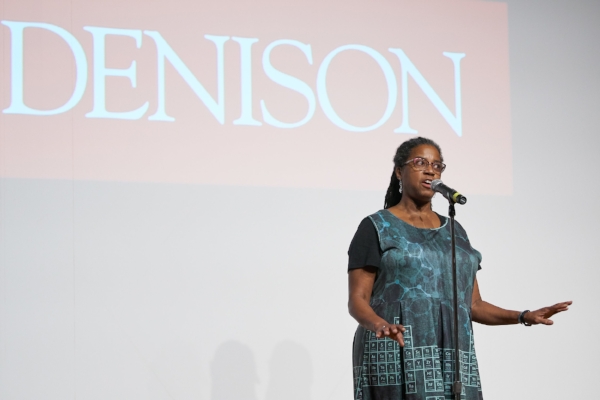
    Alison Williams ’81 will be joining the administration as the new Vice President of Equity & Inclusion. Her appointment was recently announced by President Michael Roth ’78 in an email to the campus community.

    Williams graduated from Wesleyan with a bachelor’s degree in chemistry, served as an alumni-elected trustee on the board of trustees in the 1990s, and taught chemistry at Wesleyan for two years in the late ’90s.

    “Because I’ve seen Wesleyan from different perspectives, I hope to get people to work together across those boundaries that sometimes come up,” Williams said in an interview with The Argus, referencing potential rifts among communities on campus.

    After 24 years of teaching as a chemistry professor at various institutions, she moved into work with diversity, equity, and inclusion in positions at Oberlin College and Denison University.

    “The biggest and most recent accomplishment I had was to overhaul how faculty searches were done here at Denison, and that’s led to a really diverse group of faculty being hired,” Williams said. “It involves helping people understand the biases that come into play in the search processes, and taking steps to minimize those biases so that everybody has a fair shot, regardless of their background and identity.”

    In addition to her work with faculty, Williams sought to create a culture of inclusion in the sciences. Williams’ work at Denison has been limited to improving diversity within faculty, but during both her interview with The Argus and her presentation for the position, Williams emphasized her desire to work with students as well. Coming into the role, Williams has yet to decide on specific changes that should be made, as she believes it would be best to gather information about the campus community before making any declarative statements about what needs to change at Wesleyan.

    Despite not having any concrete changes in mind, Williams stated that making Wesleyan a more diverse and welcoming space for students of color is essential in recruiting more students of varying backgrounds.

    “I think that if you can create a culture such that Wesleyan becomes known as a place that celebrates diversity and is inclusive, that reputation then can help to attract diverse students,” she said. “Parents don’t want to send their students to places where they don’t feel that their student will be welcomed and supported, so if you can create an environment where people say, ‘Yeah, that Wesleyan, they’re doing some good things,’ then you can attract more people. It’ll be easier to recruit people from different experiences.”

    Williams also spoke to the importance of intersectional identities and being able to support all of the identities that students have, ranging from familial structures to first languages.

    “To help students have the best learning outcome regardless of their background and identity is a big part of what I’m trying to accomplish,” she noted. “[We have] to learn how to embrace difference and celebrate that difference so people can learn from each other’s cultures, each other’s backgrounds, each other’s experiences.”

    In addition to her ambitions for the future of the Wesleyan’s inclusion efforts, Williams spoke about her eagerness to bring her talents back to campus.

    “I’m really excited about coming back,” Williams said. “I love Wesleyan. I really value the people I’ve met there…. When I was there before, there was no such thing as a Diversity Officer…there was no Office of Equity and Inclusion, none of those things were in place. Some of those programs are going on—the Mellon program, WesMaSS—things like that are really great, none of that was going on, so I think to take those programs and the work that’s been done on [faculty] searches and support them and make them stronger would be really exciting.”


    Genesis Garcia can be reached at ggarcia02@wesleyan.edu.

    Hannah Reale can be reached at hreale@wesleyan.edu or on Twitter at @hannahereale.