Author: Hannah Reale

  • Judge Rules Against Professor McAlear, Closing Defamation Case Against Wesleyan

    Judge Rules Against Professor McAlear, Closing Defamation Case Against Wesleyan

    A judge ruled against all of Associate Professor of Molecular Biology and Biochemistry Michael McAlear’s charges against the University on Tuesday, Feb. 18, effectively closing the case. McAlear told The Argus that he does not plan to appeal the ruling. 

    McAlear filed the lawsuit against the University in May 2019. The suit alleged, among other charges, that the University had breached its contract with him by failing to hold students accountable when they hung posters around the University’s campus that put his face and name—along with those of two other professors—alongside text that read, “Reject sexual predators emboldened by institutional power.” Later, his legal filing was amended to further allege that the University had defamed him by failing to take sufficient action against those who had hung the posters. He sought compensation for damage to his reputation. 

    The judge found the University not responsible on all counts.

    “Wesleyan argued that my reputation doesn’t have value, and admittedly I could not show that I lost my salary or that there was a specific monetary damages to all of these false accusations,” McAlear said in an interview with The Argus. “But I disagree with the ruling. And our reputations are of value, and we go to great lengths to advertise and promote our reputations.”

    The University declined to comment.

    Adam Steinbaugh has been closely following the case from his role as a lawyer and director at Foundation for Individual Rights in Education (FIRE), a nonpartisan foundation committed to defending individual rights on college campuses. Steinbaugh spoke with The Argus about the ruling and potential ramifications of the judge’s decision. 

    “I think that the court generally got things right here and that universities and colleges should not be responsible, legally, for the speech of their constituents because that would incentivize the administrations of universities and colleges to clamp down on speech as a means of protecting the university,” Steinbaugh said. 

    Still, Steinbaugh believes that this case may cause universities to become stricter when regulating speech. According to McAlear’s filing, the University made efforts to find the students responsible. 

    “The court reached that conclusion in finding that Wesleyan was not responsible by citing the University’s efforts to investigate, and to remove the flyers and posters, and to identify the people that put them up,” Steinbaugh said. “The court found that the speech itself was defamatory, so defamatory speech is not protected by the First Amendment, but it’s not hard to imagine institutions having a conflict of interest in making the determination of whether or not the speech is protected in these circumstances.”

    McAlear says that his case is about faculty rights and that the University’s employees should be aware if the Faculty Handbook isn’t being taken seriously.

    “I believe the University really doesn’t respect—and it’s clear from what they argued with their lawyers—they don’t respect faculty’s rights or faculty’s reputations, and I feel like all the faculty should know that,” McAlear said. 

    Steinbaugh argued that the University should amend its handbooks in order to better protect themselves against further lawsuits. 

    “I think that the University would be better positioned if they took a look at their policies and their commitments concerning free speech, and made them more robust, because if they had a more robust policy commitment to freedom of speech, it’d be easier to point at that and to say, ‘Look, we disclaim the ability to control speech on our campus, therefore we can’t be held liable for the speech that occurs,’” Steinbaugh said. “That might be a way to protect themselves in the future, rather than having to say, ‘Look, we investigated it, we tried to suppress the speech.’”


    Hannah Reale can be reached at hreale@wesleyan.edu or on Twitter @HannahEReale.

  • Wesleyan Announces New Timekeeping System “WorkForce,” Met With Student and Worker Outrage

    Wesleyan Announces New Timekeeping System “WorkForce,” Met With Student and Worker Outrage

    Wesleyan will begin testing WorkForce Time, a new timekeeping system for employees, in April 2020. After testing, Wesleyan intends to launch WorkForce over the summer. Since the announcement, students and non-student employees have expressed worry, anger, and confusion over how the new system will affect them and the Wesleyan community at large. 

    WorkForce’s implementation was announced in an all-campus email from Wesleyan’s Senior Vice President and Chief Administrative Officer and Treasurer Andy Tanaka ’00 and Vice President of Information Technology and Chief Information Officer Dave Baird on Tuesday, Feb. 18. 

    “WorkForce will simplify processes and consolidate the current multiple reporting systems into a single system,” Tanaka and Baird wrote in the email. “We’ll use various technologies—including time clocks, computers, phones, and tablets—to document time worked and to record leave.” 

    Concerns raised about WorkForce include its use of geo-fencing technology, a lack of transparency from Wesleyan about their contract with WorkForce, and the fear that the software will be used to cut employee jobs and pay. As such, Physical Plant and clerical and secretarial workers voted unanimously to oppose WorkForce in a union meeting, United Student/Labor Action Coalition (USLAC) has circulated a petition in opposition to the implementation of WorkForce that had garnered over 1,000 signatures at the time of this article’s publication, and the Wesleyan Student Assembly (WSA) unanimously passed a resolution calling for the administration to halt the implementation of WorkForce. 

    WorkForce’s software provides clients with the ability to record employee time, attendance, absence leave, accommodations, and also offers geo-fencing technology, among other features. WorkForce is currently in the process of customizing their software to Wesleyan’s needs before testing begins in April, according to Associate Vice President for Finance Chris Olt and Associate Vice President for Human Resources Lisa Brommer. 

    When it is implemented, WorkForce will be used by Wesleyan employees, including all student workers, to record their hours and time off. According to Brommer and Olt, WorkForce will not be used by Service Management Group (SMG) custodial workers or non-student Bon Appétit workers, who are subcontracted employees. Faculty will not use WorkForce either. 

    For the purposes of recording hours and requesting time off through WorkForce Time, Wesleyan employees will be split into seven different user groups: Secretary and Clerical, Physical Plant, Public Safety, Nurses, Administrative Staff, Students, and Temporary Employees, according to Wesleyan’s Associate Controller Melanie Messier and Information Technology Services (ITS) Senior Project Leader Barbara Spadaccini, who are Wesleyan’s co-project managers for WorkForce’s rollout. 

    “Each group has slightly different calculations for paid work and leave, and recording work hours vary based on location,” Spadaccini and Messier wrote in an email to The Argus. 

    Employees will also use the WorkForce software in different ways. For example, according to Spadaccini and Messier, Physical Plant and Public Safety will use ID cards to clock in and out, students will use a mobile time clock accessed via WesPortal, and other employees will use web-based timesheets on computers. 

    The introduction of WorkForce will also bring Wesleyan in line with Connecticut labor regulations that require employers to record their hourly staff’s start and stop times. 

    “The Department of Labor in Connecticut requires that we capture the time worked,” Olt said. “So it’s what time did you arrive, what time did you leave. And the reason for that is that it’s not enough to know [if] an employee works seven hours. The state wants to know that we’ve given them sufficient break time.”

    Another reason Wesleyan decided to implement WorkForce is because, at present, almost every workplace on campus calculates time worked, pay, and leave differently. As a result, Wesleyan’s three-person Payroll Office has become overburdened. 

    “So having dozens of different processes, it’s hard, and I feel bad for the folks in Payroll,” Olt said. “We’ve asked them to pay everyone timely and accurately, and we do a phenomenal job with the information that we get, but we don’t get all of the information timely resulting in…that delay in pay.”

    In particular, paying student workers in a timely manner has been a challenge for Payroll staff. 

    “Nearly every department who employs a student does it slightly differently,” Olt explained. “We have decentralized processes around procurement, around employment. So we’ve essentially said historically, ‘Okay, you want to employ a student, you figure out how to track their time, you figure out how much to pay them, and you figure out how to get that data to payroll,’ which has resulted in dozens of processes across the institution for managing student time.” 

    After the rollout of WorkForce was announced to the Wesleyan community, all present Physical Plant and clerical and secretarial workers at a Feb. 26 union meeting unanimously voted to oppose the implementation of WorkForce. 

    USLAC also listed their concerns in the petition and requested a response from Wesleyan by March 23. 

    One of these concerns is that Wesleyan intends to use geo-fencing technology—the creation of a virtual boundary for a worksite—as part of the WorkForce software. 

    “Wesleyan United Student/Labor Action Coalition (USLAC) stands in firm opposition to Wesleyan adopting WorkForce or any other system that uses geo-fencing,” USLAC said in a statement released on Feb. 27. 

    Senior Business Representative for the Local 153 OPEIU Seth Goldstein, who represents Physical Plant and clerical and secretarial workers at Wesleyan, also raised concerns about surveillance. 

    “USLAC is concerned because of the labor issue, but this is not just a labor issue,” Goldstein said. “This is a surveillance issue.” 

    Olt, however, said that no employee will be required to log into WorkForce from their personal devices, nor will Wesleyan require anyone to download an app. Instead, all employees will have the option to log in from their own device or on a Wesleyan device. 

    “If a student chooses to use their phone and the department chooses to use the functionality, you’d have to arrive in that location before you can check in,” Olt said. “Like you can’t check in to work in Admissions from your dorm or from Andrus Field. And if you don’t want to do that, we’ll have a device in Admissions that you can log in [to] via WesPortal, sign in, use the clock, and sign out. You don’t have to use your device at all. And then the device stays in Admissions, there’s no chance that it’s tracking you because it’s at a single place. So it’s going to feel very much like the way it happens now. The only difference is that you now have the option to quickly do it via your mobile device.” 

    Olt also said that, to his knowledge, even if employees did choose to use their personal devices to clock in and out, WorkForce and Wesleyan would be unable to track employees. However, Olt explained that Wesleyan is in the process of confirming this with WorkForce. The Argus was unable to reach WorkForce for comment. 

    “You can use your phone and log in via a browser, log in to WesPortal, record your time, and then log out of WesPortal… and there’s nothing for it to track,” he said. “So you log in and log out and it’s not tracking, but that was one of the follow-ups to the vendor.”  

    President Michael Roth ’78 reiterated this point in his meeting with the WSA on March 1.

    “We don’t want to know where people are,” Roth said. “If the most important issue is about geofencing for student workers…there’s still time to make changes.”

    Roth also criticized the petition that USLAC circulated when asked about it by a WSA senator. 

    “I’ve seen it,” Roth said. “It says things like, ‘Roth wants to know where custodians piss and shit,’ and although that’s an interesting fantasy—that’s Freudian, I love to see what people share online—that’s just misinformation.”

    Another concern raised by USLAC, other employees, and the WSA is a lack of transparency from Wesleyan about their contract with WorkForce.

    “[The WSA] calls for the publication of the University’s contract with WorkForce so that workers can understand exactly how their data will be used and how much money Wesleyan spent on WorkForce,” the resolution passed on March 1 reads. 

    “I think it’s really hard for both…student workers and workers who are directly employed by the University to kind of get a good sense of what we’re dealing with here unless we can get more information from the University,” said Katelin Penner ’22, the primary sponsor behind the resolution. 

    In addition to calling for Wesleyan to publish the contract with WorkForce, the resolution demanded a town hall for workers to voice their concerns and called for a student representative to be involved in all decisions and committees related to WorkForce’s implementation, stating that they expect a prompt response. 

    In response to calls for the contract to be released, Olt explained that Wesleyan usually does not disclose its contracts with vendors or how much it pays for services.

    “Generally we don’t share contracts,” he said. “Most of them have a confidentiality provision in it. We are working with the vendor to get a copy of their data and privacy policies…that we hope to be able to share.” 

    Wesleyan has yet to hear back from WorkForce about whether WorkForce would release their data and privacy policies at the time of this article’s publication.

    Goldstein also argued that the transition to WorkForce violates labor law because changes to the clock-in processes were discussed in the last contract negotiations between Physical Plant and Wesleyan last fall. Brommer disagrees, saying that the National Labor Relations Board (NLRB) does not require new timekeeping methods to be agreed upon during negotiation periods. The NLRB did not respond to a request for comment by the time of this article’s publication. 

    Those who oppose the implementation of WorkForce have also said that Wesleyan may use WorkForce as a way to cut salaries and jobs through close monitoring of employees to identify perceived inefficiencies. 

    “In general, USLAC is against any implementation of a system that is aimed at cutting labor costs on this campus,” USLAC member and student worker Ivanna Morales ’22 said. 

    In response, Olt said that he does not expect Wesleyan to use WorkForce as a way to cut labor costs. 

    “We don’t anticipate that this is going to cut time or eliminate positions or reduce the University’s pay,” Olt said. 

    Brommer echoed Olt’s remarks, explaining that she does not foresee changes to pay or jobs in Payroll and Human Resources.

    “There’s plenty of work to do,” she said. “So the fact that we have a system that will help us do that, there’s still analysis that needs to be done. There’s still you know, data reporting…. So we don’t anticipate anything happening in our areas yet.” 

    Spadaccini and Messier also said that Wesleyan does not intend to use WorkForce to cut jobs or pay.

    USLAC sees the implementation of the system as a sign that Wesleyan mistrusts its workers. 

    “I think as a whole, my bosses, the ones that I work with every day, trust me,” Morales said. “They trust who I am as a worker, they know who I am as a student, and the fact that Wesleyan wants to oversee our practices and claim that workers might be using the bathroom for too long, or leaving the workplace or in any way, [or] trying to steal time or wages or whatever. I think it’s insulting to all student workers. I think our work and our labor isn’t valued here.”

    Penner echoed Morales’ thoughts. 

    “This is kind of just another step in that progression of de-valuing workers and de-valuing labor,” Penner said. “So I think it’s something that we need to take a stand against.” 

    USLAC has argued that by using WorkForce’s technology, Wesleyan would be partnering with an anti-worker company, citing WorkForce’s history of working with clients to cut labor costs, such as at Ohio University

    “The implementation of WorkForce at Wesleyan would threaten the jobs and compensation of student workers and staff, many of whom are already overworked and underpaid,” the petition reads. 

    Roth pushed back against the idea that because WorkForce had been used to cut labor costs at Ohio University, it would also be used to cut labor costs at Wesleyan. 

    “The fact that a website announces that it helps people cut salaries doesn’t mean that we intend to cut salaries,” Roth said.

    While Olt recognizes that many employees may have concerns about WorkForce, he believes Wesleyan will be able to address these issues.

    “[We’ve] heard from some employees who are concerned about the change and we will work hard to address those concerns,” Olt wrote in an email to The Argus. “Our goal for this project is entirely around improvement to our processes, which are antiquated, inefficient and arduous.”

    Wesleyan also plans to hold town halls with the seven different user groups of WorkForce to better understand their concerns with the technology and explain how the software will work. 

    “I think our approach going forward is to have some town hall sessions with the different user groups because it was hard to address questions from the secretarial-clerical union stewards, because the way that they’re interacting with it is different than the way Physical Plant is interacting, and that’s different than how the students [interact with it],” Olt said.

    Morales and fellow USLAC member Helene Kenney ’20 also hope that Wesleyan will hold a town hall to address broader concerns. However, instead of the administration’s plan to conduct smaller town halls with the different user groups, they hope that Wesleyan will hold one large town hall that all employees will be able to attend.

    “We need to be able to hold direct accountability to the people who are making these choices because right now, again, part of the hardest thing is that we don’t know who’s voting for what, and who is setting what at the school,” Morales said. “And so it’s been in the dark for so long. So part of our demands is, like, they hold a town hall.” 

    “There’s been an email going around that they are going to meet with different sections of workers separately, as the WorkForce system will work differently for each different kind of worker on this campus,” Kenney added. “But it’s important to recognize that this is an issue that every single person directly employed by the University is facing. This isn’t something that they can divide us over.” 


    Claire Isenegger can be reached at cisenegger@wesleyan.edu or on Twitter @ClaireIsenegger. 

    Hannah Reale can be reached at hreale@wesleyan.edu or on Twitter @HannahEReale. 

  • WesCeleb: Jake Multer ’20, “Derailed”

    WesCeleb: Jake Multer ’20, “Derailed”

    jake_desktop
    c/o Jake Multer

    According to intensive research conducted by The Argus, there is a statistically significant chance that you’ve talked to Jake Multer ’20. This double-majoring, homebrew club-running, Wesleyan Refugee Project-leading, frisbee-playing senior has spent his four years at Wesleyan knocking on doors, running events, and fermenting. He’s got hot takes on scones and some self-described cold takes on doing good in the world. We might steal a car later.


    The Argus: You’ve been nominated to be a WesCeleb! That’s great!

    Jake Multer: I just got something in my eye. Sorry. [Gets something out of eye] Huh. Cool. Hello.

    A: Hello! There’s a lot of different ways we can start off here, but just give me a little tour of your time at Wesleyan.

    JM: A tour of my time at Wesleyan.

    A: A brief tour.

    JM: A brief tour? Okay. Just on the academic side, double majoring in Molecular Biology & Biochem and Government. I’ve known that since freshman year and have been working on that all the way through. I do research in the Coolon lab studying fly genetics and genomics and toxin resistance. I run the homebrewing club and I co-run the Wesleyan Refugee Project. What else? I play on the co-ed Frisbee team, Throw Culture. Is this the right kind of answer to the question?

    A: There’s no right answer, Jake. It’s all about you.

    JM: Terrifying.

    A: So tell me a little bit about your trajectory at Wes. You said that you’ve known since freshman year that you wanted to be MB&B and Gov, so that feels like a pretty straight line compared to some people’s, “triple major then drop, then become a dance major, then realize that’s not feasible by the end of senior year and just go back to what you were in the first place.”

    JM: That is an extremely specific question. Yeah, I would say, I mean I did have some changes in it. I came in sort-of pre-med, and then became borderline pre-med pretty quick over freshman and sophomore year, and then moved away from being borderline pre-med to not that. Just not for me. I have a lot of respect for people to do it, but I don’t think it’s the field for me. Lot of respect for doctors. [Both laugh] Did I make you snort coffee? Can that be in the interview?

    A: What about brew? I know you came in freshman year, and you were maybe the one freshman that stuck it out.

    JM: There are a few of us. So yeah, it definitely existed before me, which is why it has this awful name—the Wesleyan Homebrewers Alliance is the official name, which is bad—but the homebrew club started before me. There’s about 11 of us on the board; club itself is 45. Basically once every three-ish weeks, we get together and decide what our next batch of projects are going to be, and divide up supply runs, and divvying people up into houses and everything.

    A: What are you making right now?

    JM: We’re making a whole lot right now. We’re making a coffee stout—that’s my personal favorite, as a coffee lover. We are making our first raspberry sour, and we’re going to see how it goes. We’re making a blood orange wheat beer, like a Blue Moon, we’re making blueberry lemon mead, we’re making cinnamon-orange-cardamom mead, we’re making an amber ale, we’re making a pineapple IPA, we’re trying to make our own version of White Claw that we’re calling Red Claw, and we’re making a lemon wine.

    A: Why is it Red Claw?

    JM: Because Wesleyan. This is why. We’re now currently looking for juniors to run it next year. That’s a fun space for me, and that’s a relaxing one. And I love cooking and science-y things and crafty things and it’s at this intersection of all of that in a way that I really enjoy.

    Emmy Hughes, Executive Editor
    Emmy Hughes, Executive Editor

    A: And so with your cooking, are you on any big kicks lately in the world of cooking? That can be a cookbook, or something that you haven’t cooked with before that you suddenly really like, or…?

    JM: I’ve recently, courtesy of some choice holiday presents, recently discovered Alison Roman. She’s amazing. I used to cook like a lot of two-hour-long stirred, constantly complicated stuff. And now Alison Roman has changed the game for me because she’s all about these fancy-seeming things, or things that have like a little bit of flair, but that are very doable and manageable and [have] reasonable timelines and are not too labor intensive, in a way that I’m absolutely loving. So I’ve been cooking a lot from her book, “Dining In,” right now, or her YouTube videos….She has a bunch of cool ones with New York Times Cooking.

    A: And what about the Wesleyan Refugee Project? Is that another thing that you got involved in freshman year?

    JM: Yeah, I got involved in a lot of different service-oriented clubs freshman year, and I ended up sticking it out with the Refugee Project because, at that point, they felt like the most organized one that I was a part of. Part of the reason I got involved in the Wesleyan Refugee Project is that I was inspired to work on these issues by my grandmother, who was a Holocaust survivor and who was stateless and displaced for several years, following the second World War, eventually was resettled into the U.S. and became a citizen here and started a new life here. But her work, and talking to her about that, and our bigger family history with these issues and in relation to displacement, is what inspired me to work on the club in the way that I do.

    Now I’m one of the co-leaders of the club. I guess, bigger picture, Wesleyan Refugee Project, we’re trying to mobilize student energy and resources at Wesleyan to address displacement and to support refugees and displaced people around the world, within the U.S., and we’re trying to address some of the systemic blockers that block displaced people from accessing resources. And we provide a lot of direct services like tutoring or childcare or different things like that to displaced people living in communities around us.

    That, I would say, is what I spend the most time on, on campus. I probably spend 12 to 20 hours on it a week. I’m able to do that, fortunately, because it’s a paid position through the OCS [the Office of Community Service] as a community service organizer, which is amazing. So I don’t have to do chem tutoring anymore. Shout out to chem tutors—it’s a rough gig.

    A: I’m curious, from your perspective in WRP, which, especially in the advocacy wing, it’s a political organization on campus in some ways. And there’s two really sharply divided perceptions of Wesleyan activism and political engagement. There’s the perception of like, “Wow, Wesleyan students are so liberal, they get out and do so much and they’re so politically engaged.” And then there’s the other perception, that’s like, “Everyone talks a big game and no one actually does anything.” And so I’m curious, being involved in that scene, where you fall on that?

    JM: I think it’s hard to generalize on that. I do think that, particularly compared with a lot of other college students and colleges, Wesleyan students generally are pretty engaged in the intellectual side of stuff and in the debates and, to some degree, depending on the groups, on the actual work of trying to make change in those spaces.

    What I’m thinking about is like, I worked on a campaign sophomore summer. It’s really easy to get people to say that they’ll support someone and to do small tasks. People are pretty good for a small ask here. If you’re asking for a small donation—or asking people [to] show up at an event, that can be harder, but that’s still an okay ask. If you want people to go out and knock doors for a candidate during the day—which I don’t do as part of the Refugee Project but I’ve done that with WesDems and with other groups, getting people to show up to knock doors for a day, or to do an actual action for a period of time, is really hard here. It’s hard everywhere. So I don’t think that’s a particular indictment of Wesleyan students, but it’s really, really challenging to get people to actually commit the time and energy and go into that space. And I have a lot of respect for organizers who are able to do that.

    So in sum, I think there is a lot of good energy on this campus, and I do think that sometimes mobilizes into really concrete and cool action. I also think that there are sometimes strands on this campus that lean towards talking a lot about an issue, and some complaints about the issue, and then not actually mobilizing that into action. I think it’s a shame because there’s a lot of potential on this campus, when people actually harness their energy, to really make big concrete changes and, for a myriad of reasons, sometimes that doesn’t materialize. Does that answer your question?

    A: Yes! Do you want to talk about Max Rose at all?

    JM: “He’ll fight for you.” [laughs] Sophomore summer, I worked on army veteran Max Rose’s campaign for Congress. He was running as a Democrat in Staten Island and South Brooklyn. Pretty heavily right-leaning district, went for Trump by about 10 points….Compared to the rest of New York City, which did not. So I started out as a door knocker there, and then I became one of the field organizers; particularly, I did a lot of volunteer coordinating and a lot of managing a really unruly spreadsheet. And then I took a week off school junior year to go back for Election Day. I was part of the Get Out the Vote team. I did a lot of field manager work for the week before it, and a lot of door knocking in there, too, and then, on the day of, I had like a 70-person team, which was cool. Including my parents! So shout out to them. Thank you, Dad, for driving me around all day. Thank you, Mom, for manning that poll site.

    A: And also, you brought up your parents. So, on a related note, some people think about, “Oh, what would I tell my freshman self if I was coming to Wesleyan now, knowing what I know now?” You kind of got that chance, because your little brother started here this year. So what was the big advice for him?

    JM: [whispers] I didn’t give that much advice.

    A: Okay, so pretend you did. What would you tell a hypothetical freshman who is similar to you?

    JM: These are all so bad. Don’t eat at Summies more than one-and-a-half times a day on average. Hallcest can turn out fine if you’re adults. I don’t think these are publishable. Don’t ever eat anything called a “barbecue attack bowl.” Sixty percent of the population is lactose intolerant. But a real one? I mean, I mean all of them, but… I would say, be open to trying a lot of extracurriculars and spaces that seem appealing to— this is so much more polished, just use the unpolished ones. Oat milk is just as good as normal milk.

    A: What’s the best coffee on campus? [pause] This is the most stressed out you’ve looked the entire interview.

    JM: So like, as a recovering caffeine addict, I’m trying to limit myself to three a day. And trying to not have coffee past 6 p.m. 6:30 is my goal. 6:30 is my cutoff time. Also prioritize sleep, that’s advice for the people. I’m sorry, this is probably the most derailed interview you’ve ever done.

    A: This is not the most derailed interview I’ve ever done.

    JM: I’d say Espwesso when it’s open. Otherwise, I’m a Pi stan from all the science classes I’ve had to take. It’s always there for you. You can get a blueberry scone with your coffee.

    A: Are you a fan of scones?

    JM: This feels like a targeted question. Yeah. Honestly, I love a blueberry scone from Pi. I’m going to be real, the chocolate chip ones are inferior to the blueberry ones, and people can fight me on that if they want. The bagels there, nuh uh.

    A: Is there anything else we didn’t cover that you wanted to talk about?

    JM: Got into pickling recently, that’s not that cool to write about.

    A: It’s a little cool!

    JM: That’s just because we made pickles together! Donate to WESU, and come to events at the Refugee Project. We’re having a great gala, please come. Support local news, I don’t know, these are all boring. These are just cold takes that are good for the world. Call your senators. Give kombucha a try. I was skeptical at first, but I really like it now.

    A: You should make your own kombucha.

    JM: I’m down to.

    A: Okay, yeah.

    JM: We’d just have to go to the brewing store and get some stuff for it.

    A: Yeah, that’s the problem.

    JM: We can just steal a car.

    A: Okay.

    JM: Get your driver’s license before you’re 22, 21. Be kind to others. Butts C is the best of the Butts. Tofu coop is a steal. Egg coop, pretty good deal, if you can get a rack of eggs at the end….Don’t print that, they’ll kill me. The Office of Community Service is a wonderful space full of incredibly supportive people who will help you realize some awesome ideas. You can print that, they won’t kill me.

    Knock some doors for a candidate you believe in. If primary season seems too crazy, then do it in the general. 2020 is an important election, and if you stay on the sidelines, you’re complicit. Goodnight.

    This interview has been edited for length and clarity. 


    Hannah Reale can be reached at hreale@wesleyan.edu, or on Twitter @HannahEReale. 

  • Dear Argus, Do Better. Sincerely, Wesleyan POC
    Dear Argus, Do Better. Sincerely, Wesleyan POC

    Right before Thanksgiving break, the Argus published a review of a student remake of Lin-Manuel Miranda’s “In The Heights.” As a Dominican-American with immigrant parents, I as well as other students of color were frustrated with the various ways in which this production was disrespected.

    In the review, the writer questioned whether the story depicted an accurate reality for those living in Washington Heights. While her social critique was not wrong, “In the Heights” is about much more than just gentrification. “In the Heights” was meant to tell a nuanced story about everything in the immigrant experience — love, family, community, in addition to social commentary. Not all stories about oppressed populations need to be about their oppression; in fact, much of the US immigrant experience is defined by a transformation from overcoming this oppression. There is beauty within our displacement too. Moreover, the use of the word “conservative” to describe the story totally ignores how charged the term is — in this country, being “conservative” can mean anything from opposing affirmative action to believing in incarcerating all undocumented immigrants. Especially when used against a show of all-POC, the label “conservative” dismisses our struggle against the racist, oppressive structures that people in power abuse us with every single day.

    Even if the director, Milton Espinoza Jr. and everyone else involved in the show found a way to legally change the script to make its social critique more salient, this new show would simply not be “In The Heights.” If Espinoza Jr. were to remake the musical, it could have been interpreted as a critique of Lin-Manuel’s efforts to rightfully expand musical theater productions to POC and capture the NYC immigrant experience. But given that Lin-Manuel literally redefined the role of POC in musical theater by writing this show, it is perfectly fair for Espinoza Jr. and company to simply pay respect to such an instrumental figure with a faithful rerun.

    Curiously, the writer actually did pick a scene that deserves to be analyzed. I, too, found the “Carnaval Del Barrio” scene kinda off, but not for the same reason. As everyone was celebrating proudly and waving the flags of Latin America in the streets of New York City, I couldn’t help but notice that the Spanish flag was included in the scene. Pero mi gente, as sung by Fulanito in “Guallando”: “en el 1492 llegó un tipo que dijo que descubrió la quisqueya mía, ave maría, get outta here con eso.” In a production about Dominican-Americans and other members of the diaspora, it is demeaning to Latinx-American immigrants to elevate the flag of their colonisers and oppressors to the same level as their own. As Ricardo Vega elaborated in his Wesleying post, “In the Heights with the Whites–White Students in POC Spaces,” given that white people already take up so much space that should belong to POC, Christopher Columbus especially does not deserve a seat at the table.

    *Chadwick Boseman entered the chat* “We don’t do that here.”

    The review was on the front page of the Argus, but it was relegated to a space all the way down on the small corner of the front page, amplifying conversations about how POC shows are egregiously undercovered in the Argus. This lack of representation compounds the struggle for students of color in theater, who already need to contend with a white-dominated space. However, the front page story was about a conflict between a white student and a young black boy that could have resulted in the latter being killed or jailed by the Middletown police. While it is true that the Traverse Square conflict deserves more attention, this unfortunate coincidence in news coverage does not absolve the Argus and the greater Wesleyan community of continually marginalizing POC voices and experiences on campus. It is exceedingly rare and such an astonishing achievement for a Wesleyan musical production to have an all-POC cast, and the Argus as well as the Wesleyan community must understand the frustration stemming from this lack of attention compared to predominately-white student productions.

    Under Trump’s regime, it is difficult to be an immigrant — and even dangerous for undocumented folx terrorized by state violence. It is exactly because of these challenges that it is important for stories like “In the Heights” to inspire hope and resilience for immigrant families of color in the US. Because while “pluck, hard work, and a strong sense of community” is not “a solution for all ills,” it definitely must be a part of the solution. And it is precisely through showcasing these nuances that “art goes further.”

    Thank you to EVERYONE that was involved in this show. Thank you for the hard work y’all pulled. Thank you for representing our stories. Seeing you made us smile, laugh, and bawl out crying. No pare sigue sigue!

  • Board of Trustees Faces Questions on Divestment, Custodial Workloads

    Board of Trustees Faces Questions on Divestment, Custodial Workloads

    c/o Shirmai Chung
    c/o Shirmai Chung

    On Nov. 22, the board of trustees convened for their quarterly meeting, and as part of their program, the board invited students to Zelnick Pavilion for an unstructured open forum. The meeting marked the semesterly lunch for students to meet with the trustees. 

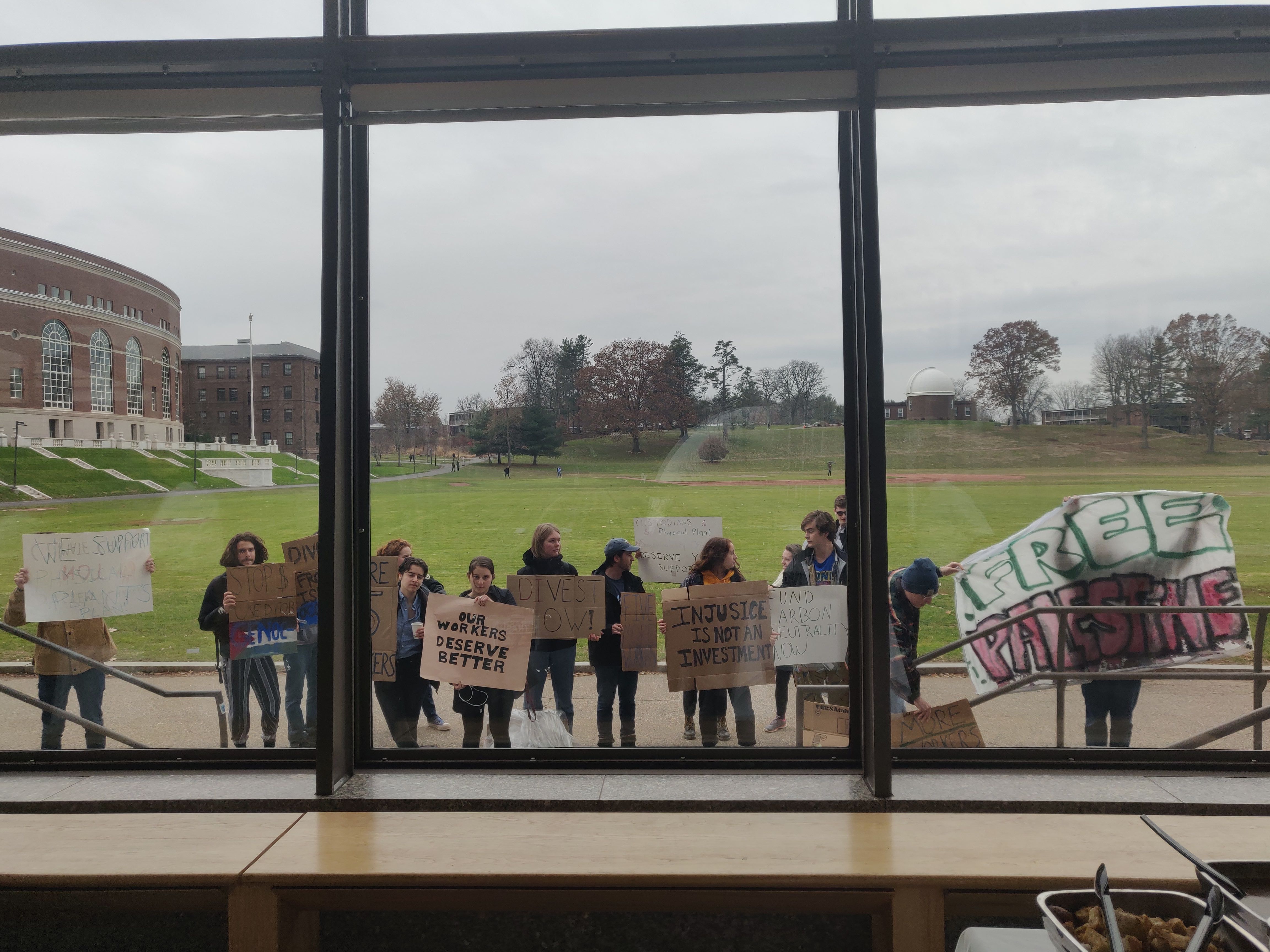
    As the board of trustees made their way to Zelnick Pavilion, protesters from Jewish Voices for Palestine (JVP), WesDivest, Climate Action Group (CAG), and the United Student/Labor Action Coalition (USLAC), stood at the entrance. They chanted “Five more workers,” which has been USLAC’s rallying cry.

    One trustee, John Frank ’78, P’12, stopped to speak with students about why they were protesting. Students explained USLAC’s platform advocating for five more workers, recounting the history of custodial staff being reduced from 60 custodians to 50. 

    “I think that the members of the board, we are the governing board of the University, we have a fiduciary responsibility to advance the interests of the University,” Frank later said. “It’s not like we are elected representatives of the alumni or the students, but obviously, we care enormously about Wesleyan, we care enormously about the community. We can’t do our jobs without understanding what the alumni think, what the faculty think, what the staff thinks, and what the students think.”

    Trustee Marc Nachmann ’91 later responded to student concerns about custodial workloads. 

    “We’ve heard about the custodian protests,” Nachmann said. “I mean, these are operational decisions. The board’s not supposed to get involved in how many people we have [where]—that would infringe on what the administration’s supposed to do. We’re supposed to set bigger-picture strategy about that.”

    “The thing you need to make sure that the students understand…is that all of this is a bit of a zero-sum game,” he continued. “There’s so much money around—you can either get more money by the student paying more in tuition, or you can have more or less cost and you can have more or less financial aid. All of this has to add up, to some extent. So it’s fine to say, ‘I want to have five extra guys,’ but where’s the money coming from and is it okay to have less financial aid?”

    Other protesters spoke with The Argus about their motives for attending the meeting. 

    “I’m here because this world’s being absolutely obliterated by fossil fuel companies and companies supporting the occupation in Palestine, and the University’s money is being used to destroy the world in those ways,” Benjy Kline ’23 said. “We want the University to stop supporting those things, and stop making all of our actions as students complicit in this form of destruction by just going here.” 

    Shirmai Chung ’22—a member of the Wesleyan Committee for Investor Responsibility, which is a panel composed of students, faculty, staff and alumni and that advises the board of trustees—attended the meeting to air the committee’s collective grievances to board members.

    “I am here on behalf of the Committee for Investor Responsibility, to ask what the board of trustees’ take on the current investments at Wesleyan is and why Wesleyan has not made a formal commitment to divestment yet, even though it has been realized on multiple occasions through blog posts by [President] Michael Roth [’78], and through our interviews and meetings with the investment office, our conversations between people in the administration that they want to divest, but there is no formal commitment yet,” she said.

    A member of USLAC, WesDivest, and JVP, Leah Levin Pensler ’20 discussed why she was protesting the meeting and the common causes of these groups in organizing action around the event.

    “We are all here in solidarity with the different demands of students and workers on this campus.” Pensler said. “I think we all share the same values in demanding this University address climate change directly, address workplace safety issues directly. We cannot call for divestment without also calling for ending climate colonialism, in tandem with that, we need to lift up all people, including working-class people, custodians, students on this campus, all workers on this campus and around the world.”

    Other climate advocacy centered on a new proposal from the Facilities Department to replace steam pipes.

    “Climate Action Group is here because Physical Plant has unveiled a plan to go carbon neutral, which includes replacing the steam pipes for heating with hot water pipes, which will not only save money but be more energy efficient,” said Will Wallentine ’23. “But the whole plan takes a lot of money, and they’re asking the board of trustees for money, and whether or not that plan goes through all depends on the board of trustees.” 

    Nachmann also addressed the Facilities proposal, which had been presented to the board that morning. 

    “We’re no experts in steam pipes, but it looks like we’ve got to do something about it, and we’ve got to figure out how to pay for it,” he said. 

    Nachmann noted that the board will not be voting on the proposal until their next meeting in February. 

    Trustees also discussed other proposals that had been brought to the board so far that day; namely, the ongoing conversation about the renovations to the Public Affairs Center, what will replace the Hall-Atwater building when it is demolished in a few years, and how the Exley Science Center and Shanklin Laboratories should be modified, if at all. 

    “The only thing we know is, number one, Hall-Atwater will go,” Donna Morea ’76, P’06, the chair of the board, said. “There are trade-offs. Do we keep Shanklin, do we not? Do we have to tear down buildings, houses, on Lawn Avenue, or not?”

    The board has run into many challenges and considerations with the dramatic renovations to the science section of campus.

    “The problem…is how far in advance you need to think through these things,” said Adam C. Bird ’87, P’19, ’22. “We’re making bets on decades.”

    In tandem with many of the student protesters, trustees emphasized the importance of energy efficiency in conversations about the upcoming remodeling.

    “We’re using a lens of energy efficiency when we look at everything,” Bird said. “Like, keeping Hall-Atwater. Hall-Atwater consumes a ton of energy, it’s totally inefficient.”

    Trustee Al Young ’88 echoed the point.

    “These are buildings that did us very good in the 1960s,” Young said. “We’re pushing 2020. That’s a huge board issue.”

    The hour-long lunch provided specific time for students to meet with the board, but Chung talked about the difficulties of the format.

    “I think one hour is too short for any productive conversation to come out of it and I think that the format of this whole event is not very productive either because there is no way to target specific members of the board of trustees to reach out to you or talk,” Chung said. “I would appreciate it if it’s more formal next time, where their roles within the board of trustees are listed.”


    Hannah Reale can be reached at hreale@wesleyan.edu or on Twitter @HannahEReale.

    Tobias Wertime can be reached at twertime@wesleyan.edu

  • Divestment is a Necessary Step Towards Ending Climate Colonialism

    Recently, the Argus published an op-ed entitled “Why Divestment Falls Short of Its Intended Goals.” This article is predicated on a glaring misunderstanding of divestment as a whole.

    The article bases many of its arguments in misguided teachings of neoliberal economics. Firstly, people pushing for divestment (at least at Wesleyan) are not doing it because of the possibility of declining returns. Divestment is pushed due to the perpetuation of violence against communities — particularly Indigenous peoples, people of color, and low-income folks — as well as ecosystems, nonhuman animals, and the land by fossil fuel companies. To cite that individuals are still reliant on fossil fuels is the classic “you critique society, yet you live in one” argument. Arguments like this perpetrate a defeatist mindset that must be eliminated in order to prevent climate catastrophe. Given the immediacy of the effects of climate change on the planet’s socio-ecological systems, we must act now to transition society off fossil fuels. Doing this requires us to envision a vast restructuring of our society, our economy, and our infrastructure. Divestment aims to accelerate this change by removing money from the fossil fuel industry.

    Regarding divestment specifically at Wesleyan, the author states that “a multitude of financial instruments mix in fossil fuels.” This is a classic argument made by those looking to delegitimize divestment; however, just about any form of capital will be connected to some immoral industry in the global economy. By divesting Wesleyan’s endowment from both its direct and indirect holdings in the fossil fuel industry, we are able to pinpoint the parts of the economy involved with the fossil fuel industry to the most accurate extent possible, while acknowledging that we are currently in an epoch in which capitalism creates an inevitable a web of immorality when it comes to investment. We must make strikes where we can.

    Furthermore, we know that keeping our endowment invested in the fossil fuel industry is not only a risk to the future of society at large, but also to the financial performance of the endowment itself. Even if one does not agree with the moral imperative to divest, there is a compelling financial argument as well. This year, after a six-year battle waged by organizers at the University of California, the University system finally agreed to divest its $134 billion endowment and $80 billion pension fund from the fossil fuel industry. The UC systems chief investment officer and the chairman of the UC Board of Regents’ Investment Committee later explained that the university’s assets entangled in the fossil fuel industry “posed a long-term risk to generating strong returns for UC’s diversified portfolios.” As our planet runs out of extractable oil, profits in the fossil fuel industry decrease, making it financially unwise to continue investing in it. In 2018, researchers from the Institute of Energy Economics and Financial Analysis published a report demonstrating an increasingly bleak future for stocks in the fossil fuel industry. They also point out that companies now take climate activism and resulting policy into consideration in their calculation of unquantified risk. In the same year, four economists concluded that fossil-fuel free investment portfolios perform at the same level that unconstrained investment portfolios do. Knowing this, Wesleyan ought to follow suit from peer institutions like Middlebury, Pitzer, Whitman, and Lewis & Clark.

    Consider the historical trajectory of Wesleyan’s investments. In 1977, nearly half of Wesleyan’s endowment was invested in companies operating directly in the South African apartheid state. While students and professors began a divestment movement at Wesleyan, the administration adopted a policy of “constructive engagement” with companies in South Africa, with the idea that companies profiting from and paying taxes to the apartheid state could work to make it better. Years went by, and Wesleyan continued making money off an increasingly violent apartheid state. After over a decade of activism, Wesleyan fully divested from direct holdings in South Africa.

    If you were to ask someone now if one should have been invested in the South African apartheid state, there would be no pandering about it. In contrast to his harsh opposition to WesDivest’s demands, President Roth was one of the hundreds of Wesleyan students who protested in favor of divestment from South Africa in the 1970s. Today, when we talk about fossil fuel divestment, there are a lot of counterarguments. Some make economic arguments, asserting that divestment won’t do anything, that it is better to work on policy, that personal choices are the answer, and so on. On his FAQ page, for example, President Roth claims that divestment makes no “meaningful impact” on climate change because “the University relies on power from these companies every day.” One day, we will look back and ask how we could have remained invested directly in companies that perpetuate violence against people, against the land, and against the environment as a whole, and ask how we could have made such excuses.

    Climate colonialism is a problem now. In January 2019, armed RCMP (Canadian police) and military forcefully moved onto Wet’suwet’en territory in the name of installing the TranCanada Coastal Gaslink, resulting in arrests for the protection of their own land. The Dakota Access Pipeline was installed through the Standing Rock Sioux Reservation against the will of the Standing Rock Sioux in 2016, forcibly constructed by the use of state violence. Man camps made up of those working on these colonial energy projects installed on Indigenous land have shown to cause a sharp uptick in crime and violence against Indigenous women. Moreover, the Energy Transfer Partners company had contracted G4S, a firm notorious for its use of psychological warfare and extensive human rights abuses, as a private militia to safeguard the pipeline from Indigenous protestors. G4S has also assisted Israeli authorities in the imprisonment and torturing of Palestinians. As Israel continues to encroach on Palestinian territory, land is destroyed for settlements, and natural resources are extracted. The human rights abuses in Palestine connect largely with atrocities committed against Indigenous peoples and land in other parts of the world. We must end these human rights abuses.

    Across the world we see how climate change and colonialism are inextricably linked, causing violence against people and the land. We must understand that climate change and divestment is an issue of colonialism. By investing in fossil fuel companies, we are investing in colonial violence, which depends on a reliable intake of capital to continue said violence. We must stop pandering to the idea that top-down gradual policy change is the only way to go, or is even effective given the immediacy of the issues at hand. Furthermore, we must terminate Wesleyan’s reliance on fracked gas sourced from the Algonquin Pipeline, which is being built by Spectra Energy within several hundred feet from the Indian Point nuclear power plant. President Roth’s solution is to commit to carbon neutrality by 2050, while peer institutions like Bowdoin College have already achieved this.

    What immediate role will Wesleyan play in averting climate catastrophe? As a university deeply committed to civic engagement, it is Wesleyan’s moral responsibility to divest from fossil fuels and the Israeli occupation now.

    Thayne Hutchins is a member of the Class of 2022. 

    Leah Levin Pensler is a member of the Class of 2020. 

  • Letter to the Editor

    This Tuesday, Middletown will elect its new mayor. As Climate Action Group, we believe it’s essential to choose Ben Florsheim if Middletown is to make genuine environmental progress. A lot depends on any mayoral election, but this race is particularly urgent: It will decide our city’s sustainability efforts for at least the next decade and change the way Middletown experiences climate change forever. 

     We can’t leave issues of climate justice up to national politicians alone – local elections matter now more than ever, and in a town of this size, one hundred votes from Wesleyan could be the difference. Very soon, Middletown’s Planning and Zoning Commission will release its next Plan of Conservation and Development (PoCD), an extensive document that outlines the city’s goals for sustainability, infrastructure, transportation, health, and cultural institutions. The PoCD, still in the process of being written, has the potential to advance far-reaching sustainability goals: How much land will we devote to green space? How will we increase access to public transportation? Will we protect vulnerable communities from weather events driven by climate change? (If you’re invested in these questions, contact the authors to learn more about the PoCD.) The mayor will be crucial in making an aspirational document like this manifest in policy. We must recognize how important it is to have a mayor who agrees with the plan. That’s where Ben Florsheim comes in. 

    Florsheim is a progressive who recognizes the urgency of climate change. According to his website, he has a number of initiatives to expand public transport, reduce the environmental footprint of homeowners, reinforce the riverfront, and address Middletown’s food desert crisis. You might remember him from our climate strike in late September – he spoke alongside students, professors, and community activists. Giuliano, on the other hand, recently denied climate change at a conservation event. Not much more needs to be said. Choosing a mayor is but one component of the fight for climate justice, a fight which ultimately comes not from government executives but from the community. Nevertheless, Middletown’s mayor will be a significant gatekeeper of resources, and we have the opportunity to choose between a hindrance and an ally. 

    Some students may feel reluctant to vote in Middletown because it’s not always clear what our role should be in local politics. Though it may seem like Wesleyan is its own insular community, governed by its own rules and internal authorities, we too form part of the Middletown community. With respect to climate change, everyone in this city has to look out for one another. 

    Irene Westfall and Ernest Braun, on behalf of Climate Action Group

  • Students on Administrative Transparency, Deliberations on Joint Venture
    Students on Administrative Transparency, Deliberations on Joint Venture

    Ever since news about Wesleyan’s potential joint-venture campus in China began circulating in late September, members of the Wesleyan community have raised questions about administrative transparency surrounding the venture. Without established channels of communication with University administration, some students turned to protest and online platforms to raise additional concerns about academic freedom and the broader political implications of the venture.

    Wesleyan Student Assembly (WSA) senators were in talks with other students and administrators in an attempt to increase administrative transparency and represent student voices, until President Michael Roth ’78 announced on Oct. 24 that Wesleyan has stopped pursuing the venture.

    The Argus originally learned of the potential joint venture after two sets of slides were mistakenly sent to a student on Sept. 10. One slide deck contained information about the potential joint venture, while the other more generally examined Wesleyan’s standing and opportunity for growth, as published by Wesleying on Oct. 18. At the request of student sources, The Argus treated information available in the slides as off the record in earlier reporting. 

    In response to the Argus article detailing the joint venture, WSA senators Ben Garfield ’22, Huzaifa Khan ’22, and Katelin Penner ’22, among others, met with Roth and Chief of Staff of the President’s Office David Chearo on Sept. 30 to discuss the proposed venture. Roth told the senators that there was currently no timeline for the venture, and that academic freedom and financial incentives for the University were top priorities in considering the venture. The senators also asked Roth about the venture in relation to the Chinese Communist Party’s (CCP) human rights abuses, as a CCP secretary would serve as the leader of the new campus.

    “He said ‘Not opening this campus wouldn’t close those concentration camps,’ referring to China’s concentration camps of Muslims,” Khan read off his meeting notes to the WSA General Assembly (GA) at the Oct. 6 meeting.

    University Communications declined to comment on Roth’s remark.

    Following their meeting with Roth, Garfield, Khan, and Penner presented a WSA resolution as primary sponsors on Oct. 6 condemning the joint venture and the actions of the CCP—reflecting their own opinions and what they had heard from other students they had talked to—in addition to requesting administrative transparency and that student representatives be present at meetings regarding the joint venture. Other WSA senators pointed out the contradiction between condemning the venture and requesting access. The primary sponsors agreed, and decided to edit the resolution and take a more measured approach to gain access to administrative information.

    While the WSA decided to depoliticize their reaction to the news of the joint venture, organizers of an Oct. 11 rally saw the campus venture as a fundamentally political issue. Hong Kong students at Wesleyan organized the rally in solidarity with Hong Kong protesters and in opposition to the proposed joint venture.

    In the proposed joint venture, the University would have partnered with Shanghai Theatre Academy (STA) and Hengdian Group—one of the 10 largest enterprises in China. Citing personal research on Hengdian Group’s deep ties with the CCP, organizers asserted that a decision to partner with Hengdian Group would make the University complicit in the CCP’s involvement in human rights violations occurring in Hong Kong, the Uyghur concentration camps in Xinjiang and other territories. 

    The second version of the WSA resolution passed unanimously two days after the protest. In the new version, the WSA called for the administration to allow two WSA representatives to sit in on meetings about the joint venture, give the WSA all of the pertinent documents about the joint venture, and increase transparency about the venture. They requested a response from the administration by Oct. 16, before Roth left on his annual trip to East Asia.

    At the second resolution proposal, rally organizer Joy Ming King ’20 proposed a preambulatory clause to label the joint venture as an inherently political issue. WSA senators, in addition to the sponsors, denied this clause to maintain their neutral stance, in order to optimize their chances of getting two student representatives in meetings.

    Before hearing the administration’s response, Garfield attended a full faculty meeting on Oct. 15, where Chearo presented on the joint venture to interested faculty members. This faculty presentation was suggested by Chair of the Faculty Sean McCann to the Provost and the President’s Office after information on the joint venture was presented to the Faculty Executive Committee on Sept. 24.

    “Although a request [for a presentation to faculty] did not formally come in, basically I anticipated that one would come in, and I said to the Provost ‘You know, I think that this is something that you should consider,’ and the response of the Provost and the President’s Office was to say ‘Of course, we will do this,’” McCann said.

    Garfield noticed that the slides presented to the faculty were an abridged version of the circulated slides. Notably missing, he said, were slides regarding a proposed timeline for potential next steps for Wesleyan University, the envisioned organizational structure and financial details for the joint venture, Hengdian Group’s involvement in other business sectors, as well as questions pertaining to issues such as reputational concerns for the University. 

    On the same day, Chearo replied to the WSA senators’ request for an administrative response to their resolution and said that Roth would be willing to meet to discuss their demands. The senators replied to Chearo’s request to meet by reiterating their demands and emphasizing that Chearo’s meeting request did not constitute a direct response to their demands. Roth also responded to the resolution by email, noting that he has already met with the WSA, but would be willing to meet again in the future.

    The next day, Chearo emailed to request an immediate meeting with the primary sponsors of the resolution. In this meeting, Garfield, Khan, and Chearo decided that if research on the venture were to continue after mid-November, when the more serious research stage would begin, two WSA representatives would serve on the central advisory committee and sit in on more formal meetings. Both Garfield and Khan believe Chearo was honest and transparent with them in this meeting.

    “We believe what he told us in that meeting,” Garfield said on Oct. 17. “There was no reason for him to be making stuff up at that point.”

    Following Roth’s announcement that the venture would no longer be pursued, the primary sponsors of the resolution along with sponsor of the resolution and WSA senator Rowan Beaudoin-Friede ’22 sent a statement to The Argus about the cancellation.

    “President Roth’s email this morning informing the Wesleyan community that his office will no longer pursue the potential joint venture campus with the Shanghai Theatre Academy and Hengdian Corporation in China is an encouraging step towards establishing communication and transparency between the administration and the Wesleyan community,” part of the statement reads. “We appreciate this gesture and think communication like this is critical to fostering a community where every individual feels safe and heard.”

    Khan said he was glad that the joint venture would no longer be pursued because he had heard student concerns about how the proposed venture would be tied to the CCP.

    “I was personally relieved to hear the campus was cancelled because a lot of students have expressed concerns about the administration dealing with the Chinese authorities and negotiating this campus, or being involved with the Chinese authorities in a venture like this just because of the fact that it’s pretty obvious to them that the events in China are linked to this venture,” Khan said.

    A student from mainland China, who has requested to remain anonymous, also voiced support for the decision to not move forward with plans to develop a joint-venture campus in China. 

    “I think that it is a good decision to keep Wesleyan the way it is for now, because liberal arts education is really so different from Chinese traditional institutions,” the student said. “I think especially in terms of art-making, China does have a lot of restrictions on what can be published or appropriate for the public to see. So it is a good idea that Wesleyan stays the way it is and then still allows art to be politically free and created in a safe environment. I think that is very important. And I do think that the Chinese government has a lot to work on, so right now it probably is not the right time.”

    In a Facebook post, Connecticut State Senator and former Wesleyan student Matt Lesser supported the decision to stop pursuing the venture.

    “Glad to see that Wesleyan has decided not to move forward with building a campus in China,” he wrote. “You can’t offer a liberal education in an illiberal environment, where professors and students have to watch what they say and where they say it.”

    While Garfield was still unsure about the details behind Wesleyan’s decision to cancel the venture, he was pleased to see that Roth seemed to take into account concerns about academic freedom into his decision.

    “It seemed as though it had a lot to do with academic freedom issues, which I think is good that he was keeping in mind all these other issues that we brought up to him in our first meeting with him and have been discussing along the way, like academic freedom and some of the other moral ethical questions about the venture,” Garfield said. “I’m glad that there was more to it for him than just, you know, not a cash grab, but a revenue source for the school and there were these other elements and I’m glad to see that.”

    Garfield saw the all-campus email announcing the cancellation of the venture as a step towards transparency by the administration.

    “We see it as transparent because it shows, rather than trying to not say anything until October 30th or until mid-November, he’s coming back from China—he got back, we know, Monday night—and hearing that he’s able to give us that input on that whole process within just three days of getting back is very helpful to us,” Garfield said. “We think it’s much better than the long and drawn-out process that has gone on so far to sort of just get information.”

    Chair of the College of East Asian Studies Mary Alice Haddad cited the circulated slides and the subsequent student backlash as part of the reason why she believes the venture was eventually dropped.

    “We were at the very early stages,” Haddad said. “Had it not been leaked, none of us would have been the wiser, but because it leaked early, there was this fairly intense criticism.”

    Rally organizer King expressed concerns about interpreting statements from administration following student input as a demonstration of commitment to transparency.

    “I’m relieved to hear that Wesleyan has decided against the proposal, but it would be wrong to see the decision as a sign that President Roth and his administration is being transparent and responsive to community input,” King wrote in a message to The Argus. “From the beginning, the campus community has been excluded from any information about or participation in deliberations over this proposal. Even the ‘updated’ version of the proposal presented to the faculty on October 15 had most of the information excised from it. Though I welcome it, even this decision was made…before the town hall scheduled for October 30, when the campus community would have been able to express opinions on the proposal. Wesleyan must stop having closed-door meetings and withholding information from the community, especially when it concerns a project of such existential importance as a foreign campus.”

    Due to Wesleyan no longer pursuing the campus, both the administration and WSA town halls will no longer be held.

    Emmy Hughes and Hannah Reale contributed reporting.


    Jocelyn Maeyama can be reached at jmaeyama@wesleyan.edu.

    Serena Chow can be reached at sschow@wesleyan.edu

  • China Campus Should Be Shelved

    China Campus Should Be Shelved

    I was outraged to learn last week that Wesleyan is considering opening a satellite campus in China. It doesn’t take an expert to know that a liberal arts education is completely incompatible with an autocratic country.

    A Wesleyan campus in China would only normalize the world’s largest dictatorship. Director of the Fries Center for Global Studies Stephen Angle tries to slough off the involvement of the Chinese government in the venture, saying that although a Chinese Communist Party secretary would be required to lead the university, they would not be involved in its inner workings. To act as though censorship and repression would magically stop at the schoolhouse gate instead of being omnipresent in every classroom is pure fantasy.

    President Michael Roth likes to cast himself as the defender of academic freedom from overzealous students, making the rounds recently to promote his latest book on the subject. He is a frequent critic of Donald Trump’s authoritarian tendencies. And yet Roth seems perfectly willing to jump into bed with an out-and-out dictatorship where academic freedom is nonexistent! The hypocrisy is maddening.

    Add to the irony that the focus of the proposed China campus is Wesleyan’s vaunted film program. The crown jewel of our cinema archives is Frank Capra’s papers, which he left to the school in 1981. Perhaps no other American director is more associated with democracy than Capra. From Mr. Smith Goes to Washington to Meet John Doe, from Why We Fight to State of the Union, Capra unambiguously stood up for freedom against the craven characters (both fictional and all too real) contemptuous of American liberty. For Wesleyan to collaborate with Hengdian World Studios, which produces mostly period dramas purposely devoid of any criticism of the Communist Party, would be an affront to Capra’s legacy.

    We all know how this movie ends. If Wesleyan goes through with this project, Roth will be as “shocked” as Captain Renault in Casablanca when charges of institutional censorship make their way to his desk. One need only look at Yale’s current imbroglio at their campus in Singapore, where a planned series on dissent was abruptly canceled by the administration to comply with “local laws.” If Yale can’t manage to uphold the standards of a liberal arts education in Singapore, an authoritarian but still more open society than China, there is clearly no hope for Wesleyan’s venture.

    Any consideration of a campus in a dictatorship is an embarrassment to Wesleyan and damaging to its reputation as an uncompromising bastion of free thought. Alumni, faculty and current students should urge the administration and the board of trustees to reject this utterly indefensible project.

  • Physical Plant Union Unanimously Rejects Contract

    Physical Plant Union Unanimously Rejects Contract

    IMG_8226
    Hannah Reale, Contributing Photographer

    Thirty-two members of the Physical Plant union unanimously rejected their contract at a meeting on Tuesday, Sept. 10.

    “Speaking to all the members over the week or so that we had after that to basically explain what we’re looking at, and then the more you talk about it, and the more you punch the numbers, you realize that it’s not that good of a deal,” said Physical Plant union steward Kris Patterson, who is a member of the Material Handling team.

    The contract expired on June 30, 2019, and members have been on an extension ever since. Negotiations for the latest three-year contract started even before the expiration date, according to Physical Plant stewards, but have continued into this fall.

    The Argus reached out to Associate Vice President for Human Resources Lisa Brommer and Senior Vice President, Chief Administrative Officer and Treasurer Andrew Tanaka ’00 for comment on the negotiations.

    “Andy Tanaka and I talked today and want to let you know that the University worked very hard, in partnership with the union’s negotiating team, to address the issues that were important to the Physical Plant employees,” Brommer wrote in an email to The Argus. “While we were disappointed that the tentative agreement failed, especially after it was unanimously approved by the union’s negotiating team, we are committed to the core benefits it provided. Specifically, we addressed key concerns about health care, pension funding, and job security while providing competitive wage increases for each year of the three year contract. We remain committed to working with the union to reach agreement on behalf of our employees.”

    The crux of the issue is health insurance. Last year, members say, health insurance costs went up by 10 percent. Negotiators agreed on a cap for yearly health insurance raises that would mean key portions of the contract—salaries and health insurance costs—would be automatically re-opened if insurance costs jumped a certain amount in a single year.

    The draft of the rejected contract included a 3-percent raise per year, a one-time payment of $500 per year, and the health insurance cap on increases from year to year; if it went up more than 4 percent in the first year, or more than 10 percent in years two and three, the contract would re-open. But members were preoccupied with the possibility that, for instance, health insurance costs would rise by 9.9 percent and they would have to accept it.

    Another part of the problem is that the University doesn’t know how much insurance costs will raise yet, either.

    “They don’t have the information—the information isn’t out yet,” Patterson said. “So in years two and three, they don’t know the numbers, and therefore it’s kind of very open. It could be 1 percent, it could be 4, it could be 10 percent. So, worst case scenario, we ran the numbers from if it were 10 percent year two and three, with the 3 percent raises, there’s guys that are going to be in the red—with the insurance going up and all the other stuff, and cost of living and everything factored into in, there’s guys that are not only not going be getting a raise, they’re going to be losing money, as opposed to guys in the upper tier barely making worth of their raise. So that’s why everybody voted no.”

    The $500 payments in the rejected contract were intended to cover potential raises in health care, but after calculating potential costs in the coming years, many workers began to believe it wasn’t a fair deal.

    “When these guys looked at the $500 each year, they were like, ‘Alright, so that’s like $340 after tax,’ so if your insurance goes up eight or nine hundred dollars, I mean…,” trailed off Physical Plant Chief Steward Pete McGurgan, who is a member of the Heating, Ventilation, and Air Conditioning (HVAC) shop.

    “We’re so close, really,” McGurgan later said. “At least that’s our opinion. We’re super close to an [agreement].”

    At the meeting, Local 153 Union Representative Seth Goldstein spoke before members put the contract to a vote.

    “We want to go back to the table, we want a fair contract, we’re not looking for a dispute with the employer, but someone’s got to stand firm against this type of corporate excess—and I say that sadly because Wesleyan University should not be a corporation,” Goldstein said.

    Some students attended the meeting on Tuesday wearing Office & Professional Employees International Union (OPEIU) 153 shirts in solidarity with the workers.

    “I’m here with the United Student Labor Action Coalition,” Madeline Wesley ’20 said to the room. “If you decide to go back to the table, we’re going to be here to support you…. [We want to] really make this campus a more equitable place for students and so that we can all be part of a community together.” 

    Goldstein also spoke with The Argus about the contract after members had voted against ratifying it.

    “Hearing the stories of our members, and seeing the calculations that they did themselves,” Goldstein said, when asked what changed his mind about whether or not members should ratify the contract. “This is not a bad contract…. It’s not for me to sell the contract, it’s up to the members. And I do want them to be fully educated about it, and I think our members said it was a good contract, except for the issue regarding the health insurance.”

    Now that negotiations are being opened again, everything in the contract is up for negotiation. Physical Plant workers expect that the negotiations will pick back up again in the coming days.


    Hannah Reale can be reached at hreale@wesleyan.edu or on Twitter at @HannahEReale.