On September 10 Middletown residents have a real choice to make in the four-way mayoral primary. Mary Bartolotta represents a chance for us to see much-needed change in City Hall and our entire community.
Of the four candidates, Mary is the only one who has concrete experience as a legislator. During her years on the Common Council, she has informed herself thoroughly on all the issues that the Council has to decide; she has taken her fiduciary responsibility seriously, reading detailed and complicated budgets with great care and coming to her own conclusions as to how the taxpayers’ money should be spent. She has listened attentively and respectfully to citizens who have come before the Council with concerns and causes for which they wished to advocate. When she has disagreed with her party’s or the Council leadership’s chosen course of action, she has voiced her opinion clearly and logically, without grandstanding or hostility, and has followed her conscience in voting.
Unlike the other candidates, Mary has an actual track record when it comes to protecting the environment. She doesn’t merely proclaim her support for a healthy environment. Understanding the danger of exposing our children (as well as our pets, wild animals, and adults) to toxic chemicals, she voted in favor of natural-grass playing fields as opposed to synthetic turf. She also supported extending the state ban on pesticide use on the grounds of K-8 schools to cover all of Middletown’s playing fields. Recently she voted with unfeigned enthusiasm for a referendum on bonding that will enable Middletown to purchase open space—valuable for keeping our air and water clean, promoting biodiversity, making us more resilient in the face of climate change, and promoting local agriculture.
Mary has shown through her actions that she cares about social equity. Her work on eliminating housing discrimination and on recognition for African-American veterans has earned her gratitude from members of our community often ignored by those in power. I recently saw Mary at a workshop on equity sponsored by Sustainable CT. She participated in the discussion—which dealt with difficult questions of social justice—displaying a degree of honesty, openness, and humility rarely seen in politicians. Her vision for Middletown is at once ambitious and realistic: she wants to see the City become more inclusive and caring, so that all its residents can thrive and realize their potential.
Mary has the qualities that make for an excellent leader: she listens, she is eager to learn. She wants to bring people together, get beyond the intrenched interests that have influenced Middletown politics for too long. Her private-sector experience in human resources will help her resist cronyism in City hiring. She will bring natural civility, intelligence, and a thoughtful, empathetic disposition to City Hall.
Krishna Winston is a Professor of German Studies and a Professor in the College of the Environment, emerita.
A recent article in the Argus entitled “Florsheim ’14 Enters Crowded Middletown Mayoral Race” seemed more like a tribute to Ben Florsheim than a serious appraisal of the mayoral field. I wanted to give a different perspective for those students interested in voting in the primary on September 10th.
I am a Wesleyan graduate (class of 1985), a Democrat, and long-time resident of Middletown. I do not think that Ben is the best candidate. It’s obvious that he is a bright person. However, I think he lacks the experience and perspective needed for the job. It’s not enough to simply call yourself a progressive. Anyone can do that. What town committees has he served on? What experience does he have with town finances and with budgets? (Keep in mind that the town budget is $166 million.) What town ordinances has he gotten passed – on the environment, on education, etc.?
I strongly support Mary Bartolotta for Mayor because in her eight years on the town council and on numerous other town committees, she has stood out to me for her work ethic, her willingness to listen, her decency, and her commitment to environmental causes and to education. She has sponsored or helped usher through ordinances on banning pesticide use on town playing fields, banning plastic bags, and limiting the use of artificial turf. She successfully opposed cutting teachers jobs during the budget process and is now the head of the building committee overseeing the construction of the new middle school. And the list goes on and on.
If you intend to vote, I urge you to go to the Middletown Eye or the Patch to see what other long-time residents of Middletown have to say. You will see how respected Mary is.
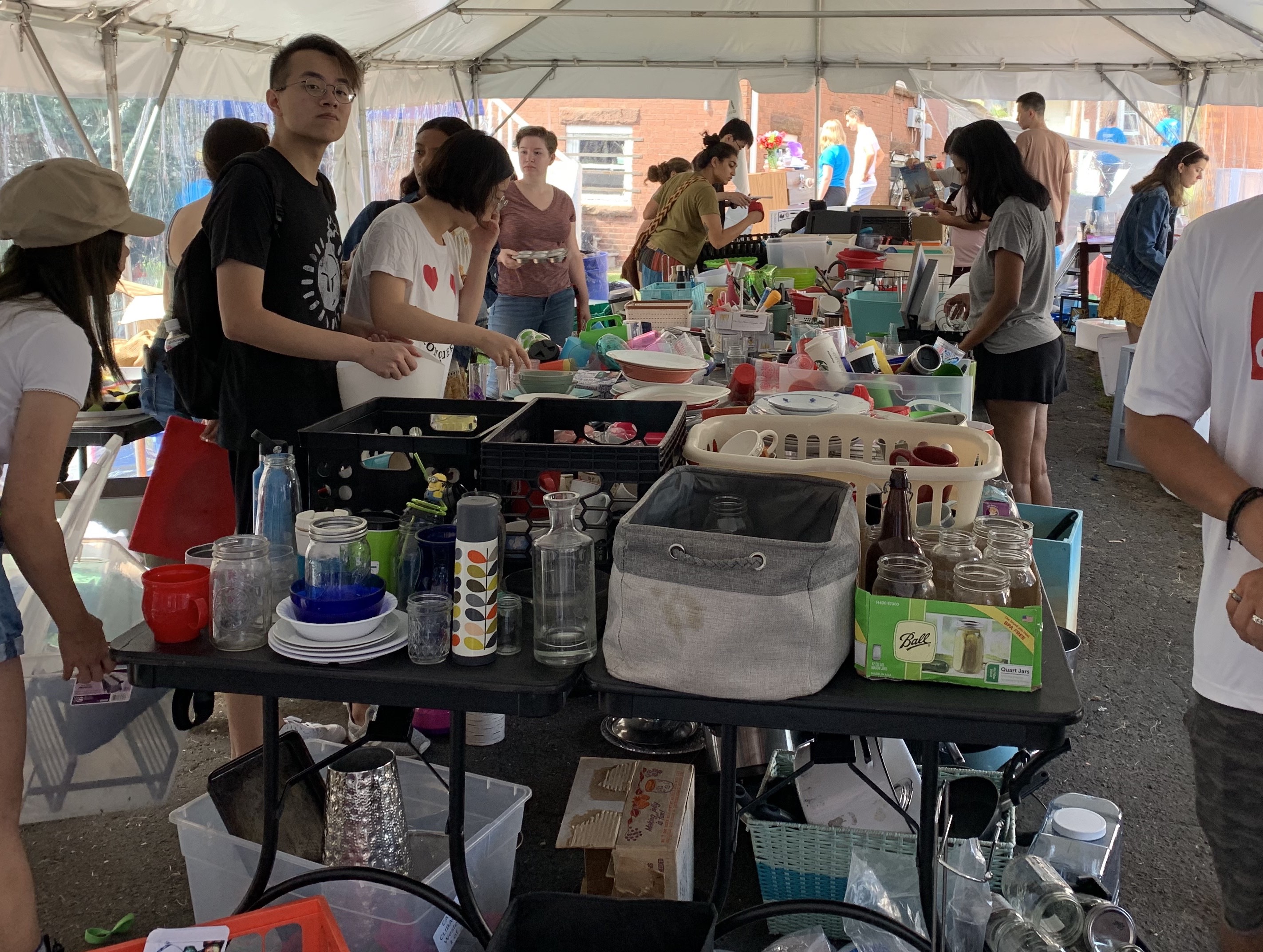
The University’s annual Waste Not sale raised more than $13,000 for charity over the course of two days. At Waste Not, students can buy used furniture, decor, and housing supplies donated by other students the previous May. This year, the Brainerd Avenue location offered small household objects like lamps, art pieces, mirrors, and kitchen items on Aug. 31 and Sept. 1, while the Fountain Avenue location—for the 31st only—offered larger items, such as couches, plush chairs, and coffee tables.
This year was the most profitable in recent memory, according to student organizers, which they attribute to the increased number of items donated in the spring. They also explained that better and more organized advertising strategies, such as tasking Orientation Leaders and EcoFacilitators with informing incoming first years about the sale, helped to spread the word.
As a result, this year’s Waste Not saw a sizeable increase in attendance compared to previous years. Daniel Osofsky ’20, an organizer for the event, explained that the number of students attempting to gain access to the event resulted in significant wait times and lines that stretched around the corner of Brainerd Avenue, down Lawn Avenue.
“The line held for longer than it ever has,” Osofsky said in an interview with The Argus. “We had a consistent line for two hours on the first day of the sale, which hasn’t happened to that degree, ever. In terms of Fountain, where I was working and where we were doing furniture, we had people come almost two hours early, which was a first. Last year, I think people only came an hour early.”
Osofsky also noted that the length of lines prevented some of the students from finding the furniture they desired.
“I felt bad because people who came 15 minutes before it started ended up with practically nothing because people had come so early,” he explained. “It kind of made me think we should do a lottery system for the couches. I guess this isn’t a bad method, because the people who really wanted stuff came the earliest…. We try to make it as equitable as possible. That’s always a question: equitability at Waste Not.”
Osofsky, like organizer Katie Shewfelt ’20, noted that in spite of some of the difficulties that arose due to increased attendance and demand, this year was extremely successful. In addition to improved advertising and descreased prices, Shewfelt attributes the success of the event to the generous donations made by students last May.
“This was definitely our best year,” Shewfelt explained in a message to The Argus. “We’ve never had the garages so full! And we made an effort to further reduce prices this year, but made even more money, which is in part because we sold more items.”
To continue the goals of sustainability and generosity furthered by those who donate items to Waste Not, the money generated from the sale of those items goes towards a variety of charitable causes.
“In the past we’ve donated to United for Puerto Rico, Prudence Crandall Shelter in Middletown, financial aid, and other charities,” Shewfelt wrote. “We like to donate to a mix of Wes, local, and global causes.”
Though Waste Not organizers have not yet decided where the proceeds from this year will be donated, they plan to similarly distribute them to a mix of regional and global movements.
On May 8, Associate Professor of Molecular Biology and Biochemistry Michael McAlear filed a lawsuit against the University concerning student-made posters, circulated in November 2016, that implied McAlear, Professor of French Andrew Curran, and Professor of Art David Schorr are sexual predators. McAlear denies all claims of sexual misconduct in his suit against the University, saying that administrators have informed him that no allegations have ever been filed against him. His complaint, filed in the Middlesex Superior Court, alleges that the University failed to defend McAlear by not taking sufficient action to identify or discipline the students involved in the poster campaign, who remain anonymous to the public.
The posters at the heart of McAlear’s complaint were circulated as part of several protests and initiatives launched by students in reaction to apparent institutional failures regarding sexual assault and harassment, including the lack of transparency in the dismissal of former Associate Dean of Students Scott Backer, during the 2016-2017 school year. An allegation of sexual misconduct against Professor Curran was central to a lawsuit filed against the University by former Associate Professor of Classical Studies Lauren Caldwell, who alleged that she experienced repeated sexual harassment from Curran between 2012 and 2014—according to Inside Higher Ed, Caldwell settled with the University out of court. Professor Schorr is alleged to have made unwanted sexual advances towards male students in his classes prior to his death in 2018.
In the complaint, which was first amended on July 12, McAlear provides a timeline of events detailing a confrontation between himself and a group of protesting students that took place on Nov. 11, 2016, prior to the distribution of posters indicating McAlear is a sexual predator. McAlear had a contentious exchange with the students, who he says were calling members of faculty perpetrators and promoters of sexual violence.
“The plaintiff told the students that he thought their protest was over-the-line and slanderous,” the complaint reads.
c/o Wesleying
McAlear believes that students called him a sexual predator due to the aforementioned confrontation. To his knowledge, he was first labeled as a sexual predator in an email sent by a student organizer to the Wes Student Union on Nov. 13, 2016, and then on posters beginning Nov. 16.
The complaint states that on Feb. 28, 2017, McAlear learned of more posters circulating with his name on them, and that an image of one of the posters had been uploaded to Wesleying. Additional posters continued to circulate in May 2017 and November 2017, McAlear alleges.
McAlear also describes an ongoing dialogue with former Provost Joyce Jacobsen, indicating that during the initial circulation of posters, Jacobsen and McAlear were in communication about uncovering the identities of the students who had created and hung them around campus. McAlear alleges that at least one student was eventually identified by the University, an allegation that the University does not deny in its July 11motion to strike. McAlear further claims that Jacobsen later declared that no action would be taken against students found responsible for the distribution of the posters.
On April 27, 2018, McAlear says that he filed a complaint with the Faculty Rights and Responsibilities Committee against Jacobsen.
“Plaintiff’s complaint alleged that Jacobsen failed to protect and defend his rights as a tenured faculty member by not taking sufficient concerted action to identify or stop the persons who were conducting the degrading poster campaign,” McAlear’s case filing reads.
Additionally, McAlear claims that although President Michael Roth ’78 initially condemned the distribution of the posters and promised he would do everything he could to prevent them from being circulated, Roth later stated that he would not take action against any students found responsible.
McAlear’s original complaint, which has been twice amended, alleged breach of contract, breach of the implied covenant of good faith and fair dealing (resulting in mental and physical distress and reputational damage), recklessness, and promissory estoppel (in other words, that the denial of previously promised protection constitutes a legal infraction on the part of the University).
As compensation for the aforementioned violations, the suit demands an excess of $15,000, including interests and costs.
Under the count of breach of contract, the complaint posits the University is in violation of Section 3.1 of the Faculty Handbook, which establishes faculty members’ right to protection from the University.
“The right to abstain from performing acts and the right to be protected against actions that may be harmful to the health or emotional stability of the individual or that degrade the individual or infringe upon his/her personal dignity,” the Faculty Handbook reads. “This language is directed at all forms of personal harassment including the use or threat of physical violence and physical or nonphysical coercion.”
In his original complaint, McAlear claimed that as a result of the distributed posters, he experienced “severe emotional distress,” which he argued is protected against in the Faculty Handbook. McAlear claimed that the subsequent failure of the University to protect him constituted a breach of contract.
The University refutes this conclusion, arguing that employers can only be held liable for negligent emotional distress that occurs during the process of an employee’s termination, as established in Perodeau v. Hartford (2002). Since McAlear retains his employment status, the University argues that he is not entitled to damages. McAlear has since amended his complaint to remove the count of negligent emotional distress, as well as the count of negligence.
On July 12, McAlear amended his complaint to assert that the inflammatory language of the posters, specifically the use of the term “sexual predator,” constitutes defamation per se, in that it asserts that McAlear committed a crime involving moral turpitude, i.e. an act that is morally unscrupulous and intrinsically bad.
In their motion, the University contends that McAlear’s complaint does not provide proof for all four essential elements of defamation per se claim—a false statement of fact, publication or distribution of this statement, negligence or intentional deceit involved in the publication or distribution of this statement, and injury to reputation caused by this statement—and that McAlear cannot pursue a defamation claim against the University if he cannot name the person responsible for defaming him.
While the court will indeed be tasked with determining the presence of the first three elements, Connecticut law presumes injury to a person’s reputation in cases of defamation per se. As such, it is unlikely that McAlear will be required to prove special or actual damages. Additionally, the court must decide if McAlear’s defamation claim necessitates the identification of the perpetrator, and, more importantly, whether the University can be held liable for defamatory statements made by its students. In their motion, the University rejects the claim that they could be found vicariously liable for defamation, as McAlear does not provide proof that University employees had any involvement in the publication or circulation of the posters.
“There is not a single allegation that Wesleyan (or any of Wesleyan’s agents) made a false statement of fact regarding Plaintiff,” the motion asserts.
While the University’s response states that it considers all factual allegations to be true for the purposes of their motion, they have asked the court to strike all of McAlear’s legal claims on several different bases, as the University contests McAlear’s legal interpretation of the facts—asserting, for example, that McAlear does not provide any proof to support the allegation that the University acted with reckless indifference to his rights
“Wesleyan denies the allegations contained in Professor McAlear’s complaint and intends to vigorously defend itself,” University Director of Media & Public Relations Lauren Rubenstein wrote in an email to The Argus. “As is our policy, we will not be commenting further on this active litigation.”
On Friday, May 2, Colorado Senator Michael Bennet ’87 announced his candidacy for president. Now, two Wesleyan alumni—Bennet and former Governor of Colorado John Hickenlooper ’74—have announced that they are running for president. Hickenlooper announced his candidacy on March 4.
As a student at Wesleyan, Hickenlooper studied English and Earth and Environmental Science. After graduating, he went on to receive his master’s degree in geology from the University in 1980, and worked for an oil company, Buckhorn Petroleum, until 1986, when the company was sold and Hickenlooper lost his job. Hickenlooper then opened up a brewery in Denver, called the Wynkoop Brewing Company, which, he notes, allowed him to engage with the local community and introduced him to local politics. Hickenlooper was elected as Mayor of Denver in 2003.
A New York Times article published at the time of the election explains the ideology behind Hickenlooper’s mayoral campaign.
“Mr. Hickenlooper’s appeal to voters has come largely from his feisty campaign style and a strategy to sell himself as a fresh-faced political newcomer, a candidate with new ideas for lingering problems,” the article reads. “He has pointed to his background as an out-of-work scientist who built a chain of restaurants and worked for nonprofit groups to convey his grit, management skills and community spirit.”
Bennet, the 21st Democratic candidate to enter the presidential race, was a history major during his time at Wesleyan. His father, Douglas Bennet ’39, was the 15th president of Wesleyan, preceding Michael Roth ’78. During Bennet’s time at Yale Law School, he served as an aide to then-Ohio Governor Richard Celeste. Bennet was named superintendent of Denver Public Schools in 2005, and then, in 2009, filled the Colorado seat in the U.S. Senate formerly held by Ken Salazar. In 2010, he was elected to the seat for a full term, and then reelected in 2016 for a second term.
In addition to sharing an alma mater and a home state, Bennet and Hickenlooper have also worked together in politics. Bennet served as Hickenlooper’s chief of staff for two years, in addition to informally advising Hickenlooper’s mayoral campaign.
Hickenlooper will be focusing on issues of gun control and global climate change in his 2020 campaign for president, both of which he alludes to in his campaign ad. Hickenlooper will also be focusing on economic reform. In April, Hickenlooper gave an interview to MSNBC asserting that although he believes in capitalism, he does not believe that the capitalist system is working for the American people.
“The greatest challenge right now is really skills,” Hickenlooper asserted. “The last Department of Labor Information showed that there are 7.2 million unfilled jobs, and only 6.3 million people looking.”
Bennet’s 2020 presidential campaign focuses on two key issues: economic mobility and restoration of faith in the government. In an interview with MSNBC’s Rachel Maddow, Bennet noted that diversity of ideas, from both sides of the aisle, need to be prioritized.
“What are we gonna do different?” Bennet said. “To stop losing, on judges, and on climate, and be able to actually create universal healthcare in this country, rather than just have a debate where they ignore us and ignore us and ignore us, and we don’t really make progress.”
Jacob Snyder ’19, who is a relative of Bennet and has previously worked on his campaigns, is currently an unofficial staffer for Bennet’s campaign and is planning to volunteer officially this summer. Snyder notes that Bennet’s Wesleyan education has informed his ability to look at political issues from a diversity of issues.
“He really sees Wesleyan as shaping his approach to creating opportunity, which is a big part of his campaign,” Snyder said. “We go to a liberal arts school, so we take sciences and we take humanities and social sciences, and that allows us to think critically about any challenges we’re facing, so we can come at it from a bunch of different perspectives. And that’s kind of epitomized in Michael, because prior to the Senate, he was the superintendent to the Denver public school system, and before that, he did a lot of work in business. So [with] those experiences at Wesleyan, and the liberal arts experience, he’s able to tackle whatever challenge he sees in the senate—and while we’re in his campaign—from different perspectives, because of the experience he has doing that.”
Synder notes that he appreciates Bennet’s focus on unifying the country, rather than dividing it.
“He talks a lot about being a pragmatic idealist, and Michael Roth [’78] talks a lot about being a practical idealist, so I just think that at a time when we are so divided as a country, we really need to find similarities and connections amongst everyone, rather than the differences,” he explained. “And I think Michael is the best person for that.”
Snyder’s campaign work will be focused on ensuring Bennet gets on the debate stage. Snyder explained that candidates need 65,000 individual donors to qualify for stage-time, and this, he says, is the first challenge.
In general, Snyder believes that both Bennet’s and Hickenlooper’s Wesleyan connection will aid their campaigns.
“The fact that there are two Wesleyan alums, with their Wesleyan spirits, trying to tackle this seemingly impossible task isn’t surprising to me,” Snyder added. “It reeks of Wesleyan.”
The women’s Ultimate Frisbee team, Vicious Circles, is heading to the DIII National Competition in Bryan College-Station, Texas, on May 18 and 19. This is the fourth year in a row the team will be attending nationals, but this year in particular was an unpredictable one, given that 13 players, including more than seven members of the A-team, graduated in 2018. This year, the team planned to focus on rebuilding, with less of an emphasis on performing well in competitions. However, this successful season indicates that the new members of the team, as well as the current team dynamic, have proven strong enough for the team to move on to the highest level of competition.
“Our team is really deep,” explained team president Sydney Taylor-Klaus ’20. “We don’t have just one or two stars where it’s like, ‘Oh, those are the really good ones and everyone else is ehh.’ We have a really deep team, where everyone is a threat.”
In the fall season, new players are taught the game, and then training begins seriously in the spring semester. The A-team practices three times a week, while the B-team practices two times a week, with both teams in competitions on the weekends. During spring break, the team takes a trip to Myrtle Beach, N.C. They then have a number of one- or two-day tournaments in the first few weekends after spring break and then will attend Sectionals.
The top four of the six teams in the sectional tournament, which included Vicious this year, move on to the Metro East Regionals competition. This year, the competition took place on the 28 and 29 of April. Only the winner of regionals will automatically qualify for nationals. This year, Vicious Circles went against the SUNY Geneseo frisbee team in competition for first-place, ultimately winning by a score of 10-6 and securing their place at the national competition.
This regionals proved to have even higher stakes than usual. Lily Gould ’19, Amabel Jeon ’19, and Kelly Jamrog 19, team captains, explained that due to an upset earlier in the pool, Vicious played Rensselaer Polytechnic Institute (RPI)’s frisbee team—one of the most competitive teams at regionals—in the semi-finals rather than the finals.
“So we had to go into that game really fired up, because we were really determined to make it to the finals and knew we had to beat them—a team of really athletic, really talented frisbee players—to move on,” Gould, Jeon, and Jamrog noted in a message to The Argus. “We started the game down, but we kept working at it, and came back from behind to win.”
After winning against RPI, Vicious played against SUNY Geneseo, which, according to players, was an incredibly close game.
“A similar thing happened with our final game against SUNY Geneseo, another really talented team, where they were up 3-1 within the first 20 minutes, and we had to dig down our heels and come back from behind again,” the captains explained. “But every single person on the team really gave it their all and showed incredible mental fortitude—something that’s really difficult to do when you’re so tired, under so much pressure, and starting from behind.”
Taylor-Klaus also expressed appreciation for how the team worked together to come back against Geneseo, as well as against RPI.
“Our really hard game was actually our semi-finals game: We played RPI, who we had lost two in the finals at sectionals, so it was redemption,” she said. “And then we played the finals, and that was an incredible game. We were playing SUNY Geneseo, and it was one of the best games we’ve played in a long time—super spirited, super competitive. It was a very close and hard-fought game, but it stayed super spirited.”
Both Taylor-Klaus and the team captains noted that regionals can be an even tougher competition than nationals because more is at stake.
“We pretty much have to go into regionals with the mindset of giving it everything we have,” the team captains explained. “Even compared to nationals, I think regionals feels like a lot more pressure. Each year we make it we’re just so overjoyed to be at nationals, and we’re pretty much happy with whatever results, but with regionals the goal is pretty clear.”
The team will go into the national competition with a number of players who haven’t attended the competition before. The team has been moving players up from the B-team to the A-team over the course of the season, both to gradually acclimate players to the level of play and because many former A-team members suffered injuries this season. Taylor-Klaus explained that there was some concern about the youth of the team, given that so many of the players were new.
“A lot of people were worried about this season because we graduated, I think, 13 seniors last year, over eight of which were on the A-team,” she said. “Some people were a little skeptical that we would be able to get back to nationals this year, they thought this year would be a developmental growth year.”
But Sofia Murtaugh ’21, a team president, noted that the young age of many members of the team is in some way an asset, as the new players put a lot of work into the team.
“This year, more than half of the team is underclassmen, but I think that actually helped us because of the general mentality of the girls,” she explained. “Since so many of us are fairly new to Frisbee and even Wes, we took nothing for granted and worked that much harder.”
Taylor-Klaus also noted that by splitting the teams into A- and B-teams earlier in the season than in previous years, the younger players could prove themselves even more.
“During spring break, we went ahead and did our A/B split, so the B-team could have played together as a team before Sectionals, because last year was the first time they played as just B,” she explained. “So we did the split a little early this year, and it was incredible to see the cohesion and the flow that we had…. Both teams had really good chemistry, which was awesome. It was a very new and young A-team, but it was very cohesive, and the chemistry was incredible.”
Taylor-Klaus expects this cohesion to continue into the national competition and noted her excitement for the weekend in May. Murtaugh, too, expressed an excitement for the challenge ahead.
“Since no one saw us coming, even a lot of Vish members ourselves, we are pumped,” she noted. “We have the heart and wonderful girls no doubt and the cohesion, supportive atmosphere, and talented Frisbee players that I think will serve us extremely well in Texas. We won’t be disappointed no matter what happens, because we’ll be playing the game we love with the girls we love at the highest level possible.”
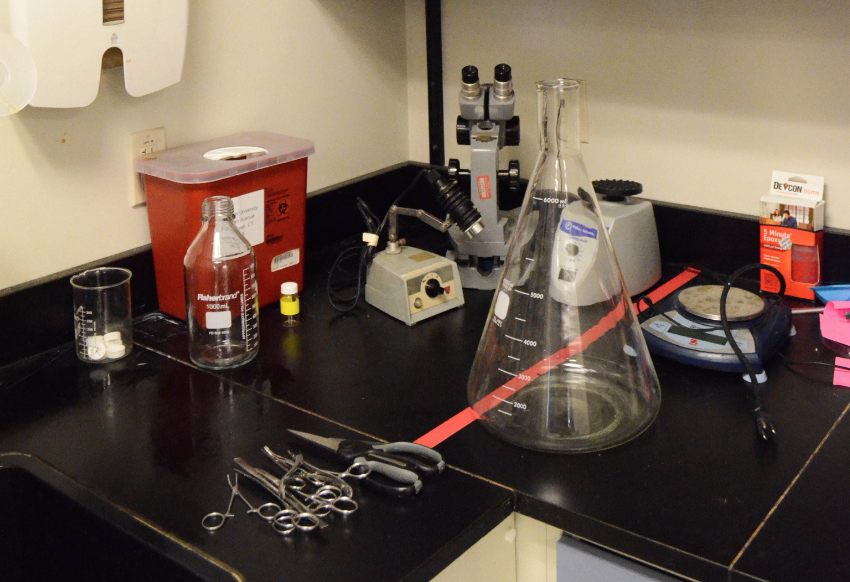
A new program called IN-Reach will be implemented this summer, recruiting high school students from local schools to work in University research labs. The program, founded by Melisa Olgun ’20 and supported by the Jewett Center for Community Partnerships (JCCP), the McNair Fellowship, and the NSM Coalition,will emphasize recruiting minority, first-generation, and low-income students. These students will be exposed to the workings of research labs in an effort to demonstrate the process of scientific research, as well as give students relevant experience in the scientific areas that interest them.
“Something like this is really special, because you’re giving that student that opportunity to see what science is like, and it’s an exposure that they otherwise wouldn’t have gotten,” Olgun explained.
The program will run from June 17 to July 29, which is the last day of the Wesleyan Science Research Program, a summer research program for University undergraduates working in University labs. Students will be paired with a lab and a mentor and will be required to work in their respective labs for at least two hours a week, but they will have the option to increase their hours per week if their mentor agrees. Students will be expected to follow a regimented schedule and keep track of the work they are performing for the lab. The work will vary based on the specific research, but Olgun notes that she wants this experience to provide an authentic taste of lab work.
“I do want this to be a more natural exposure to what science is like,” Olgun noted. “This isn’t going to be exciting at all times, but this is good experience to see what research is like.”
After coming up with the idea for the program, Olgun applied for and received the Student Innovation Fund from the JCCP. She is using the money to hire a student to design flyers and literature about the program, as well as offer end-of-the-summer gifts to students and pay for any expenses along the way.
Olgun emphasized that she wants the program to be as accessible as possible. IN-Reach will not require students to submit their GPA or transcripts. Instead, the program will ask teachers to nominate interested students for the program, and students will also be able to go to the teacher to ask for a nomination. Teachers will then email Olgun directly with information about the student and their recommendation.
“There’s no GPA cap, there’s no ‘You have to be the top of your class,’ you don’t have to be valedictorian, salutatorian,” she explained. “I think that’s one thing a lot of different science programs around the U.S. for lab shadowing do, but I don’t want that to inhibit what might just be an average student, who want to see what science is like, and be cut off from something like that.”
Recruitment of both students and mentors is underway. As of May 2, eight professors with research labs have agreed to host students for the summer. The labs, Olgun notes, range across a diverse array of sciences, and Olgun will endeavor to pair each student with one of the labs that most aligns with their scientific interests. Olgun has contacted undergraduate student researchers who will be working in the labs, noting that the high school students as a part of the program will shadow them to learn more about the process of being a student researcher.
The process of recruiting schools is also currently ongoing. The Director of Upward Bound Math-Science (UBMS), a University summer experience program that prepares local students for college, Miguel Pelarta is currently reaching out to contacts that UBMS maintains with local schools, in order to recruit students to join IN-Reach. Pelarta noted that he has held discussions with teachers at Middletown High School that were met with enthusiastic response, and there are plans underway to engage other schools that UBMS works with in Meriden, Connecticut, including Maloney High School and Platt High School.
“We will also promote this to our own UBMS students, as this will present [a] great learning opportunity to be/work in a lab for our students who may be interested,” he explained in an email to The Argus.
UBMS focuses on engaging low-income and first-generation students in math and science. Pelarta notes that these goals align with the goals of the IN-Reach program.
“It ties into our vision of exposing our low-income and first-generation students to research and STEM fields—many of which wouldn’t have access to an opportunity like this,” he wrote.
Associate Professor of Chemistry and Environmental Studies Erika Taylor also aided in the design of the program, notably by connecting Olgun with specific faculty members to ask if they’d be willing to participate in the program, as well as offering general advice. Taylor is the Faculty Director of the McNair Program, as well as the founder of the Girls in Science program, which runs over the summer. Both of these programs are part of a wider swath of University programs—including IN-Reach—which aims to provide services for low-income and first-generation students, specifically with regard to their progression into post-secondary education.
“I am a strong supporter of the program, and I am trying to work with her to identify funding sources so that we can help ensure that the students not only get to shadow and see what research looks like, but that we might be able to provide some research funds for faculty members to help ensure that the high schoolers participate in the research as well,” Taylor wrote in an email to the Argus.
Olgun explained that the idea for the program came from her own experience as a first-generation student interested in the sciences and lack of access to high school research programs. Olgun explained that she would have benefitted from a program such as this one.
“My hope is that a student will have something to put on a resumé—I think that that’s something that’s really important when it comes to college applications—but more so, to give them an idea of what it’s like to do science research,” Olgun noted. “I stayed over the summer last year, and one of the things I realized is ‘Wow, this is actually really slow-paced, it’s not actually as quick as I thought it would be.’ And so there are lulls, and there are times when you’re just processing data for five days, and you don’t realize that that’s a thing. And so, it’ll be cool for students to get that feeling, to know if this is something that they’re interested in.”
A species of fish has recently been named in honor of Barry Chernoff, the Robert Schumann Professor of Environmental Studies. The fish species—Bryconops chernoffi—was discovered in the lower Amazon basin of Brazil, an area where Chernoff has devoted much of his research. This is the first species for which Chernoff has been named.
“There are probably a hundred fish species named every year and discovered…and maybe two or three of them are named after people,” Chernoff said. “So the percentage is very low, and it’s the first one in my career.”
The species was described in a 2018 paper submitted to the journal Zootaxa, entitled “A new species of Bryconops Kner (Characiformes: Iguanodectidae) from the Rio Maicuru, lower Amazon basin, Brazil.” Prior to the discovery and the description of Bryconops chernoffi, the Bryconops genus—common in this region of Brazil and confined to the tropics of South America—had 21 known species. This particular species comes from a small biome: limited to a small tributary of the left Margin of the lower Amazon river. The type locality for Bryconops chernoffi, as noted in the paper, is a freshwater pool gathering above a waterfall on the Rio Ipixuna, which is a small tributary of the Rio Maicuru river in Brazil.
“The present contribution describes a new species of Bryconops belonging to the subgenus Creatochanes from the Rio Ipixuna, a tributary of the Rio Maicuru,” the paper reads. “The Rio Maicuru is a direct tributary of the Amazon River, being one of the relatively small, Guyana shield-draining northern-bank tributaries of the Amazon river lying between the Rio Jari and the Rio Trombetas.”
c/o newsletter.blogs.wesleyan.edu
The species, as described by the paper, has a light brown snout and lips, and a dorsal fin with variably developed red pigmentation. The paper notes that prominent features of B. chernoffi include a dark dorsal fin and an elongated area of pigmentation behind the facial bones of the fish. Individual lengths of B. chernoffi, as presented in the paper, range from 45.9 mm to 59.6 mm.
Chernoff noted that his discovery of this paper, and Bryconops chernoffi, was unorthodox.
“So about three weeks ago…I received this weird email in my junk folder from something called ‘The Dictionary of Eponyms,’” he said. “There was this thing sitting there in my junk saying ‘Dictionary of Eponyms.’ And I’m about to nuke it forever, when I saw that my bio was in it, and they were asking for biographical information. And I thought ‘Oh, this is like the [phenomenon] where you can pay money and put yourself in a who’s who…it’s become a big scam.”
Chernoff went on to note that upon looking closer at the email, he discovered that his name was written in tiny font next to the genus Bryconops.
“It was just in tiny type like 7-point font, and I saw this, and then I went to the literature and looked for [my name], and in fact there it was!” Chernoff exclaimed. “So I got this ridiculous email and that’s how I discovered it.”
When a species is discovered, its name is most often derived from a Latin or Greek root, which refers to morphology, location-of-discovery, or another relevant element of the species and biota. Those who are describing a species are also prohibited from naming the species after themselves. Thus, it is rare for a species to be named for an individual—even one who has contributed prolifically to the body of work on the genus, as in Chernoff’s case.
The paper describes the species name derivation, noting the contributions of Chernoff to the field.
“The specific epithet honors Barry Chernoff, and is in recognition for his contributions to the taxonomy of Bryconops, as well as for ichthyology as a whole,” the paper reads.
Chernoff’s work in Latin America on fish, he notes, is relevant to his current work at the University. Primarily, he explained, he has been concerned throughout his career with conservation biology and understanding biological patterns.
“My work has always been about uncovering patterns of biodiversity,” he explained. “And looking at patterns of how the biota of the world—the fish world, anyway—came to be and why they’re distributed in time and space the way they are.”
Chernoff noted his appreciation for the honor.
“This is a complete shock, and I wrote to the fellows to thank them profusely,” he said. “You know, it’s the honor of a lifetime.”
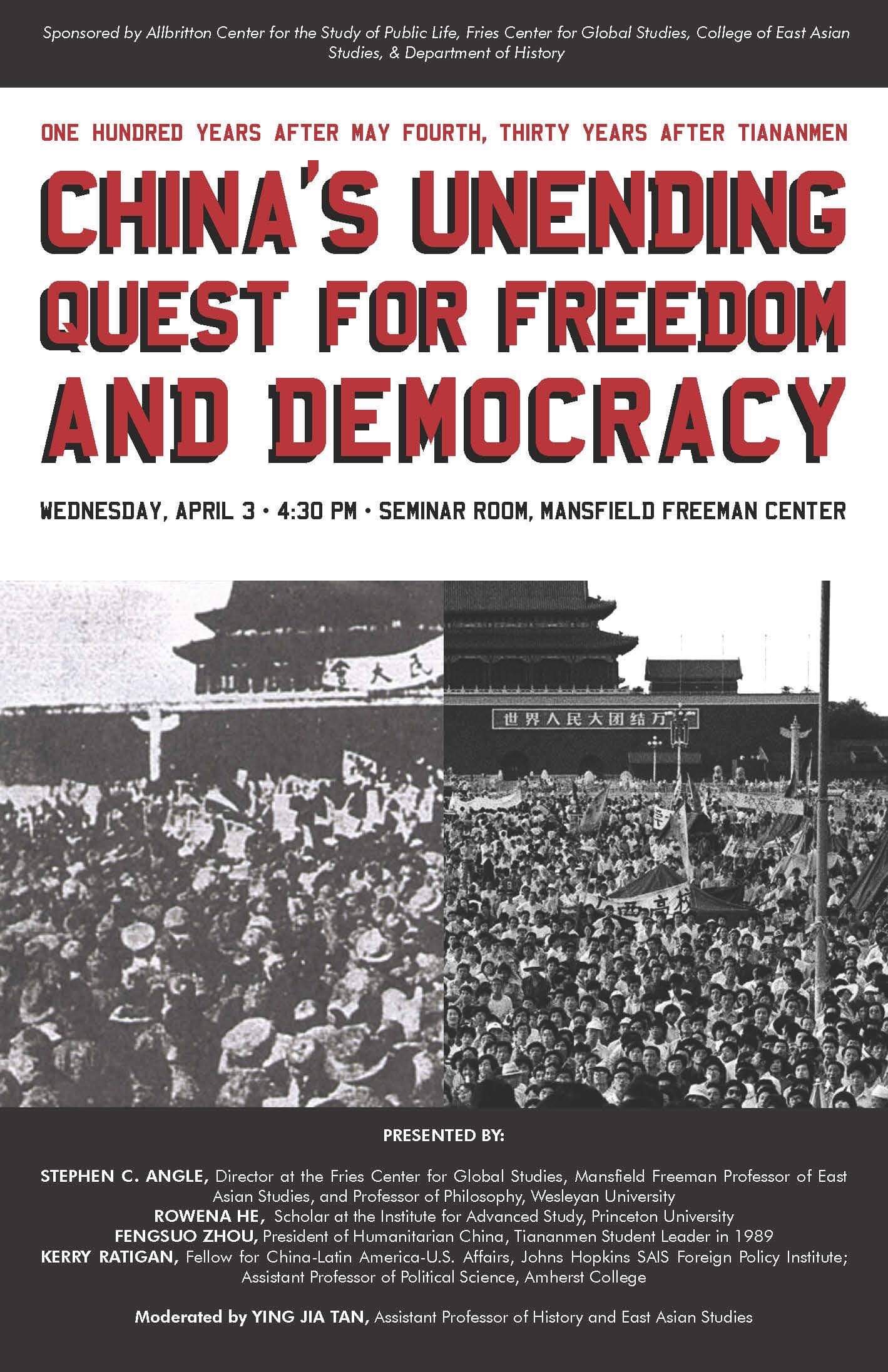
Speakers at the April 3 panel “China’s Unending Quest for Freedom and Democracy” recalled and contextualized in the current moment two historic student movements in Chinese history: the May Fourth Movement in 1919 and the Tiananmen Student Movement in 1989. The panelists emphasized the importance of the student movements in the contemporary political moment and highlighted the Chinese government’s efforts to change narratives around the movements and to prevent similar occurrences in the future. The panel featured, in addition to an exiled Chinese student activist, researchers studying state-society relations, philosophy, and intellectualism in China.
The panel was moderated by Assistant Professor of History Ying Jia Tan and was hosted at the Wesleyan Mansfield Freeman Center for East Asian Studies. The speakers were Mansfield Freeman Professor of East Asian Studies Stephen Angle, Member of the Institute for Advanced Study Rowena Xiaoqing He, Assistant Professor of Political Science at Amherst College Kerry Ratigan, and Fengsuo Zhou, an exiled student leader who closely participated in the 1989 Tiananmen Movement.
The two movements at the center of the panel are considered pivotal historical moments in which students took to the streets and became the leading voices pushing for substantial political changes. The first was the May Fourth Movement, which refers narrowly to students in Beijing protesting against the Chinese government’s weak response to the reluctance of imperial powers to return Chinese territories that had been ceded during World War I.
Tan explained that the Tiananmen student movement, which occurred 70 years later, had similar elements, including student energy, an internationalist agenda, and a violent tinge. The movement consisted of a series of nationwide demonstrations calling for civil rights, such as democracy and the freedom of speech. The military cracked down on one of these demonstrations in Beijing on June 4. That night, troops with assault rifles and tanks fired at the protestors, who were trying to block the military’s advance towards Tiananmen Square. It was more commonly known as the Tiananmen Square Massacre in Western media representation and remembered with a photo of a man standing and confronting a row of tanks alone. Anywhere from a few hundred to over 10,000 people were killed, with the Chinese government claiming that under 300 were killed while contemporary historians place the number much higher.
After Tan’s opening remarks, Angle gave an overview of the changing meaning of the intellectual and cultural legacy of the May Fourth Movement within different periods of modern Chinese philosophy, based on the book “The Chinese Enlightenment” by Wesleyan Emerita Professor of East Asian Studies and History Vera Schwarcz. He emphasized the importance of examining the influence of historical events on modern political contexts and the ways in which this examination can shed light on the present through rediscovering the past.
“One of the themes, as Professor Schwarcz puts it, is that there is a new May Fourth for each generation,” Angle explained. “The last chapter of the book is actually called ‘May Fourth as Allegory,’ in which what she means by allegory is reconstructing memory for the…purpose of instructing the present. I think this is a really important idea for us to keep in mind as we talked about [the legacy of May Fourth] because we are remembering this event in the context of the present moment.”
While the meaning of the May Fourth Movement has been reframed and co-opted in different periods—ranging from being utilized to justify further communist revolution in the early 20th century to a liberal antecedent which civil rights activists paid homage to when the civil society in China revived in the early 2000s—Angle concluded that one core element that they all share is the spirit of criticism.
“So, to genuinely accept and endorse the legacy of May Fourth today is precisely to continue to question what the legacy of May Fourth is today,” Angle concluded.
The second speaker, Fengsuo Zhou, was a key student leader in organizing the democratic movement in Tiananmen Square in 1989. Zhou was fifth on the 21-most-wanted list of student leaders after the government crackdown, and he came to the United States after he was imprisoned and his passport was revoked for years.
In his talk, Zhou gave a detailed account of his personal involvement in the 1989 Tiananmen Student Movement as one of the student leaders. He recalled how thrilled he was when printing his own words on a university’s walls to call for freedom of speech. He also recounted his experience working as a member of a radio station on covering the Tiananmen Student Movement, encouraging students who were on a hunger strike.
“[The student movement] is the most important moment in my life,” Zhou said. “It was like a volcano eruption, so splendid, wonderful and then suppressed violently and forgotten.”
While, for the sake of time, he wasn’t able to cover the last stage of the movement when the crackdown happened, he drew the audience’s attention to earlier moments within the movement, when people across all fields were calling for democracy.
“What we remember about the June fourth—most people remember the massacre, the bloodshed,” he explained. “But what happened before that: That is what we need to remember. That was very inspiring—what the students [and] people of Beijing and all over China were doing—the overseas students here, and in Hong Kong, Taiwan. It was one moment when this dream of freedom and democracy unifies everyone in China and outside of China.”
The third speaker, He, presented a critical view of the narrative adopted by the Chinese government to characterize the Tiananmen Student Movement as a “counter-revolutionary riot” rather than what she considers a patriotic movement—as the May Fourth Movement has been characterized.
“Later [after the crackdown], the government named that ‘counter-revolutionary riot,’ meaning that they were trying to overthrow the government,” He explained. “In political science sense, it was a revolution, they were hoping for revolution—that was a lie. Because the students, from day one, were following the Chinese tradition of Confucian dissent, according to Merle Goldman. So there was not a revolution, they never tried to overthrow the government.”
The last speaker, Ratigan from Amherst College, addressed how the relationship between state and society has transformed after the Tiananmen Student Movement, with the former developing tools to strategically repress the latter and thus cause society as a whole to struggle to survive. Ratigan drew upon her study of the protests and non-governmental organizations (NGOs) in China to explain how the Chinese government has adjusted its approach to social suppression after the Tiananmen Student Movement.
“Over time, repression from the state becomes far more surgical, so rather than using sort of a grand hammer—‘Oh, now we have to clear the square’—they become far more strategic,” she explained.
During the Q&A session, students asked several questions regarding issues raised during the talk, and most questions were centered on one core issue: the prospect of a democratic future for China. While present-day Chinese politics don’t indicate such a change—at least not in the foreseeable future—they did end the panel on an optimistic note.
“Eventually, history is on our side,” He said. “I have to be hopeful and optimistic in the sense that [democracy will come about in China] maybe not in my lifetime, but maybe in yours.”
c/o facebook.com/Wesleyan Students for Justice in Palestine
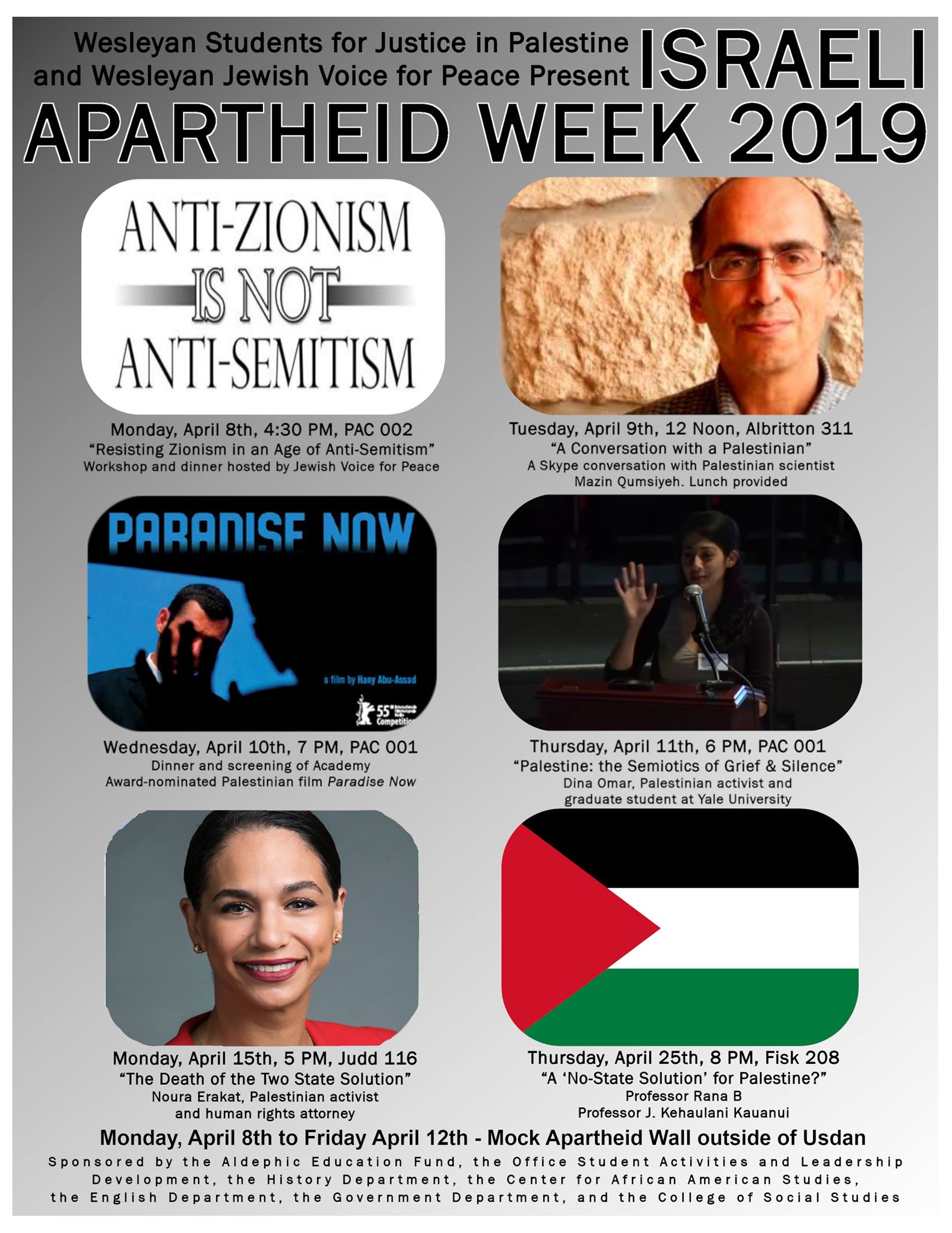
On Monday, April 8, Students for Justice in Palestine (SJP) and Jewish Voice for Peace (JVP) commenced the University’s Israeli Apartheid Week, which is sponsored by the Resource Center, the History Department, the Center for African American Studies, the Government Department, and the College of Social Studies, among other groups on campus. The week, which has been held annually for over five years, consists of six main events that aim to increase understanding of the ongoing conflict through the perspectives of both Israelis and Palestinians.
The week began with a workshop and dinner entitled “Resisting Zionism in an Age of Anti-Semitism,” hosted by Jewish Voice for Peace. On Wednesday, there will be a dinner and screening of the Academy Award-nominated film “Paradise Now,” followed by a talk from Palestinian activist and Yale student Dina Omar on Thursday. Other upcoming events include lectures from activist and human rights attorney Noura Erakat, as well as talks by Professor of American Studies J. Kehaulani Kauanui and Assistant Professor of History and Contemporary Arab Studies at Birzeit University Rana B., respectively titled “The Death of the Two State Solution” and “A ‘No-State Solution’ for Palestine?”
Kauanui, who is involved in the planning of the week, noted that this year will include an especially prominent and interesting set of speakers.
“This year’s [Israeli Apartheid Week] line-up is remarkable, both in terms of the collaborative partnership between our campus chapters of SJP and JVP, and given the prioritization of Palestinian speakers covering a broad array of political issues that address the settler colonial roots of the Israeli project,” Kauanui wrote in an email to The Argus. “The offerings of this year’s IAW at Wes are important on multiple registers, but notably because they are educational and serve as crucial forms of anti-normalization,”
The variety of lectures, discussions, and film screenings makes this year’s Apartheid Week the most expansive in recent memory. In addition to these events, there will be an artistic representation of the Apartheid Wall, erected in Palestine in 2005, outside of the Usdan University Center from April 8 to 12. The replica wall, which has been handed down since 2013, is meant to be a symbol of division, as well as the artificiality of territorial lines.
“What we’re trying to do is remove divisions that have been established between people unnecessarily,” said an organizer for the SJP, who asked to remain anonymous in order to avoid retaliation from pro-Israel groups. “The wall itself is a symbol of the division that has been erected between these people. What we’re trying to do is to show how artificial it is, by putting it up and taking it down.”
The thematic elements of the wall have changed over the years to meet the political moment, including an update, in 2016, to include a reference to Trump’s intended wall along the Mexican border. The organizer expects changes to the wall will be made in future iterations.
The student organizer explained that University reaction to Israeli Apartheid Week has also changed since its inception.
“I think across the years, especially earlier years, the students had a lot of trouble getting the administration to cooperate or allow these events,” the organizer said. “But as we’ve progressed, the University has come to accept this as a yearly event that happens. They respect us, and they respect our opinions on this and give us the space and resources to do it.”
In addition to bringing attention to the ways in which cultural narratives surrounding Israel and Palestine can be narrow or inaccurate, the organizers of the events aim to redirect the conversation surrounding the conflict, pushing against divisions between Israeli and Palestinian voices. Organizers also wish to draw a separation between Judaism and Zionism.
“Our main goal is to retake the narrative, especially in a time where Palestinian voices are at their weakest” the organizer for SJP said. “A lot of the narrative has been created and propagated by Zionists, and our goal is to introduce truth into the matter.”
Israeli Apartheid Week will conclude on Thursday, April 25. For more information on Apartheid Week events, view the full calendar.
Emmy Hughes can be reached at ebhughes@wesleyan.edu or on Twitter @spacelover20.
Erin Hussey can be reached at ehussey@wesleyan.edu and on Twitter as @e_riss.