
Author: Emmy Hughes

  • University Hosts Muslim and Refugee Advocacy Training

    University Hosts Muslim and Refugee Advocacy Training

    William Halliday, Photo Editor
    William Halliday, Photo Editor

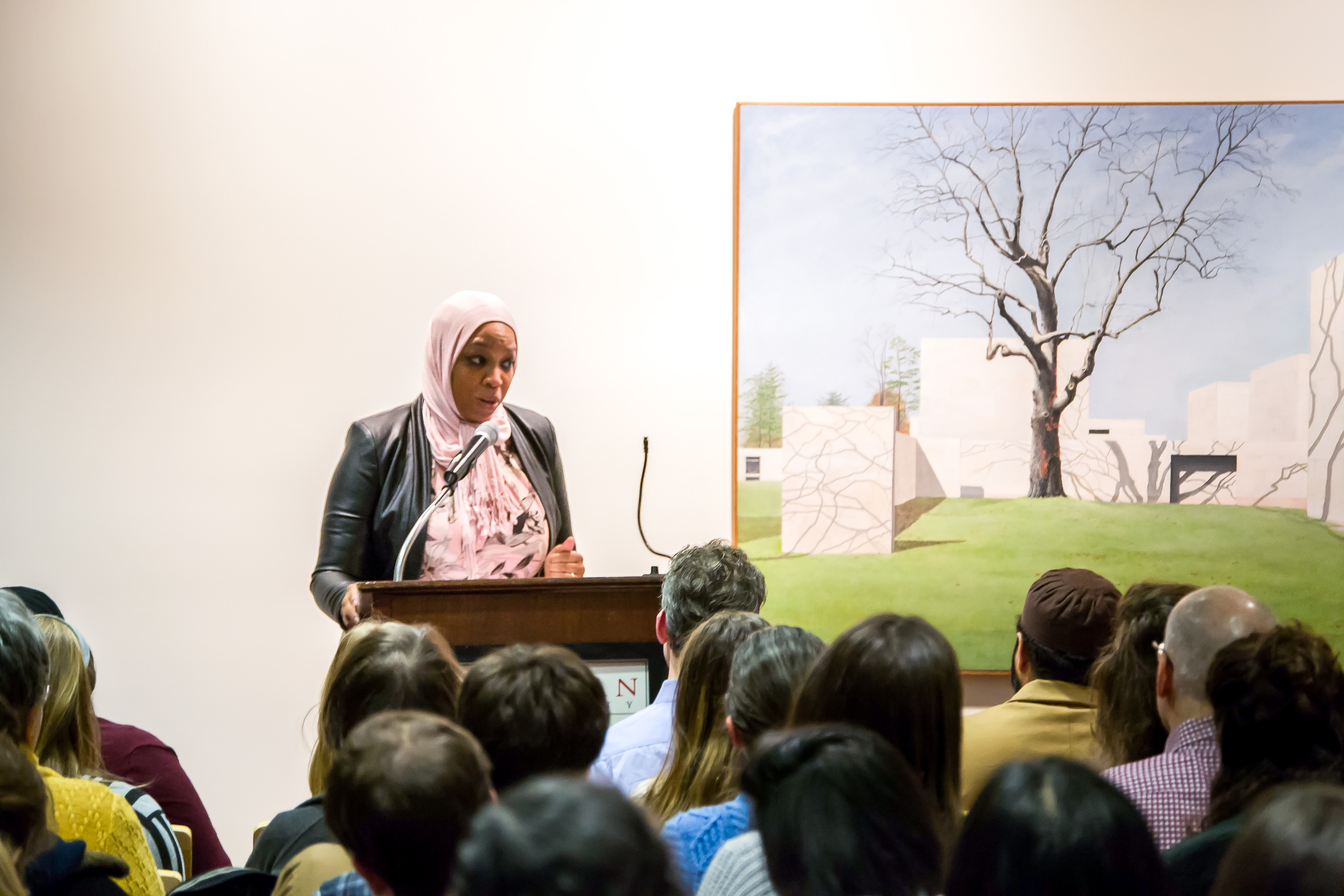
    On Feb. 1, University students and faculty, as well as members of the Middletown community, gathered in the Daniel Family Commons for an evening of Muslim and refugee advocacy training. The event came in response to a Jan. 27 executive order, signed by President Donald Trump, stating that visa-holders from seven Muslim-majority countries are barred from entrance into the United States.

    The primary purpose of the event was to provide information that would allow students to become better allies and advocates for Muslims and refugees affected by the executive order. The speakers included Steve Poellot, legal director of the International Refugee Assistance Project (IRAP), Tahirah Amatul-Wadud, legal counsel for a Muslim congregation in New York and an executive board member for CAIR-Massachusetts, and Imam Sami Aziz, the University’s Muslim chaplain.

    Due to overwhelming interest in the event, which was hosted by the University’s Refugee Project, the Office of Muslim Life, the Middle Eastern Student Union, and the Allbritton Center, the training was moved from Usdan 110 to the Daniel Family Commons room. A live feed was available on a television for those who could not fit in the room, and many students sat on the floor.

    After an introduction from the presidents of the University’s Refugee Project and Middle Eastern Student Union, Chaplin Aziz took the podium, greeting the room with the Islamic greeting “Peace be upon you.” He then told the room a story.

    “About eight months ago, I was visited by the Hartford Police Department and an FBI agent. They went to my previous address in Bloomfield, where I no longer lived. They knocked on the door, my friends were there, they said ‘He no longer lives here.’ [The police officers and agent] proceeded to my home address. Thank god my wife wasn’t home. And then they called me; they said, ‘We want to meet with you.’”

    Chaplin Aziz explained that, as he was on the phone with the officer, even possessing the knowledge that he had not done anything wrong, he asked himself whether he should meet with them. After some deliberation, Aziz decided to agree, knowing that he had nothing to hide.

    “I met with them. Their questioning was so interrogative. They talked about their concern about refugees coming into Hartford; they asked me about terrorism and whether I would report a terrorist. So I proceeded to ask them, ‘What are the signs of a terrorist, in your opinion?’ They said, ‘Somebody who grows a beard and wears Islamic clothing overnight.’ I stand before you today with a beard and a piece of Islamic clothing on my head.”

    Chaplin Aziz finished his talk with an invitation for students and community members to stand in solidarity with Muslims through kindness and open-mindedness.

    Next to speak was Poellot, who prefaced his talk with information on IRAP, the organization he works with. According to Poellot, IRAP owes its origins to a group of law students who wanted to make a difference in the refugee crisis, and it has since expanded into a network of 30 chapters in different law schools around the country.

    “We began representing refugees because there was no one else doing this work. People needed to get that assistance to get to safety,” Poellot said.

    “Together we represent several hundred clients, some of whom we work with because they worked for the U.S. in Iraq or Afghanistan, and others because they’re just incredibly vulnerable and they need assistance,” he added.

    Poellot stressed that people who are forced to flee their countries, whether they are being persecuted or not protected by their government, should be welcomed into the United States with open arms.

    He then provided a legal definition for  the phrase “refugee,” as well as information on what the United States has done in the past regarding refugees and how the new Trump administration has changed those precedents. Poellot explained that in U.S. legal terminology, refugees are people fleeing countries due to a well-founded fear that they will be persecuted for a particular characteristic they have, whether nationality, race, religion, membership of a particular social group, or political opinion.

    Likewise, Poellot explained that refugees, if recognized as asylum-seekers, are legally granted stay in the United States. The process of resettling refugees is pain staking and long, but the United States has the largest formal program in the world, according to Poellot. Refugees, when resettled in the United States, receive some assistance from the U.S. government and end up in communities around the country that provide aid. Poellot added as an aside that people hoping to get involved should look for local organizations that aid resettled refugees and volunteer.


    Poellot explained that there was a waver in the administration’s stance on admittance of green card holders, and noted that this was evidence of confusion and ongoing change surrounding the order. He added that the U.S. refugee resettlement program has been barred, and the order also bars Syrian refugees from entering the country indefinitely.

    After Poellot spoke, Wadud took the podium, opening with information on her work as a lawyer and how it has changed over time.

    “I’m a divorce lawyer…I was minding my business, handling my business, and bit by bit, I kept getting calls from Muslims in this country having issues that you shouldn’t have,” she said. “[For example,] a woman who became a court officer wasn’t allowed to wear her hijab after she became Muslim. I had to sue the Commonwealth of Massachusetts to change their policy on that. Again I’m a divorce lawyer; what am I doing?”

    Wadud spoke about her experiences as a lawyer, specifically in regard to fighting against prejudice against Muslim Americans. She stressed the importance of communication and collaboration, noting that events like this refugee training were a necessity.

    “I think we have a lot of work ahead of us, but I’m glad we have everyone’s attention,” she said. “Because what’s happening is we’re now forced to understand: Who are these Muslim neighbors of ours? What do they believe? What do I believe? Because what I’m realizing as I do this education circuit is that it’s forcing people to engage in some self-introspection. Forcing us to deal with our own prejudices. Our own courage. Our own bravery. Our own goals. And it’s life-changing.”

    After the three speakers spoke, members of the audience asked them a variety of questions, primarily related to ways in which community members and students can take action. All three speakers stressed joining organizations that are working to support and protect Muslims and refugees, as well as simply being an ally in everyday actions.

    Towards the end of the event, student Melisa Olgun ’20 asked Wadud for advice regarding engaging in internet dialogue, particularly when it comes to being targeted for her advocacy for Muslims online.

    “I’ve been the target of some very high-level fake news,” Wadud replied. “Breitbart came at me really hard last year. Frank Gaffney came at me really hard last year. I guess that means I’m doing good work!”

    To this, Wadud received a roomful of applause and laughs.

    “I’m not just a divorce lawyer now!” she said, riding the wave.

    This article has been edited to clarify recent developments in the execution of the executive order. 

    Poellot explained that there was a change in the administration’s stance on admittance of green card holders, whom the administration recently announced were not covered by the order, and noted that this was evidence of confusion and ongoing change surrounding the order. He added that the U.S. refugee resettlement program has been suspended, and the order also bars Syrian refugees from entering the country indefinitely.

  • University Partners with Denver-Based Internship Program CLIMB

    Wesleyan’s Career Center has announced they are partnering with the CLIMB (Colorado Leaders, Interns, Mentors in Business) Internship Program, based in Denver, Colorado. The 30-40 students who participate in the program will have the opportunity to hold paid internship positions across a multitude of fields, as well as participate in various CLIMB-sponsored and alumni-sponsored events.

    “The cornerstone of the program is to provide high-quality, 7-10-week paid summer internships (private, nonprofit, and public),” the CLIMB website reads. “The program offers a wide range of employment opportunities in metro Denver.”

    Jim Kubat, the Associate Director for Jobs and Internship Development at the Gordon Career Center, notes that CLIMB is intended for all students, and is not tailored to any specific major or interest. Instead, CLIMB internships span a broad variety of fields and industries in the Denver area.

    “It’s meant to fit as wide a variety of interests as possible, so that all students can potentially benefit,” Kubat said in an email to The Argus.

    Examples of available internships include the positions of Biomedical Research Intern for the Webb-Waring Center, Outdoor Stewardship Program Assistant for the Volunteers for Outdoor Colorado, and Simulator Engineering Intern for Pathfinders Systems, Inc., along with ten other potential positions. Some internship opportunities, such as the Gates Center Summer Internship Program, have multiple openings for students. More internships, according to Kubat, are expected to become available as the semester progresses, and an internship specifically for Wesleyan students called the Cardinal Internship was recently added. Each internship has its own specific duties and required skills, but all are generally intended for bright and enthusiastic individuals.

    “A program like CLIMB is ideal for liberal arts students,” Kubat explained. “[It provides] them opportunities to explore and refine their career interests; learn new skills and gain professional experience; meet new people and further develop professional networking skills; and overall enabling them to apply [their] campus education off-campus in the world of work.”

    In addition to paid internships, CLIMB sponsors events in and around Denver for participating students. Events in the past have included conversations with the Mayor of Denver and the President and CEO of the Denver Broncos, a lecture and Shakespeare play, various picnics and hikes, rafting on the Colorado and Arkansas rivers, and alumni-hosted dinners.

    Because of the focus on connecting students with alumni, CLIMB has a strong relationship with many alumni organizations of participating colleges and universities. Students are paired with alumni “mentors” who offer support and act as guides to the Denver area.

    According to the CLIMB website, the overall aim of the program is to provide an engaging education for students from top universities, as well as connect students with mentors, and improve Denver and Colorado in the process.

    “We believe this program will have major benefits to Denver and Colorado,” the CLIMB website’s description of the program’s vision reads. “The growth and excellence of Silicon Valley was generated, in no small part, by Frederick Terman who nurtured and encouraged entrepreneurs, engineers and young leaders of Stanford and other universities to settle in Silicon Valley to build their businesses and lives.  Denver is a beautiful and suitable place for the leaders of tomorrow to get to know, to appreciate, and to return to. CLIMB will help students, entrepreneurs, leaders, and creators, and encourage them to return and improve Denver.”

    Wesleyan became involved in this program when Kubat was put in touch with CLIMB through Wesleyan alumnus Mike Fries ’85. Fries is the President and CEO of Liberty Global, Denver, and is a Wesleyan Trustee.

    “Mike is interested in expanding internship opportunities for Wesleyan students,” Kubat explained.

    Wesleyan students will be joining students from Yale University, Harvard University, Middlebury College, MIT, Brown University, Stanford University, Denison University, and Northwestern McCormick School of Engineering in participation in this Denver-based program.

    “2006 was the inaugural year for the Denver internship program,” the CLIMB website describes. “It was a tremendous success with 13 interns from Yale in the Denver area. The program doubled in the summer of 2007 with 24 student interns (20 from Yale and 4 from Middlebury). In 2008, there were 34 summer interns from Yale, Middlebury, Stanford, and MIT.”

    Now, in 2017, Wesleyan is joining the mix.

    If you’re interested in applying for an internship, visit http://www.climbtherockies.org, and Wesleyan Career Center’s Handshake website.

  • Student Experiences Electric Shock by Uninsulated Wire at PAC Lab
    On Dec. 3, an overheated wire stemming from an electrical outlet caused smoke in the Public Affairs Center (PAC) Laboratory. Around ten students were in the laboratory at the time, and were evacuated by the University’s Public Safety officers. The lab is currently open, after being closed for one day, with only the single computer stall currently closed. The University’s Information Technology Services (ITS) is currently working on ensuring the lab, and other University labs, are safe for students.

    The spark and smoke in question started when student Anna Lu ’17 attempted to plug her computer charger into an outlet underneath the desk. Lu explained that due to a shadow over the plug from the desk above it, she couldn’t see the outlet clearly enough to discern where to insert the plug.

    “My left hand got caught in between the uninsulated wire and the plug system,” said Lu . “When the plug got caught in the uninsulated wire when I was charging it, that’s when it sparked. The uninsulated wire touched the carpet, and that’s when it caught fire.”

    Officers from the University’s Public Safety staff arrived on the scene, and soon an ambulance and fire trucks were called to the site. Lu then went to a hospital for assessment of her physical condition after getting shocked by the plug.

    Lu noted that because she does not have the University health insurance, it was not possible for her to go to the Middlesex Hospital for a health assessment. She instead went to the Yale-New Haven Hospital, where she received exams to prevent muscle atrophy within her hand from the electrical burn of the wire. Lu is concerned, however, about the cost of the hospital visit.

    “I don’t know if my insurance can cover that bill,” Lu said.

    Lu notes that the uninsulated wire illustrates serious problems within the structure of the University.

    “What are the moral and ethical backings behind an uninsulated wire around the entire lab?” Lu asks.

    Likewise, Lu asks how this incident ties into other aspects of the University’s safety procedures.

    “As a student at Wesleyan, as a student of color, an underrepresented minority within a STEM field, I am unaware of [the University’s] safety precautions here, as an educational institution,” said Lu.“It’s not safe for students, of any color, to be in a lab where there are uninsulated wires. Period.”

    Director of Public Safety Scott Rohde, however, notes that he believes the event may not have been a fire involving an uninsulated wire so much as an electrical cable disturbed by Lu’s plug. He suggests that Lu was trying to plug her cable into an outlet that already had a device in it, and that the security cables there to prevent students from stealing the computers may have caused overheating.

    “I wasn’t there,” Rohde said. “I did look at the picture; it looks like the most likely culprit was an electrical cable that probably came in contact when the student was plugging her device into an outlet there and may have created some heat and smoke. I don’t think there was any specific fire damage at all.”

    Vice President for Information Technology & Chief Information Officer Dave Baird also explained that the outlets are not meant to be used for students’ personal devices.

    “The lab that this occurred in is one where all of the available outlets are used by existing computers and monitors,” Baird said. “So we always advise faculty and students, ‘please don’t unplug any of the things that are in there because that creates work for us, because they’re often not plugged back in.’ Because we know that outlets are a premium there and students are doing this, we had planned maintenance for the winter to actually have some power strips…because the other thing is that nobody wants to crawl under a desk and unplug something. So we’re going to try to make it convenient for students to have some extra outlets to plug into.”

    Baird went on to explain the danger behind adjusting or removing these plugs.

    “It is kinda dangerous to plug and unplug things when there are security cables, for example, that keep the monitors and the computers from being taken,” he explained. “I believe it is actually one of those security cables that may have contacted the student’s plug when they were plugging it back in….It wouldn’t happen if the thing hadn’t been disturbed.”

    Deputy CIO of ITS Karen Warren also notes that ITS will be further assessing the situation.

    “I have staff going over there this afternoon and checking it out,” Warren said. “They’re just going to do a review and make sure that all [hanging cables] are up, tied off, or whatever the case may be. We’re going to review any other labs, and we’re not aware of any situation, just as a standard practice.”

    Despite the fact that Baird does not consider the event to have involved actual flames, and rather believes it was smoke and overheating, he explained that it is still standard procedure to ensure a fire truck is present after any situation involving smoke or fire.

    “We always err on the side of caution, so whenever there’s an electrical issue, we have to determine the extent of it, so the fire department would always respond when requested,” he said.

    He also noted Public Safety’s role in fire response.

    “I think that emergency preparedness is a big part of what Public Safety does, that includes fire response,” Baird said. “Any time there’s a report of fire we always involve the fire department because that’s not our specialty, of course.”

    Lu hopes that this event will help spark a change in the University’s use of funds regarding the safety of students, particularly students of color and underrepresented minorities. As she notes, the majority of the students in the lab at the time of the event were students of color and international students, and she hopes that in the future, the safety of these students will be prioritized.

    “I want the university to notice their safety issues, and readjust their funds,” Lu said.

    Baird, along with Warren, believes the event was a rare occurrence.

    “It seems like kind of a freak incident,” Baird said. “To the best of my knowledge, this hasn’t happened before.”

  • University Hosts Panel Discussion on Anthropology, Academic Hierarchy, and Student Activism
    University Hosts Panel Discussion on Anthropology, Academic Hierarchy, and Student Activism

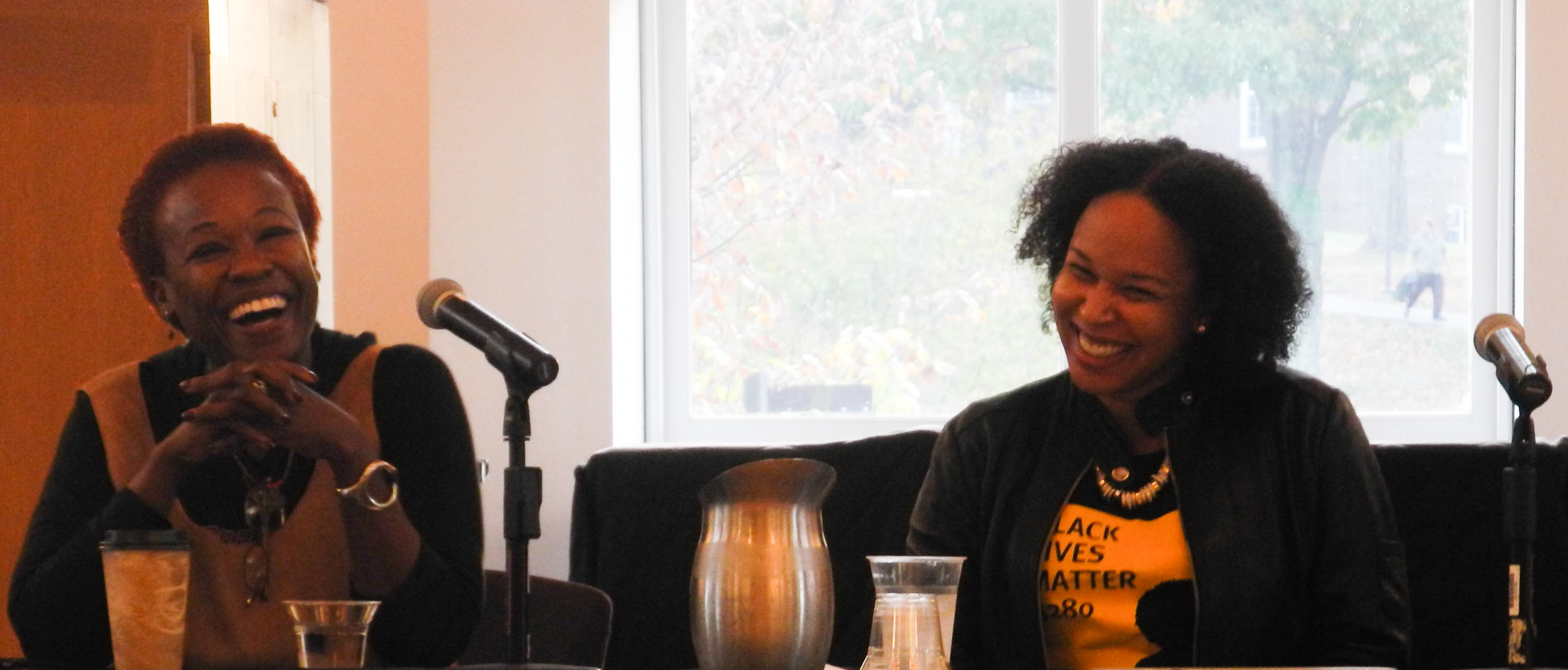
    On Nov. 1, University Professor of Anthropology and Feminist, Gender and Sexuality Studies Gina Ulysse, Professors Bianca C. Williams of the University of Colorado Boulder and Dawn-Elissa Fischer of San Francisco State University participated in a panel discussion in Beckham Hall in front of a large audience of University staff and students. The discussion, entitled “Anthropology and #BlackLivesMatter,” covered a variety of topics, particularly each professor’s personal history and how it has shaped their experience in academia.

    The talk was hosted by the University’s Anthropology Department. Professor Margot Weiss, Chair of the Anthropology Department and Associate Professor of American Studies, Anthropology, and Professor of Feminist, Gender, and Sexuality Studies opened the discussion by providing context on the intersection of anthropology and the Black Lives Matter movement and introducing each of the panelists. From there, each panelist spoke for 10 minutes about her personal history and relationship to Black Lives Matter.

    Fischer spoke first, noting that she had been following the recent news regarding Scott Backer and the relationship between students and administrators at the University. She hoped to engage with students to discuss their perspective on recent events.

    “How does the condition that you are experiencing today, in 2016, compare to 1966?” she asked of students in the audience. “Are you feeling ’68-ish? Are you feeling ’72-ish? 1983-ish? 1992? 2004? I’m concerned.”

    Fischer moved on to note that she comes from a legacy of activism that she hopes to bring to the University. She emphasized the importance of creating sustainable and visible change in communities such as the University and communities around the world.

    Williams was the second speaker, and she explored her interests in the psyche of Black Feminism, which she has spent much of her career researching.

    “As a black feminist cultural anthropologist, the main question that I say drives my research, my teaching, my service, my organizing, is, ‘How do black communities navigate the oppressive systems of sexism and racism without losing their minds?’” Williams said. “That’s what I study. I study black women and happiness because for me, emotion…is very much a good source of data. [I ask], ‘How does it feel to live at the intersection of these systems of oppression that we navigate daily?’”

    Williams also brought up radical honesty, a term that refers to being truthful about respective biases, sharing identities, and filling in cultural gaps. She emphasized the use of knowledge and learning as a means of action, and also noted the importance of treating the multiple systems of oppression in society not as separate beasts, but as arms of the same systemic power.

    “I came to anthropology because I believed that it was a field that would give me the tools and the skills to unlearn the things that I had been socialized to believe, and to help my students learn these things,” Williams said.

    Last to give an introduction was Ulysse, who discussed the roles that Haiti and performance art have played in her life and career.

    “I came to anthropology via Haiti,” Ulysse said. “There’s no other reason, really. It was what it meant to be a young Haitian person who migrated—yes, I’m an immigrant, and I love to say that—and tried to explain her country to people who didn’t quite understand it, or only understood it as the stereotypical poorest nation in the Western hemisphere. And I knew it was more complicated than that.”

    She explained that she entered anthropology to explain Haiti to people in terms that they would understand and appreciate, and to learn enough so that in the future, she could create meaningful change.

    “Anthropology to me was not even a question,” Ulysse said.

    Ulysse also noted that anthropology bridged the gap between the arts and the sciences, which was extremely important to her, especially given her love of performance as a way of expression.

    “Performance has saved me from Afro-pessimism,” she said. “Part of my turn to performance is to have that space where I can express my rage.”

    After their respective 10-minute introductions, a Q&A session with the panelists followed. Ulysse opened by asking her fellow speakers about their experiences as anthropologists. Williams responded by meditating on her own identity as an anthropologist who is a woman of color. She spoke about her efforts to “decolonize” the field of anthropology, dismantling its staid hierarchies that deprive scholars like herself of agency.

    “We’re being hired in Women and Gender Studies programs, or Africana Studies Programs, or Ethnic Studies, or American Studies programs, because somehow, no matter where we do the work, we’re not read as anthropologists,” Williams said. “And it sucks, for lack of a better word, because we see the decolonizing that a lot of our more senior folks are doing or even our peers, and for some reason we’re not being allowed to do that work within the discipline, because jobs don’t see us as anthropologists.”

    Ulysse, in her response to Williams, gave an explanation of the word decolonizing in reference to anthropology.

    “This is what I mean by decolonizing: We actually are in a moment where things are shifting in the discipline, because it doesn’t have a choice but to shift, given what’s happening with publications, given what’s happening in the world and how fast things are actually developing,” she said.

    Later in the discussion, the panelists moved to answering audience questions. Topics ranged from the importance of diversifying university staff, to the need to dismantle white supremacy, to the 2016 election’s impact on people of color.

    “The xenophobia, the racism and the misogyny is so real,” Ulysse said. “I’m scared. I mean I’m literally scared.”

    Williams commented on this nation’s fear of putting black women at the center of power in any form, noting specifically that black women are often rendered invisible. She also commented that the issue of systemic racism is under-acknowledged.

    “The problem is not the people in this room; it is the people who are not here,” Williams said.

    The discussion finished with student input and commentary on Wesleyan’s administration, with multiple students explaining that they felt their perspectives and voices were going unheard and ignored.

    Williams answered student commentary with advice on how to be heard.

    “Y’all need to sit down, figure out how power operates on this campus, and figure out the long-term and short-term goals that help benefit everyone in that community,” Williams said. “Use your collective energy to round up and make people uncomfortable.”

    Earlier on in the discussion, Fischer also offered a critical point of advice to students in the audience, no matter what discipline they might wish to pursue.

    “We have to remember to continue to fight,” Fischer said. “Things didn’t just happen on their own. This is something for anthropology, but this is something for whatever field you’re in. Fight for your discipline. Fight for your theory. Fight.”

  • History Alumnus Talks Journalism, Disability Rights, and Medievalism
    History Alumnus Talks Journalism, Disability Rights, and Medievalism

    Emma Davis, Features Editor
    Emma Davis, Features Editor

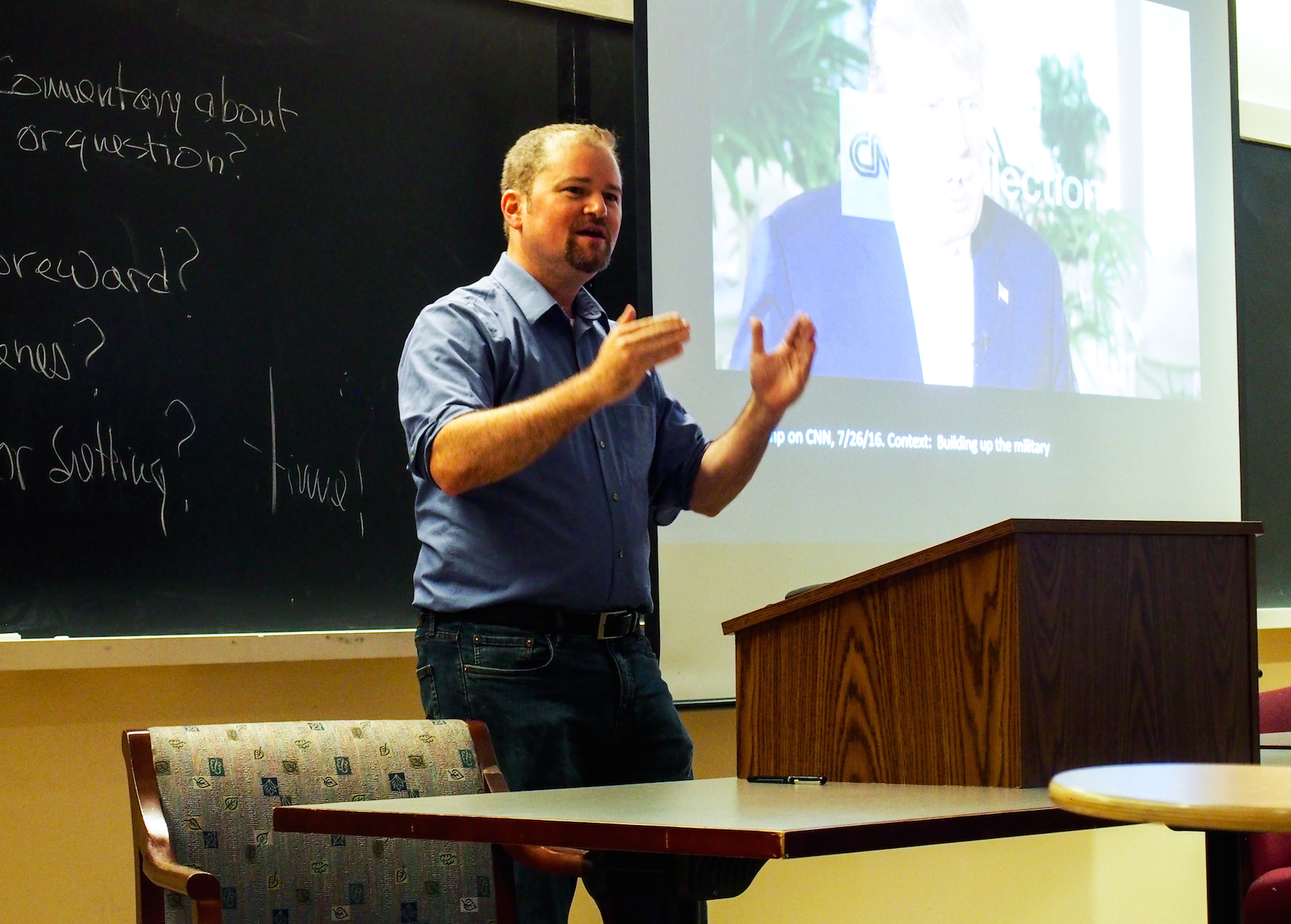
    On Thursday, Oct. 13, the University’s History Department hosted a talk by alumnus and journalist David Perry ’95 in Downey House. The talk, entitled “Life as the Unofficial Medievalist to CNN,” ranged beyond the topics of journalism and medievalism. Perry spoke about a variety of elements relating to the evolution of his career and life, with a special focus on how medieval studies, disability rights, and writing all intersected in his career.

    Perry opened his talk with a quote from presidential nominee Donald Trump. Perry, highlighting Trump’s tendency to refer to ISIS as “medieval,” noted that in contemporary society, we use medieval as a term to describe something removed from us, as something sinister. As a Medieval Studies major at the University and a history professor at Dominican University, Perry noted that the negative Trumpian assessment of medieval culture is actually inaccurate. In addition, he believes that medieval studies can be applied to contemporary issues.

    Perry then moved into a discussion of his own career, including receiving his MA and PhD from the University of Minnesota, and his time in Venice as a teacher at a small Catholic school. Perry discussed his continuing interest in medieval studies and how this interest manifested itself in his work and writing.

    Perry thought it would also be important to include some information on his personal life, since, as he notes, his personal experiences have had a large impact on his academic career. Perry explained that after receiving his PhD, he had two children, one of whom has Down Syndrome. He explained that he began to study and learn about the genetic disorder, gaining what he felt amounted to a graduate-level education in the subject. It was through the experience that he began writing journalistic pieces.

    “Almost exactly eight years ago, I wrote a little piece about Sarah Palin and the discourse of Down Syndrome [that was] critical of the ways in which both the left and the right were talking about [Palin’s] son, and talking about Down’s Syndrome,” Perry said. “I had a lot of things to say about that.”

    Along with his journalistic work, Perry also discussed some of the stereotypes that are used to describe people with Down Syndrome, both positive and negative. He explained that after Ann Coulter referred to President Barack Obama as a “retard,” there was a lot of backlash from around the country. This backlash, while well-intentioned, still reinforced a stereotypical image of people with Down Syndrome as angels.

    “I was interested in positive stereotypes as the other side of the same coin as negative stereotypes,” Perry said. “Which is to say, I’d rather you call my son an angel than to use a slur, but in fact, my son is also not an angel. He is not a two-dimensional positive stereotype any more than he is a two-dimensional negative stereotype.”

    Perry wrote a 900-word article about this topic, which he submitted through a friend to CNN. CNN published the article, which helped solidify Perry’s future relationship with the company. While this was, at the time, one of the few articles that Perry had published, that would soon change. It was after publishing this article, 16 years after graduating from the University, that Perry’s life changed forever in a very atypical fashion.

    “The thing that changed my life was that on February 12th, 2013, Pope Benedict retired,” Perry said. “Kind of a weird thing, right? Totally life-changing.”

    Perry explained that when Pope Benedict retired, media outlets began spreading misinformation.

    “[They said] pretty much in unison, that this hadn’t happened since 1406 when Pope Gregory the 12th had retired,” Perry said.

    Perry realized, however, that this information was inadequate and didn’t tell the whole story.

    “I was listening to NPR, I was watching CNN, and I said, ‘Pope Gregory the 12th?” Perry said. “That is ridiculous. Everybody knows that the proper historical analogy is Pope and St. Celestine the Fifth! Everybody knows that.”

    Perry detailed how he posted about the anachronistic mistake on Facebook, and friends suggested he write something up and pitch it to a news media source. So Perry did just that, sending an email to CNN, and it took them only three minutes to reply and express interest. Perry spent the rest of the day writing the article, submitted it, and it made the front page of CNNs website that day.

    This sparked Perry’s more committed involvement in the world of journalism. According to Perry, the articles he had written gave him what amounted to a fast track to publishing more articles in the future. Perry began writing a variety of pieces on a variety of subjects, including a piece entitled “For strong daughters, stop with the sex stereotypes,” which, according to Perry, got over a million views.

    From here, Perry’s writing took another turn in subject. Perry learned of the death of Ethan Saylor, a man with Down Syndrome who was killed by police at a movie theater. Taylor was forcibly thrown to the ground after he did not comply with the police, who then crushed his windpipe.

    “I was angry about this,” Perry said. “And I was kind of waiting for the smart journalistic take on it. Mostly what I was seeing was people saying, ‘This is an unbelievably tragedy, how could this have happened?’ as opposed to saying, ‘This is terrible, and this sort of thing happens to people all the time,’ just usually, they’re not suburban white men with Down Syndrome. I wanted someone to say that sentence, and to back it up. And eventually, I decided that maybe the journalist who was gonna have to say that sentence would be me.”

    It was at this point that Perry began writing about patterns of targeted individuals of police violence, and how disabilities factored into their victimization. Perry presented a list of names of African American individuals who were known victims of police aggression, including Eric Garner, who had diabetes and congestive heart failure; Michael Brown, who had ADHD; and Sandra Bland, who had epilepsy and depression. One-third to half of all people killed by police have disabilities, noted Perry. He went on to say that there was a lack of material written about this pattern, and that there needed to be an expanded conversation, so he began to write about it.

    Perry spoke about this aspect of his work, detailing how he has worked with a variety of groups to promote awareness of the issue. He then devoted the remaining time to discussing other articles he had written and his ongoing blog, as well as the importance of writing every day.

    The talk was attended by a variety of individuals, including Sadie Renjilian ’17, a history major, who was there to promote interest in the History Department. Renjilian shared her thoughts on the talk.

    “It’s really interesting, as seniors, seeing what we can do with our degrees, because I think all of us would like to keep doing history and we’re worried we won’t be able to keep doing history,” Renjilian said. “So it’s really inspiring to see someone who was able to keep doing what they’re interested in and expand their interest beyond that.”

    On a more humorous note, Renjilian shared one of her favorite parts of the talk.

    “There were so many amazing lines,” she said.

    One of those lines was a closing line of Perry’s talk: “You can’t prove that I’m not the unofficial medievalist of CNN.”

  • State Senator Danté Bartolomeo Visits the University

    State Senator Danté Bartolomeo Visits the University

    On Oct. 3, Wesleyan Democrats (WesDems) invited State Senator Danté Bartolomeo to speak to a group of students about her platform and experience as a senator, as well as her current race against Republican Len Suzio. The talk lasted 45 minutes and took place at Harriman Hall at 7 p.m.

    WesDems President Simon Korn ’17 organized the event.

    “Between her role in the higher education committee, her proximity to campus, and her close re-election campaign, which is a microcosm of several statewide issues, Senator Bartolomeo was the perfect person to introduce the WesDems to local politics,” Korn wrote in an email to The Argus.

    At the event, Bartolomeo began her speech with an introduction to her experience as a state senator, including her path to politics. Bartolomeo explained that her original degree from Colby College was in psychology, and before becoming a senator, she found herself in a job not directly related to either political science or psychology. She later spent some time as a stay-at-home mom, but it was through her role on a diverse range of community boards that she found herself running against then-incumbent Suzio in 2012. She narrowly beat him by less than 300 votes. She ran again in 2014 and won by a similarly small margin.

    Bartolomeo spoke about her achievements as a state senator over the previous few years, highlighting her role as Co-Chair of the Committee on Children, where she has worked to provide support for children with behavioral, mental, or emotional health issues. She also mentioned her role as Co-Chair of the Higher Education and Employment Advancement Committee, through which she has worked to increase college affordability.

    Bartolomeo equated her race against Suzio to the presidential race between Hillary Clinton and Donald Trump, with herself as Clinton and Suzio as Trump.

    When asked about her thoughts on budgetary matters, specifically how to get more money in the pockets of the middle class, she responded with an answer that tied into her experience as a promoter of higher education.

    “What I think that we need to do is we need to really commit more funding to the higher education system for the training and the educating of our work force for these future jobs,” Bartolomeo said. “That’s the way and that’s how, in my opinion, we would make the most difference. We have people telling us ‘We have jobs, we just don’t have people who are skilled at the level they need to be to have these jobs.’ Or things are changing, more bioscience and more advanced manufacturing…we’re being told the high-tech STEM jobs are going to need more people than we are currently graduating.”

    Bartolomeo discussed options for increasing night life and public transportation in Connecticut to transform regions into thriving business and cultural spots. This, she explained, was another way to increase revenue in the state, and one that could also be promoted on the scale of local politics.

    She explained that there have been attempts to get money out of local politics by setting a minimum amount of donations that a candidate needs in order to receive a $90,000 grant from the state. However, according to Bartolomeo, this isn’t enough.

    “That was all supposedly to equalize the playing field, but there’s also an allowance for what we call ‘independent expenditures,’ and that is a union, a group, a company, a person, anybody can spend money on my race as long as they’re doing it independently from coordinating with me.”

    Bartolomeo explained that in this race, a lot of money has been spent on her opponent. Connecticut Republicans only need four more seats to take a majority in the State Senate, which is why they’re spending over $50,000 on this race.

    Bartolomeo also took the opportunity to take a swing at her opponent, Suzio, by pointing out his past business decisions.

    “[My opponent] took $500,000 of payments and deposits from people because he had a log home business, but he didn’t deliver on the homes before he closed, and they didn’t ever get a penny of that money back,” Bartolomeo said. “He had this tax bill of $300,000 that he walked away from. He sold the land for one dollar; I have the receipt where he signed it. And now other people are trying to clean it up.”

    She used this story in conjecture with campaign spending, citing the Connecticut Business and Industry Association’s support of him despite his poor record.

    “The reality is, I feel like I could put my business record against his anyway,” Bartolomeo said.

    After more discussion of education and income, as well as the Community Health Center in Middletown, Bartolomeo commented on the political climate and the ways political races have become so negative.

    “It’s become more and more personal and ugly, I guess, since I’ve been doing it,” Bartolomeo said.“And I really think that our current presidential election is hurting us in that regard because it kind of makes it seem like it’s all good, you can attack someone, you can lie about someone, you can beat the heck out of them, and that’s okay.”

    Students’ reactions to the event were generally positive.

    “It was interesting to hear a representative from Connecticut speak, as I really don’t know about Connecticut’s issues, since I’m from Virginia,” Tristan Genetta ’20 said. “She primarily talked about the economy, which I was surprised about, but it’s an important matter.”

    Another student appreciated hearing about the local aspect of politics in a political climate focused on the presidential election.

    “I thought it was really interesting hearing a local politician speak about the issues that face the community,” Jake Multer ’20 said. “I also thought it was interesting hearing about the front line of politics, and how on the local level different issues are worked out, how disagreements between fellow party members worked out.”

    Student Livia Wallick ’20 agreed.

    “It was really great to get to interact with the local politician, especially a female politician, because the issues that she’s working on directly affect Wesleyan,” Wallick said. “She approved a $10,000 grant for Wesleyan’s community partnerships for the Center for the Arts earlier this summer, so she’s really been an advocate for Wesleyan’s role in the Middletown community.”

    Wallick also noted how difficult it is to be a female politician in this environment and expressed her respect for Bartolomeo in that regard as well.

    “The language surrounding female politicians and their campaigns is incredibly problematic, and she’s had to experience a lot of that from her opponent,” Wallick said.

    Korn, too, considered the event a success.

    “Her visit really went better than I could have hoped,” Korn said.“I was really happy to see how much she wanted to interact with all the students in the audience, take their questions, and address their concerns. I think she got people more interested in getting involved with local politics, which was my goal for the whole event.”

  • Students Across Campus Watch Presidential Debate

    Students Across Campus Watch Presidential Debate

    Over 80 million people watched this election’s first presidential debate on Sept. 26, making it the most-watched debate in United States history. Among those watching were hundreds of University students, tuning in from various formal and informal screenings around campus.

    The two largest organized debate-watching events this year were in the Usdan University Center and the Exley Science Center, hosted by the Usdan Center Activities Board (UCAB) and Arcadia Magazine, respectively. At Exley, a watching party was hosted in Tischler Hall for a sizable and enthusiastic audience.

    Arcadia Magazine is a multi-partisan magazine dedicated to the full spectrum of political thought, originally started by the Wesleyan Democrats and the Wesleyan Republicans.

    Audience members in Tischler Hall filed in minutes before the debate began, munching on snacks provided by Arcadia Magazine and taking seats in the large lecture hall. The debate was broadcasted on a large screen visible to students sitting in any corner of the room. After a few minutes of “The Voice,” the debate began promptly at 9 p.m. and students quieted down to listen and watch.

    Arcadia Magazine asked the audience to be respectful and avoid arguments or fights, but acknowledged that the hall need not be silent. Students were vocal throughout the debate, expressing their reactions at various poignant or memorable moments. There was a clear bias for presidential nominee Hillary Clinton in the room, evidenced by the reactions of the crowd throughout the event.

    Students generally oscillated between clapping with appreciation and groaning with distaste over the course of the debate. An audible cringe swept through the room when presidential nominee Donald Trump asked Clinton what name she’d prefer he use when referencing her, stating, “I want you to be very happy.”

    Many students also scoffed loudly when Trump said, “I also have a much better temperament than she does.” Clinton’s reply after Trump’s assessment of her temperament, a terse “Okay” with a wry smile, was met with a roomful of applause.

    A favorite debate moment for the students watching in Tischler Hall was Hillary’s response to Trump’s comment about her lack of stamina.

    “As soon as he travels to 112 countries and negotiates a peace deal, a cease fire, a release of dissidents, an opening of new opportunities in nations around the world, or even spends 11 hours testifying in front of a congressional committee, he can talk to me about stamina,” Clinton said, and the room went wild.

    There were other moments that students enjoyed, including, according to one student, the instances in which Trump was clearly uncomfortable.

    “I liked the parts where [Trump] was sipping water and looking really unhappy,” Susana Hair ’20, who was an attendee of the event, said. 

    In Usdan, the debate-watching party took on a different, more informal tone, with students sitting in clusters at tables or on couches. The debate was broadcasted on multiple screens around the floor. UCAB also provided cupcakes that students were able to decorate.

    However, according to Grace Snyder ’20, the snacks were not the only thing that differed between the screenings at the two locations. 

    “Usdan seemed more tightly packed, and people were closer together,” Snyder said. “People at Exley were focusing on the debate and on their work, but they were also focusing more intently because it was a lecture hall.”

    Emma Greenfield ’20 echoed this sentiment.

    “It was more casual [at Usdan]; I felt like at Arcadia, people were working and were really into the debate at the same time,” Greenfield said.

    Despite the difference in locations, students enjoyed watching the debate with their peers. Many students interacted with each other before and after the debate, trading thoughts and expectations. Even throughout the debate, students kept a running commentary in both Usdan and Exley.

    “It’s much better than if I had just watched it alone in my dorm room or something,” Hair said. “I think that the majority of the people here seemed to have views that correlated with mine, and that was nice. I wish there had been more snacks, but other than that I think it was good. Big screen. I always love having political interactions with other people because I get very vocal.” 

    In some ways, however, some students found the debate slightly disconcerting. For Snyder, the debate was evidence of the perpetuation of mainstream media and entertainment craze.

    “I think it’s interesting that the debate was like an entertainment spectacle,” Snyder said. “What does it say that we’re watching this and we’re just laughing at this presidential candidate? It just seems like it’s taken on a very unprofessional tone, which is kind of concerning, because you’d hope that there would be some seriousness going on around the time of the debate. But with all this media, I think we’re just kind of making a lot of jokes…about Donald Trump.”

    Despite this consideration, overall reactions to the debate were positive, and both events were objective successes. Many students enjoyed watching the debate, as evidenced by the sheer number of individuals who tuned in from locations around campus, as well as the general reactions of students after it was over.

    “[This debate] is a completely unique experience that would not have happened at any other time period in the U.S.,” Hair said.

  • “Eight Days a Week” Won’t Let You Down

    “Eight Days a Week” Won’t Let You Down

    c/o consequenceofsound.net
    c/o consequenceofsound.net

    If you’ve ever spoken to me, it’s entirely likely that I’ve managed to either bring up The Beatles or sneak in some obscure song reference under the radar, hoping someone will pick up on it. I can’t help myself. They’re an omnipresent force in my life, and in each moment, I am silently (and often audibly) willing them to be equally omnipresent in everyone else’s.

    To emphasize my love of The Beatles (and to make matters worse [better?]), I’m going to launch into a review of the recent Beatles documentary “The Beatles — Eight Days a Week: The Touring Years”, which I only managed to watch after a lot of obsequious persuasion directed at friends with Hulu accounts. The documentary came out in theaters on Sept. 16, and thankfully, on Hulu Sept. 18.

    As an ardent consumer of Beatles media, part of me was somewhat skeptical about the documentary, just on principle. The amount of books/articles/movies/satire that have been made about the iconic band over the years could fill up multiple strawberry fields, octopuses’ gardens, Penny Lanes, and long and winding roads. In some ways I found that this fear was actualized while watching the film, and in others I was pleasantly surprised by the new material.

    The documentary opens with 74-year-old Paul McCartney, in his quintessential Scouse accent riddled with “you knows,” discussing the transformation the Beatles went through before every concert. They donned their suits and “Beatle boots,” suddenly becoming the band that the audience was expecting. It’s a great opening, not just because hearing Paul’s voice sends waves of excitement into every Beatles fan, but because it feels so familiar. Viewers are also allowed access to The Beatles’ nascent lives on tour. This combination of nostalgia from a new angle is a theme that weaves its way throughout the entire movie. Most Beatles fans, even hardcore ones, don’t know about the little details of the Beatles’ touring years, but they do know the story. This documentary delivers some of those details, in the cheeky way that only a Beatles movie can.

    Before getting into the years on tour, the movie provides context on the formation of the band, including some fun shots of the very early pre-Beatles group The Quarrymen, lead by John Lennon, which John was in when he met Paul and George Harrison. The movie quickly moves into the hectic lifestyle of The Beatles while on tour, highlighting the absolute insanity of fans and inundating the viewer with telling photos of fainting 14-year-olds and fan interviews. “Ringo has a sexy nose!” shouts one girl to the camera (I couldn’t agree more). These images and clips truly solidify the hold The Beatles took on the teenage world. They were a phenomenon. Sprinkled in with these images were fun interviews of some of the stars you didn’t know were early fans, like Sigourney Weaver and Whoopi Goldberg. Both interviews were surprising and fabulous, because knowing that these distinguished actors were total fangirls back in the day is both adorable and humanizing.

    Whoopi’s interview particularly, along with historian Dr. Kitty Oliver’s interview, gave the documentary a new take that hadn’t been explored in previous films. A lot of the film focused on political and social context, like segregation and the Civil Rights movement, during the age of The Beatles. Some of the shows in America that The Beatles were meant to play, specifically at the Gator Bowl in Jacksonville, were intended to be segregated, an idea that the lads found both ludicrous and wrong.

    “We don’t like it if there’s any segregation or anything because it just seems mad to me,” Paul said in a 1964 interview. “You can’t treat other human beings like animals.”

    The Beatles refused to play at the Gator Bowl unless the show was desegregated, so the segregation rule was promptly dismantled. Dr. Kitty Oliver recounted the experience of standing next to white people for the first time, yelling and singing as loud as she could. Whoopi, too, noted that she felt The Beatles were universal, ubiquitous, and meant for everyone, regardless of skin color. This context, especially with personal accounts, gives the film a new perspective that certainly heightens its appeal.

    After highlighting the brotherhood and camaraderie that pervaded the early years, the film eventually covers the slow collapse of the touring years. Soon, the cramped quarters, the screaming fans, the tiresome sets, and the lack of free time began wearing down The Beatles, and on Aug. 29, 1966, they gave their final performance (discounting the iconic rooftop concert of 1969). The final 1966 concert set in San Francisco was not a particularly moving one either. The Beatles were done.

    While the film doesn’t cover the collapse of the touring years in quite as much detail as I would have liked, it nicely chronicles the evolution of albums and the evolution of the musicians themselves, which, in part, led to the collapse.

    “It’s just we’re men now, you know, we’re a bit older than those lads that started out,” Ringo said in 1969.

    With a combination of old and new footage, the film gives great insight into the sentiments of the four boys during the end of their years abroad. It’s honest and endearing, and what more can we ask for than that?

    Sprinkled throughout the film are some classic songs, many live from the Hollywood Bowl and remastered for the first time by Giles Martin, son of the one and only George Martin. The songs also come on a CD that you can purchase online, and I highly recommend you do, if only to hear the enjoyable introductions to songs and banter from John and Paul. The new footage and images that the documentary presents range from adorable to striking. They, too, make the documentary into its own treasure trove. Other online materials are available, including a wonderful interview live from Abbey Road studios with filmmaker Ron Howard, Paul, and Ringo that I’d highly recommend everyone watch (in some ways, I liked it even better than the documentary).

    What all this goes to show is that when it comes to The Beatles, we’re never really out of material. The story may be an extremely well-known one, but it’s not worn out just yet, and this documentary proves there are new angles to be found and explored.

    Before watching the film, I found myself mindlessly humming “Please Please Me,” which was the first Beatles single to truly put them on the map. It’s also one of my favorite songs to dance to. If my singing was a metaphor for my hope that the film would fulfill my expectations, all I can say is that it did, and then some. If you’re looking for a taste of honey and nostalgia, or if you’re a new Beatles fan just testing the waters, “The Touring Years” is a great film for the Lovely Ritas and Eleanor Rigbys alike.

  • Miyazaki Discusses The Economy of Hope

    On Sept. 19, Hirokazu Miyazaki of Cornell University gave a lecture to an audience of University students and staff entitled “The Economy of Hope.” The lecture was the second in a series of ten on the theme of “Hope and Hopelessness” hosted by the Center for the Humanities. The framework for Miyazaki’s talk centered around specific historical occasions that aroused a need for hope, a prevalence of hope, or both.

    After opening the lecture with a short summary of what his paper and lecture would generally cover, Miyazaki launched into the circumstances that surrounded his interpretation and discussion of hope.

    “My current thinking about hope cannot be separated from what happened in Japan five years ago and my own personal experience of it,” Miyazaki said.“I was in Tokyo when the earthquake Tōhoku hit Northeastern Japan. I was literally shaken, and really shaken by the nature of a tsunami really swallowing up houses and cars. We hadn’t been warned. But what happened a little bit later was even worse. The [disaster at the] nuclear power plant Fukushima really fundamentally changed Japan’s future and my own future, too. I still live with this sense of loss.”

    Miyazaki used this example to demonstrate that there are different levels of hope. For example, he noted that humans have individual hopes that pertain to themselves and those immediately in their lives, and then they have is what he calls “collective hope,” which is the hope of a community, city, or even nation. For Japan, there was a prevailing sense of nationwide, collective hope after the disaster literally rocked the nation.

    Throughout the lecture, Miyazaki offered varying perspectives on hope, from those of Western economic writers such as Jane Guyer to Yuji Genda’s discussion of “Hope and Society in Japan,” which focuses specifically on the difference between attainable and unattainable hope. The difference as Genda saw it, Miyazaki explained, was that attainable hope comes from the process of recovering from a failure.

    As discernible from the title of the lecture, much of the focus was on hope as it related to the economy, or hope as an elusive concept that could come in tangible forms. According to Miyazaki, hope can be a tangible want, but it can also be an equally intangible and ubiquitous presence, as it was for Japan in 2011, after the tsunami and chemical disaster left the nation in severe need.

    “Hope is paradoxical,” Miyazaki said. “Hope often contains within itself opposites.”

    After the lecture, Miyazaki opened the floor to the audience for questions. One audience member asked if Miyazaki discerned a difference between the English and Japanese general definitions of hope.

    “In English, I feel that when you think of hope, you tend to think of hope as a verb,” Miyazaki said. “When you pose a question of ‘what is hope,’ [one responds with] questions like, ‘for what?’ But in Japanese…this category of hope has emerged as a noun. As a result, it has invited very abstract reflection on this category, hope, without and specific linkages to objects.”

    Miyazaki then noted that this could have something to do with the differing philosophies of Japan and America. In America, he explained, emphasis tends to be the individual, while in Japan, emphasis is on the collective.

    In general, the audience’s reaction to the lecture was a positive one.

    “I though it was interesting, because [English and Japanese speakers] don’t think of hope in the same way,” Tara Mitra ’20, an attendee, said. “He talked about the verb and the noun, and that’s just something that I didn’t think of.”

    Neha Srinivas ’20 found the talk insightful.

    “He seemed really passionate about hope,” she said. “He seemed like he was really personally connected to the topic, to the material.”

    Srinivas also added that Miyazaki made the lecture more enjoyable through the use of humor.

    “He also got the room laughing about what could be perceived as a very serious topic,” she said. “He had his moments.”

    One memorable example of this occurred at the beginning of the lecture, just as Miyazaki introduced the topic. He joked that the question “what is hope?” is not an easy one, and that he has a long answer, which was essentially the paper that his lecture was based on.

    The third lecture of the series, titled “Hopes of Killing: The Cultural Politics of Eradication,” will occur on Oct. 3.

  • WSA Discusses Program Housing Regulations

    The Wesleyan Student Assembly (WSA) held a meeting on Sunday, Sept. 11 to address and discuss, among other things, the confusion surrounding a Residential Life policy that has impacted program house concerts and events. The policy arose out of situations that occurred in the 2015-16 school year, involving what was seen as program houses straying from their mission statements and becoming sites for concerts rather than house-themed events.

    “We were hearing from the general student population that some of our program houses were being viewed as concert venues more so than as the program houses themselves,” Director of Residential Life (ResLife) Fran Koerting said at the meeting.

    ResLife’s solution at the time was to enact a policy that targeted this issue, and promoted the use of events that were tailored to each house’s individual theme.

    One house Koerting mentioned in particular is the former Buddhist House, which has since been renamed as Middle House. She explained that previously, students thought that the Buddhist House was not being true to its mission. This sparked future discussions on potential issues in program housing.

    “The Undergraduate Residential Life Committee, which is the committee that is half WSA representatives and half ResLife representatives, and is primarily students, had already looked at [the fact] that we needed to put a lot more focus on the mission,” Koerting said.

    The policy had been met with some resistance from students; however, students considered the policy a blanket ban: restricting houses from hosting concerts unrelated to the theme of the house. ResLife also addressed the issue during the summer, when the majority of University students were not on campus. This meant that most students could not provide their own input as to what action should be taken.

    Koerting admitted to the flaw in the execution of the policy.

    “We didn’t get a chance to talk about it while students were still here, which is a mistake,” Koerting said. “We should have done it when we had student input.”

    This was the reason many students voiced concern about the policy, and despite this concern, the conversation was opened.

    Students spoke up about some of their thoughts and concerns at the meeting. Community Adviser Drew Trotman ’18 brought up the ways that changing program house regulation might affect underrepresented students and students of color on campus.

    “As a student of color, program houses serve as a safe space in a lot of cases,” Trotman said.

    He also noted that less-represented students could be impacted by this change.

    “I think that there has been a general, [though] of course it wasn’t on purpose, shrinking of that nightlife by eliminating these spaces where students have gotten together,” Trotman said.

    Other students voiced their opinions during the meeting, a few mentioning that they felt ResLife did not handle the issue in the most effective way.

    One student suggested that the issue might have been taken care of more effectively had ResLife approached the members of each program house individually to construct a dialogue and discuss options for their respective house.

    Another student narrated an experience with Earth House, explaining that through attending events at Earth House, it became clear to the student that the community was one the student wanted to join. Through events like these, the student explained, the houses promote interest and grow and strengthen as a community. A third student mentioned that program houses provided safe spaces for parties and locations for night life.

    Trotman also offered his own solution, explaining that the University could be involved in planning social events as well.

    “I have some friends who go to other universities and there are other university-sponsored parties,”  Trotman said.

    Program houses are meant to have no more than three house-themed events each month. The events revolve in some way around each house’s theme, from music to art to the environment. While Koerting acknowledged that Music House is an appropriate building for concert events, other houses had to ensure that if they did host concerts, those concerts related in some ways to the theme of the house.

    “I really think that if we’re talking about the safety and health of students, that sort of taking away the music from them isn’t really a healthy decision,” Jonah Toussaint ’17, another attendee, said. “I feel like it might be easier to let the people in the house decide what the house should be.”

    After multiple students voiced concern about ResLife making changes to the way program houses are run, Koerting noted that she did not believe any changes were going to drastically affect student life. A final decision has yet to be made, but the conversation has been opened. To alleviate student concerns, Koerting noted that future changes will involve student input.