Author: Elizabeth Laurence

  • “The House of Yes:” Sex and Family in the Shadows of Kennedy-esque Splendor

    “The House of Yes:” Sex and Family in the Shadows of Kennedy-esque Splendor

    c/o Lillian Hoefflin

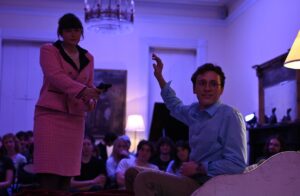
    On Friday, April 11, and Saturday, April 12, Spike Tape presented “The House of Yes” at Russell House as part of its Spring 2025 season. Written by Wendy MacLeod, the show was directed by Isa Paley ’26, starred Eliza Marovitz ’25, Matthew Nusbaum ’25, Sage Saling ’26, Kyle Reims ’25, and Daniel Brugger ’26, and was stage-managed by Coco Cooley ’26. 

    Paley discovered this play after seeing Mark Waters’ 1997 film adaptation of the show on the Criterion Channel. She loved the film, and when it came time to pitch to Spike Tape, she remembered that it was based on the play written by MacLeod.

    “I downplayed the incest in my pitch to Spike Tape,” Paley said. “I was scared of leading with [incest] because when I had pitched Spring Awakening to Spike Tape last year, they told me that it deals with themes that might be too sensitive.” 

    “The House of Yes” is a play about an ultra-wealthy family that lives next door to the Kennedys. The Pascal family consists of a pair of twins, Marty and Jackie; a younger brother, Anthony; and their mother, Mrs. Pascal. Jackie, who is in and out of psychiatric hospitals and on all sorts of medication, is convinced that she’s the infamous Jacqueline Kennedy Onassis.

    The play begins with Marty visiting home for Thanksgiving following a recent move to New York, where he sought a life of relative normalcy. He brings home his new fiancée, Lesly, who is from a small town in Pennsylvania. Over the course of the play, the family, trapped in the house by a hurricane, hashes out their past, revealing secrets of their father’s death and the twins’ sexual history, and tests fate when the younger brother fawns over Lesly. 

    Brugger, who played Mrs. Pascal in drag, outlined his original intent for the character and artistic challenges playing the matriarch. While one might interpret the choice to do drag as stylistically campy, Cooley clarified that this was not the intent of the casting choice.

    “We wanted to emphasize that this is a woman, not a drag queen,” Cooley said. “He’s not supposed to be campy; he’s just playing a woman.”

    While some directors would be inclined to lean into the campy nature of the play, it is explicitly stated in the script that this would be a mistake. 

    “It is a great mistake to imagine the play is ‘camp’ because the characters pretend to be Jack and Jackie Kennedy,” MacLeod wrote in the original script. “To do the play that way is to undermine its emotional truth, and the love, however twisted, between the characters.” 

    Paley reaffirmed that her intention as a director was to lean away from the campiness and take the love the characters had for each other seriously. 

    “We wanted to play the incest like [it] is right,” Paley said. “I didn’t want to mock them. These characters love each other and that is uncomfortable. It’s a product of insularity and wealth and only watching TV. We take the love seriously because it was already there. These people have love that they don’t know what to do with.”

    Marovitz, who assumed the role of Jackie, further remarked on the romantic nature of the relationship. 

    “I often get cast as characters who use their sexuality over people,” Marovitz said. “But to play Jackie-O, she’s so sad and in love that it felt like a romance. I don’t usually get romance—I usually get sex. It was super exciting for me to not feel like a harlot or the girl in red. I was very much the girl in pink.” 

    Marovitz and Saling spoke about how having a female directorial team positively shaped their experiences in the rehearsal process.

    “I thought about the makeup of ‘House of Yes’ and [decided], ‘I don’t want to turn down a whole bunch of women,’” Marovitz said. “It sounds simple, but it’s what made the whole process what it was…. Being a woman’s murderous lady was what I wanted to be.” 

    Saling played Lesly, a character who was typically rendered as naive, but Paley and Cooley chose to add more depth to her character. 

    “When I was doing research before, everything said that she’s very dumb,” Saling said. “That is the forefront of how she’s advertised. But Isa always said that she’s very kind. Isa never made us play into the stupidity of who she was; it was playing into the earnestness and honestness of how she spoke to people in her life. The language for how we sought out her character speaks to how the creative team was built and the success of the show.”

    The rendering of both Marty and Anthony, played by Nusbaum and Reims respectively, also offered commentary on sex and gender roles.

    “I talked with Kyle a lot about how his character is someone who doesn’t know how to be a person when it comes to romantic relationships,” Paley said. “He says ‘I love you’ before they have sex. That is so ’80s movie to me, where there’s only one sex scene. He doesn’t love her, but he thinks it’s what he’s supposed to say. He thinks he’s supposed to kiss her on the cheek, kiss her forehead, and say ‘sweetie.’”

    Kekoa Dowsett ’28, the show’s intimacy coordinator, approached his task differently for different characters. Saling’s scenes contained highly choreographed intimacy, which speaks to how her relationships with the brothers felt like an imitation of tropes in the media. 

    “With Marty, he feels like Lesly is the person he’s supposed to be with based on the movies and the books,” Paley said. “He’s supposed to be with someone who’s sweet and kind. It’s a good contrast because it’s not supposed to feel rehearsed between the twins—whereas with Anthony and Lesly, it’s supposed to feel rehearsed in this really uncomfortable way.” 

    Dowsett approached the relationship between Marty and Jackie differently—their love wasn’t choreographed in the same way as Marty and Lesly’s, as it didn’t follow conventional norms.

    Paley’s success in making this show has been years in the making. She started as an assistant stage manager on “Assassins,” then became a stage manager for “Twelfth Night” and “Bonar!,” and now has made her directorial debut with “The House of Yes.” What’s next for her and this team? I can’t wait to find out. 


    Elizabeth Laurence can be reached at elaurence@wesleyan.edu.

  • “A Heap of Broken Images” Fragments Realities


    Noisy Visuals presented “A Heap of Broken Images” in the Hewitt Workshop from Thursday, April 3, through Saturday, April 5. The show, based on a series of poems by T.S. Eliot, was directed by Kieran Gettel-Gilmartin ’25, starred Sam Slye ’25, and was stage-managed by Ali Scher ’25. 

    “[‘A Heap of Broken Images’ is] like disparate fragments that represent something that once was,” Gettel-Gilmartin said. 

    Despite being a one-man show, this production featured an immense creative team, including Juno Wright ’27 as the dramaturg, Cecilia Dondorful-Amos ’25 as the live camera operator, Michael Minars ’25 as the set designer, Simon Whitus ’25 as the lighting designer, Megan Athey ’28 as the sound designer, Catherine Christine ’28 as the video board operator, John Earling ’27 as a video contributor, Evelyn Grandfield ‘25 as a video contributor, and Lily Goldfine ’25 and Norman Slate ’25 as producers.  

    “I’m not the first person to stage ‘The Wasteland’ but may be the first person to put all the poems together,” Gettel-Gilmartin said.

    “A Heap of Broken Images” is a mixed-media, one-man show with TV videos that accompany the poems. The poems contained material discussing social anxiety, loneliness, and gender dynamics. The sequences on TV included a work by Earling and Gettel-Gilmartin, a trailer for “The Age of Innocence” slowed down, and clips from movies shown in Vice Chair of Film Studies Michael Slowik’s classes.

    “Our generation is looking around and seeing a wasteland and a heap of broken images wherever we go,” Slye said in an interview with The Argus.  “It’s significant to me that it was a one-man show because it feels really, really lonely to go through all that. COVID contributes to that. The social media culture contributes to that. I think even being on such a small campus where people are afraid of being perceived contributes to that. It could’ve been anyone on that stage.” 

    The show, through its fragmentation of poems, describes the confusion and frustration rendered by living in the political and social reality of 2025. While the director and actor articulate that they were not attempting a throughline, the staging of one man amidst a fractured flurry of images points to the human experience of feeling alone amidst an overstimulating, constant, and sometimes painful, stream of information. In this day and age, we are overstimulated by a heap of images that we don’t know how to make sense of. 

    “There are a lot of actors who are good at faking emotion,” Gettel-Gilmartin reflected. “But that’s not Sam Slye. Everything he has just bubbles to the surface. My directing style is knowing an actor.” 

    The process of staging a one-man show was not easy. The team used particular actor tools to prepare for the show. In the rehearsal process, Scher and Gettel-Gilmartin incorporated physical acting, such as the Suzuki method, to teach stamina.

    “In [Gettel-Gilmartin], I had a parent,” Slye said. 

    The three developed a familial bond during the process. 

    “Ali had some of the most genius ideas,” Slye said. “It was an extremely collaborative process.” 

    Naturally, the production was not without challenges. The tech was so incredibly involved that Gettel-Gilmartin admitted he gained gray hairs from the experience. Actors in one-person shows, such as Slye, rely on tech elements as scene partners to cue transitions between different thoughts. This reality created roadblocks for the show, as the three shows happening on campus last weekend meant there were shortages of technical equipment. Due to these equipment shortages, many designers had to use different programs for the first time.

    This Noisy Visuals production was also off the beaten path for Wesleyan student-produced theater. Noisy Visuals Vice President Slate explained how the show aligned with the group’s larger goals. 

    “We’re a small team with less bureaucracy, [so] we’re able to do more experimental things with our work and come up with our own processes,” Slate said. “We used analog tech and a live cam, which is not typical of student theater.”

    The team of “A Heap of Broken Images” and Noisy Visuals believe there is a large market at Wesleyan for experimental theater. Even though the show was experimental and explored dark themes, it still maintained a positive message, ending with a prayer for eternal peace.

    “I could deliver that message, but the rest is up to you,” Slye said during the conclusion of the play. “You’re about to leave, so start to think about the bits and pieces you want to take with you.” 

    The team brought us “A Heap of Broken Images,” but how we put the pieces together is up to us. As I put these different fragments of the production together, I conclude that it is a call for us to bring any peace we can into a world full of chaos.

    Elizabeth Laurence can be reached at elaurence@wesleyan.edu.

  • Theater Capstone “imagin/ing” Interrogates Power and Performativity Through Community Making, Dance Circles, and Nipple Covers

    Theater Capstone “imagin/ing” Interrogates Power and Performativity Through Community Making, Dance Circles, and Nipple Covers

    c/o Caleb Henning
    c/o Caleb Henning

    I had the honor of being part of the run crew for “imagin/ing,” a theater capstone performance by Alisha Simmons ’24 that took place at Russell House on Friday, April 5 and Saturday, April 6. A senior project in devised ensemble collaboration, “imagin/ing” explored experimental performance art as a transformative medium to cultivate a community of queer people of color on their journey towards liberation.

    The performance started with Simmons standing in the front room of Russell House next to a projection of a list of verbs. The audience was challenged to choose an action verb on the screen from tame words such as “sit” or “lay” to more violative acts such as “contort,” “slap,” or “kiss,” which Simmons would then act out. Simmons explained their intention to make the audience experience more immersive.

    “I wanted the audience to consider themselves as witnesses,” Simmons said.

    Each night, the audience had radically different reactions to the piece. Sometimes people would stand ready at the mic and speedily popcorn instructions at Simmons. Sometimes they nervously stood around and wouldn’t speak. Simmons noted that each audience member was faced with choices. Through “imagin/ing,” they aimed to question what choices the audience would make as surveyors of people of color. 

     “I wanted to interrogate how, as people of color, we’re performing for you,” Simmons said. 

    Following Simmons’ probe into surveillance and performance, the audience was led into the next room, where Xiran Tan ’24 had created a piece about translation. Tan danced with books while Simmons filled in the gaps. The performance represented language barriers and the gaps in the Western canon. The second part of Tan’s piece paid particular attention to Russell House’s racist history. As the performance revealed, the Russell family was active in the slave trade and one of the most prominent dealers in the opium trade. According to Simmons, the creators of “imagin/ing” all have ancestors who have been directly hurt by the Russell family.

    Simmons and Tan were followed by two more performances. Bre Jordan ’27 put up a piece about spaces that don’t listen. They screamed and banged on walls to make a point about being overlooked and rendered illegible. In a piece based on her photography that explores mother–daughter relationships, Xingyan Guo ’25 invited the audience to put nipple covers on her in order to experiment with skin, flesh, and womanhood. At the end, all four performers gathered to throw strings around and dance. Connected by the string, they invited the audience to come and dance together. 

    According to Simmons, their capstone is rooted in theories about performance, gender, and race, fusing C. Riley Snorton’s work about the necessity of psychic passing for trans people who don’t medically transition with Frederick Douglass’ imagination of his freedom. In addition, they cited inspiration from a myriad of other sources, ranging from a class called “Making Contemporary Theatre” that they took while studying abroad in London, to performance artists in Atlanta, Ga., and others who believe that performance can become a means of liberation. 

    I was personally inspired by how Simmons could cultivate a space that was communal, open, and conversational. At the core, Simmons articulated their belief that performance can be a medium for oppressed peoples to live their imagined freedom. In a performance, ideas that are seemingly utopian can become reality. By creating alternate realities and spaces, theater has the potential to build better societies and deconstruct oppressive social norms. 

    “Theater is about what people can create together,” Simmons said. “In performance you can create such amazing, genuine connections that you can’t get anywhere else.” 

    When asked about future plans after graduation, Simmons expressed their continued interest in bringing more performance art and diversity into the world of theater. 

    “What’s next for me is doing art, being gay, and getting a job,” Simmons said. 

    As Simmons sees it, theater is about making social change and interrogating reality. Simmons’ capstone left a beautiful mark on the University community, and I hope it makes way for more provocative performance art pieces on campus. Theater has so much power to challenge social norms, and I look forward to seeing more students and changemakers take advantage of this opportunity. 


    Sida Chu contributed reporting.

    Liz Laurence can be reached at elaurence@wesleyan.edu.

  • Response to “‘Small Mouth Sounds’ Was Freaking Awesome”

    Nina Jakobson’s senior capstone project Small Mouth Sounds was really awesome but I would like to bring light to the elements of the production that the last Argus article failed to mention. I was the only actor not included in the original article, or rather I was alluded to as “Kieran’s possible love interest.” I feel the need to bring justice to Nina Jakobson’s thesis and the intense work the creative team put into ‘Small Mouth Sounds. So, I sat down with Nina Jakobson to discuss the work we all created back in early March. In Nina’s thesis, they aimed to explore how the body can be an instrument for connection.

    “I personally relish the importance of community in theater,” Jakobson said. This ties neatly into their thesis statement that, “The pervasive influences of technology and mass-consumerism in the 21st century have fundamentally dysregulated the body’s place as a site of connection, community, and change-making.”

    Nina Jakobson is a yoga teacher, founder and leader of Ecstatic Dance, and active in the Wesleyan mindfulness community. In their directorial process, they centered meditation, yoga, and cast bonding. Nina Jakobson structured a meditation retreat before the semester for the cast to bond through self-discovery and meditation practices.

    Before anything else, Small Mouth Sounds’ was an ensemble piece. Each time an actor was sick we viscerally felt their absence in our rehearsal room or scenework. Nina and I discussed the unique ways in which each of us rose to the challenge of this play and contributed to the rehearsal room. Chris was pushed to figure out how to react given that his character doesn’t speak English. Kieran was so dedicated and focused even though he had a concussion while performing. Max took on the responsibility of checking in on everyone and creating a safe (and very silly) rehearsal room environment. I took on responsibilities, including vocal training, to commit to an intense role. Eliza and Isabel had to operate as a unit in order to pull off a cohesive dynamic. Leo was challenged to react to the ensemble from a distance and speak right next to Tabitha, the stage manager, calling light cues off of him.

    As an actor, my performance was mostly tied to the connections and friendships I built with my scene partners. Kieran and I played off of each other and our scenes were different each time. With Max, we had to work to build intimacy scenes together.

    “We needed to create actual connections between actors before we moved into [the intimacy],” Nina said. Like most of our work, we choreographed and structured the scene before adding any emotions or acting. Nina had the brilliant idea of putting us behind a projector and making a campy, shadow puppet-esque scene. “I was hoping to create an abstract interpretation in order to externalize the inner turmoil of the silence. Suddenly the sound gets really warped and we’re in a state of chaos,” they said.

    The intimacy work was labor intensive and required ensemble training from Professor Katie Pearl. Before each run, some actors were called to practice the intimacy, fight, and stripping scenes. The choreography scenes were workshopped every day, even before the last performance.

    “Our work as a cast emphasized breath work and choreography and outside in work,” Jakobson said. As a director, they were operating with toolkits from the school of physical theater’s theories of ‘outside in.’ Nina treated blocking like choreographic scenes in order to paint pictures of connection and miscommunication.

    Instead of analyzing the character’s emotions and mentally preparing to experience them, the actors focus solely on form. For instance, before I entered the stage I was working under the circumstances that I was very late. I would stagger my breath as if I had been running. Before approaching Max and Kieran’s cabin, I worked and wheezed my way into a frenzy in order to articulate my anxiety attack upon my entrance. Naturally, the mind responds to the body. You can trick your brain into feeling or thinking almost anything if you find the right combination of posture, facial expression, and breath. These skills came in handy for our moments of crying, fight choreography, vocal training, and intimacy work. These choreographic elements allowed me the tools to focus on my physicality in order to control my brainspace. Nina highlights this as essential to the storytelling of the piece.

    “Just in the moment of eye contact and breath between Judy and Jan, I got so much story about their mutual needs for comfort,” Jakobson said, referring specifically to the scene with Judy and Jan smoking weed together. “We can’t help but create meaning and story even if there are no words.”

    What’s next for Nina Jakobson? They say they want to continue moving, creating art, and community building. Their thesis was about building community through our bodies and it’s safe to say that each cast member created stronger connections with one another through this intense, beautiful, and physical process.

    Elizabeth Laurence is a member of the class of 2025 and can be reached at elaurence@wesleyan.edu