
Author: dbachman

  • Spring Has Sprung, and I’m Not Having It

    I just don’t like spring. Say what you want about the warm weather and sunny skies, I don’t see how all this fresh air could possibly be good for anyone. Over the winter, I could deteriorate in my room in peace without fear of interruption, leaving only to cop surreptitious Indian refrigerator meals from Wesshop. Without sunlight, my olive skin turns a sickly gray, and I can pass as ill to most of my professors with ease. Even better, no one can come close to inspecting my rapidly decaying body under thick layers of North Face jackets and ironically patterned sweaters. The cold weather months left me alone, gave me an excuse to complain and look miserable, and allowed me to relish my time indoors without guilt.

    Now, everything is beautiful, and I am expected to enjoy it. Everyone I know and their pre-frosh are outside on Foss, relaxing and chatting and acting as if schoolwork only existed in the chillier months. I saw a flower the other day and it wasn’t even on some softboy’s ironic Hawaiian shirt. Some girls miraculously already have tans. Suddenly, my pallid complexion has no excuse, and I have no mid-January sniffles to get out of class. Everyone being outside also means I have to say “hi” to everyone, or at least contemplate how many people I am on a greeting basis with after I spent half a semester in hibernation.

    If I spend a moment in my room, I feel compelled to at least open a window (sorry, Eco-facilitators), or move to my balcony where I can grumble at loudly-passing cars or even worse, say “hi” to people from a weird distance. The moment the weather is nice again, you are morally obligated to “take advantage of it,” or at least that’s the impression my mother has given me over the phone. You are also not allowed to be in a bad mood when the weather is nice. The sunshine and general merriment mocks you, as if the universe decided to tell you in particular, “Fuck you, I’m having a good time.” Day-drinking also becomes normalized again, a personal attack on those who wake up on Saturdays with actual hangovers. Sorry, darty-goers, but fun has a curfew! Leave my weekend afternoons for blearily regretting the events of my night before.

    Don’t even get me started on baseball. The field? An inconvenience. The sport? A test of true endurance, and I don’t mean for the players. If I wanted a game that lasted an obscene amount of time without a satisfying payoff, I would revisit my ex. At least for most of football season, I could use the rain and chill as a means to avoid school spirit. It’s hard to ignore a baseball game when that muddy diamond is sitting between you and your Usdan omelette, and that crisp 70-degree weather draws you to the sun like a former doomsday cultist. The best entertainment I can hope for is that someone accidentally fouls a ball through a window of Clark. Now, that would warrant a visit to the “oldest continually-used collegiate sports field.”

    At this point, now that I’ve probably alienated my entire readership, I have a confession to make: I have almost no experience with cold weather. I have grown up in Texas my entire life, attending baseball games in 90-degree weather, enjoying a temperate climate even in the middle of January. I can count the number of times I’ve seen snow on one hand, and the number of classes I’ve had canceled due to snow on zero hands. Spring, or at least the attitude and practices surrounding it, is my standard mode of operation. We took our fortune for granted, and I liked it that way. The idea of spring as something to look forward to, as something to achieve and revel in, is entirely foreign to me. Warm weather should be nothing special, and anything below 50 degrees should be an insult. Hell will freeze over at the same time as Texas, and you can take that as you will.

    That is why winter was my true escape. Yes, it was miserable, but there is some nihilistic comfort in knowing that you can blame your unhappiness on forces you can’t control. In the springtime, the sunlight brings everything out into the open, and you’re completely exposed once more, no overcoat to hide behind. Your only option is to adopt a sunny disposition, and I’m just not disposed to do that. Bring back winter, or else I’ll just wait until it’s too hot to go outside again.

  • “Peter and the Starcatcher” Takes Imagination to New Heights

    Theater is inherently pretend. People stand on stages and use objects and structures to pretend to be things that they’re not and tell a story that is either fictional, or a fictionalized version of something real. It’s make believe. But that’s a wonderful thing. That’s what makes theatrical spaces so exciting: the pretend. It makes things playful and abstract, allowing reality to bend in beautiful and surprising ways.

    Performed last week in the reverse-house of the ’92 Theater, “Peter and the Starcatcher,” directed by Ryan Dobrin ’18, makes expert use of the playfulness of theatrical space. His production is both abstract and accessible, and his team and cast of 12 actors make mountains (and sailboats, and streams, and islands) out of molehills. While “Peter” is a script that encourages this kind of abstraction, Dobrin and co. take it to new levels. The set is just a few chests and a large ladder, the costumes mostly black, non-descript clothing. It’s laudable, and it’s great fun.

    “Peter and the Starcatcher,” a play adapted by Rick Elice (with songs by Wayne Barker) from a book by Dave Barry and Ridley Pearson, is one part “Peter Pan” prologue, one part musical, one part comedy of language, and several parts wistfulness. The plot, too sprawling and messy to truly summarize, centers on a vaguely familiar orphan (Miles Brooks ’20) sold into slavery on a ship called the “Neverland,” on which he encounters a girl named Molly (Vienna Kaylan ’19). They learn that the ship contains a treasure chest full of “starstuff,” the magical dust that comes from fallen stars, and Molly, an “apprentice Starcatcher,” enlists the boy and two other orphans (Ava Grob ’20 and Ali Felman ’17) to help protect it from the forces of greed and evil in the world, most notably the pirate captain Black Stache (Charlie Barrett ’19), a fast-talking, malapropism-prone rogue who, as of now, has both of his hands. Eventually these characters, as well as at least a dozen other pirates, English lords, cooks, and nannies, end up stranded on an island, where their fates will forever be intertwined. The script is aggressively metatheatrical and silly; there are jokes nearly every minute: in-jokes, language jokes, fourth wall jokes, joking references to the source material. This strange, humorous, densely packed text can be frustratingly busy, but it can also be spellbinding, warm, and lovely. Thanks to the work of this cast and crew, it is far more the latter than the former.

    Dobrin stages his play with every single member of the 11-person cast on stage at nearly all times (and when they are not, they’re just to the side, out in the open, watching). This cleverly gives every actor, even if they aren’t a significant part of the scene, a shining moment, be it as a pirate, a mermaid, or, even in some cases, a prop. Human props are wonderful if the props have personality, and here, they do. Doors can beckon characters to open them; storms can make bodies thrash like the drop at a rave. It’s a smart decision, one that, aided with minimal but expressive lighting and sound design, and the pulse of a three-piece band of Camille De Beus ’19, Becket Cerny ’19, Music Director Daphne Gampel ’19, with Zack Hersh ’20 as a substitute, aids the show in flowing breezily through most scenes and transitions. Theater can be such a competitive space, and the involvement of such a massive cast in a show that feels light is both generous and collaborative.

    It is impossible to name and single out every member of the “Peter” cast, though it is an excellent ensemble, so for the sake of this review I will focus on the leads. Brooks and Kaylan are a well matched pair. The script shades their relationship cleverly and vividly, painting them as two contradictory but complementary individuals. The boy is clearly intelligent, charming, and different, but when we first see him, hope has been beaten out of him, and he is closed off to everyone and everything. Molly is his equal, if not better, in intelligence and skill, but as a young girl born in privilege, hers is the more vivid imagination and bright personality. As a character she is impossibly high-energy, excited and excitable, smart, and a little grating in her competitiveness and wisdom beyond her years. Dobrin’s casting of Brooks and Kaylan shows an impressive understanding of the energy of onstage relationships. Kaylan’s Molly is a precise, large personality, playing with a wide range of emotional and comedic beats, absolutely committed whether shouting about the way the world is or translating fake Norse, and Brooks is earnestness incarnate, all wide eyes and curious stares. His earnest reacting may not have the same energy as Kaylan’s bigger performance, but as a pair they are well matched and expertly performed.

    Rounding out the core characters is Barrett’s Black Stache, another younger version of an iconic character. Black Stache is written entirely in eccentricities, pop culture references, speedy patter, and mispronounced and misused words. He is almost more a punchline generator than a character, occasionally to the character’s detriment, but Barrett, in a credible fake-English accent, does a good job making the eccentricities work. He doesn’t have the emotional core of his co-leads, but he’s damn fun to watch, and Barrett relishes every clipped syllable and rapid-fire monologue.

    Ultimately, “Peter and the Starcatcher” is a smartly created, fun to watch version of a sprawling, smart play. In stripping the thing down, highlighting actors, and moving through a lot of dense material quickly and efficiently, Dobrin has given Wesleyan a very good Second Stage production. It makes you want to make believe for a little while.

  • Iñárritu Talks Life, Film, and Murder

    Alejandro González Iñárritu would like you to think that he is the man that killed Mike Nichols. During a lunch with the legendary director, Iñárritu told Nichols about his next film—his first comedy—about an actor who first became famous for being a superhero then attempting to pursue prestige on the Broadway stage.

    “Who’s in it?” Nichols asked.

    “Oh, Michael Keaton and Edward Norton,” Iñárritu replied. Nichols looked displeased.

    “Those aren’t funny actors,” he responded, “but maybe you can fix it in the editing!”

    Iñárritu informed him that there was to be no real editing, that the film was supposed to look like it was done in a single camera take. Iñárritu then mimed Nichols’ reaction, wide eyed, full of anger.

    “This is going to be a disaster, Alejandro.”

    Of course, it wasn’t. That film “Birdman” won three Academy Awards, including best picture, and took Iñárritu to new heights of success and esteem. But still, it was a comedy without the most important elements of comedy, and both Iñárritu and Nichols knew that.

    “Mike died two weeks after the film came out,” Iñárritu laughed. “I don’t know if he saw it, but I think if it did, I might have killed him.”

    That story was indicative of “An evening with Alejandro González Iñárritu,” which superseded the Wesleyan Film Series as Wednesday night’s event in the Goldsmith Family Cinema. The event, a brief conversation between four-time Academy Award winner Iñárritu and the University’s legendary Corwin-Fuller Professor and Film Studies Chair Jeanine Basinger, was an entertaining and surprisingly moving talk between two cinematic giants. The material ranged from silly and twisted, like the aforementioned Mike Nichols story, to profound and powerful.

    Before Iñárritu was bombarded with questions from excited, inquisitive University students, he and Basinger discussed his youth and early career. This began where it had to begin, with the Three Amigos. Iñárritu’s friendship with fellow Mexican directors Guillermo Del Toro and Alfonso Cuaron, is the stuff of legend. And as it turns out, it began with a cold call. A friend told Iñárritu that Del Toro was going to screen a rough cut of Iñárritu’s first film “Amores Perros” (2000) and, the next day, he received a call from the director. Despite never having met him, Del Toro boldly told Iñárritu that one of the three stories depicted in the film was far weaker than the other two. Iñárritu, taken aback by the claim, told him to come by and talk with him about what problems he might have had.

    “The next day, there was this great fat guy in my doorway,” Iñárritu said. “He ate all my food and we sat in there for two days.”

    What impressed Iñárritu was the way that Del Toro was not asking for anything in return; he simply loved movies and wanted to make Iñárritu’s better. The two have been friends ever since and, with the added friendship of Cuaron, a new force has emerged in Mexican and global cinema.

    When prompted by Basinger about his friendship with the other directors, Iñárritu went into detail about the way the Three Amigos work on movies together. They share each other’s scripts and, during the process of making their films, they are “merciless” to the other about their work.

    “Until the premiere, of course,” he winked. “Then we simply say ‘that’s a masterpiece.’”

    Iñárritu was always enamored with characters, storytelling, and the presentation of narratives. As a 20-year-old, he helped run a radio station in Mexico City, with several other young people, where they would invent stories and characters and put them on the air. One particular story they invented, a man locked in a storage box in the middle of the highway, was so convincing to listeners that it affected traffic, and they were shut down by authorities. He clearly brought that anarchist streak, that desire to mess with the perception of audiences and listeners, into his movie making, and it is a thrill to see where that began.

    At this point, and for the next hour, Basinger began to field questions from the audience for Iñárritu to answer, yielding some interesting and surprising results. When asked about the difference between making Spanish-language and English-language films and their respective cultural spheres, he talked about how vastly different production is between the two; whereas his Mexican film crews did not have as many defined jobs and lines, and so everyone was a little involved in everything, his English and American film crews were more divided and unionized, yielding confusion and complexities. When someone asked about an upcoming virtual reality project he is working on, Iñárritu told us about how excited he is to work in that medium, how nothing great has been made there yet, but it is about to. When asked about if he chooses to make movies based on caring about the story and money, he laughed and sarcastically said “money,” then referring to himself as a “mercenary.”

    Ultimately, some of the most memorable moments of the evening were pieces of filmmaking advice. Visibly moved, he told the audience that filming the most ordinary day of your life, if true, is an extraordinarily powerful thing.

    “When I was working on my first film,” he said. “I told myself: ‘if I have made one good, true scene, then I have done something right.’” He explained that he wasn’t trying to change the world, just make one good scene in a film. But, most stirring, was his discussion of filmmaking as an art form that requires you to be “rigorous.”

    “A bad beat,” Iñárritu said, “is like a hair in a soup. It could be the most delicious soup you’ve ever eaten, but once you get to the hair, it is all you can think about.”

    To make films, you have to look at every moment, every beat, every line, and make sure that it works, that it doesn’t distract or stick out for the wrong reasons, like a hair in a soup. While talking about the process, Iñárritu gestured more wildly, his body opened up, and his low molasses voice broke a few octaves. This is a man who cares about filmmaking, who has worked rigorously, and for whom the process is powerful and exciting.

    In the middle of this talk, Alejandro González Iñárritu took a moment to talk about how lucky he is to get to work in the film industry, to get to tell stories, and experiment, and just to make film after film after film. Whether or not he killed Mike Nichols, we are lucky to have listened to him, too.

  • Gorillaz Make a Miraculous Comeback

    Let’s face it: Gorillaz were never expected to be more than a gimmick. Created in 1998 by Blur’s Damon Albarn and “Tank Girl” illustrator Jamie Hewlett, the project was firmly a product of its time: a scrappy foursome of anime-inspired cartoon characters, presenting themselves as a four-piece rock band but sounding like a combination of Britpop, reggae, trip-hop, and club music. In their music videos, they painted an elaborate, fantastical backstory by frolicking among early-2000s-CGI landscapes. On tour and at award shows, they appeared as holograms alongside De La Soul and Madonna. They made bank by selling DVDs of their promotional material, back when such a thing could be done. Sure, the band’s most popular song, “Feel Good Inc.,” was a critique of the music industry itself. But Albarn and Hewlett seemed perfectly content to work within that sphere, incorporating enough peripheral trends (emerging hip-hop artists, video game design, interactive multi-media) to give them some artistic credibility and keep the project going for way longer than expected.

    So, nearly 20 years down the line, and with a new album on the horizon, how in the world have Gorillaz managed to survive for this long? The characters of 2-D, Noodle, Russel, and Murdoc emerged in that nebulous time between the decline of MTV and the rise of YouTube, and later, streaming-service-based music videos—something that should have been a death toll for a band that relies primarily on its televised visual output.

    But with the help of a small army of collaborators, Albarn crafted a genre-crossing hit single for each of the group’s first two albums—“Clint Eastwood” for their 2000 debut, and “Feel Good, Inc.” for 2005’s Demon Days—and managed to stay ahead of the curve when it came to distribution. Gorillaz found an audience through their DVDs, through their early online message boards, and through the occasional foray into politics. (They released a song about the September 11 attacks, and more than one track on Demon Days alludes to the Bush administration’s failings in Iraq.) By the time 2010’s Plastic Beach came out, the band had fully made the transition to YouTube, and the album’s joyful atmosphere, tinged with environmentalist themes, earned them heaps of praise.

    Still, the band has never been able to fully shake off its gimmicky aspects. Nine months after Plastic Beach, Gorillaz released The Fall, an album that Albarn considered groundbreaking since it was all recorded on an iPad. And other than the character of 2-D acting as a vocal stand-in for Albarn, there’s been little effort to fool anyone into thinking Gorillaz is a “real” band, playing analogous instruments to their flesh-and-blood counterparts; you need only watch Noodle strumming her guitar over a keyboard riff in the “Clint Eastwood” opening to understand that that wasn’t the intention. Indeed, at least in the early part of their career, a lot was riding on Gorillaz’s mere existence as a dark-and-gritty Alvin & the Chipmunks to keep the characters alive, instead of Albarn simply releasing the music under his own name.

    And yet, the band’s obvious artifice—where the “alternate” reality of celebrity is an actual alternate reality—was always kind of the point. Culture writer Eric Thurm acknowledges in an Pitchfork essay from January that their early mockery of fabricated celebrity narratives doesn’t fit the current state of pop music.

    “Now, it’s a fun guessing game to see why Taylor Swift is staging a relationship with Tom Hiddleston, or who Lemonade is actually about,” he writes.

    Still, he goes on, the increased willingness of the pop industry to push these narratives while winking at the audience, coupled with the consumer’s tendency to analyze and think-piece them to death with a new sincerity, could make Gorillaz’s whole shtick more relevant and satirical than it’s ever been.

    Two days before President Trump took office, Gorillaz released their first single in five years: “Hallelujah Money,” a gospel-inspired track off their then-upcoming record, Humanz. Unlike their previous music videos, the video for “Hallelujah Money” is primarily live-action, featuring guest artist Benjamin Clementine singing ominously in front of a projector. The images that light up his face are of cartoons, but not in the Gorillaz style—more like Schoolhouse Rock on a bad trip—along with what look like live-action clips from the deep caverns of Weird YouTube. When it’s his turn to sing, 2-D appears as a shadow puppet on Clementine’s torso, with a stick visibly moving his mouth up and down. The video ends with an abrupt cut to a screaming SpongeBob SquarePants, as though a new Gorillaz video wasn’t enough to remind you that you grew up in the early aughts.

    “Hallelujah Money” is an earnest song about false appearances, which validates Thurm’s point and makes the video composition especially poignant. But the four music videos they’ve released since—three of which hardly count as such, since they’re little more than 3D screensavers—have been much less concerned with sending a message. The video for “Saturnz Barz,” however, utilizes YouTube’s virtual reality (VR) feature and allows the viewer to explore the world of Gorillaz in 360 degrees. It’s a trick that, I imagine, Albarn would like to have had up his sleeve when he premiered Gorillaz back at the turn of the millennium. But while it may ignite a fierce debate amongst the film majors in the room (something about whether or not VR could create pathos), I can’t help but wonder if that in a few year’s time “Saturnz Barz” will end up like The Fall, inconsequential and a little silly. Just because Gorillaz fusses around with new technology doesn’t mean the group innovates with it.

    Again, this could still all play into Albarn and Hewlett creating an allegorical, cartoony world to reveal society’s own artifices. Or, Gorillaz could just be a digital side project by an ex-Britpop frontman that’s somehow, miraculously, managed to survive far past its expiration date. Either way, the band has adapted to the rapidly changing ways in which we digest music, and all the baggage (music videos, celebrity drama, etc.) that comes with it. Only time will tell if they keep with the trend.

  • The Myth of White Genocide Exposes the Hollow Artificiality of Whiteness

    Did you know there’s a genocide happening? It’s true! Apparently genocide is being waged viciously against white people across America! Horrifying, isn’t it?

    It’s understandable if this news comes as a shock. When one thinks of genocide they most often picture, well, real, actual genocide: the deaths of millions, the ruthless destruction of an entire culture, unheard pleas for mercy and humanity. When one thinks of genocide they probably don’t really think about vague xenophobic concerns about the racial demographics of a country tipping ever so slightly. They probably don’t imagine people starting families with others of different races and recoiling as if that was actually a bad thing.

    If this dissonance puzzles you, there’s an easy explanation for why. It’s because, not only is so-called “white genocide” not a genocide, it’s actually a made-up fucking fairy tale concept.

    For those who push this idea, “white genocide” is simply the idea that someday white people won’t be the majority anymore, and that this is tantamount to the active organized slaughter of an entire group of people. Never mind that genocide is a real horror. Never mind the historical trauma of Rwanda, Sudan, the Holocaust, the Armenian genocide, the crimes of the Khmer Rouge, the atrocities committed in Indonesia. The real horrors of genocide are when, in the next decade, you may not hold the majority of power in your nation.

    In order to understand this deeply stupid invention, it’s necessary to understand whiteness as a concept, which is just as artificial as the anxieties it often spawns in those who claim it. It’s telling them that “white genocide” so ostentatiously links the disappearance of whiteness with a loss of power, because history has demonstrated that whiteness is inseparable from white supremacy. They are two ideas joined irrevocably at the hip, and those who fear the elimination of whiteness as a piece of political and social capital have unknowingly admitted to this in their campaign to preserve that capital.

    The idea of white fragility has become more widespread in recent years, but there’s no demonstration of that fragility as potent as “white genocide.” In its very conception it reveals whiteness to be so unstable as to be potentially disrupted by the mere existence of non-whiteness in its vicinity. Those who crow endlessly about this apparent destruction of whiteness fail to realize that, in revealing the frailty and falseness of their identity, they make a very compelling argument for the death of the idea of whiteness. And, no, that doesn’t mean killing white people, for those of you who are still childish enough to think that’s an option anyone is seriously weighing. Don’t worry. You’re safe.

    What it does mean is divesting from whiteness as a legitimate identifier. It means recognizing that the clamor to achieve whiteness is not a sign that whiteness is valuable. Rather, whiteness is the ethnic equivalent of a product you’re told on late night television you absolutely must have. Calling into question the legitimacy of whiteness means acknowledging that the value of whiteness has come only through concentrated historical violence towards those who haven’t been given the label. It means recognizing that racism is a grotesque sort of social market manipulation, a means by which a dominant group continues to assert the legitimacy of their dominance by emphasizing an invented aspect of their identity and then seeking out increasingly normalized ways to punish those who weren’t so lucky as to randomly come into that identifier.

    If we want to talk about the relationship between whiteness and genocide, look no further than the Holocaust. Antisemitism is founded on the concept that Jews are actually not white. They are then not insulated from the sort of violence Antisemitism encourages. In the wake of the atrocities of Hitler’s regime, many engaged in the project of “making” Jews white, redefining the Jewish identity so that those who identified with Judaism could have access to the privileges of whiteness. In many ways, the same is true of Armenians. Throughout history whiteness has portrayed itself as a safe haven from political violence, an exclusive fortress, membership to which entitles one to protections and supremacy.

    “White genocide” unintentionally admits to how foolish this is. It reveals a group clinging to the artificial primacy of the label they invented because implicitly they know it’s a lie they’ve created to justify their repeated social and political cruelty. “White genocide” is white fear of the falseness of their dominance boiled down to its essence. Perhaps most thrillingly is that most who push this concept probably don’t even know that. They can’t see how pathetic it is to have to invent a threat to justify continued exercise of a previous invention, one whose seams are tearing now simply because it was always shoddily made. If the supremacy of whiteness was actually an elemental truth, then the idea that a little immigration or multiculturalism could dismantle it would be absurd. But since white supremacy is a fiction, the introduction of even the slightest contradiction to it has the potential to decimate this fantasy. By trying to convince others that this decimation is in fact happening, the supporters of the idea of “white genocide” have unknowingly admitted to the lie inherent in their self-professed dominance.

    There is no “white genocide.” There is no war on whiteness. All that’s happening is that a poorly made system, a shoddily crafted lie is beginning to crumble under the slightest scrutiny. Whiteness is disintegrating. It’s eating itself alive. Under the weight of its own stupidity, its foundations are giving way.

    I know what genocide is. That’s not genocide.

    That’s progress. 

  • “As You Like It” Offers Colorful, Creative Take On Lesser-Known Shakespeare

    “As You Like It” Offers Colorful, Creative Take On Lesser-Known Shakespeare

    Ginger Hollander, Staff Photographer
    Ginger Hollander, Staff Photographer

    Much of the work of William Shakespeare has been so deeply integrated into Western culture that it has become cliché. We know so many of his stories, so many of his thematic beats. We utilize them over and over again across so many artistic mediums. He is elemental, perhaps, at times, to the point of being boring.

    Which makes it especially exciting to experience those of his works that have yet to fully cross the membrane into popular culture, those of his works that—even after all this time—reject the premise of William Shakespeare being a writer who holds no further secrets.

    Enter “As You Like It,” directed by Dan Bachman ’17. It’s a colorful and daring adaptation of a Shakespeare play that is, if not obscure, at least lesser known than it deserves to be. As someone with only a cursory familiarity with the play, I found myself delighted by all the unique and deeply intentional surprises Bachman has injected into his production. Like all of the best adaptations of Shakespeare, this one gets by on the Bard’s language, and an exceptional director’s sometimes-messy-and-overstuffed-but-always-meaningful vision.

    It’s important to Bachman that “As You Like It” is, perhaps, not the most archetypal of Shakespeare’s work.

    “It’s both the Shakespeare play that I’ve seen the most and the one I know well that I think gets mentioned the least,” Bachman explains. “Not only is there no expectation like in signing a contract; with ‘As You Like It,’ there’s no expectations at all. I imagine half the audience, if they’re only casual Shakespeare fans who read him in high school, they have no familiarity with this.”

    Even if you’re a Shakespeare wonk, you’ll likely be surprised by Bachman’s production, which feels experimental, adventurous, and singular in a way that many more “faithful” adaptations cannot. Take the set for example: A collection of large colorful geometric blocks that resemble those used by young children in kindergarten. It’s the Bard as filtered through Ilya Bolotowsky. According to Bachman, this both addresses the strange combination of fantasy and history in which Shakespeare stages his play and allows the production to finds its own setting outside of historical or geographical context.

    “The time period is very vague,” Bachman explains. “I can’t place it anywhere.”

    This malleability is crucial to the success of the adaptation. Imagine a production where one character wears traditional Tudor finery and another wears a wrestling onesie. Imagine a production that, at times, seems to dispense with space and time, to exist solely in the realm of theater. It’s not revolutionary for theater to gesture towards its own artifice, yet here it feels uniquely unpretentious. That acknowledgement of performance is ultimately crucial to what Bachman is using Shakespeare’s original language to say. At its core, “As You Like It” is deeply concerned with performativity (it is perhaps best known for its “All the world’s a stage” monologue). Still, this production turns that concern on its head and discusses performativity not just as an organic feature of living, but as a sort of dishonesty which must be addressed as such.

    Jack Warren ’20, who was cast as the Jacques—a “sad man of the forest” in Warren’s words—reiterates this. They explain how their character’s journey is ultimately about discovering the “hollowness of the world” in spite of his philosophizing, and humor.

    Ginger Hollander, Staff Photographer
    Ginger Hollander, Staff Photographer

    “For this production,” Warren emphasizes, “we are trying to preset a Jacques who is sort of aware of his cohorts’ performativity, who is growing aware that just as all the world’s a stage all of these people who supposedly care about these things are pretending.”

    This emphasis on performativity never distracts from the visceral potence of the performances, however: Each actor and actress appears to be deeply and thoroughly invested in their character. This is a powerful contrast, and one that only further emphasizes the dedication of the cast and crew in crafting a production that goes beyond mere adaptation. For all the unique vision and experimentation, there’s also a clear love of the language and history of the play, a necessary counterweight to some of the strangeness on display in Bachman’s final product. 

    The playfulness of Shakespeare’s writing is wonderfully embodied by these actors. Bachman and company understand that, despite the Bard’s reputation as perhaps the most intimidating part of any high school English curriculum, Shakespeare was never pretentious in his time. He could be philosophical and poetic, but he was also riotous, bawdy, silly, and even vulgar. The Elizabethan language flows organically from these actors’ mouths, and Bachman understands it just as well, his substantial cuts (down from roughly 25,000 words to a mere 10,000) never hindering the play.

    Stage Manager Hugo Kessler ’19 says that, for all the fluidity of the final product, the process of creating it was intense.

    “We had such a short amount of time to put up an entire Shakespeare show,” he explains.

    You wouldn’t know if from the production that came out of the process, which is daring, deliberate, and punctuated with numerous moments that drive home why Shakespeare remains so fascinating to so many actors and directors. It’s a play that hums with the passion of all involved, a messy and worthwhile labor of love.

    As Bachman explains, “I wanted to put together a show that I love and do something different. Do something interesting.”

    He should be happy to know he succeeded.

    “AS YOU LIKE IT” will run in the WestCo Cafe at 8 p.m. on Thursday, Friday, and Saturday.


  • Dirty Projectors Innovate with Break-Up Album

    Dirty Projectors Innovate with Break-Up Album

    There’s nothing subtle about a good breakup album. Pick any record from the canon—Blood on the Tracks, Rumours, 21, even Lemonade, to an extent—and you’ll find an artist or band breaking their signature sound in two, fracturing their familiar sound with stinging words or wailing melodies or both. The shift in the artist’s emotional direction is often linked to a creative change as well.

    The challenge, then, in Dirty Projectors’ David Longstreth writing a breakup album, is that his work is notorious for being fractured. Since the band gained a loyal cult following their 2009 release, Bitte Orca, the name Dirty Projectors has become synonymous with Afrobeat rhythms, disrupted tempos, and so much genre cross-pollination that it’s impossible to count all the influences percolating throughout their songs. The band formed initially as Longstreth’s solo project in 2003, but the signing-on of vocalists Amber Coffman and Angel Deradoorian in 2007 locked in the group’s harmonic sound. Coffman also played guitar for the band, and her relationship with Longstreth was the inspiration for several Dirty Projectors tracks, most notably “Stillness Is The Move.”

    It’s hard to ignore the absence of Coffman and Deradoorian on Dirty Projectors’ new self-titled album. Even the cover directly references that of Bitte Orca, which prominently featured Coffman and Deradoorian’s faces. The album makes up for its lack of vocal interplay by expanding on Longstreth’s kitchen-sink method of songwriting, pairing electroacoustic melodies and every kind of percussion under the sun with blatant lyrics regarding heartache, loss, and moving on.

    “I don’t know why you abandoned me,” Longstreth sings in a deep, distorted voice, right out of the gate on the album opener, “Keep Your Name.” “You were my soul and my partner.”

    The lyrics occasionally turn bitter in the way breakup songs tend to do. Longstreth sneers on the same song, “What I want from art is truth, what you want is fame.”

    “Winner Takes Nothing” furthers this accusatory tone through lines like, “You’d sell out the waterfront for condos and malls.” But there’s a warmth here, too—a fond nostalgia for a past relationship as well as a past musical partnership.

    On “Up in Hudson,” a seven-and-a-half-minute-long odyssey chronicling the rise and fall of Longstreth and Coffman’s relationship, Longstreth recalls the Bowery Ballroom, where “something awkward but new” bloomed and remembers the “obscured but pure” feeling of falling in love. Even post-breakup, the image of “listening to Kanye on the Taconic Parkway” sounds more vibrant than downcast. The album’s blood-pumping electronics actually echo a lot of the Kayne’s own breakup record, with references such as, “It’s just been 808s for the eight days since our restart went heartbreak.”

    “Cool Your Heart” may be Dirty Projectors’ brightest and poppiest song to date, starting up its tropical, off-kilter beat with the whirl of a caffeinated robot. The chorus, penned by Solange (yes, that Solange) and sung by Dawn Richard, is fitting for a mainstream, feel-good pop anthem: “Wanna be where you are/You’re the right one/Wanna be where you are/Cool your heart.” The chopped-and-spliced samples of trumpets, saxophones, West African drums, and sci-fi sound effects warrant multiple listens if you hope to catch everything packed into the production. It has a similar effect to the tracks found on Bon Iver’s album from last year, 22 A Million. But while that record felt cold and somewhat detached from its themes of spirituality and rebirth, “Cool Your Heart” is full of joy and confidence in its personal, subjective narrative.

    “Indie R&B” is perhaps one way to describe Dirty Projectors, but even that nebulous label doesn’t quite fit. “Death Spiral” does have an Aaliyah/Timbaland vibe to it, and the first part of “Ascent Through Clouds” would fit nicely into 808s & Heartbreak’s track listing. But at the halfway mark, the song descends into madness with no clearly defined time signature and an odd mix of glitchy distortion and ethereal, overdubbed vocals. “Work Together” combines tick-tock beats with bouncing synthesizer effects, sounding more in line with Strawberry Jam-era Animal Collective than anything else.

    For all its experimental, avant-garde weirdness, Dirty Projectors the album feels like David Longstreth taking an overall positive outlook on the changes in his life. Fans of the band’s previous albums, especially Bitte Orca and 2012’s Swing Lo Magellan, may bemoan the departure of two of the project’s most vital members. However, Longstreth’s myriad of samples is his new vocal dance partner, intertwining the record with his own mixed emotions. We can only hope that this beautiful, messy album bridges Longstreth into comfort in his newfound solitude.

  • Don’t Discount People’s Opinions Because They’re Celebrities

    During the lead-up to last year’s presidential election, both candidates recruited celebrities and other well-known public figures in order to champion their respective causes. Regardless of whether these figures had a tangible impact on the process, one of the things I find most troubling is when people outright dismiss the political opinions of public figures such as athletes and movie stars.

    One of the most poignant examples of this was after the Michael Brown shooting in Ferguson, MO, when members of the St. Louis Rams football team (now Los Angeles Rams) raised their arms in a ‘hands up, don’t shoot’ gesture in support of the Ferguson protesters. Many criticisms were levied against the players, some suggesting that their actions were “tasteless, offensive, and inflammatory” (St. Louis County Police Association), while others, such as Fox News’s Greta Van Susteren, asked why the players felt the need to “ruin football with politics and controversy.” At Hollywood award shows such as the Oscars, winners often give politically motivated acceptance speeches, such as Leonardo DiCaprio’s call to action in regards to global warming, or Adam McKay’s demand for bank regulation after his victory with “The Big Short.” Ultimately, the critiques of political statements made by athletes and celebrities in general boil down to the idea that these public figures do not have the right to express themselves politically because they are only qualified to entertain us, not inform us about political realities.

    This is an absurd criticism. Not only does it deny both logic and reality, it undermines democracy. I personally believe that when a person makes a political statement, one should evaluate it on the merits of the argument. If, for instance, an economist encourages one specific economic policy over the other (such as regulations on derivatives on Wall Street), because they have authority on the matter, I am inclined to defer to their judgement where I don’t have any personal experience. But ultimately, I am still going to evaluate what they say as separate from their qualifications. Likewise, if somebody who has no professional qualifications suggests that free market economics are actually preferable to regulations, I am going to evaluate what they’ve said based on the soundness of their argument. Just because you don’t have a graduate degree in economics doesn’t preclude you from being able to express your economic views or from having a reasonable, persuasive point of view. In the same way, athletes who express their political beliefs should not be discounted because what they are saying does not relate to their job. Just to be clear, I am not suggesting that the beliefs of athletes and other celebrities are inherently stronger arguments; I am only suggesting that they are not inherently weaker.

    In addition, public figures using their celebrity status to make political statements is not a recent development. At the medal ceremony of the 200m dash at the 1968 Summer Olympics, gold and bronze medalists John Carlos and Tommie Smith (both of the United States), each raised a black-gloved fist in what is now known as a Black Power salute. Many of American novelist and screenwriter Dalton Trumbo’s works were informed by his left-wing and communist political background, and ultimately he was blacklisted by Hollywood for a time. No aspiring musician can avoid any of Bob Dylan’s protest songs, such as “Blowin in the Wind” and “Masters of War.” The same is true for any aspiring filmmaker with films such as “The Battle of Algiers” and “Schindler’s List.” Sports, novels, songs, and films all have political aspects to them; to suggest that athletes as well as the creators of these pieces of art should not be involved in politics at all and should be reduced to producing banal entertainment is to forget why this art is created in the first place.

    I also want to mention comedy and satire. In the same way that films can function as forms of political expression, so too can comedy. The preeminent satirist that comes to mind is Jon Stewart of “The Daily Show with Jon Stewart.” In response to criticism about his show, Stewart has often remarked that he is “a comedian first.” It is important to note that Stewart does not mean to suggest that he does not attempt to make any political commentary, only that he focuses on comedy before he focuses on the political message when he’s crafting a segment. There are both comedic and political aspects to his satire. Being funny and having a political message are not mutually exclusive. The criticism that I’ve heard a lot about Stewart, but also left-wing satirists (such as Stephen Colbert and John Oliver) in general is that these two parts cannot coexist. Once you try to be funny, you can no longer be political. Again, I feel that this ignores the history of artistic creation and of satire–simply look to Mark Twain.

    The reason I feel so strongly about restricting the political expression of public figures is that the political expression of anybody and everybody is critical to the success of democracy. When people’s voices are marginalized, even if those people are privileged, democracy is failing to function properly. Democratic governments should gain their power from every single person in a country, not just a small portion of people.

    It doesn’t matter who you are; you have the right to express yourself, especially your political opinion. Being an athlete doesn’t delegitimize your perspective, nor does being a songwriter or a novelist. In the end, as long as you are able, hearing everybody’s perspective, whether you agree with it or not, is important to the successful governance of this country and other democracies around the world.

  • I Don’t Care That You Don’t Care About Beyoncé
    Trigger Warning for Extended Discussion of Racism and Sexual Violence

    There is a particularly ugly trend—a culturally delusional, woefully self-involved epidemic—of white people being paid to share uninformed opinions about Beyoncé Knowles-Carter. These pieces complain about her “inappropriate” use of sexuality, the “divisiveness” of her music, or how the writers, white people, deserve to have unfettered emotional access to whatever it is she’s talking about on her albums, as if all her music should be for them. I have not yet checked, but I’m sure this has been the case over the past couple of days in the wake of the singer’s devastatingly wonderful set at the Grammy’s, where—dressed in garb bringing together iconography from Yoruba and Christian spirituality (it’s worth noting that this is not a first for Beyoncé. Her recent pregnancy photoshoot referenced two separate Yoruba deities. Beyond that, if you’re interested in reading more, I would recommend tracking down one of the many fantastic pieces by writers of color on this subject)—she performed two songs from her recent visual album Lemonade.

    Within minutes of the performance, social media was abuzz, declaring the singer blasphemous and egotistical. I think Piers Morgan may have wet himself. It was disappointing but not surprising. Hell, when Beyoncé deployed a number of photos to announce that she was pregnant with twins, the internet exploded with pieces about how she was misrepresenting pregnancy or that it was gauche to announce her pregnancy at all (because Black women apparently don’t deserve to look as glamorous while pregnant as Demi Moore once did). No doubt, white people nationwide have continued the pattern since that Grammy’s performance. I don’t know how long the average white person can go without criticizing something about Beyoncé, but it seems like anti-Beyoncé rage is just like oxygen for some of us. And that’s a problem. That’s a big problem.

    So, just let me say, from the bottom of my heart, with all the love I can muster: White people, we gotta chill out about Beyoncé.

    Let me be clear: You are allowed to dislike Beyoncé’s music. You don’t have to like any music you don’t want to. What is important and problematic, though, is the way that you engage with this dislike. Did you listen to “Formation” and say, “huh…I’m not really feeling this?” Or did you listen to it and think to yourself that it was imperative for you to decimate this track and its video with your blindingly white critique? Did you watch a few snippets of Lemonade and figure that it just wasn’t your thing, perhaps not even supposed to be your thing? Or did you dedicate yourself to explaining to everyone who would listen (anyone who was close enough to have the misfortune to hear) the exactly 700 ways you thought Lemonade was tacky and self-indulgent and exclusionary?

    You are allowed to like or dislike whatever you want, but when it comes to an artist like Beyoncé—a woman of color whose latest and most controversial work has been about embracing Black femininity—it is patently irresponsible to not engage with the currents of misogynoir in our country that have motivated much of the backlash against the singer, and very well might be informing yours.

    Lemonade itself addresses this. There’s a Malcolm X quote Beyoncé samples, an excerpt from a speech the Civil Rights leader gave to a Los Angeles crowd in May of 1962. The quote goes: “The most disrespected person in America is the Black woman. The most unprotected person in America is the Black woman. The most neglected person in America is the Black woman.” It’s a powerful piece of rhetoric that speaks a powerful truth, and sheds light both on what Lemonade is dedicated to combatting and what a large chunk of the reaction to Lemonade ended up invoking: that white America has always saved a special hatred for women of color, whom this nation has abused, exploited, objectified, demonized, used, and exiled. Dating back centuries, white America has had an especially perverse relationship with women of color: defiling their bodies on our terms and punishing them for trying to embrace sexuality on theirs; happy to see them as sexual objects but shunning them when they try to live as sexual agents. Much of the institution of American slavery was about the institutionalization of sexual violence, and that mindset has ingrained itself alongside all of the other enshrined and excused tenets of anti-Blackness in this nation’s history.

    So, when white men and women turn out in droves to criticize Beyoncé for making a career based on her looks, for exploiting her own sexuality, for appearing too comfortable or too showy with her own motherhood, her own self-worth, they are invoking more than just the anti-materialist or anti-shallow-pop-music rationale they hide behind when they’re called out. They are knowingly or unknowingly buying into the massive system of misogynoir that afflicts this country and a large swath of its population. They are engaging in a targeted rhetorical violence designed for the insidious purpose of barring Black women from the opportunity of feeling, let alone celebrating, self-worth.

    Beyoncé’s showmanship is not some unique display of arrogance. Her exaltation of her own sexuality is not some unique display of indecency. Her invocation of religion is not some unique act of heresy. Are you mad that Beyoncé dressed like the Virgin Mary? John Lennon said the Beatles were bigger than Jesus. Are you mad that Beyoncé dances “suggestively?” Have you seen the music video for Britney Spears’ “Toxic?” Are you mad that Beyoncé flaunts her lifestyle? Have you seen Taylor Swift’s Instagram? Have you ever seen a single “E! True Hollywood Story” about any of those big famous rock stars who spent their days writing about how many women they were scorned by or how many women they were gonna use to get revenge? Showmanship, self-love, sexuality: None of these things were invented by Beyoncé, but still she is routinely berated for trying to make them her own. I’m not some big-time detective, but it almost feels like there’s something else going on here.

    And even if Beyoncé is the best example of the hatred thrown at Black artists (both men and women, ultimately) who just so happen to do what so many other white artists have done for decades, it’s not unique to her. The media routinely covers Azealia Banks just for the opportunity to call her a crazy, irrelevant bitch, wallowing in the historical refusal to show compassion to women of color with mental health struggles like a pig wallowing in shit. Bashing Kanye West is a goddamn national pastime and you could almost hear the sigh of relief from white people when he began associating with Donald Trump, since now they could retroactively claim the moral high ground. Whenever some rapper says something slightly unpalatable or dresses flamboyantly, white people go up in arms, despite the fact that magazines are still regularly granting interviews to Gene Simmons. Again, it’s almost like there’s more at play here.

    That we have become so comfortable accosting Beyoncé Knowles-Carter, abusing her on the pages of our blogs every time she is bold enough to blink or smile or share the blessings of her life with us, is, frankly, disgusting. It’s abhorrent. It’s a crime and failure of self-blindness, the violent failure of our refusal to try out any sort of self-reflection despite centuries of exploitation and genocide. And before you fucking #NotAllNotBeyoncéFans me, I know. I know that you might not like her music because you just don’t like her music. But if it’s so important to you to make that known, and to wage an unending uncreative crusade against her, then you might need to look in the mirror. You might need to ask yourself some hard questions.

    And then shut up. 

  • One Day Plays: A Writer’s Perspective, Hour by Hour

    One Day Plays: A Writer’s Perspective, Hour by Hour

    c/o Second Stage Instagram
    c/o Second Stage Instagram

    This Saturday night, I sat down full of hope and vodka, surrounded by people I love, and enjoyed my sixth and final viewing of the One Day Plays, a showcase that exhibits what Wesleyan students can create theatrically within the time limit of a mere 24 hours.

    The One Day Plays are a Second Stage tradition in which writers, directors, and actors collaborate over a 24-hour period between Friday to Saturday evening to produce seven short original plays. It’s an act of collective insanity that leaves most participants (certainly myself) in a zombified state for the entirety of the day that follows. And yet, it is wonderful. It is theater making that does not thrive if too much ego is attached, a pure rush for all who are involved, and a showcase that, even after four years, has never failed to surprise me.

    For my last One Day Play, I decided to participate as a writer, in collaboration with my dear friend and housemate Hazem Fahmy ’17. During the process, drawing inspiration from my former editor Dan Fuchs ’15, who covered the One Day Plays with Michael Darer ’18, I decided to also write about the writing, walking the audience through what it takes to be a part of the frenzied production in all its glory and shortcomings. This is a direct homage to that two-and-a-half year-old piece.

    Because of this, I will not be reporting on the actual show, nor making a qualitative analysis of other people’s work. This is just my personal experience in my last One Day Play, writing with a friend and making something strange and silly with the most restrictive of deadlines.

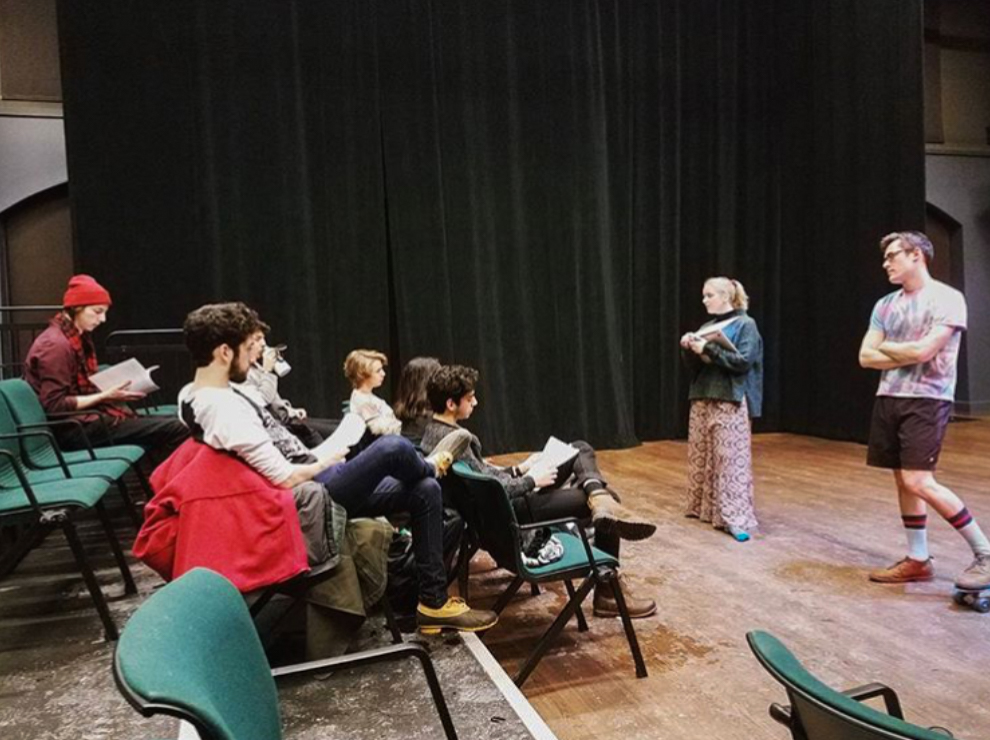
    10:00 p.m.: Hazem and I walk down to the ’92 Theater to meet the writers, directors, and actors we will be working with. We introduce ourselves and our props (I brought a giant duck stuffed animal named Phil, who, less than 24 hours later, was being thrown across the stage) and sit in preparation for the rest of the night.

    10:45 p.m.: After lengthy introductions to what will take place, we sit down with the writers, and through a lottery system, our show is cast. It’s not late, but I already feel tired.

    11:00 p.m.: Luckily, I brought an industrial size jug of coffee with me. I’m not usually one to drink coffee, but these are extenuating circumstances. Other writers sneak a sip or two to fuel their own work.

    11:05 p.m.: First thing’s first, we have to find a comfortable place to write. We settle on the windowsill of the Zelnick Pavilion. I’m wary of the fact that a building entirely made of windows will get colder the later we stay here on this snowy night, but Hazem wisely observes that this is the best back support that we can find, so it’s time to start writing. We set ground rules: as few pop culture references as possible, make sure the jokes are funny even for those who don’t know both of us, and definitely, definitely, definitely not too long.

    11:45 p.m.: We write the first four pages with great speed, fueled by coffee, wine, and mozzarella sticks. The jokes make us laugh, though I’m worried a post-apocalyptic world built around hummus is an alienating concept, and two adult women pretending to be babies to make it on the Broadway stage even more so. We take a break, I go to the bathroom, Hazem goes out for a cigarette, I read and laugh at some other people’s scripts. It’s a good crop!

    12:15 a.m.: The break lasts longer than we think, and the next few pages come out more slowly. Still, miraculously, what we’ve written, and what we keep writing, makes us laugh. I hope it’s not a delusion, but it’s probably too late for that.

    12:45 a.m.: Six pages in now. Despite our resistance against the use of pop culture references (which is proving to be difficult, as Hazem and I have just seen “John Wick, Chapter 2” and can’t stop thinking about it), we decide to include one. The baby on Broadway, who inspires our characters to attempt to become “Broadway Babies” is revealed to actually be Colm Wilkinson, the original Jean Valjean from “Les Misérables.” I do not know why this is funny, but it is. We’re starting to get a little sloppy, and exhaustion makes the script funnier. We would both be up this late on a normal Friday, but with the pressure of writing a short play, the weariness hits us faster.

    1:30 a.m.: After a relatively unproductive half hour, we decide to take another break. Hazem, bless his heart, goes out and gets us Whey [Station]. It tastes better than it ever has. I read some more scripts and watch some funny YouTube videos, and draft a series of possible conclusions in the interim. It’s starting to feel rather late, so, full of cheese and bread and potato, we endeavor to finish the script.

    2:30 a.m.: We have written our ending and spent a good amount of time rereading the script, tweaking lines, making sure everything lands. We giggle into each other’s shoulders and feel good about our work. But we want to make sure. We share it with other writers and see either stunned faces or consistent giggles –exactly what we’re looking for. There’s a lot of pride, but at this point, the exhaustion is real, everything is a little blurry, and coffee is no longer helping.

    2:45 a.m.: We send it in and, struggling to stand up, push our way into the cold night, shuffling toward warm beds and the relief of sleep.

    Less than a day later, after spending the night in this ordeal, Hazem and I sat in an audience and saw our show, along with six others; laughing, groaning, grateful. I will miss these One Day Plays–this amazing, silly, stupid, wonderful tradition. I write this, half-asleep, behind on work, strangely sore, and knowing I’m going to miss this truly, deeply, dearly. Who knows? Maybe next year, you’ll find me in the audience, remembering my time here, and how much the One Day Plays shaped who I am. Or maybe I’ll just look at a jar of hummus and smile.