
Cardinals: Member of NCAA Division IV? It could happen.
There exists currently a divide within the Division III President’s Council regarding the state of athletics. A Feb. 13 New York Times article by Bill Pennington reports that the 420 schools making up NCAA’s Division III are closer than ever to splitting into two groups: one division maintaining more restrictive recruiting policies, the other remaining more permissive on such issues. The repercussions of such a split would affect Wesleyan athletics directly.
While far removed from the multi-million dollar business that is Division I athletics, Division III athletics has grown in both size and importance. The increase in scope has caused many observers to reassess the motivations behind intercollegiate varsity athletics at the Division III level.
To understand why the presidents of these schools are at odds over the direction of athletics, one must first understand the many different types of schools included in Division III. In his article, Pennington cites fellow NESCAC (New England Small College Athletic Conference) school Colby College and the University of Wisconsin-Stevens Point as prime examples of the great disparity between Division III schools.
Colby has an enrollment of 1,871 and fields 32 varsity teams. Meanwhile, Stevens Point enrolls 8,800 students and runs just 16 varsity teams. These student-to-team ratios may lead one to believe that Stevens Point is the more successful athletic institution, and in this case that holds true. When you consider a school like Williams College, however, the picture becomes a bit blurrier.
The Director’s Cup is a season- long competition in which schools earn points for achievement in individual sports and for success in a range of sports. The National Association of Collegiate Directors of Athletics awards the cup at the end of each academic year. Williams won last year’s Director’s Cup, its tenth, despite supporting 32 teams on an enrollment of only 1,965. Meanwhile, Washington Universty in St. Louis—which finished seventh—fielded only 13 teams despite having 6,601 students. While Williams and Washington are both well-endowed private institutions, the top 10 also included public schools SUNY Cortland (five) and New Jersey City University (two).
The intrusion of athletics onto the academic lives of Division III student-athletes remains a contentious subject. Athletes at Wesleyan may know from experience that some professors are less-than-accommodating when it comes to scheduling conflicts. The question of how much athletics affect student-athletes’ academic performance remains an important issue that must be addressed.
In particular, participation in post-season tournaments and extra time away from the classroom has on student-athletes are often cited as factors that affect student-athletes’ academic performance. The NESCAC remains one of the more restrictive conferences within the division. NESCAC regulations still prevent the conference’s football programs from entering post-season play. Founded in 1955, the NESCAC has only been a “playing-conference” with post-season conference tournaments since 1999.
Pennington’s article also suggests other issues major points of contention.
The rabid competition between admissions offices, particularly at the more elite schools, inspires much debate.
“My coaches have already told me, ‘Forget it, it would be such a negative to be in a sub-division,’” said Middlebury College President Ronald D. Liebowitz in Pennington’s article. “Personally, I doubt students would stop choosing Williams, Amherst or Middlebury because we’re in a Division IV. But I know others feel differently,”
The above quote leads me to believe that perhaps college presidents are looking at the bottom line as the major factor in making this decision. While I am disheartened that the wishes of the student-athletes are absent from the discussion, with money taking precedent, I suppose that is not an overly surprising revelation.
Pennington also notes that a conflict similar to a social class conflict has developed among the Division III schools. This, again, is not surprising. The geographic makeup of the division is centered clearly on the eastern half of the country, and the northeast in particular. Further, the northeast region is home to some of the nation’s finest schools. These schools, including—perhaps especially—the NESCAC schools, carry with them an off-putting air of prestige.t
Schools in other regions of the country, where conferences are more widely spread geographically, academically, and financially, would face an incredibly uncertain future in the event of a split. Meanwhile, the northeast schools can rest assured, at least relatively so, that they will stick together.
Thus, we must ask again, what does this all mean? While Franklin and Marshal College President John Fry, who also serves as chairman of the Division III President’s Council, argues in Pennington’s article that the status quo cannot remain, I remain unconvinced.
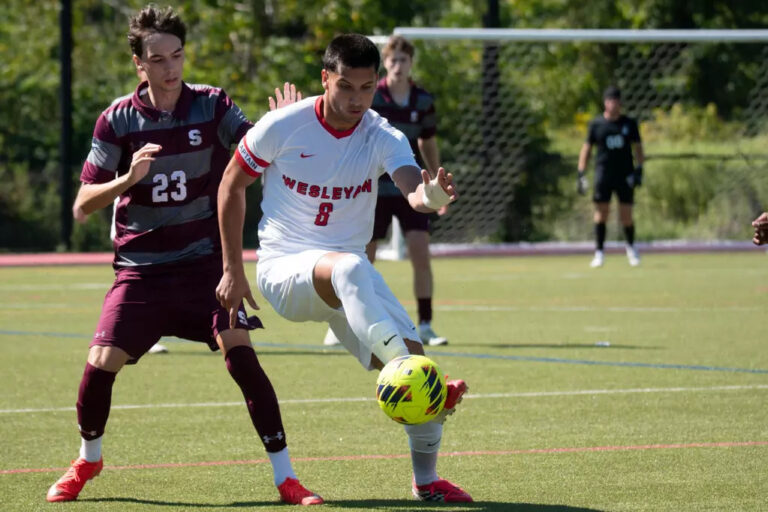
As a Wesleyan student-athlete, I believe my athletic quests at Wesleyan are just as important as my academic endeavors. Just as I want to take the best classes with the best professors at Wesleyan, I want to face the best competition on the biggest stage in Division III athletics. Preventing the student-athlete from healthily striving to be the best runs contrary to everything an athletic department should promote.
Obviously, there are numerous issues with the current structure and the growth of Division III athletics warrants concern. Pennington’s article highlights these points. At the same time, it leaves me highly skeptical of the presidents’ motivations to complete this split.
I do not know where Wesleyan Director of Athletics John Biddiscombe and outgoing President Doug Bennet stand on the proposed split and general direction of athletics at Wesleyan. Frankly, my concern does not rest in what they currently believe, but instead lies in how Mr. Biddiscombe, President Bennet, and the incoming president go about weighing in on the decision to the national council.
With 27 men’s and women’s varsity programs, this decision will have a direct effect on a large number of Wesleyan students. Thus, I encourage the administration to take the students’ thoughts and concerns into consideration as they move forward. Without an open dialogue, the decision will leave out the opinions of the very students who represent the school every week in locations throughout the country.



Leave a Reply