
FIRE Updates the University’s Grade in Most Recent Report
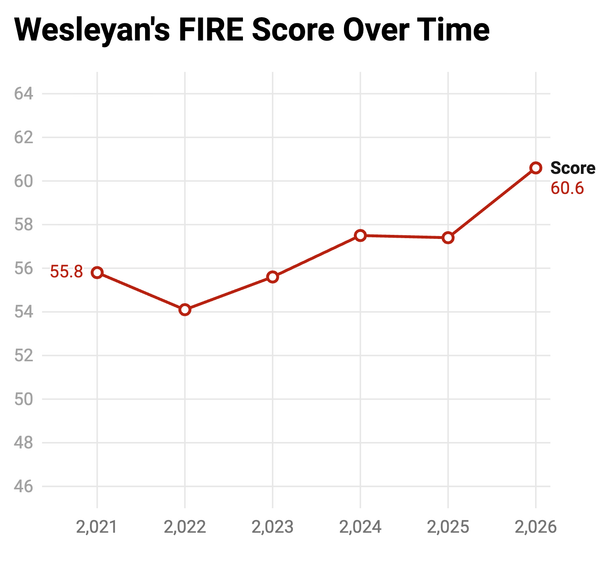
After three consecutive years of an F grade, The Foundation for Individual Rights and Expression (FIRE) increased Wesleyan’s letter grade and moved it up 7 spots in their 2027 College Free Speech Rankings, from 127 to 120 out of the 261 schools evaluated. The school received a score of 60.6/100, up 1.3 points from 2025.
FIRE was founded in 1999 with a mission to be a “defender of fundamental rights.” It specifically focuses on free speech on college campuses. The organization later focused its efforts to include off-campus First Amendment advocacy. FIRE annually evaluates the free speech environment of American universities.
Wesleyan ranks in the top 50 for “Openness,” meaning the ability to have a discussion surrounding controversial topics, and “Administrative Support,” denoting trust in university officials to protect free speech. Wesleyan’s protest and demonstration policies, harassment policies, and advertised commitments to free expression all received a “green” rating from an April 2026 review.
FIRE claims an increase for Wesleyan in “Comfort Expressing Ideas” and “Political Tolerance” from 2025. Wesleyan rose 100 places in the former category, which assesses students’ comfort with expressing ideas.
FIRE’s 2027 report decreased Wesleyan’s rating around “Disruptive Conduct” and “Self-Censorship,” dropping down 122 places for the latter into the bottom 25. Wesleyan’s harassment and posting and distribution policies received a “yellow” rating, meaning FIRE views the policy as too ambiguous, potentially leading to administrative abuse.
Gray West ’28 worked in D.C. for a youth program sponsored by FIRE over the summer.
“I think that the bigger issue [than disruptive conduct] is probably self censorship on campus,” West said. “I think that one aspect that could solve that is seeing what healthy disagreement looks like.”
West cited WESeminars’ “Dialogue Across Difference” event with the Center for Prison Education and the first event in the Democracy 250 series as panels that brought together voices across the political spectrum.
“Bringing more events like that to campus, where students are walking out with more questions and are actively watching individuals disagree…is the continuation of what needs to happen on campus,” West said.
President Michael Roth ’78 is a known advocate for free speech on college campuses, famously writing op-eds on how to bolster the First Amendment at universities and stating his support for FIRE financially.
Despite his public support for FIRE’s lawyers and defense of American free speech, he views the College Free Speech grading as injudicious.
“It’s just totally misguided trying to apply either a color or a letter grade to something as complex as free speech,” Roth said in an interview with The Argus.
In order for a university to increase its grade, FIRE encourages schools to adopt the Chicago Statement, which Roth called “a branding exercise for the University of Chicago.”
“The idea that institutions that adopt these principles get bonus points, or if you give the head of
FIRE an honorary doctorate, you get bonus points,” Roth said. “It’s unworthy of them, because they do such good work.”
The organization reported 0 speech controversies from Wesleyan in 2026. However, Wesleyan faced backlash from right-wing groups after members of Turning Point USA were heckled by students at Usdan University Center in Feburary 2026.
FIRE last responded to a speech controversy at Wesleyan after an The Argus published an anonymous opinion article that criticized the Black Lives Matter movement in September 2015. Roth joined FIRE in calling on the Wesleyan Student Assembly (WSA) to ensure the continuance of The Argus’ funding, revoking a resolution that proposed redistributing The Argus’ $17,000 print budget as a punishment for the op-ed.
In a letter to the WSA from Oct. 2015, FIRE wrote that “such action against [The] Argus, if carried out, constitutes retaliation against the newspaper due to the viewpoint of one of its writers and violates the principles of freedom of expression and Wesleyan’s own commitments to free speech.” In response, a March 2016 WSA resolution established a Media Publications Fund so that The Argus would continue to be funded.
Conversely, in Febuary 2011, Roth received a letter from FIRE after he banned social activity on fraternity property not recognized by Wesleyan. FIRE claimed the policy “blatantly violates Wesleyan’s moral and contractual promises of freedom of assembly in Wesleyan’s Student Handbook.” Wesleyan responded by revising the policy and the affiliation agreement, while still including requirements for fraternities to become coeducational in order to be recognized by Wesleyan.
President Roth expressed his continued support for FIRE, attending a FIRE conference in Philadelphia, Pennsylvania, from Wednesday, Nov. 4th to Friday, Nov. 6th.
“I’ll take our D minus in exchange for having an organization that really does defend free speech,” Roth said.
Finn Feldman can be reached at ffeldman@wesleyan.edu





Leave a Reply