
Students and Faculty Transition to Stellic for Registration Amid Issue-Plagued Rollout
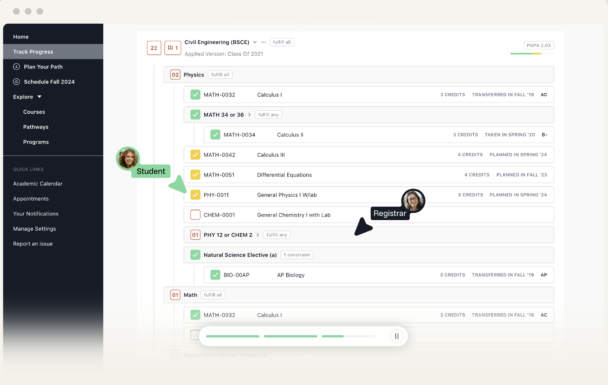
The adoption of Stellic, the new degree-planning platform, was widely panned as confusing by students and faculty ahead of pre-registration for spring semester courses. Stellic has expanded the class and degree information available to students. However, a series of issues plagued the platform’s rollout and site features, prompting the CEO of Stellic, Sabih Bin Wasi, to visit campus on Sunday, Nov. 1 for the Wesleyan Student Assembly’s (WSA) weekly General Assembly in an effort to assuage student concerns.
According to the University, Stellic promised to fill in many gaps in functionality left by its predecessor WesMaps, which was nearing its 30th year of usage.
“The main reason for the switch was to provide better support for pre-major advising by allowing students to build out a four-year plan, clearly visualize major requirements, and eventually replace WesMaps, which is very outdated software,” WSA President Andrea Herrera ’27, who chaired the WSA Academic Affairs Committee last year, said. “The long-term vision remains to make degree planning intuitive and transparent so students can easily map out their four years.”
According to the Office of the Registrar, the shift to Stellic was planned to take place this year as a companion to Workday, the University’s new cloud technology.
“We identified some of the areas in which Workday would be unable to fully align with our defined practices and sought partners that could support the open curriculum and our specific approach to registration, while integrating with Workday,” University Registrar Joshua Berry said. “Stellic was unique in that it had success in supporting universities with similar approaches and had many success stories, particularly as one of the only applications that allowed students to rank courses for pre-registration.”
The move to Stellic was further expedited due to security concerns regarding University cloud software PeopleSoft.
The adoption of Stellic, however, has left students and faculty wondering about how to perform degree planning tasks they once took for granted. Stellic has been plagued by a number of routine issues which have caused students considerable difficulty in signing up and confirming their schedules. A hard enrollment cap for classes, a five-credit limit, and course add requests only going to one co-instructor of a course have all been especially challenging.
These roadblocks have led to frustration among those used to the old platform.
“Clearly, Stellic has to be better,” Professor of Biology and Environmental Studies Frederick Cohan said. “There is no one who’s going to argue that it’s as good as it ought to be.”
First-years took on Stellic before even stepping foot on campus, registering for classes over the summer on the new website.
“I feel like just Stellic by nature is a very confusing website,” Kai Nowak ’30 said. “Everything in weird places and there’s multiple steps for everything. Even when the [Academic Peer Advisors] came to talk to us about it and people had questions, they would like be like, ‘Oh, we don’t totally know what’s gonna happen with that.’”
Students have additionally experienced a multitude of issues signing up for and confirming their class schedules on Stellic.
“The most frustrating part was that philosophy classes weren’t reflected as counting towards the major on Stellic,” Caelan Lee ’29 said.
Although Stellic offers information on class size and attendance, faculty members praised WesMaps for its legibility regarding discerning when classes had empty seats.
“That information has disappeared and I have no idea whether it will be possible to recreate that data in Stellic in an easily accessible format,” Professor of Government Peter Rutland said.
Many errors have been resolved following individual student correspondence with professors or the Office of the Registrar. But many at the University worry that these difficulties may be features of the new platform.
“I’m not sure how many of the problems are just temporary or will be permanent features of the system,” Rutland said.
The Office of the Registrar has been the primary point of contact for registration issues and complaints.
“We’ve heard a range of feedback from students, faculty, staff, and advisors,” Berry said. “In response, we have held sessions in concert with Academic Affairs and the WSA to gather information and any requests for improvements and welcome all types of feedback.”
The Educational Policy Committee additionally sent out a survey for students and faculty to share their feedback.
According to members of the WSA in attendance at the General Assembly, Bin Wasi acknowledged that the implementation of Stellic was “a mess.”
“Sabi [Bin Wasi] wanted all of us and all of the students to know that…even though it has been implemented well at other schools, Wesleyan was an anomaly, and he wants continued input from Wesleyan students and faculty in how to make it better,” WSA Senator Lucas Tikkala-Cutler ’30 said.
The Academic Peer Advisors are tabling in Usdan University Center on Tuesday, Nov. 3 and Friday, Nov. 6 to help with pre-registration on Stellic.
Aarushi Bahadur can be reached at abahadur@wesleyan.edu.
Miles Craven can be reached at mcraven@wesleyan.edu.






Leave a Reply