
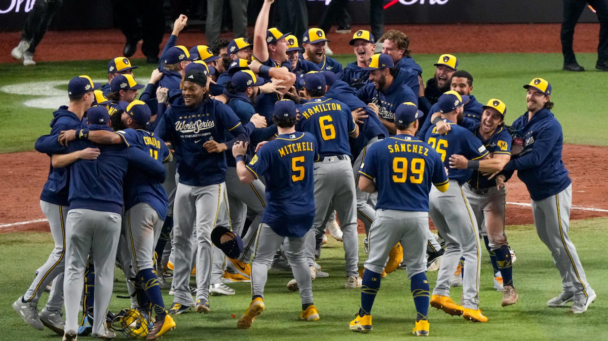
Milwaukee Brewers Claim Their First World Series Championship In Franchise History
On Wednesday, Oct. 28, the Milwaukee Brewers won the World Series in a dominant fashion. This World Series victory marked their first in franchise history. While the Tampa Bay Rays and Milwaukee Brewers are not typically marquee teams, this series presented a rare opportunity for these teams and their players to etch their names in history.
In Game One, the Brewers got off to a hot start in the first inning, with a Christian Yelich RBI triple and William Contreras RBI single giving the team an early 2–0 lead. Brewers ace Jacob Misiorowski was strong in the early innings, giving up only one run and preserving a 2–1 lead for the Brewers. Abner Uribe and Aaron Ashby kept up the good pitching for Milwaukee, as Jackson Chourio added another run with an RBI single. Things got scary for the Brewers in the ninth as the Rays managed to have the bases loaded and one out against closer Trevor Megill. The Rays made it 3–2 with a run after the Brewers double play got overturned. However, that’s all that they would get as Megill would strike out the next batter claiming a Game One victory for the Brew Crew.
Thankfully for the city of Tampa Bay, the Rays had their ace Drew Rasmussen starting in Game Two. Rasmussen has given up just 3 runs across his 18 postseason innings prior to this start.
The Rays offense got off to a hot start, scoring four runs in the first inning with help from an error from Brewer Cooper Pratt and a two-run home run from Liam Hicks. The Brewers punched back quickly though, cutting the Rays’ lead in half in the bottom of the first. Neither offense could generate any more runs until a Jonathan Aranda error in the fourth brought the Brewers another run closer. Then in the sixth, Sal Frelick tied it with a solo home run, and in the seventh, an RBI single from Pratt gave the Brewers a 5–4 lead. The comeback was complete when the Brewers bullpen shut down the Rays offense over six innings of work to give them a 2–0 series lead.
All hope was not lost for the Rays as they headed home for three games at Tropicana Field, where they were 55–26 in the regular season.
The Trop didn’t hamper the Brewers offense as they got the scoring started in the third with two RBI singles. They kept it going, scoring eight runs in two-out situations, giving them a 10–0 lead. The Rays offense couldn’t muster up anything against Robert Gasser and the Brewers. The game ended 10–1, with the Rays down 3–0 in the series and in desperate need of an offensive miracle.
The Rays offense felt the pressure, and started Game Four with two runs through their first four innings. However the Brewers would score two runs of their own. That left the game tied through nine innings. Finally, in the 12th Cooper Pratt broke the 2–2 tie with a solo home run. While many thought that would be the World Series-clinching home run, the Rays offense had some other ideas. The Rays stormed back, claiming a 4–3 victory thanks to a Ben Williamson walk off single.
The Brewers were not rattled by the loss as they had their ace Misiorowski lined up to start again. Meanwhile, the Rays would start their own ace Rasmussen despite short rest. The Brewers got out to an early 1–0 lead with a RBI single from Pratt. The offense added three insurance runs in the fifth and sixth with key hits from David Hamilton and William Contreras. Misiorowski was special, throwing five and two-thirds innings scoreless. The Brewers’ bullpen shut down the Rays offense, closing out the World Series clinching victory.
The Brewers had an 11–2 record in the postseason with a great World Series performance: Aaron Ashby’s 18 scoreless innings in the playoffs, Jackson Churio’s 11 hits in the World Series, and Cooper Pratt’s 6 consecutive hits in the World Series. Arguably, any of these players could have been named World Series MVP; however, William Contreras was named MVP collecting eight hits, driving in four runs and commanding the Brewers pitching staff to give up just 12 runs across the 5 World Series .
In the preseason, many predicted that the Los Angeles Dodgers would win their third straight championship. So this matchup was quite a surprise considering the Brewers beat down of the Dodgers and the unexpected season from the Rays. Regardless of the preseason prediction, and how this series turned out, this series was a reminder of the importance of playing fundamental baseball (running the bases and fielding the baseball well).
The Brewers looked poised to start a dynasty as many of their players are young and under contract for years to come. Additionally, they have one of the top farm systems in baseball which will help supplement their talent. However, the payroll structure of MLB next season remains to be seen.
The expiration of MLB’s Collective Bargaining Agreement (CBA) on December 1st positions this to be one of the most interesting and influential offseasons in MLB history. After the CBA expires, no transactions will be able to occur until the new CBA is ratified. This likely means a lot of free agents will sign between now and December 1st to avoid uncertainty about any of the possible restraints on salary the new CBA might bring.
There are a decent crop of good free agents available, though there is a lack of established names. The biggest and arguably most interesting free agent is two-time Cy Young award winner Tarik Skubal. Outside of Skubal, Michael King, Seiya Suzuki, Randy Arozarena, and National League Championship Series MVP Jake Bauers headline the free agents.
Regardless of how the CBA and offseason plays out, we need not forget the magical run the Milwaukee Brewers took us on this season.
Benjamin Mayer can be reached at bmayer@wesleyan.edu.
Leave a Reply