
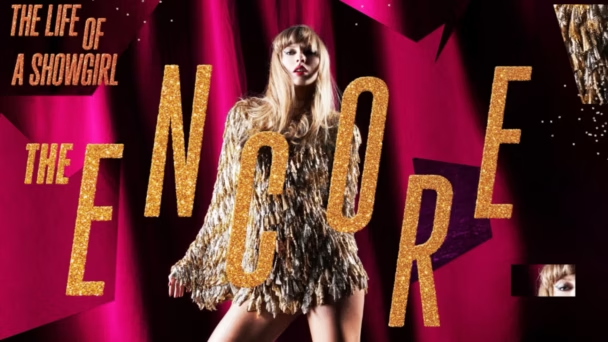
Taylor Swift’s The Encore Is Not “Completely Insufferable”
Like many, I was initially disappointed by The Life of a Showgirl, Taylor Swift’s 12th album. While the original 12 songs have grown on me since last October, The Life of a Showgirl remains one of my least favorite Swift albums.
Nevertheless, I was pleasantly surprised by Swift’s deluxe edition, The Life of a Showgirl: The Encore. Released on Sept. 25, 2026, the deluxe edition contains four new tracks that made up for the letdown I felt after the original 12 songs.
The lead single, “Patient Zero,” masterfully blends the synth-pop style of Swift’s Grammy-winning 10th album, Midnights, with the lyrical critique of a toxic ex found in the scorching song “The Smallest Man Who Ever Lived.” In a unique twist on the classic break-up song, Swift offers kindness and an open ear to her ex’s new partner.
“I’ve gotta be honest I’ve been expecting your call / No it’s not a bad time at all,” Swift sings. She also warns his new partner about his love-bombing and manipulation, citing her authority as “patient zero” of his “toxins.” The tune is catchy and energizing, and it’s incredible how Swift subverts the standard narrative of a slighted woman into one of solidarity and female empowerment.
“Cleveland!” has received the brunt of the criticism of The Encore, but this track is actually my favorite of the four. The upbeat song, which utilizes a rhythm reminiscent of musical theater’s grand swells, is both a romantic tribute to her husband, Kansas City Chiefs quarterback Travis Kelce, and a clap-back at the hate she receives in the media: “And showed me The Heights / So hate all you like / This is the love of my life, hey, hey, hey.”
“The taste of me is acquired / But it’s his favorite dish,” Swift sings, dismissing critiques about her appearance, authenticity, and relationship with Kelce. The melody is fun, bright, and easy to sing along to. Industry critics have cited this song as an example of Swift’s inauthenticity and simple lyricism, making her point clearer than ever: She may not be everyone’s taste, but that is irrelevant to her, since she’s found the person who doesn’t find her “completely insufferable.”
The third track, “Pink Clouding,” is my least favorite of the new songs, but still a solid tune. It is pop centered, with fast, breathy vocals and an especially catchy bridge. Swift utilizes the language of addiction recovery to open up about her guilt over a relationship that didn’t work out, and this concept of a “pink cloud” turns into a metaphor to represent the relationship she leaves.
“I didn’t wanna let you down (pink cloud, pink cloud) / So I left you up there on a pink cloud (pink cloud, pink cloud).”
Swift is mature and insightful as she recounts the damage she did to her former lover.
“And I swear to God, to this day / I wake up scared that I left scars on a good person,” Swifts sings, creating an apologetic, deeply poignant description of a failed relationship that echoes the emotional suffering of album Evermore with the pop peppiness of Lover.
The album concludes with “Babylon,” which I’d argue is the most classic Taylor Swift song we’ve seen from the The Life of a Showgirl era. Reviving the fictional storytelling of the acclaimed pandemic-era sister albums Folklore and Evermore, “Babylon” is a nostalgic yet depressing closer. Narrating the journey of a character who doesn’t appreciate his present situation and chooses to live life in the past, Swift calls out how he uses nostalgia as a form of self-harm. Using the ancient, magnificent city of Babylon as a metaphor for not appreciating what we have until it is “almost gone,” Swift creates a melancholic story that powerfully closes off the album.
The Life of a Showgirl may not be Swift’s most profound or lyrically complex album, but these deluxe tracks have certainly moved it higher in my rankings. Critics and fans alike will continue to debate Swift’s talents and status as a pop icon, but newly married Swift brushes off their hate, satisfied that she found “the love of [her] life.”
Talia Curran can be reached at tcurran@wesleyan.edu.


Leave a Reply