
Collecting China: Wesleyan’s Forgotten History of American Missionaries in China
“Collecting China: Missionary Assemblages of a Distant World, 1844–1911” is a new exhibit that opened in the College of East Asian Studies Gallery at the Mansfield Freeman Center on Wednesday, Sept. 23. The exhibition is a compilation of artifacts that were brought back by American missionaries associated with the University dating back to 1835, just four years after it was founded. This is an extended viewing of the exhibit, which first opened last spring and ran from Tuesday, March 3, 2026 to Monday, Aug. 31, 2026, in the lower-level corridor of Olin Memorial Library with a luncheon reception that took place on Wednesday, April 22.
According to one of the curators, Sida Chu ’26, the exhibition was warmly received by the University’s faculty, staff, and students, as well as members of the wider community. It was therefore extended to be on view for another semester in the College of East Asian Studies Gallery.
“Collecting China” is open to the public Tuesday through Friday, from 12 p.m. to 4 p.m. It was curated by Chu and Nancy Li ’28 as a part of a bigger tutorial in curatorial practice led by Assistant Director of Exhibitions and Assistant Curator of Education Rosemary Lennox and Associate Director and Curator of Visual Arts, Benjamin Chaffee ’00.
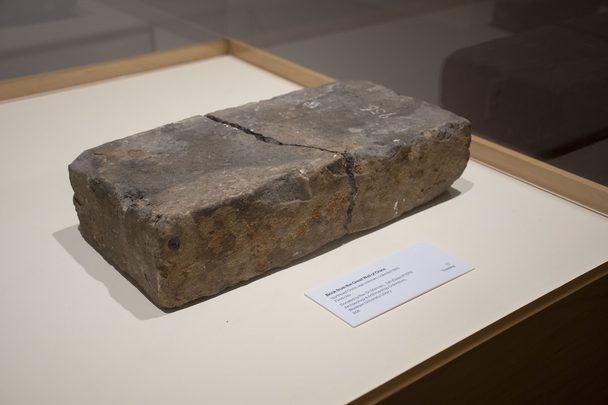
The artifacts in this collection range from a physical stone from the Great Wall of China to a copy of the Gospel of Matthew translated into the Fuzhou vernacular by Rev. Dr. Moses Clark White, class of 1845, a University alum who worked as a missionary in Fujian province.
In highlighting the University’s involvement in the history of this exhibition, co-curator Li said that while they began working on the exhibition wanting to “critique the cultural imperialism embedded in missionary activity, as we continued our research, we also had to ask ourselves: Who are we to represent the voices of those who actually experienced and lived alongside missionary work in China? The history of missionary activity in China is much more complicated than just cultural imperialism.”
“We were eager to critique these missionaries as agents of cultural imperialism, as our Wesleyan liberal arts education taught us to do,” Chu said. “As we read more of their diaries, correspondence, and articles in international publications, it became clear that our alumni sincerely believed in spreading the word of God as a way of saving people they saw as suffering. Some of them, for example, were also fierce defenders of Asian people and of Asian immigration while the Chinese Exclusion Act and the ‘yellow peril’ narrative were raging in the United States.”
As the two explained, these artifacts offer a lens into how missionaries shaped Chinese culture, and they are also connected to the history of our institution.
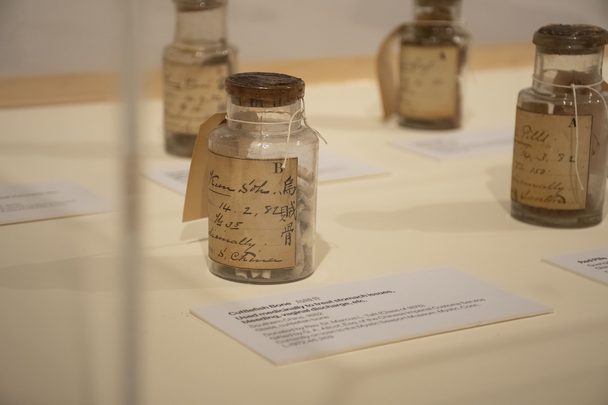
The artifacts were all pulled from different special archives around campus: the Special Collections & Archives in Olin, the Wesleyan University Archaeology and Anthropology Collections (WUAAC) in Exley Science Center, and the College of East Asian Studies archive. Specimen bottles collected by Rev. Dr. Marcus L. Taft, class of 1876, were also pulled for this exhibit, which were previously in the possession of the Mystic Seaport Museum.
Chu said, “Wesleyan’s museum planner at the time, Dicey Taylor, admitted to Mystic that she was ‘ignorant of the content, use, and value’ of the collection, and said the Wesleyan museum had no ‘need for or interest in’ the bottles.”
Both curators concluded with takeaways from working on “Collecting China.”
“I think most viewers, including myself, have a tendency to try to make sense of why certain objects are arranged together, even when that relationship is not immediately explained,” Li said. “What kind of narrative are we creating simply by placing these objects next to one another?”
“Having more material is not always better,” Chu said.
This exhibition is open until Friday, Dec. 4, so be sure to check it out!
Sina Adam can be reached at sadam@wesleyan.edu.


Leave a Reply