
The State of Satire: 20 Years After 30 Rock
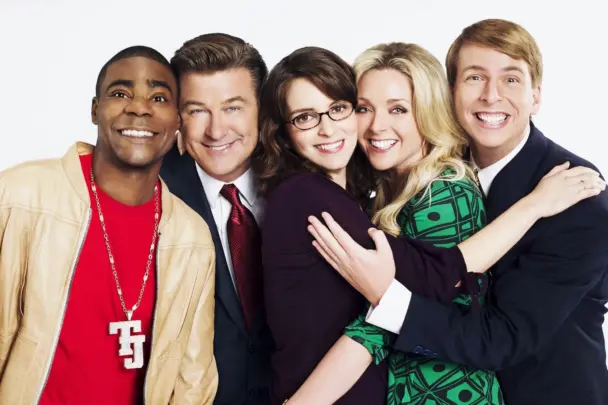
Last Sunday, a sold-out audience filled the 6000-capacity Radio City Music Hall to celebrate the 20th anniversary of “30 Rock,” which premiered on Oct. 11, 2006. In honor of this momentous occasion, writer, producer, and actress Tina Fey was joined by the extended cast (Alec Baldwin, Tracy Morgan, Jane Krazowski, and Jack McBreyer), along with surprising cameos from Lin-Manuel Miranda ’02, Tom Hanks, and Conan O’Brien. Fans of the hit series understand the significance of the occasion. The fast-paced, painfully astute corporate satire has become a sacred text for comedy fans and writers alike. Frequent bingers, like myself, quote the show’s cutting-edge humor on a daily basis, with its broad satirical elements shaped directly into the show’s ethos.
The series follows Liz Lemon, the compellingly nerdy protagonist brilliantly captured by Fey, who is the showrunner of the SNL-esque “TGS with Tracy Jordan” (named The Girlie Show at conception before adding the unpredictable Tracy Jordan, played by Tracy Morgan). Lemon’s daily professional responsibility to maintain composure among her disgruntled writers and ego-driven actors, particularly Lemon’s self-absorbed long-time friend Jenna Maroney (Jane Krazowski) and her unpredictable feuds with Jordan, present distinct challenges in each episode. The mentorship between Liz Lemon and her boss, the determined network executive Jack Donaghy, who epitomizes the neo-liberal capitalist greed of the corporate class, also becomes a meaningful relationship through the show’s seven seasons. Loosely based on Fey’s experience as head writer of “Saturday Night Live” (SNL), “30 Rock” parodies the complex corporate structure of NBC and the stringent obligations of network television. With this premise, “30 Rock” could satirize nearly anything. Take its many paid product integrations, such as in Season 2 when Lemon, after praising Verizon cellphones, turns deadpan to the camera and asks “Can we have our money now?”
As Emily Nussbaum describes in The New Yorker, 30 Rock controlled “a surreal machine capable of commenting on anything, from feminism and prismatic perspectives on race to national politics, reality television, and corporate culture—always from a New Yorker’s P.O.V.” In this way, no object became too grand for ridicule. Unlike other shows set in New York, like “Friends,” “Sex and the City,” and “Seinfeld,” Nussbaum describes how 30 Rock became “obsessive about the actual city, referring to events large and small.” At the beginning of the episode “Somebody to Love,” Lemon references a mysterious maple syrup smell, which actually permeated New York in the late aughts and was first reported by the Gothamist. Another episode, “Subway Hero,” references real-life Subway Samaritan Wesley Autrey, with then-Mayor Michael Bloomberg appearing for a surprise cameo. In the same episode, Lemon suspects her new Middle Eastern neighbor to be a terrorist, and reports him to Homeland Security after seeing a subway advertisement instructing patrons “IF YOU SUSPECT ANYTHING, DO EVERYTHING,” referencing the manufactured xenophobia that became a keystone of the Bush administration’s domestic policy. The political jokes were risky, lampooning the modern state of the GOP and the failures of the War on Terror.
During the first season, Jack Donaghy dated United States Secretary of State Condoleezza Rice, but felt uncomfortable during intimacy, confessing, “I’m all for fantasy role-play, but Abu Ghraib?” In another episode, Donaghy is recruited to be the Homeland Security’s Director for Crisis and Weather Management, a jab at the Bush-era bureaucratic national security structure. In the final season, the 2012 election plays a pivotal plot role, with Donaghy feeling obligated to help the GOP ticket because “if I don’t help Romney, it’s four more years of socialism and corporations not being people and a basketball court at the White House,” in what seems like a reference to the 2010 Citizens United v. FEC. As Sam Adams describes in “Slate,” the show “endures because of the density and smartness of its writing, and a deep-set commitment to absurdity that stands outside of time.” Yet the most memorable jokes are always the ones that hit closest to home. When Liz Lemon opens up to her judgmental boss about her new boyfriend, she confesses, “he has a degree in ethnomusicology from Wesleyan, so he’s a receptionist in a dental office.”
I would be remiss not to mention the extreme controversy that has haunted “30 Rock” since its premiere. In 2020, co-creators Robert Carlock and Tina Fey publicly requested the removal of four episodes from the series due to the use of race-changing makeup. This racist imagery, which signifies an offensive attempt at provocative humor, is a clear miss in the show’s long line of complex social commentary.
However, “30 Rock” was not strikingly original in its contrarian conception. Other shows, like “Arrested Development,” which premiered in 2003, became a critically acclaimed satirical comedy. In a similar framework to “30 Rock,” Peter Queck and Bhaskar Sunkara describe how the show was “conceived in the aftermath of the Enron scandal and during the early years of the Bush administration” with overarching themes of criticism of the war on terror, the invasion of Iraq, and torture. The story follows the Bluth family, who epitomize the out-of-touch, corrupt elites, as they fall victim to a corporate scandal and lose their coveted wealth. The patriarch, George Bluth Sr. (Jeffrey Tambor), is imprisoned as the oldest son, Michael Bluth (Jason Bateman), attempts to recoup his family’s plummeting wealth. Asawin Suebsaeng describes in “Mother Jones” that “Arrested Development” “delivered what was arguably the sharpest satire of the Bush era and the Iraq War that has been broadcast on television.”
Yet the satirical political humor of these distinctive comedies feels obsolete in this era of media. Our collective malaise after surviving a global pandemic, enduring two terms of Donald Trump’s neo-fascist regime, and experiencing the threat of a massive AI proliferation has seemingly restricted our ability to digest political humor. In an interview with The Atlantic, Baldwin, who received an Emmy in 2017 for his portrayal of Trump on SNL, confessed that political satirical humor has become outdated. “None of it’s funny,” said Baldwin. “I don’t find it funny anymore…. There’s nothing left to say about Trump.” In this article, Will Gottsegen argues that many of the comedians who prospered during Trump’s first term are “sick of the shtick—and they’re skeptical about the function of political comedy in a world that’s arguably beyond parody.”
The witty political humor that shaped the onset of Trump’s ascent has waned significantly, for the extravagances that once defined its ethos have become too accurate to satirize. Watching Julia Louis-Dreyfus’s fierce portrayal of Vice President Selina Meyers in the 2012 hit show “Veep” has aged more like historical foreshadowing than a humorous parody. Even when we attempt to satirize the current moment, we can’t escape the existential dread that lingers. Take Jane Wickline’s recent portrayal of Anthropic CEO Dario Amodei during the Season 52 premiere of SNL: while Wickline masterfully leaned into the depiction of Amodei, I was unable to shake the eerie undertones of her portrayal. The line “AI is the devil and I its maker!” got laughs from the audience, and yet it read more like an affirmative mantra than a satirical portrayal of a leader. Because of this, satire in the modern age is a feat to accomplish, and the audience has seemingly lost their appetite for political comedy.
The complex demands of the media during Trump’s second administration have also played a vital role in this shift. With the cancellation of Stephen Colbert’s late-night show, the influence of political comedy is waning. Brendan Carr has used his role on the Federal Communications Commission to restrict broadcast TV as we know it, threatening the future of “Jimmy Kimmel Live!” scrutinizing NBC’s DEI policies, and investigating “The View” for platforming Texas Democratic Senate Candidate James Talarico. Additionally, our modern oligarchic media landscape has seemingly restricted freedom of speech. With the Ellison family’s growing media influence after the completed Paramount/Warner Bros. merger and Amazon’s growing prospects as a production studio, billionaires are reshaping the media landscape as we know it. In 2026, Amazon spent $75 million to acquire the documentary “Melania,” a poorly reviewed, propagandized portrayal of our First Lady (the First Lady and her production team received a reported $28 million).
This is exactly what neo-fascist playbooks seek to accomplish: restricting free speech and paralyzing citizens to a point of inaction. Thus, satire becomes a vital lifeline for political dissemination, and we must craft it carefully to combat growing authoritarian control. It is when we are subordinated to inaction that satire is dead.
Carter Appleyard can be reached at cappleyard@wesleyan.edu.




Leave a Reply