
SPARC: A Renewed Focus on Collaboration in the Performing Arts
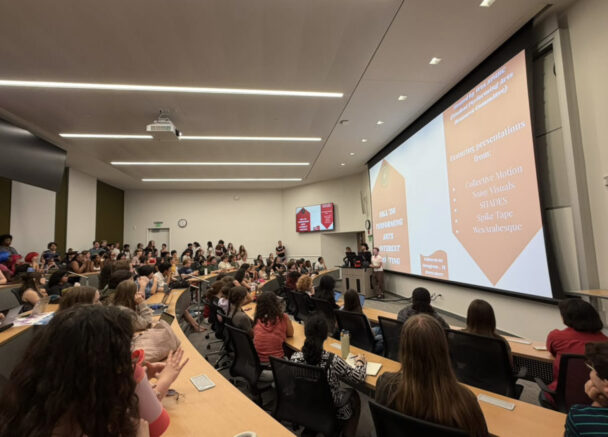
On the first day of classes, there was an interest meeting for theater enthusiasts, producers, dancers, and technical managers held at the Frank Center for Public Affairs. Excitement buzzed as the room quickly filled. By the time everyone had arrived, the space was overflowing.
This enthusiasm was due to the Student Performing Arts Resources Committee (SPARC), beginning its first meeting. Working closely with performance arts groups such as Spike Tape, SHADES, Noisy Visuals, Collective Motion, and Wes Arabesque, the interdisciplinary committee aims to serve as an overarching group, supporting clubs and promoting equitable scheduling for events in various locations across campus, including the Patricelli ’92 Theater, Russell House, and WestCo Cafe.
“[We] are not producing any shows, whether that be a play, a musical revue, or a dance showcase,” SPARC wrote on their Fall 2026 Community Feedback form. “Our programming is limited to community-focused panels, talkbacks, and mixers.”
The introductory meeting was also a way for various performing arts groups on campus to introduce themselves to students. SPARC was developed with the goal of managing the schedule of the ’92 Theater and establishing common spaces for theater groups to interact. Rather than focusing on any individual group, SPARC trains and supports the dance and theater communities in their entirety, prompted by recent restructuring of the theater community over the last several years.
Every semester, the University’s many performing arts groups stage various student-run productions. In the Fall semester alone, Spike Tape is staging “The Storm Play,” “Clue,” “The Accidental Death of an Anarchist,” “House of Stars,” “Bug,” and “Cabaret.” These performances provide opportunities for student involvement in the arts.
SPARC provides knowledge and support to help these different groups interact.
“I feel like every conversation we have with multiple groups present uncovers a whole range of possibilities for new kinds of productions, through club crossovers I never even imagined were possible,” SPARC Co-Chair Simon Holland ’28 said. “If these new opportunities are supported by a more connected community as a result of SPARC, I will be a happy man.”
From Tuesday, Sept. 15 to Thursday, Sept. 17, and Monday, Sept. 28 to Tuesday, Sept. 29, SPARC collaborated with Spike Tape to provide tech training, highlighting sound, light, stage management, and projection.
“Check out these amazing trainings to learn lighting, sound, stage management, operating lights, and sound boards; join us!!” SPARC posted on Instagram. “These trainings are for anyone and everyone!”
Through these sessions, those interested are able to learn from one another, allowing more experienced students to share their knowledge with students who are new to theater tech.
“I greatly appreciate SPARC’s commitment to evenly distributing theater resources,” SHADES Marketing Coordinator Osato Oronsaye ’29 said. “They seem to be pretty levelheaded about who deserves what, and where, and when. Whenever things go wrong, or things don’t go as planned, I still appreciate SPARC’s willingness to talk to us and figure out solutions for the future, as opposed to just shutting us down and shutting us out.”
SPARC wants to continue growing their reach throughout the semester.
“Having everyone on campus know the resources available to them, whether they be participant or club leader, who to talk to to get those resources, and how to get those resources in the easiest way possible is always our goal, and I hope to begin to see that frankly by the end of this year,” Holland said.
Regarding long-term goals, the SPARC managers highlighted their desire to grow the group, and proposed positions available to students.
“Promoting equity across performing arts groups on campus will always be our goal, and we ultimately want to make sure we provide fellow participants with the resources they need,” Holland said. Both Holland and fellow Co-Chair Kekoa Dowsett ’28 affirmed the importance of prioritizing good connections, with the goal of being supportive for the community.
Beyond just contributing to a performance, there are even more opportunities for involvement in the arts at the University, and a plethora of students clamoring to seize these opportunities.
Elizabeth Cameron can be reached at ecameron@wesleyan.edu.


Leave a Reply