
Letters on Pragmatic Hope: Keep Hoping, and Vote!
This piece is part of Letters on Pragmatic Hope, an essay series in which Wesleyan professors and administrators reflect on a daunting question: How can students act with purpose and efficacy amid an increasingly authoritarian environment? The series aims to gather responses from a diverse group of Wesleyan faculty, offering a vision for how students can turn despair into pragmatism and action.
To the question “What can Wesleyan students, many of whom feel powerless, do to push back against the tide of authoritarianism? How can they create good for their communities, their cities, and even their nation?” my answer is:
You still have the vote. We are hearing the message that democracy is not just about voting, and that is of course true. Nevertheless, democracy is very much about voting, first and foremost. Having spent my life studying the literature of an authoritarian society, a category to which the Russian Empire, the Soviet Union, and post-Soviet Russia belong, I feel that Wesleyan students who are U.S. citizens should not lose sight of the importance of participating in elections, both local and national.
This is a privilege that few people in world history have been accorded. The national Congressional election that is coming on Tuesday, November 3, 2026, is a highly consequential one. The events of the last two years—the destruction of foreign aid programs resulting in hundreds of thousands of deaths, the demolition of the Voting Rights Act, the degradation of the national agencies that defend our health and our national security, the attacks on science and free speech, the softening of support for President Volodymyr Zelensky in Ukraine’s struggle against Russian aggression, and the disastrous war with Iran—would not have been possible without the acquiescence of the Republican Congress. It may seem like a slim thread to hang our hopes on, but retaking at least one of the three branches of government from a Republican Party that seems to have decided that authoritarianism is okay is the only thread offered to us at the moment.
Last year, one of my students mentioned to me that she could barely remember a time when the current president wasn’t either in power or dominating the public arena. I understand that holding onto hope when this has been your life’s experience is difficult. I have to struggle to imagine how that feels, since my political memories extend back to Eisenhower. I lived through the assassinations of John F. Kennedy, Martin Luther King Jr., and Robert F. Kennedy, as well as many of the moments of progress and retrogression our country has experienced, so perhaps it’s a little easier for me to hold onto hope, since I have seen that progress in social justice can be made despite setbacks.
Nevertheless, I am personally insulted by, and ashamed of how, with the election of 2024, we have turned our backs on the contributions that immigrants have long made to this country. My father was born in 1892 in what was then the Austro-Hungarian Empire, which subjugated minority peoples like his own group, the Slovaks. He had two years of formal education. He came to this country in 1910 with $20 in his pocket and went to work in a tannery in Milwaukee, Wisconsin. A tannery is a factory where animal hides are turned into leather. My father described vomiting every morning from the smell. But no one was waiting at the door to arrest all the young Slovak, Polish, and Czech men after their day of backbreaking, disgusting work. My father lived to see all four of his children graduate from college, two with advanced degrees, thanks to his own hard work as well as the strong social safety net and congressionally mandated support for education.
Perhaps these essays are not meant to be exercises in partisan politics, but forgive me for stating the obvious: throughout my life I have observed that gains for the least privileged groups in this country, especially since 1981, have come through the efforts of elected officials of the Democratic Party. I firmly reject “bothsidesism.” It does make a difference whom you vote for.
Does this mean that, should the Democratic Party regain control of Congress, everything will be perfect? No, of course not. But we must each take responsibility for doing whatever we can to move things in a better direction, based on our observations of what candidates for public office have done in the past and are likely to do in the future.
The Czech playwright and activist Václav Havel, who later became the president of Czechoslovakia, was imprisoned under the Communist government many times, including from May 1979 to February 1983. During this longest imprisonment he wrote letters to his wife that were later published as “Letters to Olga.” In one of these letters he writes, “When I speak of faith and hope, I’m not thinking of optimism in the conventional sense, by which we usually mean the belief that ‘everything will turn out well.’ I don’t share such a belief and consider it—when expressed in that general way—a dangerous illusion. I don’t know how ‘everything’ will turn out and therefore I have to admit the possibility that everything—or at least most things—will turn out badly. Faith, however, does not depend on prognoses about possible outcome. . . It is not a state of enchantment, induced by the narcotic of an evocative object, but rather an intrinsic ‘state of the spirit,’ a profound ‘existential dimension,’ an inner direction that you either have or don’t have, and which—if you have it—raises your entire existence onto a kind of higher level of Being.” [Václav Havel, Letters to Olga: June 1979-September 1982, trans. Paul Wilson (Henry Holt, 1983), 150-51.] My father had that kind of faith when he boarded a ship from Bremen, Germany, in 1910 at the age of 18, and I consider his story to be a powerful imperative and reminder not to sink into cynicism and despair.
The vast majority of the writers in Russia and Eastern Europe whose works I’ve spent my life studying and teaching did not have the opportunity to vote. Nevertheless, they did have the kind of faith and hope that Havel speaks of here, and it went into their art, sometimes at the cost of their freedom or even their lives. You’re not being asked to risk your lives—yet—but it would be tragic to let go of hope at this critical moment. So please vote!
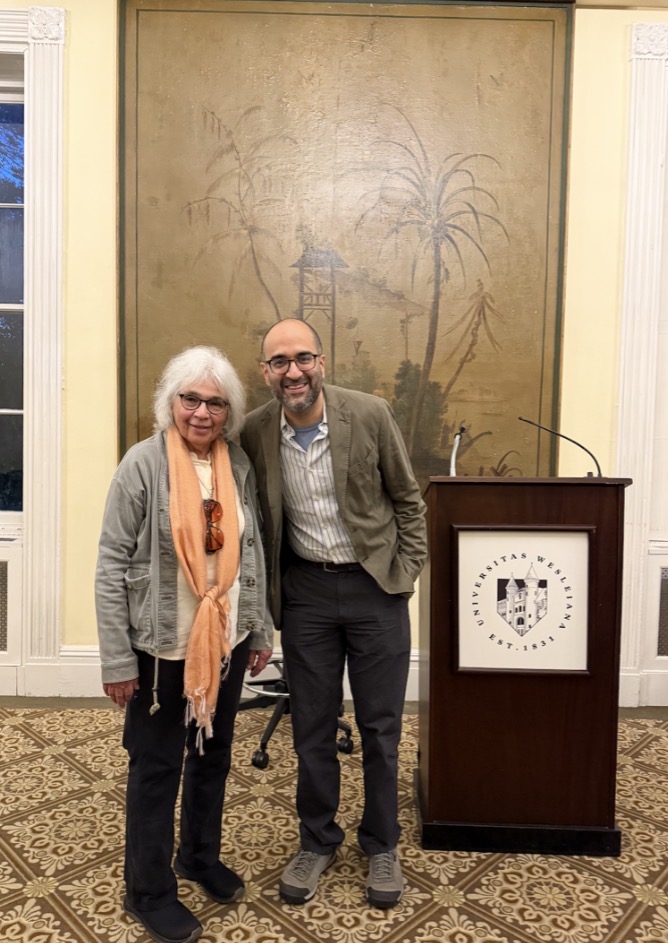
Susanne Fusso is a Professor of Russian, East European, and Eurasian Studies and the Marcus L. Taft Professor of Modern Languages. She can be reached at sfusso@wesleyan.edu.
Leave a Reply