
Player of the Week Yousuf Saeed ’27 Discusses Mental Strength and Being “Hungrier” for a Win
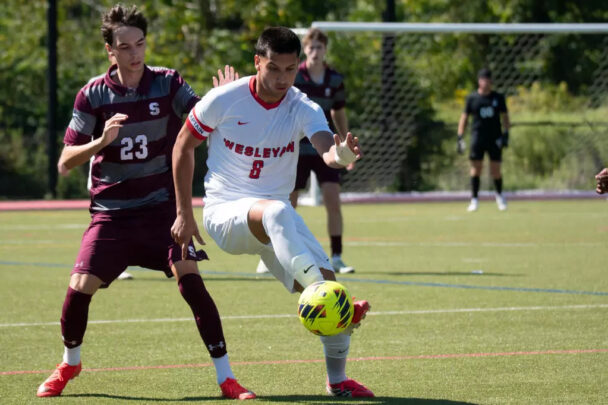
Yousuf Saeed ’27 is a neuroscience major from Houston, Texas, and captain of the Wesleyan men’s soccer team. The midfielder has started the season hot, currently ranking first in the NESCAC for shots on goal, second in total shots, second in average points per game, and second in goals.
Saeed has delivered a goal in four out of six games thus far, notably scoring a goal in each of the first three matches of the season. The highlight of Saeed’s three-game run came during the matchup against #1 defending champion Tufts University. Tufts had been on a 23-game win streak before Wesleyan shutout the Jumbos 2–0, with Saeed’s game-winning strike coming in the 52nd minute. Saaed’s incredible three-game stretch won him both NCAA DIII Player of the Week and NESCAC Player of the Week.
As the team’s leading scorer, Saaed has proven himself to be both a vital leader and formidable opponent on the field. The Argus sat down with Saeed to discuss his soccer backstory, the win against Tufts, recent awards, and his outlook on the rest of the season.
The Argus: When did you start playing soccer?
Yousuf Saeed: I started playing in 2010, after the World Cup in South Africa. I was five years old at the time and remember thinking to myself, ‘I kind of like soccer.’ So I told my dad, and he got me set up with a small youth team that was around five minutes from my house. I’ve been playing ever since then.
A: Did you have any soccer or athletic players as inspirations growing up?
YS: When I was really young, I used to love Lionel Messi. My family supports Mexico, so Giovanni dos Santos was one of my inspirations back in the day, though he might not be as well known to the world. Also, Iker Casillas was a goalkeeper that I liked a lot.
A: Do you have any pregame superstitions or traditions?
YS: I used to have more superstitions back in the day, but I kind of let go of that to the best of my ability. In terms of a routine, I tape my wrist before every game, even though my wrist isn’t injured. I do it because it puts me in the right state of mind before I go out to play. It’s my mental way of saying: “It’s game time.”
A: When did you start considering playing college soccer, and what led to your decision to play at Wesleyan?
YS: I became interested in playing college soccer during my sophomore year of high school. By my junior year, I was emailing most colleges. My dad has been amazing. He’s helped me the most in terms of my recruiting process. He was doing a lot of research with me, and he was the one who found the NESCAC up here in the Northeast. I’m from Houston, so the Northeast schools aren’t as known to us. We emailed all the NESCAC schools and Wesleyan was the one that stood out to me the most, especially after visiting and talking to the coaches over the phone. With time, it just kind of became more clear that this was the place I wanted to be.
A: What’s the most rewarding and challenging part of being a student athlete here at Wesleyan?
YS: I would say it’s hard to put an equal amount of mental focus both into academics and athletics. Wesleyan’s a school that prides itself in being committed to both, but devoting 100% of yourself to both is tough mentally and physically. But, it’s a blessing, and I wouldn’t trade it for the world. I think that the most challenging thing is when game day is tomorrow and you have a homework assignment due tonight, you’re forced to ask yourself: What do I pay more attention to?
A: Coming into this season as a senior and a captain, what were the team goals?
YS: As a team, we try our best to harp on our next game being the goal. Coming into the season, it would be impossible not to think about an NCAA championship or NESCAC championship; those are kind of sitting in the back of our minds as big picture goals we want to strive for. Our first game was against Springfield, so as a team, our focus was mostly on the first game, then it was on Tufts, and then it was on Swarthmore. Just trying to take each game at a time is our approach to the season.
A: You started the season with three goals in three straight games. What do you think enabled you to get off to such a hot start this season?
YS: To be honest, I don’t know. It was just one of those things where you go into the game with an open mind. Hoping for good stats, hoping for a goal, hoping for an assist. I thank God I was in the right place at the right time and that I was able to hit the ball correctly. At the end of the day, having confidence in yourself—being mentally strong—makes all the difference. Coming right back down if you do score and coming right back down if you don’t is what matters: balancing your emotions. In terms of what enabled me, honestly, I couldn’t tell you. I just felt good those days and even better when I scored.
A: In your second game of the season you played national No. 1 Tufts who were on a 23-game unbeaten streak. What was the game plan and the team mentality going into that game?
YS: The game plan was to treat them as any other opponent, just with an extra competitive edge. Since they were number one, they were unbeaten, we had an even bigger point to prove. Games in this conference come down to hunger, to willpower, to who wants it more. On that day, we wanted it way more. We were hungrier, more excited, and came out more ferocious. They were on their back foot from minute one. I’m glad that hard work ended up paying off in that game.
A: Was there any special message or change of game plan going into the second half of the game since it was 0–0?
YS: We were still happy with our first half even though the game was scoreless. We had the ball for the majority of the time. We were doing the right things with the ball. We were shutting down their offensive threats. The message was: Let’s be patient, and the goal will come.
A: In the second half you scored the game-winner against Tufts. Take me through that goal. How did it feel to ultimately come out with the victory?
YS: The ball was played in the air to Ford Cash ’29. He brought it down, kind of bobbled a little bit off of his heel, and I found it in front of me. I thought: “Let me drive with this and see where it takes me.” I took it down 10 or 15 yards, then the only thing in front of me was the goal. So I took one more touch and just tried my best to find the back of the goal. Thank God it found the back of the goal. It felt so good. It was a huge adrenaline rush for the team. Obviously it feels incredible to personally do something like that, but I was happy that as a team we were able to get one up on a squad like Tufts.
A: You were named both NCAA DIII Player of the Week and NESCAC Player of the Week for your performances against Springfield, Tufts and Skidmore. What was your reaction to receiving these honors?
YS: I didn’t even know that they did the NCAA Player of the Week awards, so when I saw that, I was honestly pretty shocked. It’s just very humbling. I’m so grateful that the hard work that I put in paid off. The hard work that our team put in paid off. I can’t attribute that kind of award just to myself, I have to attribute it to my teammates for putting in the work. They didn’t get appreciated enough while working their tails off day in and day out. I’m just very thankful to God for the opportunity to receive something like that. But it’s very early in the season, so I’m trying to move forward from that as soon as I can. It was a good achievement, but I’m leaving that in the past now.
A: More recently, you had a tie at Brandeis where some people thought the officiating wasn’t entirely impartial. Then this past week, you had a tough 0–1 loss at Bowdoin. What, if anything, did you learn in these games that you’re hoping to bring to the next ones?
YS: A game like Brandeis 0–0 away on the road is frustrating to tie. It’s frustrating to tie regardless. Was there maybe some bias from the ref? I don’t know. I think it’s easy to point fingers at external factors like that. Do I think that there were some calls that could have gone in our favor that didn’t? Yes, 100%. But do I think that’s the reason we tied? No. We had the opportunities to put the game away, we just didn’t take advantage of them. That’s why we tied 0–0.
Against Bowdoin, we didn’t play to the best of our ability as a team or as individuals. To be the kind of team that we want to be, to achieve the goals that we want to achieve, we need to be better at capitalizing on the chances we get, even if they’re few. Also, we need to make sure that we stay alert defensively when the other team gets a chance to score, like Bowdoin did.
We had two very frustrating results. I think the tie against Brandeis is a testament to the fact that we don’t settle for one point, we want three. But Bowdoin was a good learning experience. We thought we were all that, so it’s always good to get humbled by a tough team like Bowdoin. It puts you in a more hungry mindset going forward.
A: Looking ahead, you’ve got a lot of season left. Is there anything in particular that you are looking forward to?
YS: The Little Three games are great. The crowd’s always buzzing and the environment’s fun. You know you can’t ignore those rivalry games against Williams and Amherst. For me, the next game is always the most exciting one, especially because we focus on the things that we could’ve done better in the previous game. Being able to have an opportunity to implement that stuff in the next game is always exciting. But those big name games are always ones that are sitting in the back of your head.
A: Looking back, if you could give your first-year self a piece of advice about succeeding as a student athlete at Wes, what would it be?
YS: I’d probably tell myself to lock in a little more academically. My first-year grades weren’t horrible, but I think there’s definitely been an upward trend in my grades since then. I would also tell myself to relax, take each game as it comes, and just be grateful for the opportunity to be out there.
This interview has been edited for length and clarity.
Benjamin Mayer can be reached at bmayer@wesleyan.edu.
Gabe Fredette can be reached at gfredette@wesleyan.edu.



Leave a Reply