
Music and the Cultural Politics of Change
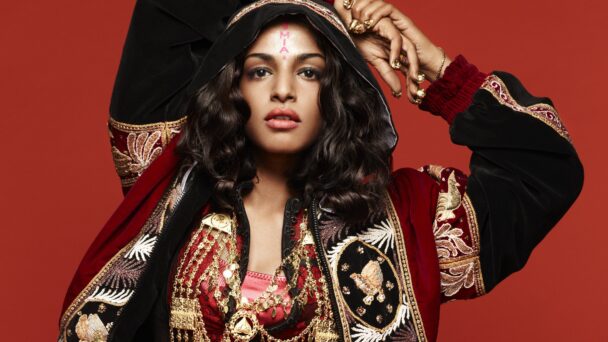
M.I.A. is no stranger to controversy. The Sri Lankan-born rapper, whose professional name is an initialism of Missing in Action, positions her artistry in conversation with international human rights and wartime politics. For M.I.A., a multidisciplinary artist shaped by displacement as a youth during the Sri Lankan Civil War, the personal and the political have always been inseparable, and this tension defines the ethos of her early work.
Throughout M.I.A.’s first album, “Arular” (2005), named after her father, who was a major figure in the Tamil separatist movement, the rapper challenged the Western rhetorical division of good and evil during the early years of the War on Terror. With lyrics like “Growin’ up, brewin’ up / Guerrilla gettin’ trained up / Look out, look out / From over the rooftop,” from “Fire, Fire,” or “It’s all this for revolution / Cuttin’ up the coupon, saving for a telephone / Can I call home? Please, can I go home?” from “Amazon,” the rapper explores the personal consequences of imperialism, political violence, and displacement. In one of the album’s lead singles, “Sunshowers,” M.I.A. tells the story of a man targeted and killed for associating with Muslims: “Semi-9 and snipered ’im / On that wall they posted ’im / They cornered ’im / And then just murdered ’im.” Despite MTV banning the video for the lyrics “You wanna go? You wanna winna war? / Like PLO, I don’t surrendo’,” M.I.A. refused to self-censor, and her sophomore album, “Kala” (2007), strengthened her lyrical ingenuity and commitment to international advocacy.
In her most commercially successful song, “Paper Planes,” inspired by her difficulties obtaining an American visa, the artist adopts the perspective of an immigrant who resorts to criminality and violence in order to emphasize the barriers immigrants face in seeking social mobility while satirizing Western fears and stereotypes surrounding immigration. The song’s chorus features controversial gunshot sounds, inspired by M.I.A.’s experience as an immigrant and refugee, as “gun sounds are a part of our culture as an everyday thing. If you’ve been exposed to gunfights and violence and bombs and war then I can use those sounds backing my thoughts.” While Paper Planes peaked at #4 on the Billboard Hot 100, M.I.A. confesses that her success “happened because it was the Bush era. Someone needed to come up and say all this kind of crazy s–t…What I had was my ideas. I had freedom of thought and freedom of speech, and I wanted to exercise it in a land that promotes that.”
Yet recent comments from the visionary rapper, who on May 2, 2026 proclaimed, “I’ve been canceled for many reasons. I never thought I would be canceled for being a brown Republican voter,” reflect a radical departure from the anti-war, anti-imperialist sentiment of her early work. With her public distrust in the COVID-19 vaccine and support of conspiracy theorist Alex Jones, M.I.A. has since embraced MAGA politics, publicly endorsing Donald Trump in 2024 and predicting on X that “Trump is going to ride America through the most challenging 4 years coming, pulling out weed, and RFK will inherit America when God is ready to replant and rebuild it righteously.” Her latest non-musical venture, Ohmni, is a fashion line that claims to protect the body from electromagnetic frequencies, 5G, and digital surveillance, suggesting that her skepticism toward established institutions has extended beyond politics into technology and science. “I feel like I’ve done 10 years on the left being canceled by the right, and now I’ve done enough years where people think I’m right and I’ve been canceled by left,” M.I.A. confessed.
Interestingly, her political trajectory isn’t an isolated case; it highlights the growing number of musical artists involved in conservative politics and conspiracy theories. Rapper and producer Ye (previously known as Kanye West) is known for his distinctive sound, which helped transition mainstream hip-hop in the early 2000s away from its dominant gangster rap style toward a more relatable perspective on class, economic struggle, and everyday life. Throughout his early discography, Ye investigated themes of systemic racism, political power, and the prison-industrial complex. In songs like “New Slaves” (“Meanwhile the DEA / Teamed up with the CCA”) and “Crack Music” (“How we stop the Black Panthers? / Ronald Reagan cooked up an answer”; “Who gave Saddam anthrax? / George Bush got the answers”), Ye directly critiqued the GOP’s policies under the presidencies of Nixon, Reagan, and Bush, even going as far as to publicly claim “George Bush doesn’t care about Black people” after the devastation of Hurricane Katrina. However, his outspoken support of Trump during his first term and fictitious comments regarding the validity of slavery (“When you hear about slavery for 400 years. For 400 years?! That sounds like a choice.”) present a stark contrast to his earlier music, which continuously probes themes of institutional racism. Of course, Ye’s antisemitic comments constitute an especially egregious case of rhetoric that should not be conflated with political provocation. His threat to go “death con 3 On JEWISH PEOPLE” or his claim that he saw “good things about Hitler”, therefore, will not be addressed in this article.
Another singer, Nicki Minaj, prioritized her Trinidadian immigrant identity throughout her early discography, noting in “Trini dem Girls” that “them island girls is the baddest” and demanding “Now, where my West Indies? / Where the fuck my curry chicken and my rice and peas?” in “Beam Me Up Scotty.” But the singer, who proclaimed shortly after the 2016 election on the song “Black Barbies” that “Trump want me go home…Now I’m prayin’ all my foreigns don’t get deported,” has recently aligned with the MAGA movement during Trump’s second term, confessing that she was “probably the president’s No.1 fan.” She has also criticized queer reporter Don Lemon, or in her words “DON ‘C—K SUCKIN’ LEMON,” after he reported on an anti-ICE protest that interrupted a Minnesotan church service, shocking her queer fans, who she has empowered over the years.
What explains the alignment of these visionary, forward-thinking artists with the conservative movement?
First, these artists, in rejecting political correctness, have become alienated from the same cultural institutions that once celebrated them as visionaries. As these institutions have increasingly embraced progressive norms around acceptable speech and behavior, some artists have come to perceive these norms as restrictive; they have not abandoned their longstanding distrust of institutions so much as redirected it. Their rebellion, which previously targeted the cultural establishment, now manifests itself as opposition to “wokeness.”
Second, the MAGA movement provides contrarians with a direct means of expressing their rebellious impulse. For these artists, the appeal of the GOP is the opportunity to reclaim the role that they have always occupied as “the outsider” or “the provocateur” who is willing to violate the boundaries of respectable culture. In this way, the contemporary right attracts a personality type that once belonged disproportionately to the cultural left.
Third, there has historically been a complicated relationship between a musician’s work and their broader legacy. Singer-songwriter Morrissey, whose work as the lead singer of The Smiths shaped the band’s subversive, outsider appeal, publicly positioned the band as anti-Thatcher and wrote continuously about working-class struggles and sympathy for marginalized individuals. In recent years, however, Morrissey has publicly supported far-right UKIP, Brexit, and controversial Reform U.K. founder Nigel Farage, and has made racist comments, even referring to Chinese people as “subhuman.” Famous guitarist Eric Clapton, whose musical identity has “a strong pulse of the blues,” is also deeply indebted to the Black American blues style of Robert Johnson, Big Bill Broonzy, and Muddy Waters. Yet, in 1976, at a concert in Birmingham, Clapton delivered an infamous speech supporting the National Front, a U.K. far-right, fascist party, and their “Keep Britain White” movement. He has since spoken out against the COVID-19 vaccine and collaborated with Van Morrison, another musical figure synonymous with the counterculture movement of the ’60s and ’70s, to attack pandemic restrictions.
In these cases, some music listeners can separate the artist’s work from their broader public personas. Despite the sparse revenue made from a single stream, we choose whether to interpret Ye’s confession that “No one man should have all that power” as a critique of social corruption and capital accumulation or as in contradiction with his own billion-dollar net worth. Our capacity to consider the latter highlights our comfort in the contradictions that shape complex, artistic legacies.
Carter Appleyard can be reached at cappleyard@wesleyan.edu.

Leave a Reply