
House v. NCAA Has College Athletes Signing Contracts Back Into College
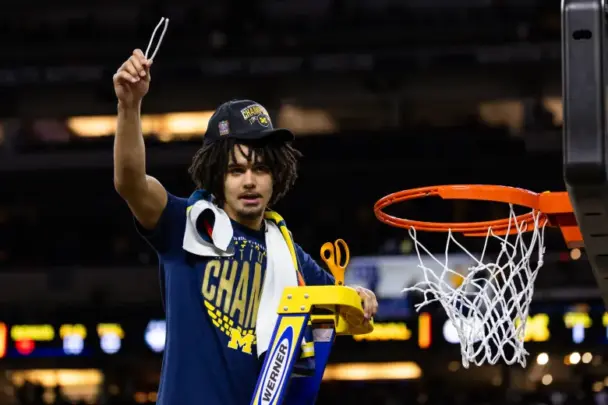
Coming off a National Championship, many members of the University of Michigan men’s basketball team had some serious decisions to make about their future. They’d either declare for the NBA Draft this upcoming summer or return to Big Blue for a shot at back-to-back titles.
On April 9, ESPN’s Pete Thamel posted to X about Elliot Cadeau, the Most Outstanding Player at the Final Four this year, and his future:
“Michigan and star point guard Elliot Cadeau have agreed to a deal for him to return for his senior year,” the post read.
The next day, Thamel posted about Trey McKenney’s future as well:
“Star Michigan guard Trey McKenney has signed to return to the Wolverines,” the post read.
To the average eye, these may seem like normal basketball insider reports. However, one major phrasing move from Thamel made these posts stand out from insider reports of the past. In both of them, the athletes “agreed to deals” to return to college. In McKenney’s case, he signed to come back.
Signed. To go back to college. That’s new.
In the five years since the NCAA passed the temporary policy allowing college athletes to sign contracts with companies based on their name, image, and likeness (NIL), the potential for college athletes has skyrocketed. NIL has made the college athletics landscape significantly more appealing, as the opportunity to cash in on one’s own athletic talent is no longer reserved for those who can turn pro.
NIL, though, refers to players earning money from outside sources, not from their own schools. College-backed salaries are a product of House v. NCAA (2025), a landmark court case for the future of college athletics.
House v. NCAA signaled big changes for college sports: It ruled the NCAA was limiting the “earning power of athletes,” and they needed to begin giving athletes compensation for their services. The case forced the NCAA to pay former college athletes who have competed since 2016 over $2.8 billion in sum as a part of damages. The case itself led to the NCAA enabling Power 5 conference schools to pay their student-athlete population a total of $20 million.
Lawsuits of the NCAA for similar reasons have come up in the past, but the success of NIL upped the volume for this to occur, and House happened to be the case to get the job done. But that enables the language used to describe Cadeau and McKenney returning to Michigan. Instead of deciding to come back, they signed back. It’s not just allegiance to the Wolverines; it’s also a monetary benefit.
Even though it’s a different sport, Howie Roseman, the Executive Vice President and General Manager of the Philadelphia Eagles, highlighted recently how the appeal of college athletics is hurting the pros.
“For the first time in really the history of the National Football League, you are taking players who are taking pay cuts,” Roseman said. “So, the character of those players, their passion and love of the game, comes to the forefront even more.”
Roseman perfectly sums up why athletes are deciding to return to college. Especially if they are in an elite program, they can make greater bank playing college ball than in the pros, where they likely have to work their way up the depth chart and make minimum salary early on.
Because the elite college programs now can give student athletes a salary, they act akin to professional teams, offering contracts to players to either stay in a program or transfer from another. The NIL era has drastically increased the use of the transfer portal, and the post-House era has escalated its use tenfold. With this, the portal has essentially become the college version of professional free agency. Additionally, because the portal is only eight years old and student-athlete salaries are only months old, the guardrails that free agency has in the pros are non-existent in the college game.
That’s why you end up seeing athletes spending four seasons at four different schools. In the past five years, it’s been NIL packages and deal potential that have attracted athletes from one school to another. But with player-college contracts being introduced, athletes can essentially choose the highest bidder as far as what school is willing to offer a larger chunk of their $20 million to an individual.
It disincentivizes players to develop under a four-year program, while encouraging athletes to make the most of their eligibility by earning the most money wherever they can get it. This phenomenon has certainly played a factor in the many coaches retiring from the men’s basketball sphere within the last five year: Jay Wright, Mike Krzyzewski, Roy Williams, Jim Boeheim, Bruce Pearl, Tony Bennett, Jim Calhoun, Jim Larrañaga, the list goes on.
Out of all these names, Larrañaga’s retirement was certainly the most shocking. Coming off a national championship appearance in 2024, the respected University of Miami coach told the press he was calling it a career halfway through the next season. In his retirement press conference, Larrañaga put words to how many coaches felt about the new landscape of the NCAA.
“I’m exhausted,” Larrañaga said. “What shocked me beyond belief was, after we had made it to the Final Four…the very first time I met with the players, eight of them decided they were going to put their name in the portal and leave…. The opportunity to make money someplace else created a situation that—you have to begin to ask yourself as a coach, ‘What is this all about?’”
If this is what a coach months removed from a championship appearance thinks, imagine how coaches in smaller programs must feel when they can’t retain their players long-term. The turnover rate has become ridiculously high, and coaches are completely changing the way they recruit to focus more on those at smaller programs versus those in high school.
By putting more effort into transfer portal additions, recruiting from high school becomes much harder for student athletes. Yet simultaneously, the college landscape of yesteryear—unpaid athletes, loyal players, coaches recruiting high school players—has shifted down to the high school scene, where athletics are now taken significantly more seriously.
The professionalization of high school athletics, specifically with basketball, is a trend that pre-dates NIL, but was accelerated with its introduction. Highly touted prep schools like Montverde Academy and Sierra Canyon High School are now known as hotbeds for high school talent. Plus, athletics-oriented academies like IMG Academy and the soon-to-be-opened Masters’ Academy in Massachusetts focus on preparing athletes for professional sports, which is clearly coming sooner than many ninth graders may realize. The developing landscape of high school sports makes it so that student athletes as young as 14 could make detrimental decisions for their athletic career based on where they choose to attend high school.
What’s even worse from this is that most of the opportunities for student athletes post-high school are reserved for the upper echelon of talent, especially with the transfer portal being coaches’ new preferred mode of talent acquisition. With more competition at the high school level and college coaches spending less time recruiting prospects, it creates a pressure cooker for young student athletes that necessitates them to perform immediately in order to have a chance at the next level.
John Calipari, the championship-winning basketball coach currently at the University of Arkansas, has been up front about his concerns about what the transfer portal has done for high school recruiting.
“Does anybody care what this is doing for 17- and 18-year-old American kids?” Calipari said to the media on Dec. 30, 2025. “Do you know what this opportunity has done for them and their families? There aren’t going to be any high school kids! Who, other than dumb people like me, are going to recruit high school kids?”
Calipari’s dead-on. Who, other than coaches like him who care about the development of young talent from high school prospect to NBA star, would focus on high school when the bona fide talent is the portal? It makes the percentage of high school athletes who play in college shrink even more than its current low amount. Ultimately, it’s created an unhealthy situation for coaches, high school athletes, and, at some point, college athletes themselves, though I’d assume the top tier of them are fine because they are earning large salaries.
Why is this relevant now? Earlier this month, the men’s basketball national championship wrapped up, and as spectacular as late-tournament matchups were, the number of “Cinderella” teams has declined significantly. Mid-major schools made a much smaller impact on this year’s tournament than in years past. Only four double-digit-seeded teams made it through the first round this year, fewer than 2025 (5), 2024 (8), 2023 (5), and 2022 (7). The Final Four consisted this season of two #1 seeds, a #2 seed, and a #3 seed, which was an improvement from last year’s four #1 seeds, but 2024 featured a #11 seed and a #4 seed, 2023 featured zero top seeds, and 2022 only had one. The gap between the best teams and the mid-major, Cinderella-esque teams is widening, and it can be easily attributed to more talented players transferring there for better financial opportunities.
Between back-to-back underwhelming March Madness tournaments and the incoming lull in high school recruitment, college basketball (as well as college sports as a whole) has some major red flags. If the NCAA doesn’t address them soon, the attractiveness of the college game that they thought they solved with NIL will return and intensify.
Max Forstein can be reached at mforstein@wesleyan.edu.



Leave a Reply