
What Happens When the World Cup Becomes a Betting Market?
100 days from now, the World Cup begins. The tournament is projected to draw six billion viewers across 104 matches and 39 days. It will be, by any measure, the biggest sporting event in history. It is also arriving in a country where sports gambling has become part of the cultural fabric. In 2018, the United States’ legal handle was $6 billion. Last year, it was $163 billion. Sixty-two percent of World Cup fans plan to wager on the tournament, according to Paysafe research; 29 percent will be placing their first-ever online bet. FIFA, for its part, has signed its first-ever official betting data deal, allowing licensed sportsbooks to stream matches directly to their customers. The World Cup is the most romantic tournament in sports. It will also be a $150 billion betting market. What happens when those two things intersect?
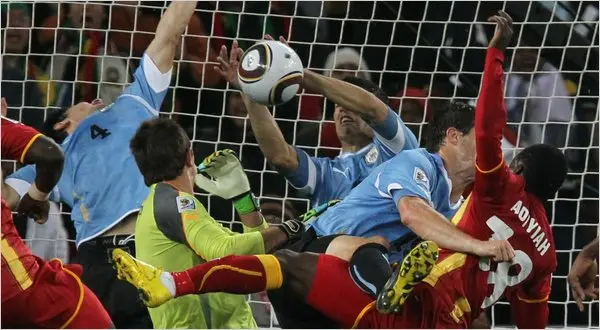
The World Cup is the greatest sporting event on earth, in part because it is not purely a sporting event. The narratives that animate it emerge from history, geography, and politics. You don’t need to understand soccer to understand what Ghana vs. Uruguay meant in 2010, when Luis Suárez smacked the ball with his hand on the goal line in the final minute of extra time, denying what would have been the winning goal and Africa’s first Semifinal appearance. Maradona’s Hand of God was more meaningful because the match occurred four years after the 1982 Falklands War. The tournament has been generating these stories for 100 years.
Those stories haven’t and aren’t going anywhere. But for the first time, there’s a competing answer to the question of why any given game should matter to you. There used to be a skill in finding stakes in a neutral game. Sometimes it was the underdog, a player’s story you remembered, endearing fan traditions, or a friend who needed company in their misery. The dull games made this harder, but that was part of the deal, too; you sat through the tedium, and when something finally happened, it meant more because of everything that preceded it.
Gambling solves the problem of the dull game. It’s the main appeal to most casual gamblers, and that’s very valid. But a pre-assigned stake and a constructed one produce different kinds of attention. When a significant portion of viewers arrive at a match already positioned, they’re watching the same game through different lenses. The person betting on corners watches the entire game through that angle, losing attention when the ball is in the middle third and constantly hoping crosses get deflected. The shared room, which has always been sport’s most powerful feature, becomes thinner.
For me, the crystallizing moment came in the 70th minute of Germany vs. Costa Rica at the 2022 World Cup. Costa Rica had lost their opening match 7–0 but had just taken a 2–1 lead against Germany. If it held, they’d advance despite being +2000 underdogs. It was exactly the kind of story the World Cup exists to produce, and what made me fall in love with sport. However, I had bet the over on 3.5 goals, and I needed Germany to score. So I sat there, watching one of the better underdog moments of the group stage with friends who were pulling for Costa Rica, hoping the European superpower would score.
Gambling raises the floor for the average fan in the sense that there is always something at stake. Most people who bet would tell you that’s the point, and they’re not wrong. But floors and ceilings tend to move together. The urgency that makes a dull game watchable is the same urgency that makes a transcendent one feel like just another match with money on it. Stakes and meaning are not synonymous, though. Gambling can provide the former, but the latter requires something else entirely.
At their heart, sports are compelling because of stories. Without context, even the highest level can fall short of its potential. The 2022 World Cup final was the greatest game in the tournament’s history by almost any measure. Lionel Messi, the greatest player alive, was pursuing the one thing that had always eluded him, representing a country in economic freefall. Kylian Mbappé (the heir apparent) and France were chasing back-to-back, with questions of national identity woven through their entire campaign. You could watch that final knowing none of that, and it would still be remarkable. But you wouldn’t feel it the same way. That context comes from writers who spend months traveling, making calls, and sitting with the material long enough to give it back to you in a form that changes how you watch. They don’t just produce a Messi piece; they put you in Argentina and reveal the expectations of the country and how they’ve weighed on him. So when you watch Messi net two goals and the first penalty, you feel the specific gravity of what just happened in a way the broadcast alone could never give you. That’s what sports journalism, at its best, has always done.
The industry isn’t dying, but it’s going through a painful period. Its decline has many authors—private equity, the economics of digital media, and attention spans restructured by algorithmic content—and it would be unfair to pin it on any single cause. But gambling is a meaningful part of that shift. As the betting market has grown, sports media has followed the money. Articles and broadcasts focus on injury report analysis, line movement, probability models, and prop picks. Long-form journalism still exists, and people are still doing it. But it competes for the same shrinking attention and the same shrinking budgets against content that is easier to produce, easier to measure, and more directly tied to where the money is going.
Nothing catastrophic is coming, and the “so what?” is a fair question. But how you experience this tournament has changed in observable ways. The broadcast has odds in it now. The sports section runs picks. The 29 percent of viewers placing their first-ever online bet this summer aren’t arriving as soccer fans who also happen to be gambling, but rather as gamblers at a soccer tournament. A shared imaginative space where strangers find reasons to care about the same thing without being told why is still there; it just has more competition than it has ever had before.
Sam Weitzman-Kurker can be reached at sweitzmankur@wesleyan.edu.

Leave a Reply