
From The Argives: Ring by Spring, a History of Marriage at Wesleyan
When the class of 2029 first arrived at Wesleyan University, we were welcomed with a speech by President Michael Roth ’78. In the speech, he sought to excite us about how significant our time spent at Wesleyan would be for the rest of our lives. Throughout his remarks, he emphasized the friendships that we would form with others here and came to the conclusion that many of us may be sitting next to our future spouse.
This exclamation was met with a stirring throughout the crowd, many students giggling and fervently glancing around to scope out their future spouse. Of course, many people who meet at Wesleyan go on to marry each other, and in the spirit of Valentine’s Day, we at The Argus wanted to do some digging on the history of marriage at Wesleyan. From weddings on campus to courses on how to have a successful marriage, this is certainly a robust history.
Beginning in 1936 and continuing for decades, Wesleyan used to host an annual “Marriage Parley,” a conference in which intellectuals would lecture students on marriage. An Argus article issued on Mar. 18, 1952, entitled “Dr. Ruby Kennedy Closes Wes Parley On Marriage” described the various topics of discussion at that year’s parley. In particular, this lecture prepared students, all men at the time, for the time in marriage when physical and romantic attraction would wear off.
“As a wife, the woman must act as ‘the axis of the family,’” Mel Shapiro ’55 reported on the speech by the Professor of Sociology from the Connecticut College for Women. “After the first few years of marriage, when the original physical and romantic attractions wear off, a more mature love must follow to make up for this loss. At this time, the wife must be a true companion to her husband.”
In this same issue, we read about other lectures and discussion groups from the 1952 parley including one from Dr. Herbert Lamson, a sociologist from Boston University. In the article “Martial Problems Topic In Lecture, Discussion Groups,” student reporter Mike Phelps ’55 quoted Dr. Lamson’s opening lecture.
“Dr. Lamson set the 1952 Wesleyan Parley in motion with a mathematical equation Thursday evening—‘Petting plus alcohol equals pregnancy,’” Phelps wrote. “The Doctor went on to elaborate upon such matters as the standards one should set up in his quest for a mate, such as common interests, and agreements concerning religion, children, and finances. A distinction between infatuation and love was propounded for the benefit of those who were confused about this matter.”
One can only wonder how well Wesleyan students today would respond to such advice about homemaking and family planning, and whether a conference like this would be as well attended as it was in 1952.
For students who enjoyed these conferences but wanted to prepare even more for marriage and learn more about how to be “successful” in the institution, there was also an option for a marriage course.
On Mar. 18, 1947, the Argus issued an article entitled “Marriage Course Plan” inspired by the Marriage Parley, in which student reporters Chuck Stone ’48 and Pete Fellows ’48 suggested that a marriage course return to Wesleyan.
“A course on marriage existed before the war, which was under the direction of the late Dr. Fauver, ex-president McConaughy and Prof. Schneider,” Stone and Fellows wrote. “That this course was abandoned during wartime years is understandable. The need now, however, is even greater for a course on marriage. Accordingly, we would like to suggest the following plan. Beginning next September a year course be initiated for seniors only: this course meeting perhaps once a week. Such a course would be of an informal and voluntary nature involving no academic credit for those participating. The course of instruction should include the physical side of marriage, to be presented by a physician; the psychological side to be presented by a trained psychiatrist; and the religious side to be presented by a religionist.”
Stone and Fellows wrote passionately about the course’s necessity given the nation’s rising divorce rates, suggesting that a voluntary, no-credit course be offered to seniors. Of course, this plan assumed that most seniors would be marrying soon after graduation.
“The reasons for this plan, as it has been proposed, are as follows: That it be limited to seniors only because the individual classes would be smaller and better discussions and study might possibly result,“ Stone and Fellows wrote. ”In four or five years, there will be, in all probability, very few married students on Campus and the problems of marriage would, therefore, be more real and urgent to seniors only.”
In the latter half of the 1940s, with the war over, the U.S. census reported that the average age for American men to get married for the first time was 23 years old. In 1947, Business Insider stated that America’s divorce rate was 3.4%, an all-time peak in the country’s history up to that point. Putting this into perspective, Newsweek reported on Oct. 18, 2025 that the average age for American men to get married is 30.2 years old, and it is common to hear the “fun” fact that nearly half of marriages end in divorce.
As time went on and the average age to marry rose, the pressure on university students to marry immediately after graduation softened. However, Wesleyan marriages were certainly not rendered obsolete.
An Argus article issued on May 29, 1989, presumably the last edition of the year, was entitled “Wedding Bells to ring for six seniors!” In this article, three couples who all met in their freshman year gave interviews about their relationships.
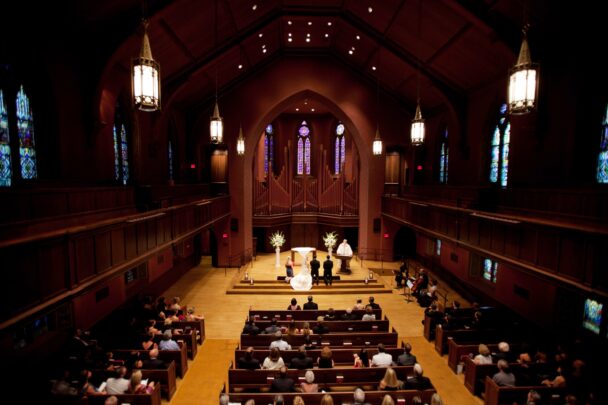
“Nadine Deluca ‘89 and Scott Elder ‘89 are preparing for a June 24 wedding at the Wesleyan Chapel,” Paul Klehm ’89 wrote. “According to Deluca, the couple met during the second week of frosh year, and have been dating ever since. They became engaged on April 1, 1988.”
Students of the ’80s clearly had newer ideas of marriage than those of the ’40s, as evidenced by the groom-to-be’s account of his friend’s reaction to the wedding.
“According to Elder, friends reacted with ‘a lot of surprise’ to their engagement,” Klehm wrote. “He said that some said, ‘Ohmigod, you’re too young’ or ‘You’re only 22!’”
To this day, Wesleyan still hosts weddings in buildings all across campus. This Valentine’s Day season, consider if your life partner is sitting next to you in class or just down the hall. For those of us who can’t possibly fathom that, for now, let’s be grateful that we are not assumed to marry months after graduating college.
Sasha Chajet Wides can be reached at schajetwides@wesleyan.edu.
“From the Argives” is a column that explores The Argus’ archives (Argives) and any interesting, topical, poignant, or comical stories that have been published in the past. Given The Argus’ long history on campus and the ever-shifting viewpoints of its student body, the material, subject matter, and perspectives expressed in the archived article may be insensitive or outdated, and do not reflect the views of any current member of The Argus. If you have any questions about the original article or its publication, please contact Archivists Hope Cognata at hcognata@wesleyan.edu and Lara Anlar at lanlar@wesleyan.edu.


Leave a Reply