
Guest Speaker Talks Bad Bunny’s Cultural Legacy Ahead of Super Bowl Performance
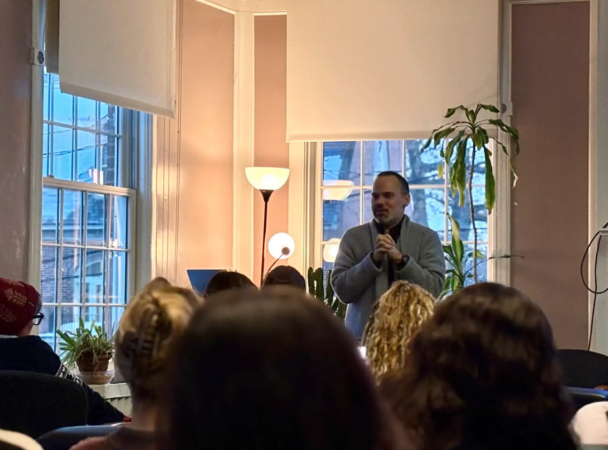
A group of 50 students and University faculty crowded into the Romance Languages department building on Tuesday, Feb. 3 to hear Juan Pablo Rivera, a Puerto Rico native and Professor of Language, Literature, and Culture at Clark University, speak about the current most listened to artist in the world: Bad Bunny.
“Ten years ago, a boy used to work as a shopping bagger in the town next to me,” Rivera said. “Now, he’s headlining the Super Bowl.”
Rivera has been teaching about Benito Antonio Martínez Ocasio, better known as Bad Bunny, in his advanced Spanish classes since online classes during the COVID-19 pandemic pushed him to introduce music videos into his curriculum. He guided attendees through the cultural history and impact of Bad Bunny’s music.
Rivera gave the audience a crash course of Bad Bunny’s career, pausing to provide context and to analyze lyrics and visual design. Introducing El Apagón, a song from Bad Bunny’s fifth studio album that critiques the impacts of colonialism and gentrification in Puerto Rico, Rivera told the audience that “this is the moment that we see that Benito is very openly, very publicly, becoming a political figure.”
Despite—or even because of—Bad Bunny’s Puerto Rican patriotism and politically outspoken behavior, Rivera expects streams of the Super Bowl LX to rise, given the international appeal of Bad Bunny’s music.
Rivera attributes Bad Bunny’s upcoming performance to the National Football League’s (NFL) efforts to expand the sport globally. Requirements state that all football teams must play at least one game abroad. Games have been played in London since 2007 as part of the NFL International Series, and more recently, games have taken place in Canada, Mexico, and Germany. In Latin America, where Bad Bunny’s music is popular but soccer reigns supreme, his performance could encourage viewers to tune into football. Rivera also noted that Bad Bunny has succeeded in finding international stardom while singing almost exclusively in Spanish, something other Latin American singers have failed to do.
Lani Glatter ’29 agreed with Rivera and pointed to the cultural significance that Bad Bunny’s performance could have.
“The Super Bowl is such an American, patriotic, white people kind of event,” she said. “I think it’s so cool that they asked him to do it, and that basically his whole set is probably going to be in Spanish.”
Bad Bunny is no stranger to being politically outspoken. While accepting the Grammy for Best Música Urbana Album on Feb. 1, he began his speech with a sharp declaration: “Before I say thanks to God, I’m gonna say: ICE out!” During his speech, which was primarily delivered in Spanish, he dedicated his success to “all the people who had to leave their homeland, their country to follow their dreams.”
Rivera spoke on Bad Bunny’s history of experimentation with gender and fashion through the lens of queer and feminist studies. He discussed Bad Bunny’s use of drag and feminine signifiers early in his career, and lauded the artist’s shift towards platforming queer performers.
The evolution of Bad Bunny’s self-expression, especially through clothing, has interested Rivera since he first noted a shift in his presentation to emphasize cultural heritage. In his talk, Rivera noted Bad Bunny’s fashion at the 2024 Met Gala, where he wore a flor de maga, the national flower of Puerto Rico. Bad Bunny has since donned other traditional signifiers, including the guayabera and pava straw hat. Patriotic signaling was also heavily present in Bad Bunny’s most recent album, DeBÍ TiRAR MáS FOToS.
“Symbols of masculinity, symbols of identity, symbols of El Campo, the countryside, express a kind of nostalgia for our ancestors, for our grandparents, for the people who are no longer with us,” Rivera said, pointing to the album cover, which depicts a pair of empty chairs and a bunch of bananas, which are omnipresent on the island. “But it’s also nostalgia for our migrants, for the Puerto Rican diaspora population.”
In an interview with the Argus, Rivera highlighted why Bad Bunny’s music has resonated with him academically and personally.
“I really enjoy how he’s really focused on the struggles that Puerto Ricans endure and other Latinos endure, but also without adopting this victim mentality, right?” Rivera said. “He also highlights that we are a strong people—resilient, creative. He has given me and other people I know a sense of pride in being Puerto Rican.”
Aarushi Bahadur can be reached at abahadur@wesleyan.edu.


Leave a Reply