

Why Catfish Malaysia Are the Ambassadors of Chaos and Authenticity
It’s 11:07 p.m. and the post-performance hubbub in the room begins to die down. Seconds tick by at a leisurely pace. Of course, it won’t last. Excitement builds. The hushed murmurs begin to swell to a clamoring din. The players step onto the stage. One of them gently plucks the mic from the stand. The lights of obligation and structure dim; the subconscious forces of chaos and verve raise their heads, their attention now commanded. As the initial roar of guitars announces an incoming presence, electric tendrils of vibratory sensation crackle in the tightly-packed room; the rest of the world ceases to exist. A salvo of energy crescendoes. It’s finally time. No, it’s finally Catfish Malaysia.
Catfish Malaysia is not something that can be definitively described. They have an inalienable ethos that is uniquely their own, based on their three pillars of autonomy: chaos, authenticity, and creativity. These tenets are consistently reflected in what they do on stage, in the seclusion of the practice rooms, or on a random Tuesday afternoon.
Before the opening note is even struck, one cannot help but gawk at the extravagant, daring, and innovative garb of Catfish Malaysia. The tone is set by lead vocalist Felix Kane ’28. His fiery red blazer sears the eye, complimented by his emotionally-fueled vocal delivery. One glance at him says it all: Felix has become a part of the music, venturing out into the similitudes of sound and feeling. He has become one with the Catfish Mother, embodying the central forces of chaos and creativity. Felix’s words concur with his performance.
“Creativity is my reason,” he said. “Creativity is everything to me.”
Guitarist Isaiah Longstreth ’28 shares this sentiment. Surely his innovative outfits require planning and forethought—but he assures that they do not.
“The Catfish Mother tells me what to wear hours before the performance,” Longstreth said. “It allows me to be free and more in touch with the people in my life and with who I want to be.”
Longstreth believes becoming more in touch with the moment allows him to return to a place of passionate curiosity, a feeling that reminds him of his childhood.
Certainly, the musicians in Catfish Malaysia possess uber amounts of musical proficiency and comprehension. Jack Pagano ’28 (also known as Hobbes, Jack Trombone, or Triplet Pagano) is known for the trombone but is also incredibly savvy with performance keyboarding and lights; Theo Klagsbrun ’28 breaks the imposed limits upon the bass instrument, innovating on its sound whilst crowdsurfing. Longstreth casually rips Chuck Berry; Alec Pederson’s ’28 deep knowledge of jazz brings in another distinct sound. And yet, it is their panache and chaotic spontaneity that truly distinguishes them from other groups.
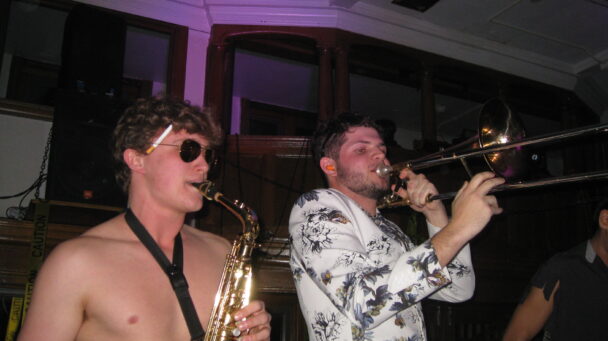
It must be noted that Catfish Malaysia is not a band. Referring to them as such severely curtails and downplays their dynamism: Catfish Malaysia is a culture—a movement of raw, unbridled energy.
“We are a ball of energy moving through space,” Trombone said.
Klagsbrun takes it further.
“We are a snake that slithers just to show that it can,” Klagsburn added.
Catfish Malaysia is an entity that rejects the bounds of conventionality. But don’t get it twisted—the identity of Catfish is not that of some sexy, perfect, sparkling music machine. They improvise everything. They strike notes with pitch that deviate from the score. Their strings break live.
Klagsbrun puts it concisely: “We are far from great. We revel in the muck, mire, and grime. Trust that we will fuck up and make it a sound.”
Most of their performances sound nothing alike, save for the raucous energy that characterizes their shows. It is fair to say that Catfish doesn’t attempt to saddle the beast of music and domesticate it. Instead, they let the music’s vibrations roam free everywhere they go.
The importance of freedom in everything Catfish does and represents cannot be overstated. They see music itself as a path to freedom, where the forces of oppression and judgment are swept aside and replaced with the ability to find one’s self. This value is most reflected in how they view the audience as another instrument.
“I can’t ignore the big instrument which is the crowd, and I have to find how my sound goes with them: under, over, or through it,” Kane said.
The bread and butter of Catfish Malaysia is live performance. This fact contributes to their hesitancy over making an album. Practice sessions and records could never fully replicate the heat-of-the-moment energy of a live show. When asked about the possibility of a live album, Catfish agreed that it was an appropriate middle ground where they could unleash and aptly capture their emotions and passions in conjunction with the audience.
Catfish’s creativity does not only pertain to themselves. Pagano touches on the “cardinal sin” which occurs when freedom is not allowed to blossom.
“The ultimate disrespect of the Catfish Mother is to suppress truth and realness, to not embrace your freedom and to be unable to have an autonomous expression of ourselves,” Pagano said.
The sentiment is clear: Be whomever you like. Catfish Malaysia sees that much of the world is constructed in such a way that suffocates creativity and individuality. Their music and expressionism stands in stark contrast to this. As a movement, Catfish intends to spread the right to being one’s true self all across campus, throughout the country, and all over the world.
There has been frequent mention of the Catfish Mother, but who exactly is she? She is the patron saint of Catfish Malaysia, their inspiration, their counsel.
“The Catfish Mother is an entity that has come into us, and gives us guidance,” Pederson said. “We are in the midst of a journey without a set destination, searching for something we haven’t heard or felt.”
Longstreth notes that during performances he is “possessed” by the Catfish Mother. Kane reflects on the forms Catfish Mother takes on: “Her catship can be many colors: sometimes green, sometimes yellow, red, or blue. As we are experiencing the music, she is with us, letting us understand how to communicate with our sound.”
Pagano talks about the ways the Catfish Mother influences the experience of the performance.
“The Catfish Mother makes you dance, but if you suppress that urge to dance, we have failed,” he said. “This sentiment illustrates how deeply intertwined with spirituality Catfish’s mission is. The Catfish Mother is in all of us. She shares the music and forges unity between the group, the music, and the audience.”
The question regarding new directions and future plans was posed to Catfish Malaysia. Many answers were supplied.
Kane mentioned how he’d like to play in more venues across campus—but one place in particular.
“I’d love to have a show in the Chapel,” he said.
Longstreth talked about expanding the repertoire of Catfish Malaysia further.
“I’d like to write a song that can be played differently each rendition, despite having the same general guardrails,” Longstreth said.
Guitarist Henry Kathawala ’28 talked about spreading the Catfish culture to other places.
“My big goal for this semester is playing off campus,” he remarked. “I want to see how it goes over playing for an audience who doesn’t know us and who aren’t all our friends.”
Saxophonist George Schunk ’28 echoed Kathawala’s sentiment about playing off campus, and noted how it’s a big jump to make.
“Honestly it’s really exciting,” Schunk said. “It’s also kind of scary at the same time.”
He also personally spoke about connecting with the saxophone on deeper levels.
“I want to learn more about improvisation and improve my understanding of my abilities to contribute more to Catfish,” he added.
Klagsbrun spoke about incorporating new people and new forms of art into Catfish.
“I’m looking to get more creative people involved with us: singers, painters, artists; I want to have everyone, audience included, to be a part of the art we’re making,” Klagsburn said.
According to Anthony Kiedis, lead vocalist for the Red Hot Chili Peppers, music is “the great communicator.” Catfish Malaysia takes this idea and runs with it. Their music is a form of communication between other souls and within oneself. The Catfish Mother leads them to innovate upon their sound and expression in a unique fashion. Most crucially, in a world where conventionality is an easy pitfall to succumb to, Catfish vehemently rejects the notion of “normality” and strives to push the boundaries of what can be done. When not looking deep into the complex intricacies of Catfish, one risks not appreciating the magnitude of what they stand for. In times of polarization, unrest, wounding, and suppression of true identity, Catfish Malaysia stands as a symbol of freedom and community. Catfish Malaysia is a movement. Move with it.
Ryland Breen can be reached at rkbreen@wesleyan.edu.



Very interesting