
But I Wept For ’t: How Spike Tape’s “Pericles” Left Us Laughing and Crying
Over four centuries after it was first written, “Pericles” came to WestCo Cafe this past weekend. The show, playing from Dec. 4–6, 2025 at two and a half hours long, was over before I knew it. An intricate tapestry of stories, the plot cycles through six cities and 35 different characters via a frame narrative structure.
The iconic complexity of Shakespeare’s text made it all the more impressive that Iza Konings ’26, the director, set up the play so that it was not just easy to understand, but practically impossible to misunderstand.
Konings said that setting the play up so that people could understand meant it had to be performed in the round.
“I absolutely adore Shakespearean language, but I know that it isn’t easy to digest,” she said. “The way to handle making the production feel more understandable and more accessible is just by making it very dynamic. One of the ways that we can do that is by putting it in the round, because I think if you’re having actors come in from all sides, and you’re having actors start saying lines backstage already, it adds this kind of ever-shifting element to the show, which I think makes it a lot easier for the audience to understand.”
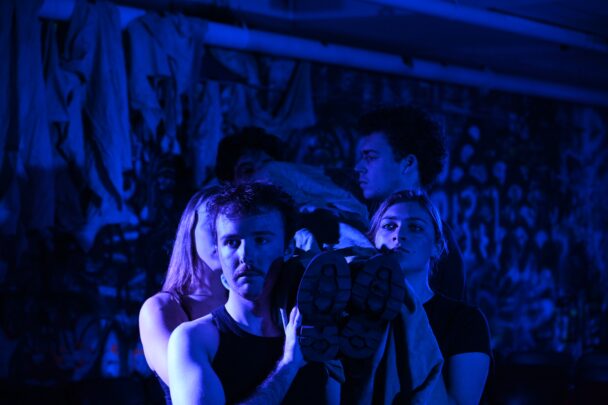
The theater-in-the-round style worked very well in the WestCo Cafe. The set incorporated every single element of the space: In the first scene, the play’s narrator sat on the cafe’s windowsill with a large light shining on her. The graffiti on the walls worked with white rags placed around the room to elevate the play’s post-apocalyptic atmosphere.
“I think it’s just a really fun kind of setting to play with,” Konings said. “Just the aesthetics and the costuming and the set that you’re able to make when you have that kind of setting is so much fun and really allows for everyone’s creativity to shine through. There’s actually a lot in the text itself that supports a kind of post-apocalyptic setting; Pericles has a line about seeing the desolation in the streets of Tarsus, so the text itself actually also does support a post-apocalyptic reimagination of the show.”
The costumes, created by Avi Kahtan ’28, were an incredible aspect of the show, supporting the post-apocalyptic setting through their modern twist and tattered construction. Each city-state had a corresponding color, which further helped the audience understand the shifting locations and characters. Pericles wore baggy black jeans and various yellow tops that adapted as he journeyed through the highs and lows of the show. Every character had a different costume, which was crucial, as everyone in the cast but Pericles and the narrator (played by Abigail Grauer ’27) played multiple parts: Two of my favorites were Antiochus’ and the narrator’s. Antiochus (played by Gryphon Magnus ’28) was right in the thick of this post-apocalyptic setting, as demonstrated by his tattered black leather jacket with red cuffs lined with spikes. Beneath the jacket lay his bare chest. On the other hand, the narrator’s black suit, clean and regal, removed her from the plot. Her elegance and ethereal ease made sense.
Konings said the play is special to her because it stands out among Shakespeare’s works.
“I chose Pericles specifically because I think it’s one of Shakespeare’s most dynamic plays,” she said. “A lot of his earlier works are kind of very stuck in a typical Shakespeare mold of [being] either a comedy or a tragedy or a history, but this has both tragic elements and comedic elements.”
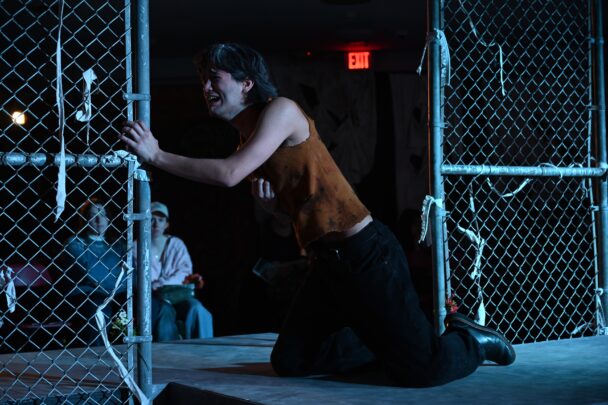
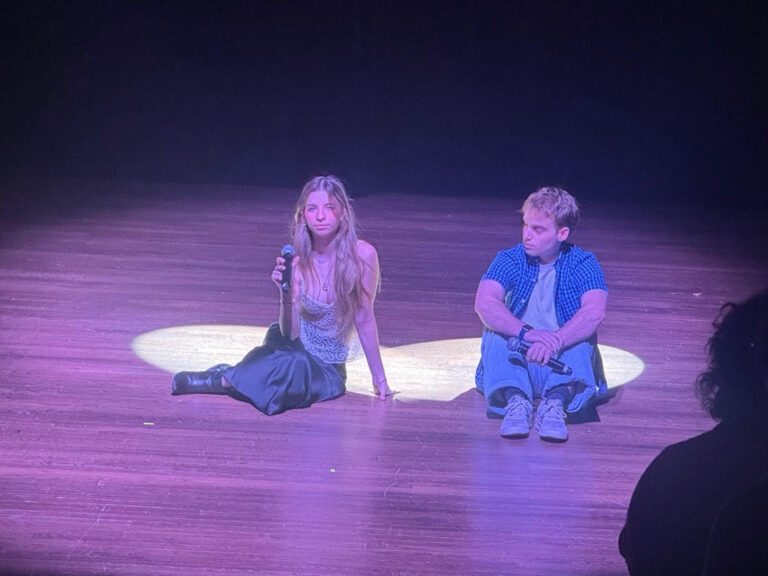
Indeed, many of those comedic elements arrived during tragic moments. The moment when Marina is about to die and wants to know why she was going to be killed, she says, “I never spake bad word, nor did ill turn / To any living creature. Believe me, la, / I never killed a mouse, nor hurt a fly. / I trod upon a worm against my will, / But I wept for ’t.” The line got a huge laugh from the audience.
Chloé Naudet ’27, who played Marina, spoke about her process for finding the character.
“Iza really helped put in perspective [that] Marina at the start of her arc as we see her in the show is just naive and sweet and kind,” Naudet said. “[At] that moment, I have to earnestly [play] this character. If I kill the worm, I hurt something by accident, I would genuinely have the reaction of, ‘Oh, that’s terrible. How could I have done this?’ I would have to weep for it. [You have] to fully [be] part of the text, even if it’s funny and it’s sad at the same time, acting the truth of the character and their situation, even if it is a little ridiculous at times. It’s fun.”
Another comedic moment occurred at one of the happiest moments in the play. Pericles is reunited with his daughter, whom he had long believed dead. Lysimachus, who connected her to Pericles, holds out his arm and offers Pericles the use of it. Pericles leaves him hanging to go be with his daughter. The awkwardness of this moment was blocked and directed so hilariously that the audience burst into laughter. The laughter grew when Campbell Greenberg ’26, who played Lysimachus, let his arm fall limply after holding it up for far too long.
“It’s written into the script,” Konings said when asked about this moment. “Lysimachus has a line where he says ‘come lend me your arm,’ and in the way that I had blocked the scene, Pericles was standing right next to Lysimachus. Me and the actors just realized [that] in this moment, Pericles has just found his daughter again. He wouldn’t just take the hand of some random guy that he just met. He’d want to be physically close to his daughter and so [it was] a great moment to just do something funny. And [Greenberg] just has such incredible comedic timing.”
In addition to the talent of the cast, the crew showed their expertise through dramatic lighting that fit with Konings’ vision of rendering Pericles accessible, as the color of the lights changed based on which of the six city-states the characters were in.
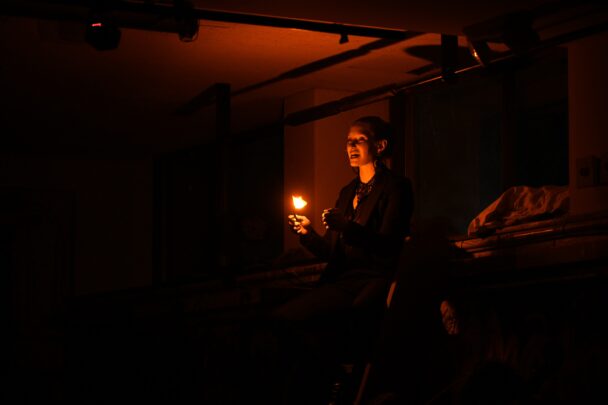
I cannot end without mentioning the original music, composed by Kate Lyman ’26, which added palpable emotion to the production.
“I sat down with Kate and we talked through all of the different locations that we go to and the different vibes, and just kind of building the themes off of it,” Konings said about the score. “In rehearsals, we had the whole pit come in for a couple rehearsals and then obviously for all the tech. If there was a moment in the show where I was like, ‘Oh, I really want music right here,’ I would go to the musicians and be like, ‘Can we do some kind of sad, creepy instrumentation here, or some kind of joyful riff here?’”
Kekoa Dowsett ’28, who gave an electrifying, energetic performance as the titular Pericles, wrote that the experience was very gratifying.
“Initially it proved to be [a] fairly difficult endeavor: This show at first glance is so all over the place both in story and emotional content (we liked to say in rehearsals that things just sort of happen to Pericles),” Dowsett said. “However, as I dug more into the text alongside this lovely cast and under the careful and extremely skilled direction of Iza, who helped me realize the beauty of honoring loved ones through grief, I realized how much the text supports an emotional arc that became so natural to engage with—from the happiness and innocence of a bratty, youthful prince to the devastation and grief-driven maturity that can only come with loss to the overwhelming joy of being reunited with a family never known.”
Four hundred and sixteen years after “Pericles” was written, it’s incredible that a group of directors, actors, crew members, and musicians still found a way to leave audiences spellbound with it.
Henry Kaplan can be reached at hrkaplan@wesleyan.edu.



Leave a Reply