
From Co-op to Cato Corner, Exploring Bon Appetit’s Relationship With Wesleyan’s Sustainable Dining Options
Wesleyan has multiple programs aimed at promoting local food sourcing, from Bon Appétit’s Farm to Fork initiative, to student-run Local Food Co-op, to student visits to local farms. Still, students have called into question what defines local sourcing and what Wesleyan can do to further support dining sustainability.
Cato Corner Farm Visit
Last Thursday, dozens of students learned about cheese production and met local head cheesemaker, Mark Gillman. Rory Joslin ’28, an Environmental Fellow and fellow at the national Real Food Challenge, organized the event, hoping to inspire a larger interest in the movement for locally sourced food on campus.
Joslin explained that the event was inspired by a class on food systems, which emphasized the importance of supporting local economies.
“I think it’s important to put food money back into a local economy,” Joslin said. “It’s [also] a much better quality normally, because if you have this industrialized agriculture, it’s much more carbon intensive. It’s the practice. It’s really not humane for the animals.”
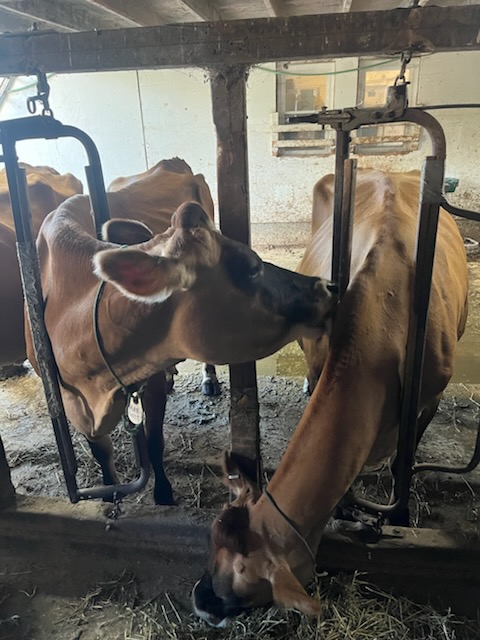
At Cato Corner Farm, Joslin said he saw systems which treated the animals with respect and dignity. Cows come to be milked when they want, he said, and graze from an open pasture.
Students then explored inside the cheese factory and observed the process of cheese creation. They also pet cows.
Cato Farms argued that higher quality animal treatment translates to a higher quality of products, warranting higher costs.
Local Food Co-op
Since 2011, the Local Food Co-op has operated a student-run farm-to-fork meal organization that connects Wesleyan students with local farmers in exchange for meal plan points. Zoe Sonkin ’26 is the Co-op’s operations manager.
“We have bread from Sweet Sage Bakery, eggs, meat, and some produce from Cold Spring,” Sonkin said. “We also have produce from Starlight Garden. And then we get jarred goods from Cold Spring. We got our coffee from Purgatory and our cheese from Cato Corner.”
This semester participants also had the option of choosing jarred goods, which include pickles, jams, and salsas.
“Our goal is to connect Wesleyan students with local farms and producers,” Sonkin said. “And [our goal is also] to push money [from] Bon Appétit to local communities and farmers.”
After Sonkin confirms price points with each farm and delegates how much one share equals, Co-op release a form for swipe night. At the beginning of each semester, students can split shares with up to six people, picking from eight co-ops. Around 400 students participate in a semester. The next sign-up date for Co-op will be in the first week of February.
According to Sonkin, there is also a noticeable quality difference between WesShop and Co-op produce.
“We can get leafy greens or like onions and sweet potatoes and then another week have like, radishes, turnips, squash,” Sonkin said. “So it’s kind of like, you also have to be kind of spontaneous with what you’re cooking and try out new foods.”
Local Co-op is entirely student-run, from communication with the farms to budgeting and delegation.
“All the students do all the stuff,’’ Sonkin said.
Sonkin argued that local farms are slowly getting phased out by corporations, which, she said, care more about capital than the food produced.
“Working conditions are definitely better on smaller farms, and there’s just more respect for the human and the non-human,’’ Sonkin said. ‘‘Just a lot more respect when capital isn’t at the center.”
Co-op has sparred with Bon Appétit over pricing and bureaucratic challenges over the years.
Because Co-op sells food to students using Wesleyan meal plan points, Bon Appétit manages the finances, taking 20% of revenue from Local Co-op’s earnings in processing fees. Bon Appétit has capped Co-op budget’s to $75,000, limiting the number of food shares they can sell to students. New farms, Sonkin said, are also dissuaded by Bon Appétit’s required extensive forms.
Bon Appétit is owned by Compass, a multinational corporation that produces billions of dollars in revenue each year.
While Wesleyan has committed to a minimum of 20% of the school’s food originating from local sources, Sonkin questioned that local label.
“[Wesleyan’s Farm to Fork program] has a lot less regulation than [Co-op] does for our farms. We like them to be within a 45-minute driving distance.”
Bon Appétit defines locally-sourced as within 150 miles.
While 20% of the food is locally sourced, the other 80% comes from companies including Sysco, Broadliners, and Wesleyan’s produce purveyor. These companies provide large-scale rebates for bulk purchases of their food. Half of Bon Appétit’s parent company Compass’s profit comes from corporate rebates.
Michael Strumpf, the Resident District Manager of Bon Appétit, explained the Wesleyan’s contract with food companies.
Strumpf started in kitchen management in 2004 and has been working at Bon Appétit for over 25 years. In 2007, he began at Bon Appétit management.
Strumpf says they’re always looking to expand into locally sourced items.
“All the tofu we buy is from The Bridge in Middletown,” Strumpf said. “Every Friday, the fish we get is coming right from Red’s Best, out of Boston, and it’s probably less than 24 hours out of the water when we get it. So that’s a farm-to-fork fisherman. It’s really cool.”
Feeding everyone at Wesleyan (118 full and part-time union employees, student workers, and 3000 students on a meal plan) can be tricky, however.
“You can’t please everybody every given day, right?” Strumpf said. “Especially with food, it’s very subjective. A huge challenge these days is food allergies, you know, and it’s something that keeps me awake at night. And it takes a lot of eyes on what’s going on, and making sure you’re keeping everybody safe.”
Strumpf says he sees an effort in student activism for sustainable sourcing of food.
“I also oversee operations at Stonehill College in Massachusetts, and the students there [are] nothing like the students here,” Strumpf said. “They’re not engaged. They don’t have the same level of interest as the Wesleyan students. That’s for sure.”
Claire Farina can be reached at cfarina@wesleyan.edu.



Leave a Reply