
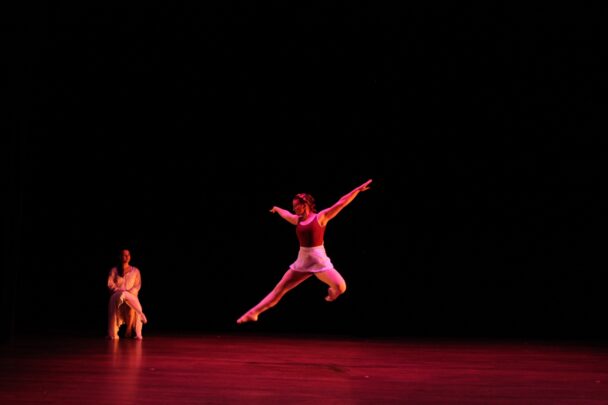
WesCeleb: Lael Blackmore ’26 on Choreographing Sugarplums, Volunteering in Hospice Care, and Love of Opera
If she’s not pirouetting on stage, harmonizing with the Onomatopoeians, or cramming for her next neuroscience test, Lael Blackmore ’26 can be found volunteering at the Middlesex Hospital or simply taking in the beauty of Wesleyan’s foliage. Perhaps, if you are unfamiliar with her name, you may be familiar with her work as one of the directors, choreographers, and performers in WesArabesque’s “The Nutcracker” last weekend, or the Collective Motion (CoMo) showcase this Saturday, Nov. 22.
The Argus sat down with Blackmore to hear about her aspirations to become a pediatric surgeon, as well as her basement ballet phase.
The Argus: Why do you think you were nominated for WesCeleb?
Lael Blackmore: I just finished directing “The Nutcracker,” so that could be part of it.
A: What are your majors, and what drew you to the major?
LB: I’m majoring in neuroscience and behavior, and in Science and Technology Studies. I’m pre-med, so I’m going to medical school, and there are a lot of classes you have to take. I definitely wanted to major in something that would require [the same] prerequisites. I looked at the neuro electives, and they sounded so interesting. It’s multi-disciplinary with psychology and biology, and I think that’s really cool. Then, with my Science and Technology Studies major, I wanted something besides just the biological sciences. I thought that having a broader study of science itself would be really useful for my career.
A: Tell us a little about your dance background. When did you start? What styles have you studied?
LB: When I was three, my parents took me to see “The Nutcracker.” I’m from Seattle, so it was Pacific Northwest Ballet, and I immediately was like, “Mom, you have to put me in dance class.” So she did, and I have been doing ballet ever since. I did it straight through, even during COVID-19, when it was Zoom ballet. I would say my ballet training was pretty rigorous. We met about 10 hours a week when I was in high school. I also did contemporary dance, but ballet was my main focus.
When I got here, I started doing CoMo, which is more of a contemporary dance group, although you can do ballet for that. But then I was really fortunate because some of my good friends decided to found WesArabesque while I was abroad. I have been able to direct a couple of ballets, first “Sleeping Beauty,” which was last semester, and then “The Nutcracker” this semester.

A: What is your process for choreographing?
LB: It usually starts with either a feeling or a song. I love to listen to music. Sometimes I just listen to a song, and I just feel the emotion of the song so strongly that it becomes this story that I’m trying to tell through the dance. I don’t choreograph just to make it look nice on stage. It’s only meaningful to me as a choreographer if it tells a story.
A: Were you taught how to do that, or was it something that just felt natural?
LB: It did feel natural. During COVID, when we had to dance online on Zoom, my parents were nice enough to co-opt the basement into a mini dance studio for me. I got into the habit of, before we had to log on to Zoom, going to dance in the basement just by myself with my headphones in, listening to music, and I would practice my improv. I feel like the choreography stemmed from improv, because when you’re improvising, it’s just feeling the music, basically. So when I got here, I was like, maybe I should turn this into an actual performance instead of just me by myself in my basement.
A: What was your favorite dance to choreograph or perform?
LB: Recently, in “The Nutcracker,” I choreographed a pas de deux, which means a step of two. It’s a duet between the Sugar Plum Fairy and the Cavalier at the end of “The Nutcracker.” I spent a lot of time and effort to make it really suit Tchaikovsky’s music. And I’m very proud of that. I had wonderful dancers. In the contemporary dance realm, the first piece I ever choreographed was Spring semester of my freshman year, and it was about my family.
A: You were a candy cane dancer in this year’s production. How would you describe this role in three words to people who may not know?
LB: Dynamic, exciting, and sharp.
A: How do you think dance complements the other work you do here at the University?
LB: Growing up doing ballet taught me strong dedication and hard work. You kind of have to correct yourself—you have to look in the mirror and say, “Okay, these are the things that I can do better,” and then you have to apply that to yourself.
Here, I think of dance especially as my creative and emotional outlet. With singing, I love it, but I don’t really compose or arrange songs, but with dance, I create things. Every dance that I choreograph tells a personal story. I try to make it applicable to everyone, but it stems from something that I’ve experienced.
A: You’re also part of the a cappella group Onomatopoeia. Have you been a member throughout your time at Wes?
LB: Yes, I joined the first semester of my freshman year. It is audition based, so I was lucky enough to get in, and this year, I’m the only senior in the group, and though we don’t have technical leadership, I feel like people look to me to lead a little more because I’m the oldest and the most experienced.
A: Do you have a performing background in singing or theater as well?
LB: Not really acting, but I did choir when I was really little, and in middle school, I started taking voice lessons. I sang a lot of opera. It’s kind of a niche background, but I loved it. I fell in love with opera when I was little, kind of at the same time I fell in love with dance. My parents used to play it a lot on our old CD player. I’ve always liked classical music, and that’s the intersection of ballet and opera.
I love my a cappella group. I’ve met some of my closest friends through that and through dance.
A: How do you balance all that with pre-med and two majors? Are you part of other organizations outside of the ones we mentioned?
LB: This semester, I’m definitely very busy. Probably need to sort of take a little bit of a load off next semester. But I do volunteer at Middlesex Hospital. I volunteer on the hospice floor, so our job there is to make people more comfortable as they’re dying. I do that once a week. And then I also just recently joined the Feng Lab on campus, which is animal behavior focused. We’re looking at neural mechanisms of animal behavior and kind of why animals do what they do.
A: What is your role at the hospital?
LB: My job is kind of behind the scenes. We restock shelves, we clean the kitchen, but the hospice floor is very family centered, because people visit a lot when their relatives are in hospice. So there’s a kitchen and a common living room area. We clean, we bake brownies sometimes, or make coffee for families. A lot of my job is also just going in and talking to the patients if they’re sort of awake and alert. So some of them just get lonely, and so they want someone to talk to, so I just sit with them and have a conversation, or sometimes there are things that nurses and techs who work on the floor don’t necessarily have time to do, like comb the patient’s hair or do their nails.
A: Does that feel profound? Heavy?
LB: Sometimes it’s heavy, for sure. Especially if they’re more mentally alert, and can talk to you about the fact that they’re dying, because some people just don’t necessarily know what’s going on. But I find it really rewarding because I feel most like myself when I’m taking care of people, which is why I know I want to go into medicine. And I love working with kids. The people in hospice are not usually children, I would hope, but they are usually elderly people. Both of those categories of humans are very vulnerable. I think that it is also rewarding to work with vulnerable populations.
A: So post-grad plans include medical school. Are you jumping right into that?
LB: I’m going to take a gap year. I have my EMT license, and I worked as an EMT one summer between my sophomore and junior years before I went abroad. I’m going to renew it over winter break. I’m hoping to go back home to Seattle and work there as an EMT while applying to med school. I hope to be a pediatric surgeon. I have a lot of experience working with kids, and that’s my favorite thing.
A: Do you have any advice for your freshman self?
LB: I think to slow down and enjoy the little things. I came in pre-med, I’ve been pre-med since I was nine, and it’s easy to just be trying to hit the next goal to get to the next thing. You’re always chasing this very far away goal of being a doctor that’s so many years in the future. I think when I was a freshman, I forgot that you also have to enjoy just being in college instead of seeing college as a vessel to go to med school. It’s its own entity. Just enjoy that and be spontaneous.
Jade Acker can be reached at jacker01@wesleyan.edu.

Leave a Reply