
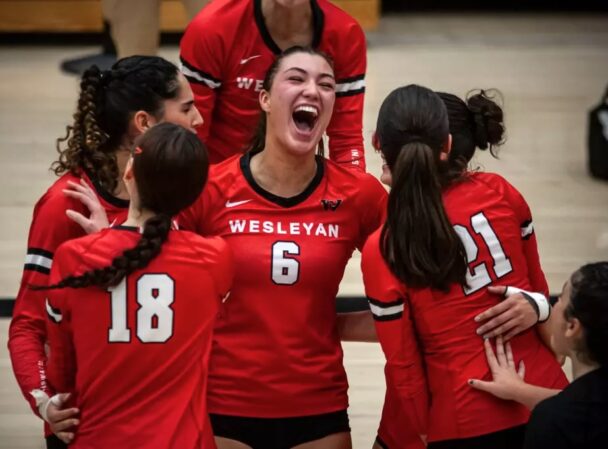
Player of the Week: Siena Steines ’28 Talks Midwest Volleyball, Taking Down Bates, and Team Confidence
Siena Steines ’28, a prospective psychology and government double major, plays outside hitter on the University Volleyball team. Steines had a successful rookie year on the team, crossing one hundred kills and ranking among the top three on the team in kills per game, but this season she has found a new gear. Steines has emerged as an efficient offensive powerhouse, ranking fourth in the NESCAC in both kills per set and hitting percentage. In the NESCAC Quarterfinal against Bates on Nov. 8, Steines led her team to a dominant four-set victory, pacing the Cards with 17 kills. Her performance earned her the NESCAC Player of the Week Award. The Argus sat down with Steines to discuss her award, her journey through Midwest volleyball, and the positive changes she’s seen in the program in her two years at the University.
The Argus: When did you first start playing volleyball?
Siena Steines: I started playing volleyball when I was 10 when I moved to Minnesota because all my friends were playing. My mom played in college, too. She was my first coach. In sixth and seventh grade, we were allowed to try out for the high school program, and I made the freshman team. Then I played basketball, and basketball was my main sport. Now, I feel like I’m fine with being more aggressive, but at the time I would always stop and say, “sorry.” My mom was like, “Maybe we should get you to a no-contact sport.”
A: How was your mom as a coach?
SS: She made us run a lot! It was weird seeing my mom yell at all of us. But also we were all 10, so it wasn’t that bad either.
A: What about the sport of volleyball grabbed you early on?
SS: I think it was the team aspect. I moved a lot when I was younger, and whenever I’d move, I would join a new volleyball club, and then those would become my friends. You get close to those girls so quickly, and that’s honestly why I loved it so much. I’m also a very competitive person. I love competing in every sense of my life. You could compete with these girls and then be best friends with them off the court.
A: You went to high school in Illinois. I know a lot of people have heard of the California volleyball scene, but what might people not know about the equally impressive Midwest volleyball scene?
SS: I’m trying to convince [Coach] Ben [Somera] to get another Midwesterner, since I’m the only Midwesterner on the team right now. But, Illinois, Minnesota, and Wisconsin are so competitive. And I found, everywhere I went, it was so competitive. And also, I feel like everybody knew each other up there. I have friends that played for Wisconsin clubs that I’m still friends with, because we would see each other all the time doing that.
A: When did you start thinking about playing volleyball in college?
SS: I started considering it my freshman year of high school. I just always assumed I would go play. I never really saw an end to it. I got hurt my sophomore year, and I was kind of like, “If I don’t recover from this, I’m done.” But I love this sport so much. I just kept playing, even though I wasn’t supposed to. I was supposed to take some time off, and I didn’t. And I’m glad I didn’t, because if I hadn’t gone back and gotten treatment, I wouldn’t be here.
A: How did you push through those years of injury to achieve your goal of playing in college, and eventually at Wes?
SS: When [Coach] Ben reached out to me, I visited, and I loved it right away. I was like, “I need to be here, I need to be part of this team.” And that that’s what motivated me to keep going, because I knew there was something waiting for me after that that I already loved so much.
A: What was it about Wes and our program here that made it the right place for you?
SS: I’ve always wanted to be on the East Coast. I love Boston. That’s where I want to be a postgrad. And I love the small school aspect. My high school was huge, but, coming here, I was very excited to know everybody. It felt like an immediate family. And Ben’s exactly what I wanted in a coach. He’s very straightforward with what he wants from a player. Also, he’s funny too, which I really appreciate.
A: How was the transition into college life? Were the upperclassmen helpful in making that transition seamless?
SS: I’m so glad we play a fall sport. I met all the other fall athletes early. So when everybody else was coming in, I [was] not nervous to go out and meet more people. And I have a huge class, so it was immediately 10 other girls that I could spend all my time with.
A: Your first year here was a bit of a down year after a period of great years. How did you and the other freshmen frame that and learn from it coming into this year?
SS: I remember our senior captain was like, “You guys, we aren’t hot shit. You have to work for it.” And that was a really transformative mindset. Just because we’re Wesleyan doesn’t mean we’re gonna win everything, and that’s what motivated us in the spring season and this entire year. We have something to prove. We’re not that team that we were last year, we’ve grown, and I think that’s been what’s transformed us. And I also think our team just feels so tight this year. It feels like a cohesive unit, and that’s because of the work we did in the beginning of the year.
A: Throughout the year, what are the biggest differences you’ve seen in execution between this year and last?
SS: I think communication is really our big thing on the court. Being able to trust each other and trust people who come off the bench. We have so much depth on our team. There’s no doubt that we’re able to get things done, even with people who aren’t part of that starting six.
A: Last Saturday, the team beat Bates in your NESCAC Quarterfinal match. You led the team with 17 kills and were awarded the NESCAC Player of the Week Award. How does it feel to earn that kind of recognition?
SS: I was so excited. I called my mom right away. My friend Leila Feldman [’28] texted me, and was like, “You got the player of the week!” And I was so happy. My coach says it’s a team award, and I really think it’s because of my team. It was great.
A: How was the trust between you guys in that four-setter, and how were you able to get it done?
SS: After our first two five-set matches of the season last week, we had to do a little mental reflection. We had a really strong week of practices, and I think that gave us a lot of confidence going into Bates. There was so much trust on the court and just a lot of confidence that we could get it done. Everybody did what they had to do, and everybody put their all into it. That’s what I love so much about our team: everybody’s always putting in 100% effort.
A: What does the team have to do to follow through on the rest of the season and go as deep as possible into the playoffs?
SS: This week and last week, we were big on setting our intentions, holding ourselves accountable, and staying disciplined. So I think as long as we keep that going and keep our trust together, we’ll be totally fine. I think now that we’ve mentally prepped, we’re ready for a revenge round with Tufts. We’re ready to show them that that wasn’t what Wesleyan volleyball is.
A: Finally, if you could give a piece of advice to your freshman self, what would it be?
SS: Don’t waste your energy on little things, keep your perspective on things that matter like your team, school, and managing your time. This year I’ve done a lot better at knowing when I need to train, knowing when I need to study, and knowing what my priorities are. Coming in freshman year, you’re all about meeting new people and saying yes to everything. But I think this year, I know what I want to accomplish with this team, and I know what I have to do to get there.
This interview has been edited for length and clarity.
Ethan Lee can be reached at ejlee@wesleyan.edu.




Leave a Reply