
Cherished Eating Club Reopens Following Stalled Renovations
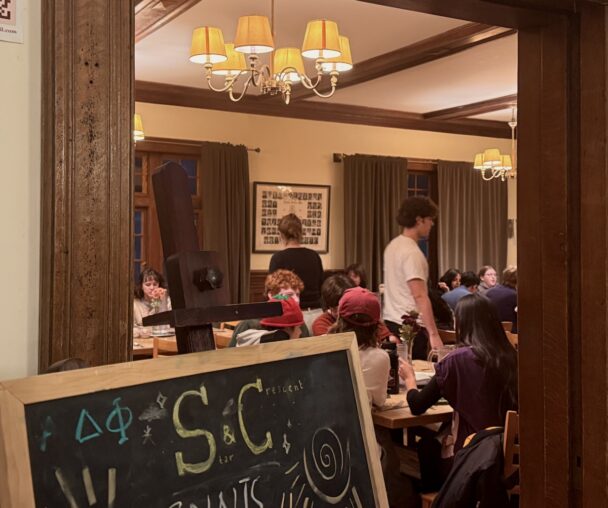
After being closed for nearly two months for renovations, the student-run restaurant Star & Crescent Eating Club (S&C) opened again for dining services in mid-October. Located on the first floor of the Alpha Delta Phi Society (ADP) building, the nonprofit restaurant has a history dating back to 1878 and is a cherished dining option for the student body.
The S&C began to-go orders on Thursday, Oct. 16 and officially opened for in-person dinner services the week after Fall Break. Since Sunday, Nov. 2, the S&C has been back up and running with regular lunch and dinner operations.
Serving Up and Staying Cool
The culprit of the renovations: a large wooden refrigerator dating back to the 1950s.
“Most walk-ins [refrigerators] today are made out of metal because it holds coolness better,” S&C Head Chef Stephanie Payne said. “And so [the old one] was just coming to the end of its time, and it was breaking down a lot more. The pipes were freezing up, so it wasn’t cooling properly.”
According to S&C Steward Jack Oshinsky ’27, the ADP alumni network helped the restaurant acquire a new refrigerator, which is still in the process of being installed. Oshinsky is one of two stewards who act as restaurant managers for the S&C.
“They got us a new one,” Oshinsky said. “But there was a heat wave in Connecticut over the summer, and so companies that were available to handle an installation like that were limited in their services.”
In the meantime, Payne and the kitchen staff have been working with rental refrigerators, which adds an additional hour to prep time daily, slowing down their service time.
“Now we have a rental from the company,” Payne said. “So that’s the big white trailer outside that I get to go in and out of…. This week I’m concerned about having kids go out there, so I’m going to limit it to who can actually go into that cooler,” adding that it may pose as “a safety concern.”
Although the S&C has paused operations in the past due to circumstances such as the COVID-19 pandemic and difficulty finding head chefs, it has largely maintained a steady rhythm of service, garnering a steady flow of student diners most weeks.
The most recent change by S&C staff was the addition of an expeditor position and the option to pay at the end of service, both implemented to make the dining experience more comfortable and efficient.
A Community Conduit
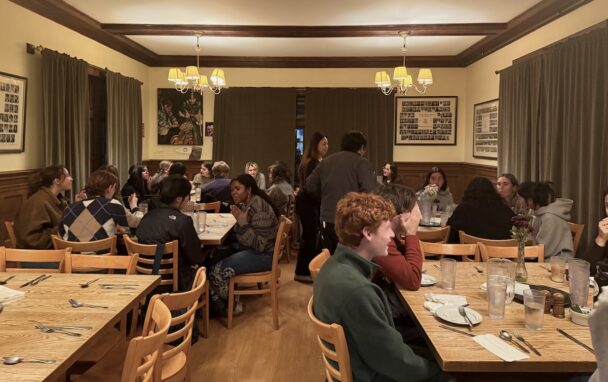
The first evening of re-opening, Oshinsky bustled around the floor of the restaurant, manning the long line, taking orders, and serving up dishes the kitchen staff prepared.
In the slivers of time in between, he stopped to make small talk with diners.
According to ADP President Jerry Persaud Jr. ’26, the S&C is one way ADP gives back to the broader Wesleyan community.
The steward’s position is an elected one, with two stewards in charge of creating schedules, hiring people, running service, paying bills, and handling finances. This semester, that’s Oshinsky and Charlotte Accola ’27.
Aside from the stewards, the head chef and the waitstaff are essential for completing any given meal service.
“The server is a volunteer position within ADP,” Oshinsky said, adding that it’s part of ADP membership obligations that members serve volunteer shifts. However, working at the S&C is not limited to ADP members, and any student on campus can apply.
Payne, affectionately known as “Chef Steph,” has been the only non-student employee of the S&C since Fall 2023.
At the S&C, Payne is responsible for menu planning, ordering food, training kitchen staff, and handling some of the more mundane tasks.
Born and raised in Clinton, Conn., Payne moved around to follow her passion for the arts, arriving at the University after working as a chef for a few years. Payne completed her undergraduate degree at Temple University and received her Master’s at University of Texas at Austin around 1998.
Her diverse experiences in art history education and kitchen management have made her a beloved fit at the S&C.
“I’ve worked in kitchens where people don’t want to be there,” Payne said. “But here, it’s like, everybody comes in and they just want to be here, and they’re looking forward to coming in. So that’s kind of, it’s contagious, you know.”
Reimbursement Rigmaroles
Although the S&C functions like any other dining service, it’s certainly the most unique dining spot at the University. The restaurant makes profits from meal points, and the price for each meal—ranging between 13 to 15 points—is determined by the University.
According to Oshinsky, the S&C staff retain 92.5% of what they make in points, and the University takes in the remaining amount in fees.
“The organization is reimbursed through a check to their bank account monthly for any points collected, minus administrative fees,” Director of Auxiliary Services Michelle Myers-Brown wrote in an email to the Argus. “These fees help cover costs incurred by the University in supporting a non-Wesleyan entity (e.g., staff time, equipment maintenance).”
Oshinsky said that fees were 5% last year. Myers-Brown attributes the rise in fees to general rising costs.
“As overall costs have increased, our fees have been adjusted accordingly,” Myers-Brown wrote.
Still, Oshinsky expressed that the S&C staff is grateful to the University for accommodating their operations within the meal plan system.
“I just love that there’s a place like this on the college campus, you know, because it’s unique,” Payne said, adding that the S&C provides student staff like Oshinsky and Accola the opportunity to work with professionals and have safety nets for challenging times.
Oshinsky said he hoped that students would take advantage of the meal prices before they rise, as the S&C staff might have a say in determining meal prices next semester.
“If you enjoy the S&C, take advantage of it, because it is the cheapest food you will ever be able to get on campus for the rest of your life, right?”
Oshinsky posited that in spite of the lofty time commitment, any ADP member with a passion for the restaurant can fulfill the role. He said that one of the most rewarding aspects of the role is the community.
“I just love seeing the same people and new people come to the restaurant and have a good time, like that’s all I’m trying to do, is just provide that for the campus,” Oshinsky said. “So at the end of the day, I get to lie down and feel satisfied with what I’ve done.”
As a final note to the community, Oshinsky shared his appreciation for the staff. “I want to nominate some of our employees for some awards,” Oshinsky said. “Worst waiter is going to be Zach Hoyer [’27].”
Eli Ramirez can be reached at eramirez@wesleyan.edu.
Janhavi Munde can be reached at jmunde@wesleyan.edu.





Leave a Reply