

The Man Behind Bar Night: Ted Greenberg ’26 on DJing, Politics, and the Politics of DJing
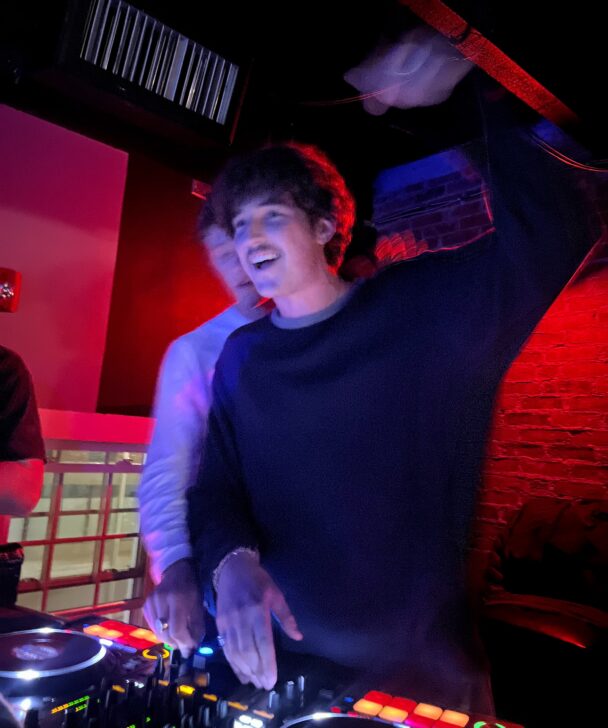
You most likely know Ted Greenberg ’26 from the stage of Mezzo Grille (Mezzo’s). Greenberg has controlled the music at almost every Bar Night—the weekly Thursday night ritual in which the University’s attendees congregate at the local bar to dance and socialize—for the past three years. He landed the role of resident Bar Night DJ in his freshman year and has since become renowned for the role, earning him the nickname “DJ Ted.” But during the rest of the week, Greenberg’s life is more tame: Right now he’s working on a CSS thesis and thinking about attending law school. The Argus sat down with Greenberg this week to ask him about the process of earning his Mezzo’s crown, his political aspirations, and what it takes to please a crowd.
The Argus: Why do you think you were nominated for WesCeleb?
Ted Greenberg: I imagine it has to do with my role at Mezzo’s and as a DJ on campus. I’ve been involved with the bar for a while and feel like it’s become like a real Wesleyan staple, especially in our tenure here. It’s been a Wesleyan-defining role for me.
A: How did you become the resident DJ at Mezzo’s?
TG: I started DJing during Winter Break of my freshman year on a whim. I’d been listening to a lot of house music that fall because my hallmate introduced me to a bunch of house stuff. I started to kind of dig on my own and discover more. And then, I don’t know what drove me to buy a DJ board; I just woke up one day, and was like, this sounds like it’d be fun. And then I just self-taught over Winter Break, watching YouTube tutorials and stuff.
By the end of that spring, I had played a gig or two on campus and also a couple of Forbidden Llama gigs when that was still a thing. But the momentum was gravitating back toward Mezzo’s. I was like, I want to get involved in that. I introduced myself to the manager on a random Tuesday in the spring of freshman year, just being like, “Hey, I would love to DJ here. I’ll do it for free. Just give me a shot.” I did it once at the end of freshman year, inside, on the first floor, so it wasn’t the full thing. I was like, okay, how do I build this? That summer, I texted him, being like, “Hey, I would love to have Thursday nights.” He was like, “Here’s the deal. You do it for free the first time. We’ll give you a shot. Don’t fuck up, and you can keep doing it.” And I was like, “All right, great.”
A: What’s it like to have that role? Is there a power dynamic when you’re up on stage, in control of the music?
TG: I think that is one of the drawbacks; the physical geography of the place kind of perpetuates that dynamic in a way that’s not always comfortable. But I also think that since other Wesleyan kids and I have been doing it, it’s a little more fluid. It’s not just a DJ on the stage in the Wesleyan crowd; it’s a Wesleyan DJ. We can all be involved.
I have a great time. I’ve met so many more people at school, so it’s been a great social outlet for me. I have been trying to take a step back because I feel like it runs its course to some extent, and I have a lot of help now from kids who are younger and really want to be involved. I help them and oversee the process, but let them take the lead. I try to have as many people get involved as possible. It’s more fun. It makes it more communal if you have people rotating in and out from different grades and social circles.
A: How do you go about mentoring underclassmen? In your estimation, what makes a good DJ?
TG: I think it’s totally subjective. In the Bar Night context, it’s like, play what people want to hear. That’s kind of something that I’ve reconciled with a little bit because I love really niche, underground house music that would never fly at the bar because nobody knows it. It’s just grooves and there’s minimal lyrics: stuff that you’d hear at a warehouse in Brooklyn or something, but not at a college dorm. Despite what I listen to on the daily, or what I want to be mixing, I would never impose that on the bar because it’s not the vibe. I think it’s about being able to recognize that nobody comes to Bar Night for the DJ. It’s not about that, it’s about the social space and going out with your friends. The best thing that you can do is just exist in the background. Don’t draw attention to yourself.
A: What are some of the Bar Night staples? Which songs do people want to hear?
TG: It’s all SoundCloud remixes of Top 100 songs. I spent the entire summer before I started DJing digging through SoundCloud, looking for all of these rip-off house edits. I built it out from there. Occasionally, I’ll try to get a little bit more experimental and pull something that’s slower, but it’s pretty restricted in terms of what you can get away with. As soon as people actually start to show up, it’s time to jump into the stuff that everyone’s going to know.
A: What have you observed from your position as DJ? What’s it like to witness everyone on their night out from a more detached perspective?
TG: It gets pretty rowdy on stage sometimes. Sometimes I have to navigate telling somebody off; that can be hard because everyone is your peers or classmates. You don’t want to embarrass anybody. Like, this is my equipment and it’d be nice to not have you be touching everything, but at the same time, I don’t want to call the bouncer over and be like, get them out of here. It’s a little bit stressful sometimes, but it doesn’t get like that very often.
A: What drew you to the College of Social Studies (CSS) major?
TG: I came to Wesleyan for CSS. That subject has always been my academic interest. When I was applying to schools, I discovered CSS and was really enamored by what the program was doing. And I love it; it’s really great, and it’s a good foundation for law school, which is what I want to go into.
A: How did you decide on law school?
TG: I want to use it as a bridge into public service at some point. Law, and particularly constitutional law, especially right now, feels like a very relevant path. This past summer I was at the U.S. Attorney’s Office in New York at the federal prosecution office in the midst of the whirlwind of this administration. It’s really driven my motivation to be involved legally. I feel like a JD provides a lot of merit as far as what kind of doors that opens in the future for you, like state diplomacy, public service work, or elected office.
A: You grew up in LA; in my experience, a lot of people from LA at Wesleyan want to work in film and TV. What made you choose politics?
TG: My parents are very politically active, so I’ve been exposed to it for a long time. They initially forced me to be involved, and then I chose to be. It felt like a natural part of my childhood. Also, my parents are in the entertainment industry and my whole childhood was in and around entertainment. So I think, to some extent, it’s a rejection of that, because I have a chance to do something that’s completely the opposite of what they’re involved in.
A: What are you thinking about for post-grad? How does one balance DJing and a career in politics?
TG: It’s not a particularly compatible intersection. I’ve thought a lot about that. I’ve never really seen DJing as a viable career path. I have a lot of fun with it, but in terms of branding, the traditional connotations that come with DJing and the nightlife are not necessarily conducive to a successful career in elected office. But I’ve also been producing music for around two years now, so I think that’s the outlet that I probably will continue to use more frequently than DJing. I mean, I’ve done a lot of gigs in New York over summers, and if I’m in the city, I could see myself continuing to do that, to some extent. I really do love it and have a great time doing it. It’s not something I want to give up. Maybe there’s a way to mold it so that it’s a bit more applicable.
A: Do you like DJing in New York and LA? I imagine those are harder nightlife scenes to break into.
TG: It’s a lot of self-promotion, which I think is a good exercise. I’ve been doing gigs now for three years, so I’ve had a chance to meet people that are doing it at the level that I’m doing it. It all comes down to extensive networking. It’s been fairly successful.
Henry McBride ’24 taught me how to produce. He’s a really good friend of mine, and he’s living in the city now as a DJ and goes internationally touring. He’s really kind of in that world. Through him, I’ve met a lot of cool people, because he’s been actively making a career out of it. A lot of the gigs I had this summer were people that he connected me with: a couple other friends who are from New York and have been in the nightlife scene for a lot longer, and have more of a sense of who to talk to.
A: What’s your favorite class you’ve taken at the University and why?
TG: I took Russian Politics with Visiting Assistant Professor Leonid Volkov. He was a Yale World Fellow. But he was on Alexei Navalny’s campaign; he was his chief of staff, which was a ridiculously cool anecdotal experience to hear. He spent years on the front lines of the Russian opposition movement. It was a really interesting class structure because it wasn’t traditional. He’s not a trained professor and doesn’t know, procedurally, what that kind of responsibility is, which I think was great. It was taught through lived experience.
A: Can you tell me a little bit about your CSS thesis?
TG: It’s an examination of American public education and how the historical progression of public schools has failed to uphold the standards of democratic education theory. I’m arguing that American public education is the institution that’s responsible for molding democratic citizens, and there are certain responsibilities they’ve failed to uphold as a product of external forces that are manipulating the character of education to serve ulterior ends. It fundamentally becomes undemocratic and is kind of a deviation from its original, prescribed character in America’s founding. It’s also attempting to tie that failure into contemporary democratic erosion of identity politics and the degree of polarization that we’re experiencing now.
A: What advice would you give your first-year self?
TG: It’s scary, coming in as a first-year and having no idea what the social dynamics are or how to navigate the complexities of college. I was definitely more reserved freshman year, and as the years have gone on, I’ve found myself opening up a lot more. I think the social responsibility of DJing has a lot to do with that. But people are more open here than I often give them credit for.
I’ll meet somebody for whom I was certain there was no way I’d get along with them, and I’m like, well, we could have been friends for the last two years. Those instances happen more often than you would expect here: There’s somebody who you’ve been adjacent to for a long time, and you have crossover, and you become really close, really quickly. I think that’s a universal experience here.
This interview has been edited for length and clarity.
Lula Konner can be reached at lkonner@wesleyan.edu
Wenwan Shen can be reached at wshen@wesleyan.edu



Leave a Reply