
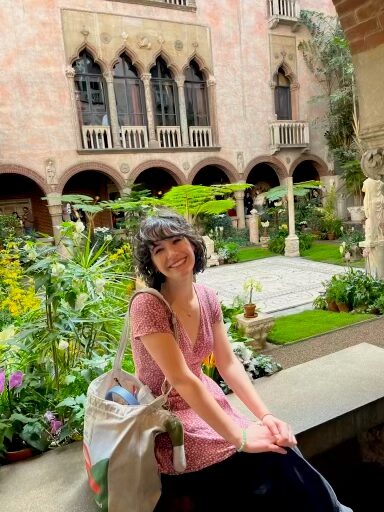
WesCeleb: Kate Borows-Lai ’26 on Pumpkin Fest, Working With Preschoolers, and Finding Serotonin in the Outdoors
Kate Borows-Lai ’26 was born and raised in Manhattan, but her friendly disposition and grounded perspective would make you think otherwise. On campus, Borows-Lai is a psychology major, a farmer, and someone who believes in waving. Last week, The Argus spoke to Borows-Lai about her interest in social work, her semester in Taiwan, and the transformative power of spending time outdoors.
The Argus: Why do you think you were nominated for WesCeleb?
Kate Borows-Lai: I’ve been involved in a lot of things that helped me get to know people on campus. I take a more front-facing role on [Long Lane Farm] and people have seen me tabling at student events and festivals. I was in this lab for two years where I went up to people and interviewed them with a microphone outside of Usdan, which helps you get to know a lot of people interpersonally. I also have this issue where [when] I don’t wear my glasses, I can’t see people. That leads me to waving at a lot of people, because it’s safer to wave than not when you think you might know them. It’s kind of formed into a philosophy for me where you should just say hi to people you don’t know. And I think it served me well—just friendliness as a goal.
A: What drew you to the psych major?
KBL: I’ve always wanted to do some sort of community health work, like direct patient-to-patient care, psycho-education, and mental health advocacy. So I was interested in the psych major because of that. Through my time in it, I’ve definitely learned that instead of [it being] what I thought psych was, which is just being a therapist, there’s so much more. My professors have helped me learn that, and I’m drifting more toward social work and public health now. And the psych major is huge, so it allowed room for that growth, which is good. I found myself kind of leaning more towards [Science and Technology Studies] classes, and now that I’m at the end of my psych major, it’s time to kind of synthesize. Like, okay, I learned research methods. I learned these principals of psych, but how do they apply in the real world, right? I think that’s a good trajectory for anyone in the major.
A: What kind of social work are you interested in? I know you did a horticultural therapy internship this summer.
KBL: I’m interested in both clinical and community social work. I think they inform each other. I worked with a lot of clinical social workers this summer in a hospital setting, and they taught me a lot about how, when you’re caring for someone’s physical health, their mental health is inextricable from that, even if they don’t come in with a mental health issue. And a lot of that is environmental, and can’t be treated just in the hospital. So I’d like [to have] that clinical background [and to] be able to apply it. What does that mean when you’re out of the hospital? How are you continuously in recovery, caring for yourself? How does your environment affect your mental well being? I know it certainly affects mine, like, a lot, and I want to be able to cultivate those environments for people and help them do the same. It means a lot to get your hands dirty, literally, and [to] be able to do that yourself and not rely on the medical system. That agency is important.
A: How did you get interested in the outdoors as a therapeutic tool, especially having grown up in New York City?
KBL: I never thought I’d be a farmer or a gardener. I didn’t have any exposure to it. [For] my parents, actually, dirt is their worst fear. I didn’t grow up going on hikes or any of that, [but] I really wanted that. It’s part of why I came somewhere with a real campus in nature and not somewhere in a city. I knew I wanted to join the farm from the second I got into Wesleyan, and I was really excited about that [and] about the fact that it wasn’t a faculty-run farm that hired students and more [of a] student project; you could learn as you did it and eventually manage it. And I didn’t know I was interested in environmental psychology, or how environments can positively and negatively impact our well being, until I started working on the farm and realized: Oh, I feel so much better when I’m here, mentally, socially. I can connect with people. Actually seeing something from start to finish is huge for my sense of purpose.
I want to be able to do that for other people. I’ve seen many different people experience that same growth when they come to the farm for the first time, [whether] they come recurringly or just once. I work at a preschool, Snow [Elementary] School, and they have a nature program. They have to spend at least 50% of their day outside. And I’ve hosted them for field trips at the farm; when they come and those kids are just rolling around in the dirt and we teach them, like, where the veggies they eat for dinner come from, that’s huge. That’s really rewarding.
A: What is it about the farm that makes it easier to connect with people? Is it having a shared project?
KBL: I think any time there’s a shared project [and] goal, it’s going to foster community [and] make the individual and the groups feel like their mental health is better. But I think there’s something about being in nature; it allows for this connection that we don’t experience—not to be like, “screens”—[being] on our screens all the time. Also, I learned this from my work this summer: Scientifically, being in the dirt is really good for you. [There are] components in dirt that act similarly to what’s in SSRIs that bind to serotonin. They kind of mimic the experience of feeling serotonin in your brain. So it’s really good for us to be in the sun, like it’s good for a plant. I also think we don’t know where our food comes from. To learn about your situation in the world in the same way people who take history do—to me, it’s so grounding.
A: You led the organization of Pumpkin Fest this year. Can you tell me about that process?
KBL: It’s a group effort, but in the past, my good friend Isaac Moss ’25 really spearheaded that. And there were a lot of calls with her, kind of passing on that knowledge, which felt really nice, because it was an excuse to talk to her, and also, [there was] this grand knowledge sharing thing. It’s the best day of the year—of my year—every single year. It’s really part of what made me want to join the farm so much. I think Long Lane is one of the most community-centered organizations on campus, not just on Wesleyan’s campus but facing outward towards Middletown’s community and the greater Connecticut community. We always have a mixture of local vendors from around Connecticut and student vendors and organizations; there’s people raising awareness about issues that they’re passionate about, and seeing all the booths come at the same time in the morning and talk to each other and learn about each other is so nice. I like seeing those people [who] don’t usually talk a lot. I got to see a lot of the kids who I work [with] at preschool; [they] came with their parents. There was face paint everywhere. People were dancing to folk music. It’s a grand old day for connection.
A: What attracted you to therapy and social work in the first place? Did you feel like you were a good listener?
KBL: I don’t even know if I thought I was a good listener; I just wanted to listen to people. I think it’s a good career for learning from people all the time. At least in the medical world, it’s one of the careers that has less of this patient-doctor dynamic, where [doctors] inherently have all the knowledge and they’re giving it to the patient. It’s more like you’re learning from each other as you go.
A: You’re also a CEAS minor. What drew you to that?
KBL: I first started because I wanted to learn Chinese. I didn’t think I’d end up taking all these other history [and] culture classes, but I ended up really liking the department. I wanted to learn Chinese in part because it’s a really popular language. In social work and public health, you’re interacting with people all the time. It’s just a good way to connect with more people in that realm. It’s also just beautiful. It’s really vivid, really imagery-heavy. So I started learning that in sophomore year [and] really liked the department, started going to—everyone should go—the CEAS building, [it’s] beautiful. I took this class with Professor Tan, [“Chinese Eco-Civilization: History, Experience, and Myths”] [CEAS 223], that really bridged together a lot of interests I didn’t know I had, because it was kind of environmental, sciency. It just caught on from there. It’s really fun to speak another language or to learn another language because you run into your teachers or your language partner, and suddenly you forget, oh, I can just break into this other language with them.
A: You studied abroad in Taipei, Taiwan. What was that like?
KBL: It was the best experience ever. It was so fun. I didn’t expect to love it as much as I did. It felt so good for me to learn a new language. I felt those synapses growing. I learned a lot more about what I want to do. There was a student farm on our campus in Taipei that I would visit sometimes that was just beautiful. It looked a lot different than Wesleyan’s. It was cool to compare the two and just talk to students randomly who were there about it. My favorite part of Taipei is there’s a lot of culture parks everywhere [that are] combinations of traditional museums and parks [and that are] open to the public [and] free. […] They preserve some type of cultural or environmental history, while also bringing this present connection. Sometimes there’s booths and flea markets—something like Pumpkin Fest—or sometimes there are swimming pools. So it’s a good third space that teaches you about the past. Like, there was one about the history of Japanese logging in Taiwan that was just really interesting. It’s kind of a sad history. But the park itself was really pretty. There’s kids running around. I wish we had more of that in the U.S.
A: What are you thinking about for post-grad? Do you want to travel again? Are you already thinking about social work school?
KBL: I have figured out that I want to pursue a master’s in social work and master’s in public health, [a] dual degree. Like I was saying, I really got more out of the psych major when I started realizing [the] more systemic, policy connections, and I feel like that’s what the public health side would [allow]. I’m really excited about it. I don’t think I want to do it right out of college. Grad school is expensive. I want to figure out exactly what I want to do. I’m thinking of trying to work in a mental health nonprofit. There’s some things I’m looking at in Taipei, [but there are] a lot more [jobs] here than there. But I’m mostly feeling excited and not actually scared.
A: Do you see yourself moving back to New York?
KBL: I’m from downtown, and my parents both grew up in New York; they have a lot of history with the space. I do too. I love it there. I just want to learn about a different place. I want to go somewhere else. Philly has a lot of community gardens. I would move there. New York does have the most community gardens per square foot. It’s cool that we do that. But I would love to live somewhere else, be around some more nature, be able to go on a walk, smell the fall air.
A: What would you tell your first-year self?
KBL: I think people should go to the Middletown Nature Gardens. They’re beautiful and underrated. Whenever you’re feeling stressed about a test, just go walk around there. You’ll feel better.
Join anything that gives you community and has a shared goal. It doesn’t have to be in nature. But those two things, I feel like, will serve you well your whole four years and give you a family when you’re gone from your family.
Lula Konner can be reached at lkonner@wesleyan.edu.


Leave a Reply