
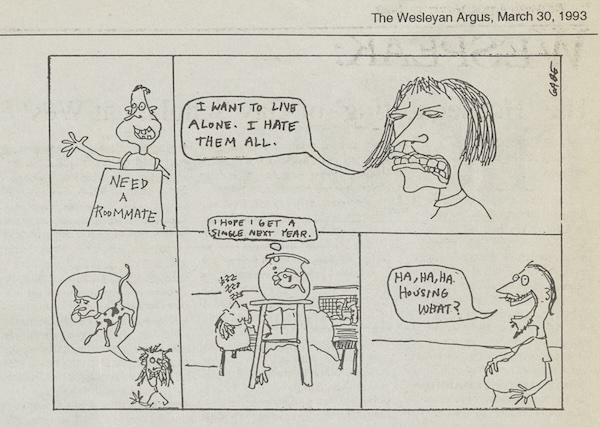
From the Argives: How Off-Campus Housing Got Axed
For decades, one question sparked fights between students and administrators: Who gets to decide where students live?
A mere 20 years ago, over 200 students lived in houses all about Middletown, independent of the University—a practice that feels almost impossible to picture today. This week, The Argus captured the contentious decline of off-campus housing, revealing how the issue became a flashpoint for deeper battles over money, control, and student power.
The history of the housing tug-of-war is a long one, starting in 1965 with “Crowding To Continue In Upper-Class Dorms; Barlow And Lauter Reject Off-Campus Living,” an article by A. Clifford Saxton ’68 published in The Argus on Feb. 26 of that year. The piece covers the administration’s defense of mandatory on-campus living.
As then-Dean Mark Barlow Jr. told The Argus, “‘We feel that if Wesleyan is going to be an academic community, people should live together so that the out-of-class dialogue which often makes great contributions to a student’s education can be carried on.’”
University-owned housing also brought in money, which was used to construct additional University-owned housing.
“‘When you build new dorms, you have to keep them filled in order to make them financially solvent,’” then-Dean Charles F. Lauter told The Argus.
This cycle, vital to the University’s finances, promised increasing returns on investment. The larger the dorm, the less the University spent per student.
The discussions continued in the April 10, 1992 issue, when The Argus published an article by Michael Stoll ’95 entitled “Housing Privileges Rationed.” Stoll reported a sharp reduction in off-campus housing availability, which dropped from 275 slots to 200. The official rationale was blunt: The University needed to maximize revenue from its existing residential infrastructure.
“By reducing the number of students who are granted off-campus status for the full year, the University believes it can fill vacancies projected in university-owned housing and earn more money,” Stoll wrote.
Then-Dean of Student Life Denise Darrigrand spoke frankly, telling The Argus, “‘We want to try to reduce lost income. […] We’re in tough economic times.’”
The decision also meant the end of automatic off-campus housing for fraternity members and program houses.
“Changes Welcome Beware Clusters,” an uncredited article published in The Argus on March 30, 1993, urged students to pay close attention to the changing landscape of residential life. The anonymous contributor warned that beneath the administrative language of reform, a more significant restructuring was underway: student clusters constructed of all four class years.
“Clusters [of students in on-campus housing] will do more to change residence life at Wesleyan than the elimination of special interest housing, WestCo and Eclectic would have,” the author wrote.
The Argus further cautioned readers: “But let us not allow the administration to pull the wool over our eyes.”
Just weeks later, an article by Cory Sims ’95, published on April 30, 1993, revealed the full extent of the housing retrenchment: The administration suddenly rescinded 100 students’ year-long off-campus housing, and only 150 year-long off-campus housing slots remained.
“‘There are a lot of really tricky numbers they can pull the wool over our eyes with,’” then-Student Institutional Priorities Advisory Committee President Morgan Harting ’93 lamented.
Darrigrand, however, maintained that these decisions were purely logistical, telling The Argus, “‘It’s basically a mathematical equation. It’s not a policy question.’”
Sims reported the consequences of the sudden off-campus housing cuts: “The remaining 100 [students] will have to move into campus housing next January, either cutting short contracts with private landlords or paying two rents in order to satisfy University requirements.”
In the fall of that same year, an article by Andrew Schell ’96 entitled “Chase Asks Alumni to Urge Frat Coeducation” suggests that the administration’s long-term vision for student housing extended beyond budgetary concerns.
Then-acting Dean of the College Krishna Winston told The Argus, “‘The University’s goal is to eventually create an entirely residential university by phasing out off-campus status.’”
Winston continued, saying, “If [the fraternities] go co-ed, they won’t have to sell their buildings to the university.”
Fraternity leaders warned that this was not a Greek issue alone. Delta Kappa Epsilon President Ray Giordano ’94 told The Argus, “‘Everybody on campus should be worried about it.’”
In a Dec. 8, 1995 article titled, “Off-Campus Policy May Change After Petitions Flood Res-Life,” The Argus reports on a growing backlash against rigid housing policies. Administrators, however, remained focused on financial efficiency, despite objections from students.
As Darrigrand explained to The Argus, “‘We had a fair number of students going away second semester, leaving us with a huge on-campus vacancy rate.’”
“The university’s room rents were needing to be raised to subsidize the vacancies,” she continued.
In an April 2, 1999 article titled “Wes Students Enjoy Off-Campus Living,” The Argus describes the bureaucratic mechanisms that now governed access to off-campus life.
Then-Assistant Director of Residential Life Deborah Colucci told the paper, “Wesleyan has a certain number of beds, say 2,800, and so we need to fill 2,800 beds each year.”
But for many students, off-campus housing presented a far cheaper option.
“The money is a big benefit and not paying the University an exorbitant amount of money for housing that’s worth less,” Melanie Spencer ’99 told The Argus.
Larger questions about the University’s administrative power were also in play. An unaccredited April 8, 2003 article, “A Plea to ResLife,” pointed to the consequences of new fraternity contracts as evidence of a troubling pattern.
The new contracts gave Public Safety sweeping authority to enter houses and included clauses obliging them to accept future amendments “without question,” The Argus reported. The University, the article argued, was using these contracts to “exercise ultimate power” and had already “factored in the revenue” of students denied off-campus status.
On April 20, 2004, Eliza Simon ’04 covered the looming end of off-campus housing as it was before in her article, “Administration to phase out off-campus housing in upcoming years.”
“‘One of the unique things about Wesleyan is that we have a residential community,’” Then-Assistant Director of Residential Life Rich DeCapua told The Argus.
DeCapua added, “‘The ideal would be to get rid of off-campus housing entirely.’”
On Sept. 21, 2004, Sara Levin ’05 and Greg Dubinsky ’07 reported the realization of DeCapua’s goal in an article entitled “Off-campus housing to be virtually eliminated.” Levin and Dubinsky confirmed that administrators were planning to reduce the number of off-campus students to “a handful.”
An unaccredited editorial published in the same issue of The Argus wrote that “forcing students to isolate themselves in dorms on-campus is contradictory to the spirit of integration…”
After 2004, less than 25 students lived outside of campus. The number has remained roughly the same since then.
Housing rights remained a live issue well into the 2010s. Pei Xiong Liu ’12 covered one of the era’s most heated debates in an article titled “Change to Housing Policy Draws FIRE,” which was published in The Argus on Feb. 18, 2011.
FIRE—the Foundation for Individual Rights in Education, an organization dedicated to defending free speech and thought—publicly criticized President Michael Roth ’78 for a new University policy that restricted where students could visit, a move critics said crossed a constitutional line.
Student activist Lucas San Juan ’13 told The Argus, “‘…the policy has the effect of suppressing our rights as individuals. In the administration’s vendetta…they have created this policy without any other concerns.’”
The fight over housing had become something larger, reflecting deeper tensions about authority, autonomy, and the future of the University. What started as a question of living arrangements grew into a struggle over power—and over what kind of place the University would be in the years to come.
“‘…[The policy] affects everyone,’” San Juan told The Argus. “‘By limiting freedom of association, it curtails the rights of all students and changes the relationship of students to the administration.’”
Hope Cognata can be reached at hcognata@wesleyan.edu. “From the Argives” is a column that explores The Argus’ archives (Argives) and any interesting, topical, poignant, or comical stories that have been published in the past. Given The Argus’ long history on campus and the ever-shifting viewpoints of its student body, the material, subject matter, and perspectives expressed in the archived article may be insensitive or outdated, and do not reflect the views of any current member of The Argus. If you have any questions about the original article or its publication, please contact Head Archivists Hope Cognata at hcognata@wesleyan.edu and Lara Anlar at lanlar@wesleyan.edu.




Leave a Reply