
University Revises Security Camera and Video Retention Guidelines Following Expansion of Usage
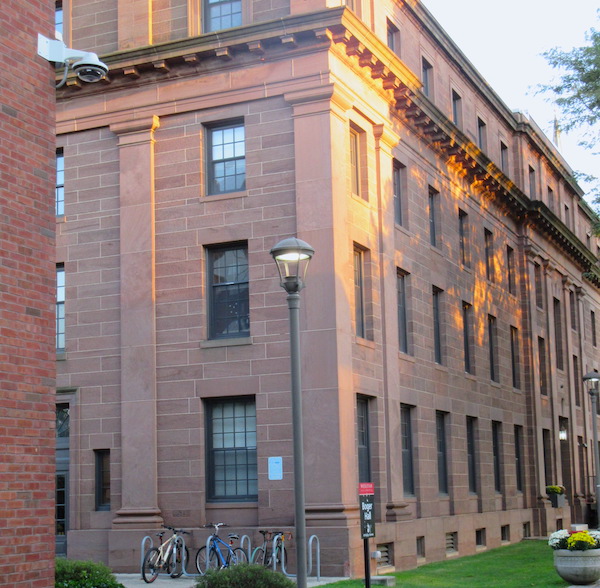
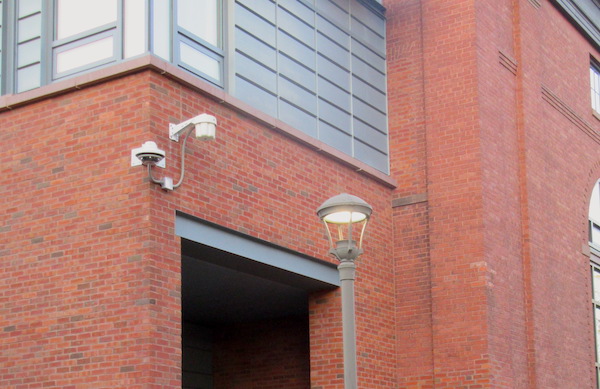
On Sunday, Sept. 14, 2025, the University’s Office of Public Safety (PSafe) issued an updated security camera policy via a campus-wide email with guidelines for camera use and data storage. The policy reiterated that the school’s security cameras are installed only in public areas, that access to footage is restricted, and that footage is not routinely monitored in “real time.” The change came following the University’s installation of several new security cameras in the areas outside of North College and Boger Hall last September.
The University’s surveillance policies have faced criticism by concerned students following the administration’s responses to incidents of vandalism and punitive actions taken against student protestors in previous years. During several pro-Palestine protests held on campus in recent years, student organizers and attendees alike donned masks for fear of being doxxed or even targeted by the federal government.
The University’s new policy expands upon an earlier version last updated in June 2021. It identifies security cameras as one tool of many used to enhance campus security, both to deter crime and protect the University campus community.
“This policy…seeks to balance the safety and security of the University community and property with the privacy interests of students, faculty, staff, and visitors,” the document states.
The trade-offs between campus security and student privacy at the University form fall into a broader national conversation about the balance between civil liberties and public safety. The urgency of the issue has only ballooned following the deadly shooting of conservative political commentator Charlie Kirk at a college event, and many universities are reexamining their security protocols and surveillance policies in turn.
Director of Public Safety Scott Rohde said cameras are never intended to target personal expression.
“This came up in the previous year, where people were concerned about personal expressions and that sort of thing being captured or utilized against them,” Rohde said. “Camera placement is not to catch people exercising an appropriate right or practice at Wesleyan. Public Safety values people’s free expression.”
In keeping with this principle, many older guidelines remain unchanged. Cameras may only be installed in common areas and must not capture private spaces such as offices, residence halls, locker rooms, or restrooms. The updated policy now explicitly restricts the use of cameras in health and counseling service areas, though PSafe has reserved the right to periodically review these locations to determine whether cameras are still warranted.
The servers storing footage are housed in the University’s data center, backed by batteries and generator power to ensure operation during electrical outages. Access is limited to authorized users and may only be reviewed for legitimate institutional purposes as determined by the Director of Public Safety.
“These servers are configured to automatically overwrite the data recorded without any intervention by ITS staff, so we don’t access them unless requested by law enforcement,” Vice President for Information Services and Chief Information Officer David Baird wrote in an email to The Argus. “I have been at Wesleyan since 2012, and I cannot recall ever having been asked to release footage.”
The updated policy also clarifies the scope of video surveillance for University-owned cameras, emphasizing that campus security cameras do not record audio. The only audio collected is through the University phone system, where calls to PSafe are recorded.
“They’re really apples and oranges,” Rohde said. “What we found is that people were mixing that and getting very confused, and said, ‘Well, your cameras must be recording our voices.’ No. They’re completely different operations and only one applies to video recording, and the other applies to telephone recording, which is limited to people who call dispatch.”
PSafe records calls because they can be critical in certain instances, including when a room number or name needs to be confirmed. That recording can be immediately played back in emergencies. Historically, they were placed in the same policy, Rohde explained, but he suggests they should be two separate policies. When or if an audio recording policy would be drafted is unclear.
A new 30-day retention rule has also been added, shortening the period dictated by the previous policy. Although some cameras have been in place for nearly 20 years, PSafe consulted with faculty, staff, and the Public Safety Advisory Group to set a new retention period for the June 2025 update. The previous policy allowed footage to be held for 60 days, but PSafe found that they rarely reviewed footage beyond 30 days, a standard consistent with many other universities.
“Previously, there was not a specific time frame for retention,” Rohde said. “Given the change in the prevalence of security cameras virtually everywhere…it felt like a reasonable time frame would make sense. It is a best practice that many businesses, as well as campuses, follow.”
Visiting Professor of Government David Aaron ’95, a former federal prosecutor with extensive experience in surveillance operations, also welcomed the change.
“I am happy to see that there is a retention policy that limits how long footage will be kept – that was an update I really wanted to see,” Aaron wrote in an email to The Argus. “Thirty days is a reasonable amount of time because it gives the school and law enforcement enough time to request footage of most types of crime likely to occur on a college campus, without creating the dreaded eternal archive of searchable video.”
Aaron also pointed out the importance of ensuring that Public Safety and IT staff implement the prescribed destruction schedule properly and securely dispose of video data.
The updated guidelines also specify the proper release of data to authorized parties. The school is permitted to release video footage in the following cases: the Vice President for Student Affairs, the Dean of Students, or their designees may share footage for Student Code of Conduct investigations; senior administrators may release it in response to criminal activity, campus disturbances, safety concerns, or emergencies; and law enforcement may access it for investigations, prosecutions, or court-ordered requests.
That last scenario has worried some student activists, who fear that Trump’s Department of Justice or Department of Homeland Security (DHS) could target student protesters, utilizing the University’s own video footage to bolster a potential prosecution or investigation.
Aaron also outlined how universities can balance student privacy with law enforcement cooperation.
“In that middle zone, where the school can exercise discretion within the bounds of the law, any university will have to consider a variety of factors,” Aaron wrote. “[These include] the safety of the student body; the impact on victims, witnesses, and suspects; how much disruption to tolerate on campus; potential chilling effects on student life; and other factors. Different schools may balance these factors differently, which is fine as long as students are treated consistently and fairly.”
Separate from the question of video security surveillance and cooperation with law enforcement, Aaron cautioned against other risks to students.
“I have experience as a Wesleyan student, a prosecutor, a professor, and the parent of a college student,” Aaron wrote. “I think the classic vulnerabilities that students overlook relate to misplaced or abused trust and momentary, impulsive lapses of judgment…unfortunately, those threats will always be there and will continue to get more complicated as technology evolves and proliferates.”
Carolyn Neugarten can be reached at cneugarten@wesleyan.edu.



Leave a Reply