
Allbritton Center Kicks Off Year With Open House
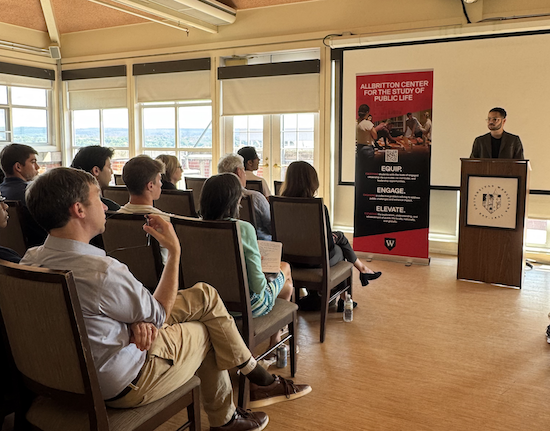
On Monday, Sept. 15, the Allbritton Center for the Study of Public Life (CSPL) hosted its Open House, outlining the center’s goals and programs for the upcoming academic year.
Executive Director of the Allbritton Center for the Study of Public Life Khalilah Brown-Dean kicked off the event by directly addressing the attendees.
“For many of us, it is difficult to know where we feel comfortable, given all that’s happening across the United States and across the world,” Brown-Dean said. “And so the fact that with all that is going on, you took the time to come together on Monday [and] to be with us means that you are willing to engage in public life, and I’m honored that you have made that choice.”
Brown-Dean discussed the Allbritton Center’s role on campus. The center, which is named for former University board of trustees member Robert Allbritton ’92, was established in 2009 to facilitate interdisciplinary collaboration between the University’s social science departments.
“We believe that it’s not enough to just study public life; it is a requirement to shape it,” Brown-Dean said. “We do this work in collaboration with amazing students.”
After her introduction, Brown-Dean introduced Jewett Center for Community Partnerships (JCCP) Director Clifton Watson. Watson emphasized the impact made by the roughly 400 University students involved in JCCP programs. The students led 20 volunteer groups working with 75 community partners located throughout Connecticut. He explained that JCCP’s programs focus on three specific areas.
“[Our first focus is on] providing support to community partners working in areas related to education and youth, and folks who share our passion for the environment and sustainability,” Watson said. “[Another focus] is what we refer to as reimagining justice, which is essentially a container for interests related to mass incarceration.”
Director of the Center for Prison Education (CPE) Tess Wheelwright discussed the CPE’s partnership with Cheshire Correctional Institution and York Correctional Institution, where almost 70 students had registered for fall classes. She noted that the 16th year of the CPE was a big one.
“It’s quite a lively moment in Connecticut for college access for incarcerated learners,” Wheelwright said. “There’s a new undersecretary [Daniel Karpowitz] in the Governor’s budget office who has put out a needs assessment report, measuring eligibility for college education for incarcerated people. So we expect a kind of competitive field, and the field is growing in exciting ways.”
The next speaker was WESU General Manager Ben Michael. WESU is a non-commercial radio station owned by the University and featuring both student DJs and Middletown residents. Michael explained the station’s operations and involvement with the broader Connecticut community.
“Over the years, WESU has evolved to reflect the diversity of the communities we serve on- and off-campus,” Michael said. “There are lots of amazing pockets of programming that serve very disparate communities who wouldn’t necessarily be seen at the same table eating together, but we all share the same resource and have Wesleyan students to thank for providing us with such a wonderful home.”
Director of Patricelli Center for Entrepreneurship Ahmed Badr ’20 spoke about the Patricelli Center’s initiatives, which range from classes like “Leadership & Social Innovation: Patricelli Center Impact Fellowship” (CSPL252), a course intended to connect University students with an intergenerational selection of leaders spanning CEOs and journalists, to five sponsored grant programs.
“There’s always, always exciting things happening,” Badr said.
Badr also introduced the newly appointed Entrepreneur in Residence Marisa MacClary ’94.
“I’ll be meeting students and mentoring students this fall and then teaching in the spring,” MacClary said. “I hope that my class can sort of embody the journey that I went on. I was the founder and CEO of a company called Artifact Health, which was a digital healthcare company. I ended up selling that company to an AI company called Iodine Software, and it was about an eight-year journey that I’m excited to encapsulate in this course and teach the students what I learned through that process.”
Students in attendance also discussed how participating in Allbritton-led programs has helped them shape their identity at the University.
“I wanted to get involved on campus,” Patricelli Center Community Fellow Baron Fisher ’26 said. “It was my freshman year, and I wasn’t exactly sure how to do that. I just sent [Badr] an email. He texted me back a few minutes later and said, feel free to come meet. And so we met during office hours, and he shared with me all the different ways I could get involved at Wesleyan. So I’m hoping, as a senior, to try to share that with other people on campus, that by showing up to events like this, by meeting new people in the community, you’ll have a very fulfilling experience.”
Spencer Landers can be reached sklanders@wesleyan.edu.
Brendan Kelso can be reached at bkelso@welseyan.edu.
Correction: this article was updated on Tuesday, Sept. 16, to reflect that the Connecticut Office of Policy and Management’s Criminal Justice Policy and Planning Division Undersecretary is Daniel Karpowitz, not Kiri Patel.

Leave a Reply