
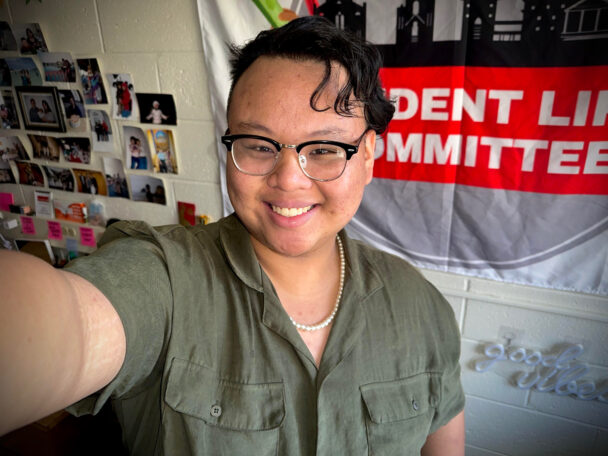
WesCeleb: Paul Quach ’26 on Leading the WSA, Student Unions, and the Beauty of the West Coast
Paul Quach ’26—Wesleyan Student Assembly (WSA) president, psychology researcher, and WestCo resident—embodies what it means to be a Wesleyan student. In this week’s WesCeleb, he reflected on his four years at Wesleyan, from advocating for first-generation, low-income (FGLI) students, to negotiating worker contracts, to exploring Middletown coffee shops, to documenting his college experience on YouTube. Quach shared his proudest accomplishments, lessons learned, and advice for first-year students with The Argus.
The Argus: Why do you think you were nominated to be WesCeleb?
Paul Quach: I think I was nominated because [I’m] the Wesleyan Student Assembly president. Usually, they’re the first person for the WesCeleb.
A: Can you talk a little bit more about your involvement with the WSA? The University has been through a lot of changes in the past few years. What are some of the challenges that you’ve faced as a WSA member through it all?
PQ: I got elected [president] in the spring; I was on WSA for all four years. I started on the Student Life Committee, and then worked my way up to Vice Chair and Chair. I was in a bunch of meetings being like, “Hey, do you wanna be the student representative to this XYZ committee?” So I did that on WSA, and then was liaison to the FGLI Advisory Board, connecting them, and then just being a resource all around.
Some of the things we offer the Class of 2029 now, we wouldn’t have had in my freshman year, so it’s very awesome to see those changes go into full effect. But there are times when I was like, “Oh, shoot. Do I leave the WSA?” This is a lot of work, and I kind of get stuck with it, and then the admin gets more familiar with you, and they become more open to exploring the new ideas you have.
A: What WSA policy do you feel most proud of?
PQ: One of my priorities has been all the FGLI projects I’ve worked on. The [Summer Storage Program for low-income students] improved immensely. It went from storing three boxes to five, with better transportation [and] support. In doing that, we also [offer] summer break shuttles, making sure that there’s a full program for students to go back and forth.
Something [else] we’ve looked at is medical amnesty, a policy we’ve worked on for three years under the Student Jury Processing Committee. I worked with the Equity and Inclusion Committee last year a lot trying to figure out what the wording was because the information was mixed between whether it’s a one-time [exception] versus what the medical amnesty policy really means.
A: You’re a psychology major, and your research focuses on emerging adolescents. How did you discover that you were interested in that?
PQ: I was originally a physics major before I switched in my sophomore year to psychology after taking a social psych class. So now I’m a psychology major, [with a] double minor in data analysis and Human Rights Advocacy. Through my involvement in psychology, I was really interested in the research side of things. I am part of the Ronald E. McNair Postbaccalaureate [Achievement] Program Scholarship, which helps students from undergrad go to graduate school. I found Professor Dubar and the sleep labs and the psychosocial adjustment lab, and that’s what I’ve been researching. And that’s where I’ve grown my passions, taking what I’ve known and connecting to what people are saying. I just want to understand my generation more—people around my age, [who are] adjusting to college, and [who are] at a predominantly white institution. How does that impact and inform my experiences as an FGLI student of color? That has guided a lot of my research questions into my passions and interests in emerging adulthood.
A: You’re not only a Human Rights Advocacy minor, but also someone who cares deeply about empowering campus programs. How do you feel about the University’s decision to end the UNHR partnership?
PQ: I’m not the happiest with how it all went down. It was just weird timing. I think what I was really happy about was how the students kind of took the lead. We did a petition, and we talked to the admin. We were pressing them; filling up their schedules. I don’t think the program will be the same, but I trust that the University will try its best.
A: You’re also the Chief Steward of the Wesleyan Union of Student Employees (WesUSE), which became the first undergraduate union to win voluntary recognition. What has your experience with the organization been like?
PQ: Yeah, we’re the first voluntarily-recognized student union. So I joined after my first year on staff. That was [my] sophomore year, and Ruby Clarke ’24 was the Chief Steward back then. I worked a lot with her through the WSA. It was a WSA-WesUSE connection. I was like, “Okay, how do I just better the lives of my employees?” We negotiated our contract and renegotiated our contract, because it was up for negotiation. We just finished our processes, which took us from last fall to the summer, so we made huge changes, like increasing pay.
A: Outside of all your extracurriculars, what do you do to relax?
PQ: It depends. [I like] sitting on Foss. I’ve been a proud WestCo resident for two years, so I really love that. I’ve also explored a lot of Middletown. Perkatory is one of my favorite coffee shops on Main Street. Now [as a senior,] it’s a lot of cooking, and cooking for my friends: that’s what I like to do the most. And sometimes I make videos. When I go to conferences, I do a little quick YouTube tour, although it’s more for my parents to see me and to document my college experience.
A: Like many Wesleyan students, you juggle a lot of obligations at once. Do you think there’s something about the Wesleyan culture that generates that kind of productivity in people? Or do you think Wesleyan just draws that kind of person?
PQ: I think both. I think we’ve definitely built that culture; everyone does their own thing and fills their schedule doing that thing. So this is really awesome to see. I think that’s a really rich culture at Wesleyan of people wanting to get involved and try new things. And that’s what motivates me to get so involved as well.
A: What advice would you give to your freshman self?
PQ: I think, culturally, it’s a totally different vibe in Middletown, Conn., than in Salem, Ore., and I definitely did have a tough freshman year. I mean, friendships come and go, and I definitely struggled a lot academically as well. I would say don’t hesitate to ask for help. And if someone, like a professor, is hinting, like, “Hey, do you need help?” don’t think of that as a negative thing. Just be open to it. Reach out for help or rely on your friends and peers for support.
There are so many resources on campus. I mean, I sound like a broken clock as an RA…but over time, I recognize that more and more. So explore and take risks. Let loose and have fun. Just enjoy your time here. Make memories. Work hard, but don’t overwork yourself.
A: Although you’ve adjusted to Middletown culture, do you still feel connected to Oregon? Do you plan to move back after school?
PQ: Oh yeah, 1,000%. I’m thinking about grad school on the West Coast. That’s my goal. I think home, though I didn’t have the best relationship with [my] family, has improved immensely since I left. I think that’s just something that I’m going to study as well in the future, like family, parental, and interpersonal relationships in the college context. So it’s just really awesome to see that for myself. So I’m excited to go back.
A: Any final thoughts?
PQ: Two slogans that have stuck with me throughout my time at Wesleyan, and they are WW’ntPQD: What Wouldn’t Paul Quach Do? and #KeepinItCUTE!
This interview has been edited for length and clarity.
Lula Konner can be reached at lkonner@wesleyan.edu.
Lyah Muktavaram can be reached at lmuktavaram@wesleyan.edu.

Leave a Reply