
Jaffe’s Richard III Takes Play in New Direction
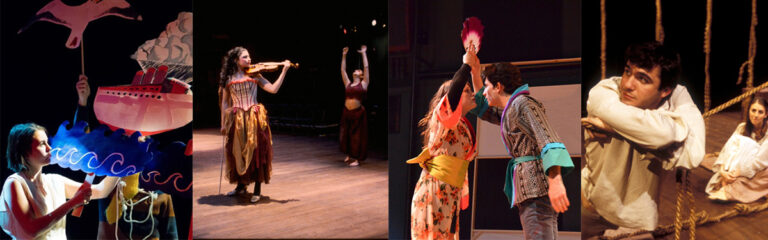
This weekend a classic drama, William Shakespeare’s Richard III, is being given a new face. In fact, this gritty, ten-person show has two faces for the eponymous king; the following is an interview with Emma Sherr-Ziarko ’11 and Ben Vigus ’11, collectively known as Bemma Sherr-Vigus, who are performing together as Richard for their senior theses in the upcoming Theater Department production directed by David B. Jaffe.
Argus: How did the idea to have two people play Richard come about?
Sherr-Ziarko: Well, last March we were both thinking about doing acting theses and so we got together, and we were both in Shakespeare class together, with David.
Vigus: And so we went to David, and we kind of off-hand suggested, “Hey David, you should do Richard III, and we should both play Richard!”…And he gave us a look.
S: Which I interpreted as he thought we were a little crazy. But then two months later we got an email from him that said, “I’ve decided, we’re going to do Richard III, and you two will play Richard.”
A: So what has been the best part of playing this role with another actor?
S: Particularly with a role of this magnitude, I would say, it allows us to explore the role as more of a dialogue.
V: It’s like the conversations that you have with yourself. In the working process it’s actually made a lot of things less intimidating.
A: How do you each view your individual Richards, and subsequently, how do you view your collective Richard?
V: We had conversations early about what we were not going to be. We are not the female and male, anima/animus aspects of Richard, we are not a Fight Club-y “Real” Richard and “Schizophrenic Projection” of Richard. We are two physical beings, who are an embodiment of one character.
S: Right. And it’s interesting because we’ve attempted to approach the role as more honest than one would normally think of Richard. You know, Richard is the scheming, lying, dissembling villain.
V: But because we’re both not reaching for some iconic villainous Richard, we come at it from very different places, grounded in who we are.
A: What else makes this production different from other productions of Richard III?
V: Well it’s really cut down.
S: I think it’s the second longest play—second to Hamlet.
V: And that’s too long. So we cut about 40 percent of the play, and got it down to a run time now of about 2:15.
S: But also what I think is ingenious that David realized from the beginning, was that we’re doing this play as an ensemble of 10 20-something year olds, and we’re not pretending that we’re 80 years old, or 10 years old. We’re not going to be in Elizabethan costumes, thank God.
V: We have an ensemble of 10 actors who are going be able to tell this story. And so we have two actors playing Richard, and then just about everyone else is playing two or three roles. And they swap onstage and you see all of that. Also, we’re taking kind of a non-literal approach to—that sounded pretentious—
S: You’ve said more pretentious things.
V: I was talking about aesthetic! It’s really hard to talk about aesthetics without being pretentious! Anyway, we’re not trying to make it look like people are actually dying on stage. We’re staging things in a little more of a stylized way and using blood to symbolize a death, or suggest it, or evoke the feeling of that death. And Taiko!
S: Taiko!
V: That’s another thing that’s cool about this, that’s one of the first ideas that David ever had, was that we were going to have Taiko—really intense beating drums in the background of the whole production—doing great things.
A: What’s your favorite line in the show?
V: Margaret, of course, has all of her wonderful names that she calls Richard. There’s just a slew of them.
S: “Thou elvish marked abortive rooting hog.” May be my favorite. It’s on my refrigerator.
V: “Why strew’st thou sugar on that bottled spider?” “Foul bunch-backed toad”. “Hell hound”. Richard gets called a lot of bad things… He’s generally unliked.
S: Which is completely undeserved. For me, one of his last lines, “I have set my life upon a cast/And I will stand the hazard of the die.” Which I think is very Richard to me. Yeah, I’ve done these horrible things, but I will deal with the consequences.
A: What’s the greatest challenge of performing Shakespeare today, in America, at Wesleyan?
V: I think there’s a really strong aversion to Shakespeare. I think it’s hard to make it relevant. And for good reason; it’s just very difficult to know what people mean when they talk, and then to invest in the story if you can’t connect to their basic meaning.
S: The important thing for me is to remember that it’s beautiful text, and it is, I believe, the most beautiful text written in the English language. And if we can use that, and appreciate that, and bring it to a certain level, it can be understood and enjoyed by Wesleyan students, by Americans, and everyone.
[nggallery id=7]

Leave a Reply