
Week One of Art Studio Theses Stuns With Powerful Displays of Technique
Week one of the University’s 2026 senior art thesis season started off strong, featuring works by Matt Aljian ’26, Vansh Kapoor ’26, Lukas Shvetsov ’26, Quinn Frankel ’26, and the pseudonymous Tita.
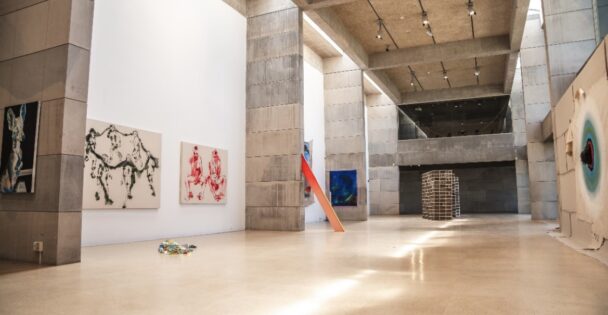
The theses were on display at the Ezra and Cecile Zilkha Gallery (Zilkha) from Wednesday, March 25 through Sunday, March 29. The works showcased the artists’ personal styles, technical skill, and experimentation. The Argus reached out to these artists to get some insight into their creative processes and inspirations.
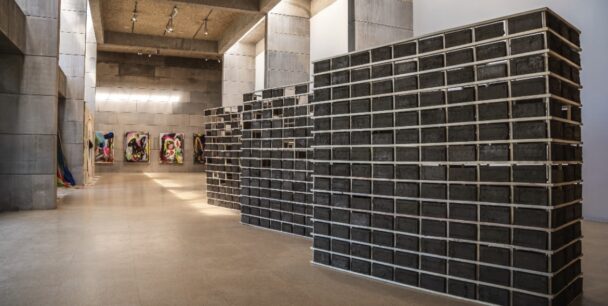
Aljian’s work, titled “Dig, Mix, Ram, Release,” is composed of 935 hand-formed blocks of soil, each one dug, mixed, compressed, and molded through a repetitive, intense process.
“I am interested in textures, uniqueness, process, labor, repetition, weight, and precarity,” Aljian wrote in an email to The Argus. “I want you to think about me making all of these blocks by hand. I dug this dirt, moved it, transformed it, and displayed it. My hands grew calloused, my back hurt, my lungs breathed it, and I became stronger.”
According to Aljian, the installation asks the viewer to look not just at the finished forms, but at the labor behind their creation. Aljian likened the transformation of the soil to that of the body and mind of the artist.
The soil, locally sourced from Facebook Marketplace, was mixed with sand, cement, and water, and poured into molds. Aljian had five molds, each holding 42 blocks. The molds were compressed with a board and mallet, requiring days to dry before disassembling.
Aljian shared the process of discussing the creation process of the blocks.
“One funny issue I ran into while doing this project was my need for soil during our very snowy and cold winter,” Aljian wrote. “With my shovels and pickaxes in tow, I had to excavate and load into my car massive chunks of frozen dirt. They melted in my often too warm workspace … but not before I had to carry the hundreds of pounds of dirt from my trunk to my upstairs studio. I got to do this whole dirt moving process a lot too.”
Aljian’s work feels heavy, personal, and intense, transforming a simple material into a discussion of labor, repetition, and change.
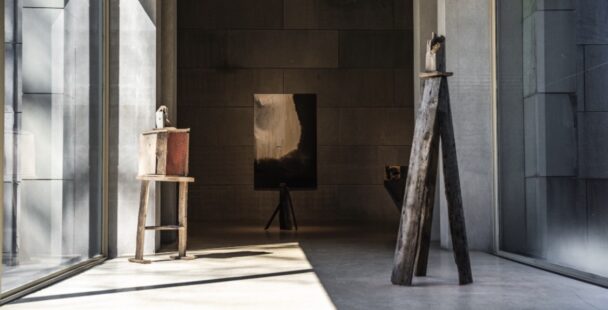
Shvetsov described his senior thesis “Ectoplasms” as a changing, sustainable artistic practice, rather than a static body of work. Over the course of the year, his materials and methods went through significant changes. He began the project working with salvaged wood and other raw materials, creating two-dimensional structural pieces that emphasized historical and cultural properties.
After Winter Break, however, his work went in a different direction.
“I decided that I wanted to use oil paint again and started working on the three-dimensional paintings that I showed in Zilkha,” Shvetsov wrote in an email to The Argus. “I wanted to address similar themes, while working with a completely different set of materials that were also more traditional—oil and canvas.”
The resulting work reflects this change in technique, highlighting a contrast between wood and canvas, raw construction and his later incorporations of color and paint. Shvetsov emphasizes the importance of developing his artistic methodology throughout the creation of his thesis, writing, “My process is iterative and intuitive, so making a lot of different kinds of work is very important to me.”
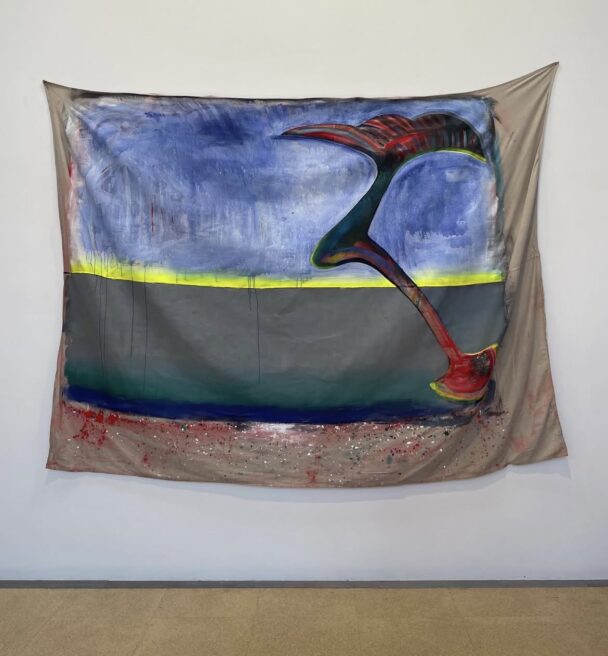
Kapoor approached his thesis piece “Nein Seams” with a focus on material and the tension between art and object.
“The beginning of a work usually begins with an interest in either a specific material or an iconographic reference,” Kapoor wrote in an email to The Argus. “I like to buy materials/employ found objects which involves sitting with them for a while and debating the action(s) I’d like to take upon them.”
For instance, he incorporated scrap canvas from a painting professor, and a gradient beam found on a run into his thesis work. Kapoor said he transformed the found object, shifting it from a discarded piece to the focus of artistic intent.
Kapoor additionally engages with the visual perception of painting—one piece involved the re-stretching of an oil painting inside out, so that the painting itself could only be viewed backwards through a mirror. He reorients the canvas, destabilizing the viewer’s gaze and adding dimensionality to the piece.
Alongside oil and acrylic paint, epoxy, and chalk, Kapoor incorporates sewing into his artistic practice.
“This is very intentional as my mother is a lifelong seamstress and that had a large influence on me artistically through my childhood,” Kapoor wrote. “To me, the act of sewing is a means of reclamation through care. It suggests the human hand, and as most of my work seeks to create an alien universe, I hope that the seams in each painting ground it with humanness and vulnerability.”
Through cloth and thread, Kapoor places his surreal visuals onto a more practical backdrop. When discussing his process, he emphasized the synchronicity of his work.
“I’ve realized I like working on multiple pieces simultaneously,” Kapoor wrote. “In the beginning stages, all of the work is in a different stage of development. Some works are still in the womb, and some objects have yet to make their way towards me.”
When asked about any advice he had for any students looking to create their own art studio thesis, Kapoor said to “work like a titan and finish like a jeweller.”
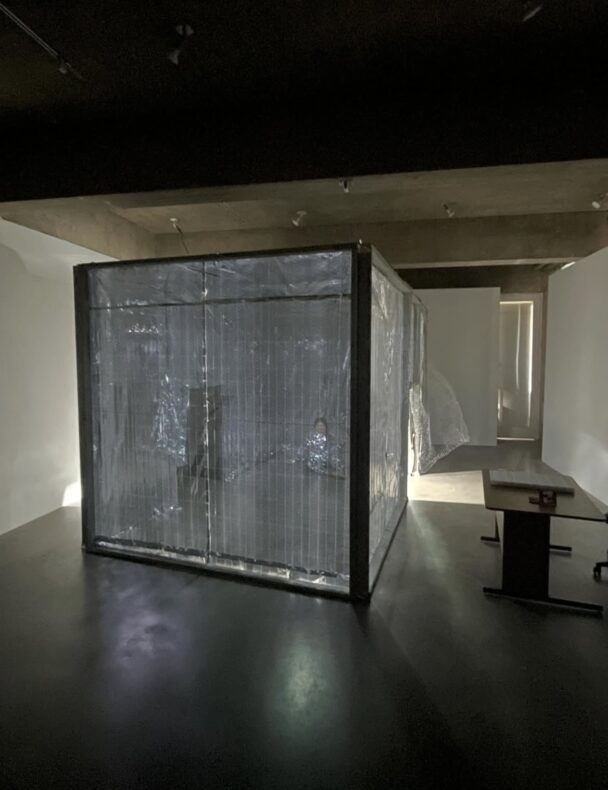
Tita, a student who displayed their work anonymously, confronts personal memory in her senior thesis, reconstructing the conditions she experienced in immigration detention.
“2025 changed everything. It was a year marked by fear, anger, and a constant sense of uncertainty,” Tita wrote in an email to The Argus. “My family, my friends, and my community were suddenly being labeled as ‘criminals,’ and it felt like the life we had been trying so hard to build with peace and protection was slipping away.”
She chose to confront her experience in her senior thesis, creating a room with the same dimensions as a U.S. Immigration and Customs Enforcement (ICE) detention cell.
“When I first entered the country, I was taken into a room with bright lights that never turned off,” Tita wrote. “There was no privacy at all.”
The walls of the room are covered with chicken wire and emergency blankets. The chicken wire evokes entrapment and vulnerability, while the blankets function as mirrors and windows simultaneously. Rather than providing protection, the blankets become further symbolic of warped promises of safety. The room’s surface feels cold, impersonal, and industrial.
Inside the structure, Tita placed a piñata representation of herself, made from hollow plaster shell and covered in decorative paper. “My favorite part of the process was creating my twin,’” she wrote. “There’s something powerful about seeing a version of myself exist outside of me, both familiar and slightly eerie.”
The figure is weighted yet fragile, colorful yet empty: a juxtaposition that Tita says she uses to relay her experience of hope and hardship. Additional elements, such as Tita’s handwritten poems and an interview about her story, serve to situate the viewer within her experience.
Kapoor was not the only one who attributed artistic inspiration their mother.
“To me, she is deeply artistic, though not in the way that is usually recognized or displayed in museums,” Tita wrote. “Her art exists in everyday gestures, in the way she expresses emotion, and processes experiences.”
Tita shared her advice on creating a thesis.
“Don’t force yourself to make art that you wouldn’t want to live with or stand behind,” Tita wrote. “This process is too personal, so make it your own. And go to thesis shows.”
At a recent meeting with The Argus, President Michael Roth ’78 gave his impressions of the showcase.
“I was super impressed by the work that was there week one,” Roth said. “There were works that were extremely delicate and made out of very common raw materials, like these little wooden pieces, that were beautiful.”
Roth remarked on Tita’s thesis as well.
“There was a figure inside that is haunting,” Roth said. “There was a description by the artist, and it was a story of coming to Wesleyan as an immigrant and how challenging it has been…and how most people who come here don’t realize how extraordinary a change it can be for them…. It was incredibly moving.”
Week three senior art thesis exhibitions will be on display from Tuesday, April 7 to Sunday, April 12 at Zilkha. Works by Anthony Crossman ’26, Coline McEachern ’26, Katia Michals ’26, Stella Oman ’26, Greta Schloss ’26, and Asher Baron Weintraub ’26 will be featured.
Katerina Vasyukevich can be reached at kvasyukevich@wesleyan.edu.

Leave a Reply